12 min read
Quick answer: These are the signs you need a queue management system: arguments about who is next, idle counters beside long lines, a crowded lobby, priority customers waiting with everyone else and managers with no wait-time data. Each sign has a specific fix, from ticketing to analytics.
In a hurry?
- Most branch chaos comes from three gaps: no fixed order, no visible wait and no data.
- Fix order first (tickets or a single line), then make the wait visible, then separate the flows by service, priority and appointment.
- Measure wait time and walkaways for one week before you change anything, so you can prove the before-and-after.
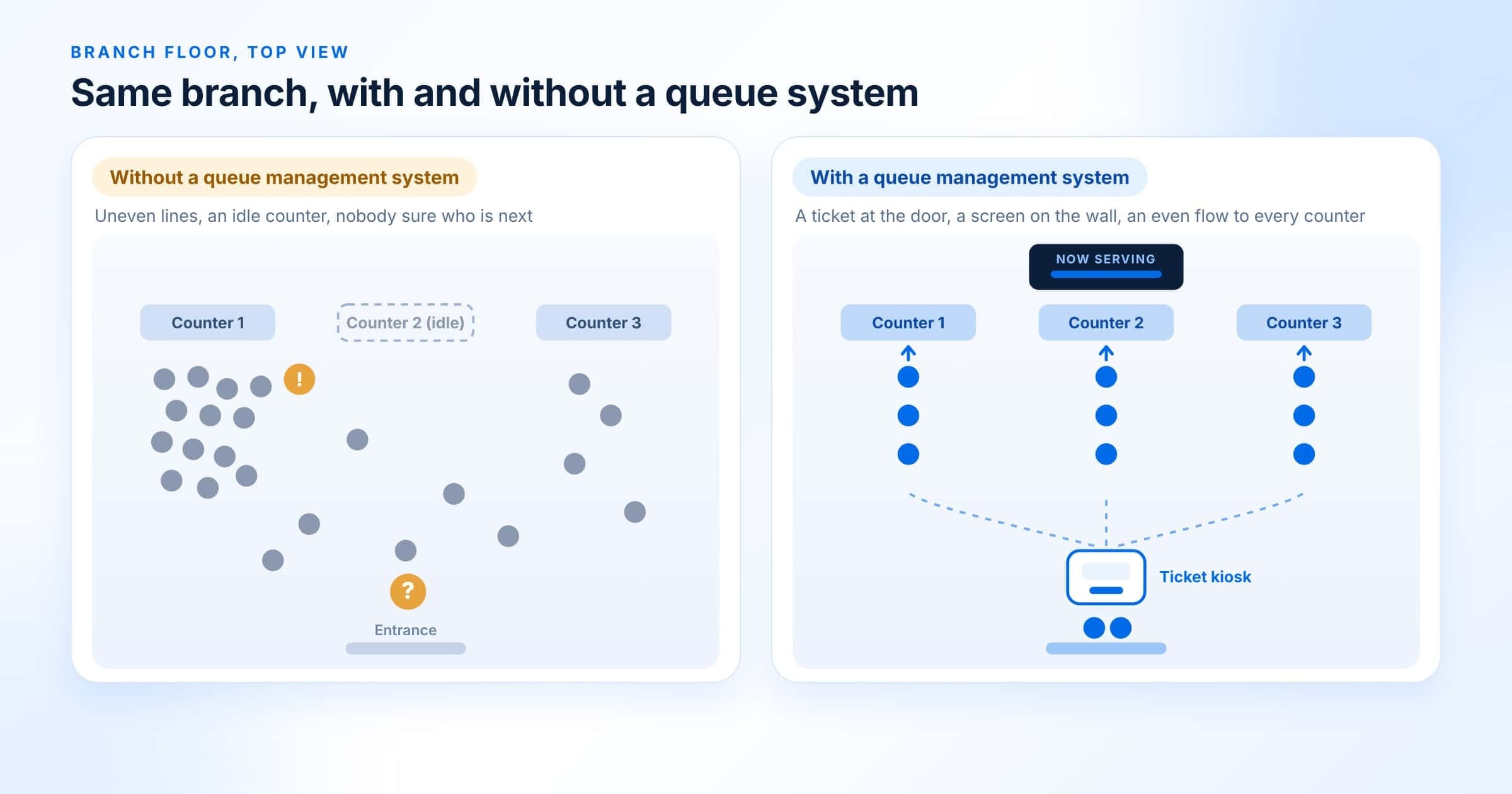
Walk into any branch without a queue management system at 11:30 on a busy day and you can read the chaos in seconds. People stand in clusters, nobody is sure who arrived first, one counter is idle while another has a crowd, and staff spend their energy managing the room instead of serving it.
Customers notice, and their patience is shrinking. Zendesk’s CX Trends 2026 report, based on surveys of 6,182 consumers in 22 countries (including the United States, the United Kingdom, Mexico and Spain) conducted in June 2025, found that 68% of consumers expect a quicker response than they did a year ago and 74% find repeating themselves very frustrating. That is a customer service study, not a queue study, but it describes the same shift: customers expect organizations to be fast and to remember them. The stakes are commercial too. Watermark Consulting’s 2026 Banking Customer Experience ROI Study, released on April 14, 2026, found that banks with the strongest customer experience generated 2.4 times higher stock returns than those with the poorest, across about nine years of J.D. Power rankings.
This guide lists the ten signs that a branch has outgrown manual queuing, what causes each one and what fixes it. It is a diagnosis, not a buying guide; when you are ready to choose, read our guide to choosing a queue management system. Wavetec has built queue management systems since 1986 and has more than 30,000 systems deployed in 80+ countries.
The Symptoms at a Glance
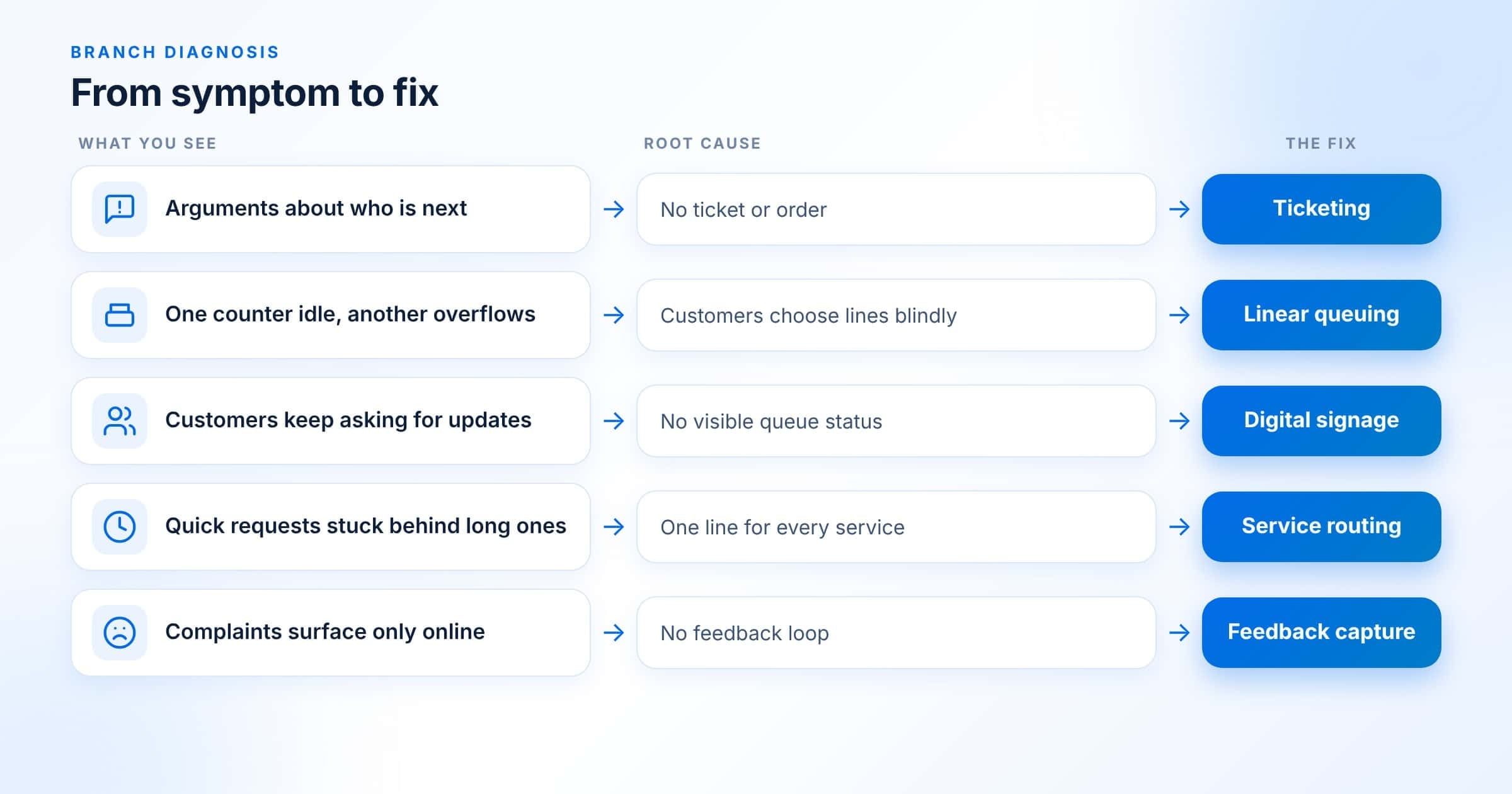
| # | What you see | Root cause | Fix |
|---|---|---|---|
| 1 | Arguments about who is next | No ticket or order | Ticketing |
| 2 | Long line at one counter, none at another | Customers choose lines blindly | Linear queuing |
| 3 | Customers keep asking staff for updates | No visible queue status | Digital signage |
| 4 | Quick requests stuck behind long ones | One line for every service | Service-based routing |
| 5 | Elderly or priority customers wait with everyone | No priority rules | Kiosk check-in |
| 6 | A full lobby and people outside | No occupancy visibility | People counting |
| 7 | Booked customers wait behind walk-ins | Two flows in one line | Appointments |
| 8 | Staff react after the queue is already long | No live view of demand | Lobby Leader |
| 9 | Managers argue from opinion, not data | No reporting | Spectra analytics |
| 10 | Complaints surface only on social media | No feedback loop | Opinion Plus |
The Ten Signs
1. Nobody Knows Who Is Next
Without tickets, order lives in people’s heads. A customer who steps away to take a call loses their place, someone arrives late and stands near the front, and arguments follow. Staff become referees. Ticketing, as with Wavetec’s take-a-number solution, replaces memory with a number, so the first person in is the first person served.
2. One Counter Is Idle While Another Overflows
When customers pick their own line, they guess, and they guess wrong. A single shared line fixes that: with Wavetec’s UNO-Q linear queuing, everyone joins one line and is called to the next free counter, with no ticket needed. It suits fast, simple transactions in pharmacies, post offices, small retailers and service centers.
3. Customers Cannot See What Is Happening
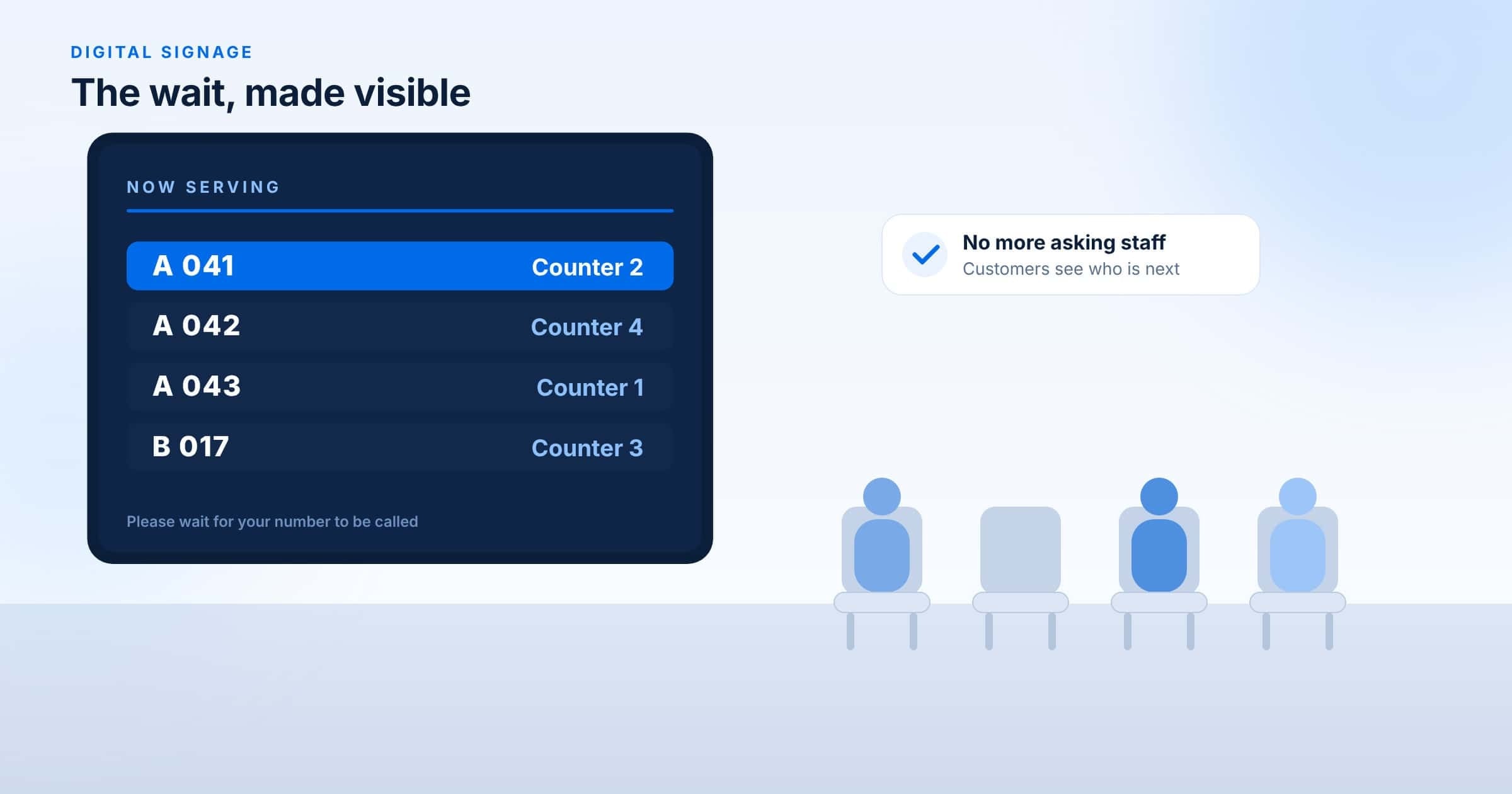
Uncertainty makes waiting feel longer, a pattern covered in our piece on the psychology of queues. If customers cannot tell how many people are ahead or which counter is next, they ask staff, who are then interrupted again and again. Screens close that gap. The Donatello Media Player lets a branch build screen layouts and show queue status, and the wider digital signage range puts it where customers can see it.
4. Quick Needs Get Stuck Behind Complex Ones
A customer who wants to collect a form waits behind someone opening a business account. Without service types, every request joins the same line. A queue management system sends each customer to the next available counter based on service type, priority and staff availability, so short requests flow through while longer ones go to the right desk.
5. Priority Customers Get No Priority
Elderly customers, people with disabilities, pregnant women and premium customers often deserve a faster path, but without rules, it depends on a staff member noticing. Wavetec self-service kiosks can identify customers at check-in by bank card or national ID, depending on the configuration, and apply priority rules automatically.
6. The Lobby Is Overcrowded and Nobody Can Count
Physical crowding is uncomfortable, and in some buildings it is a safety and compliance issue. Wavetec SafeQ people counting counts entries and exits with 3D imaging and sends automatic alerts when occupancy limits are exceeded; Wavetec states it is GDPR compliant and protects the anonymity of customer data. Our people counting guide explains how the sensors work. Virtual queuing moves part of the line out of the lobby by letting customers join remotely.
7. Walk-Ins and Appointments Collide
Customers with bookings expect to be seen on time. Without a system that tells the two flows apart, they wait behind walk-ins and lose trust. Appointment management lets customers book, reschedule and check in on arrival, and WhatsApp queuing lets walk-ins scan a QR code, chat with the business and receive live position updates. Our comparison of queue management and appointment scheduling explains when each flow fits.
8. Staff Only React After the Queue Is Already Long
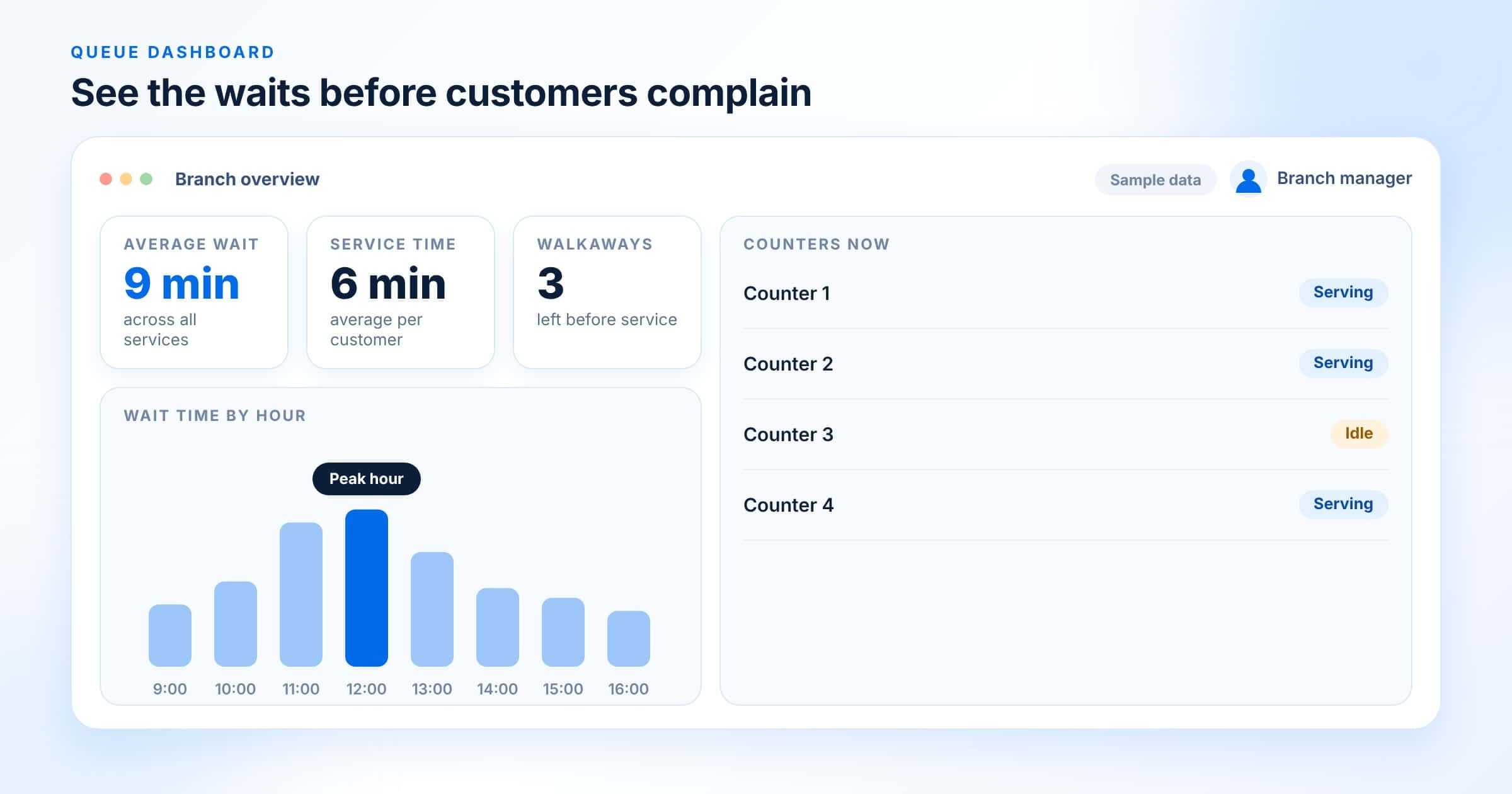
Without a live view, a manager notices a bottleneck when customers start complaining. Lobby Leader puts queue, wait-time and service-time figures on one live dashboard, so a manager can open a counter or redirect a customer before the line builds. Our tips on improving customer flow cover what to do once you can see the queue forming.
9. No Data, So Nothing Gets Fixed
If nobody measures wait times, service times and abandonment, improvement becomes opinion. Wavetec’s queue management lists wait time, service time, abandonment, throughput, CSAT and SLA attainment as tracked KPIs, and Spectra analytics is the software layer for real-time monitoring and reporting across branches. Our guide to queue management analytics explains what each KPI tells you.
10. Complaints Arrive Too Late
Without a feedback loop, branch problems appear in reviews instead of dashboards. Opinion Plus collects feedback at the counter or after the visit and raises real-time alerts when experience issues appear.
What Changes When the Branch Runs on a System
The ten signs share one pattern: the branch relies on people to do what a system does better, such as keeping order, routing and counting. The table shows the same branch before and after.
| Area | Without a queue management system | With a queue management system |
|---|---|---|
| Order | Memory and goodwill | A numbered ticket or a single line |
| Counter choice | The customer guesses | The next free counter calls the next customer |
| Wait information | Customers ask staff | Screens, SMS or WhatsApp show position |
| Service mix | One line for every request | Routing by service type |
| Priority | Depends on a staff member noticing | Priority is part of the routing rules |
| Appointments | Booked customers wait behind walk-ins | A separate flow with check-in on arrival |
| Lobby | The crowd builds until someone notices | Virtual queuing and occupancy alerts |
| Management | Complaints and opinion | Wait, service and abandonment data by branch |
The right column is not one product. Most branches start with ticketing or a single line and add signage, routing and analytics as they grow, which is why the order of fixes later in this guide matters.
Want to see how routing, screens and reporting work together in one branch?
Banks That Fixed It: Real Deployments
The signs above are not theory. These Wavetec bank deployments started with the same problems.
- United Bank Limited (UBL), Pakistan, 1,061 branches. Before the rollout, the 400 newest branches showed the classic signs: customers had no idea when their turn would come, crowds formed around counters, footfall was uneven between branches and staff had no real-time view of peak hours. Wavetec’s Spectra software and ticket dispensers brought structured waiting, less congestion at counters and dashboards that let managers plan peak hours. That covers signs 1, 2, 6 and 8.
- Interbank, Peru, 196 systems at 180 locations. Customers check in at branded 15-inch touch-screen kiosks with their bank card or national ID, are recognized by name and get an SMS when they are next, so they can step away instead of standing in line. Interbank reports its customer satisfaction index rose from 33% to 84%. That covers signs 3 and 5.
- Banque Saudi Fransi, 79 branches in Saudi Arabia. As part of a branch transformation program, BSF needed consistent service and real-time visibility of volumes, wait times and service times. Customers check in at kiosks that identify them by card reader and prioritize them by account type, Donatello screens show live ticket and counter information, and Opinion Plus collects feedback, all reporting to one central system. That covers signs 5, 9 and 10.
As Aftab Khan, GM of Financial Solutions at Wavetec, put it when MCB Bank rolled out Wavetec’s cash deposit machines in September 2026:
“financial institutions can modernize routine cash transactions without compromising operational control or customer trust.”
The same rule applies to the queue: order and visibility first, then speed.
Each of these banks started by naming the problem. That is the habit to copy, and the next section shows how to build a baseline in a week.
How to Check Whether Your Branch Has the Problem
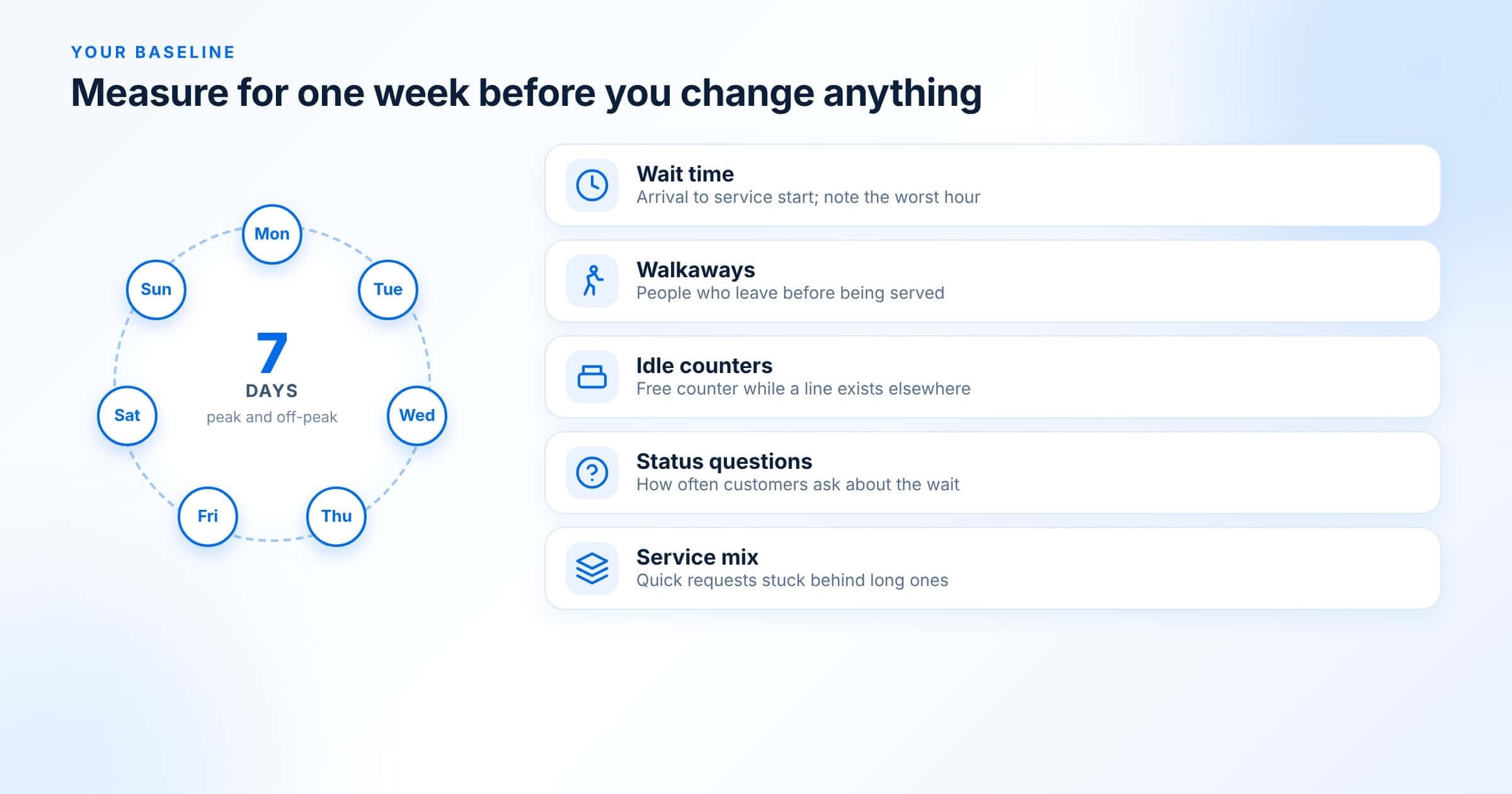
You do not need software to find out whether these signs apply to you. Pick one busy branch and record five things for one week, at peak and off-peak hours:
- Wait time. For a sample of customers, note when they arrive and when service starts. Look at the average and the worst hour, not only the average.
- Walkaways. Count people who leave before being served. This is the abandonment figure a queue system later tracks automatically.
- Idle counters. Note how often a counter sits free while a line exists elsewhere. That is sign 2 in numbers.
- Status questions. Ask staff to tally how often customers ask how long the wait is. A high count points to sign 3.
- Service mix. Note how many quick requests wait behind long ones. A high share points to service-based routing.
If two or more of these look bad, the branch has outgrown manual queuing. Compare your waits with our roundup of average wait times in banks, hospitals and retail, and read our guide to a wait time management system for the targets to set once you can measure them.
Does This Hit Every Industry the Same Way?
The root causes repeat; the pain changes. Banking branches feel it as priority and compliance pressure, which our bank branch queue management guide covers in depth. Healthcare sites feel it as anxious patients and clinical delays, which we cover in our piece on why hospital queues are so long. Government offices feel it as volume and appointment mix, as the Clackamas County case study shows. Retail stores feel it as peak-hour crowds and telecom stores as service mix. Browse the full case study library for your sector.
Where to Start: A Sensible Order of Fixes
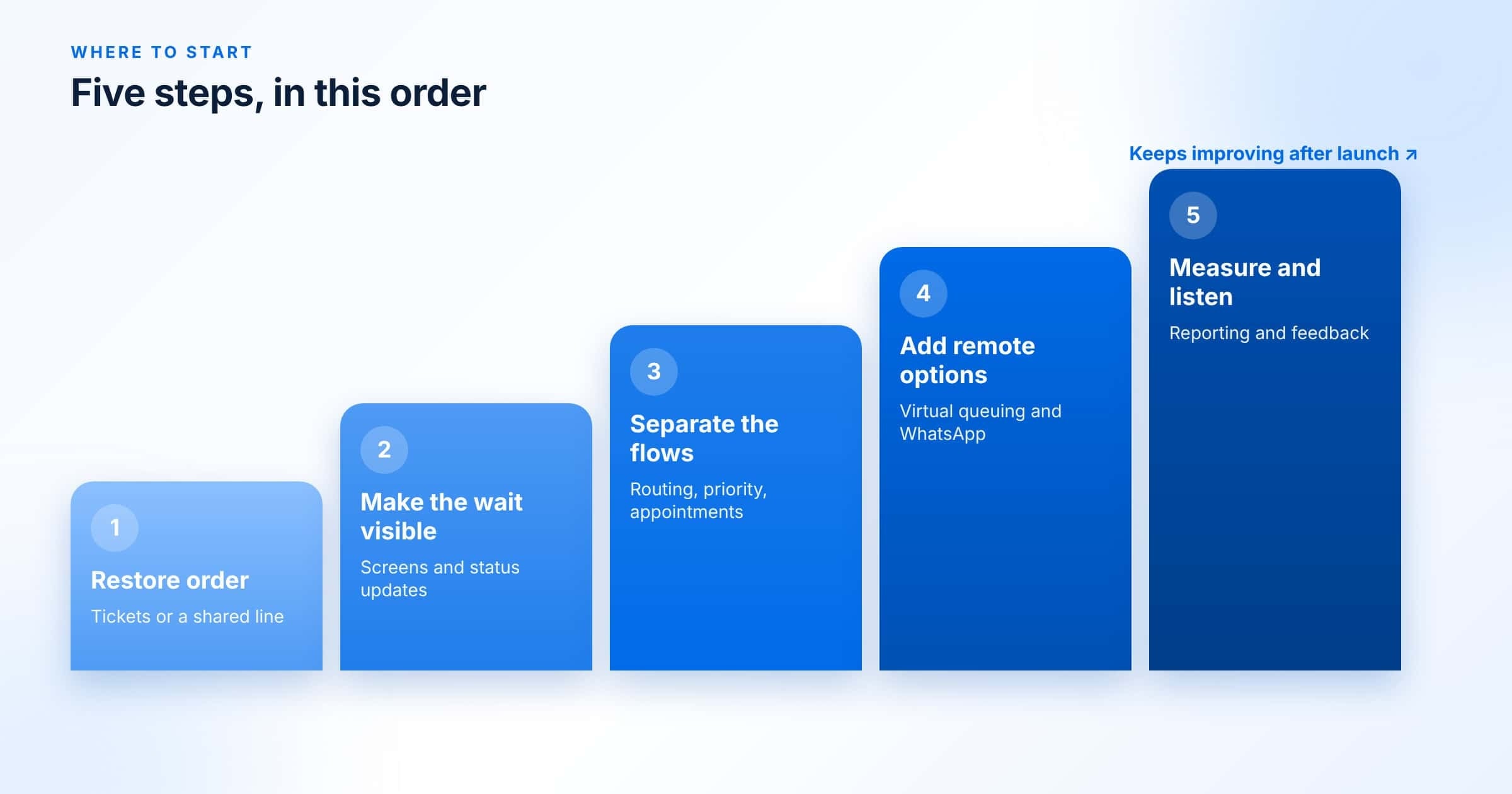
You do not have to fix all ten at once. Most branches see the biggest relief by working in this order:
- Restore order first. Tickets or a shared line remove arguments and make every later improvement possible.
- Make the wait visible. Screens and status updates stop the constant questions at the counter.
- Separate the flows. Route by service, apply priority rules and give appointments their own path.
- Add remote options. Virtual queuing and WhatsApp let customers wait outside the lobby.
- Measure and listen. Reporting and feedback show which counters, hours and services need attention, so the system keeps improving after launch.
Treat the first month as a pilot in one branch: record wait time and abandonment before and after, ask staff what changed in their day, and only then roll out. A branch that can show its own before-and-after numbers makes a far stronger case internally than any benchmark. Our queue management system implementation guide covers the rollout steps.
Security, Privacy and Accessibility
Fixing queues should not create a new risk. A system that collects names, phone numbers or ID details needs access controls and retention rules. Wavetec states that its queue management platform supports role-based access, audit logs, encryption in transit and data-retention controls. Wavetec is ISO 9001:2015 certified, holds ISO/IEC 27001:2022 certification, is SOC 2 compliant, GDPR compliant and HIPAA compliant. Its queue management system security guide lists what to ask any vendor. Integration matters too; see our integration guide.
Accessibility is part of the diagnosis. Priority rules for elderly customers and people with disabilities only work if kiosks, screens and apps are usable by them, so ask any vendor for a written accessibility statement covering reach height, contrast, audio prompts and language options, measured against the ADA and WCAG. Wavetec supports ADA and WCAG requirements; confirm the exact requirements project by project.
Where AI Fits
Once a branch is measured, the next step is asking better questions of the data. Wavetec’s Nexia Reports is available now: a user asks a question in plain language and receives a report, dashboard or visual analysis with an explanation, built on a governed data layer, as a complement to Power BI or Tableau. Wavetec Nexia Consultant is also released, and Nexia Journeys and Nexia Avatar are on Wavetec’s roadmap. Wavetec lists role-based access, audit, approved tools and human approval as governance controls. Our article on the AI queue management system explains how prediction fits on top of the basics in this guide.
Frequently Asked Questions
Bring Order Back to Your Branch
Branch chaos is rarely about staff effort; it comes from missing order, hidden waits and no data. Fix them in that order, measure the result in one branch, and the case for rolling out writes itself.
BOOK A FREE DEMO