The UAE Playbook: How Banking, Government, and Healthcare Are Solving their Queuing Problem
Wavetec has teams in 9 countries through 10 offices, Dubai among them, and its customer experience solutions are in use across 80+ countries, backed by more than 20,000 installations worldwide. In the UAE, that reach turns into something concrete: Wavetec queue management technology working inside a bank, a federal identity authority and a federal health ministry. The three sound unrelated. Put their deployments next to each other and they turn out to be solving the same problem.
See how Wavetec’s queue management system connects to the systems UAE institutions already run on.
The UAE is a demanding place to do it. In the 2024 UN E-Government Survey, the UAE ranked 11th globally with an EGDI score of 0.9533, and first in the world on telecommunications infrastructure, according to the UAE government portal. When a country’s digital baseline is that high, a service counter that stands apart from the institution’s own systems stops being a minor inconvenience. It becomes a gap.
The rules are tightening in the same direction. Federal Decree-Law No. 30 of 2024 established a National Digital KYC Platform for the financial, banking and insurance sectors, and The National reported that it “establishes a strict legal framework for safeguarding customer data”. In health, Federal Law No. 2 of 2019 says health data may not be stored, processed or transferred outside the UAE except where the Health Authority, in coordination with the Ministry, permits it, and sets a retention period of not less than 25 years from the last health procedure. PwC’s summary of the law covers the same ground.
This piece looks at what that means for the front of the house. Three UAE institutions, three sectors, one question: what does a queue management system connect to, and who controls it?
Banking: A Queue That Sits Inside the Bank’s Security Model
Commercial Bank International (CBI)
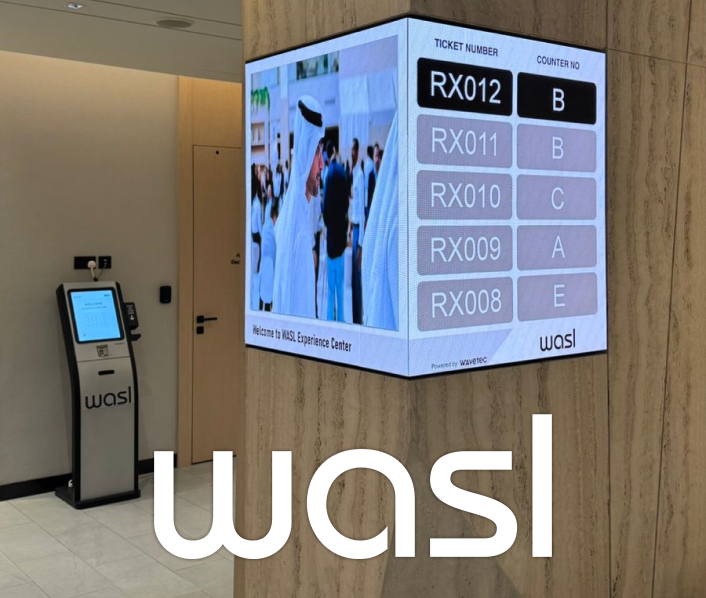
Commercial Bank International is a Dubai-headquartered UAE bank, established in 1991, listed on the Abu Dhabi Securities Exchange and an associate of QNB Group. It replaced its legacy queue management system across six branches with a centrally managed Wavetec platform: Spectra Queue management system and a central reporting layer, M-18 self-service kiosks, Donatello digital signage, counter displays and staff calling applications.
What makes the deployment worth studying is less the hardware than the way it was fitted to the bank. Staff sign in through the bank’s own LDAP single sign-on, so Wavetec’s applications use the identity system CBI already manages instead of a separate set of logins. The kiosks and signage run a standardised Android 14 enterprise platform. Role-based access control and audit logging are part of the setup. The deployment is on premises, in line with the bank’s approved security architecture. Bank-card readers at the kiosk identify eligible priority customers at check-in and send them into the right service flow, and automated emails and scheduled reports mean branch teams spend less time chasing numbers.
National Bank of Kuwait, Dubai
National Bank of Kuwait’s UAE branch in Dubai follows a similar pattern. Its Wavetec queue management system gives staff calling tools, customer-facing queue displays and a central reporting view with a live dashboard, and staff access runs through LDAP single sign-on. The shape matches CBI’s: the queue is part of the bank’s own identity and reporting environment, not a separate box on the wall.
For the wider branch picture, see Wavetec’s guide to bank branch transformation.
Government: A Queue That Reports Into the Government’s Own Performance Systems
The Federal Authority for Identity and Citizenship (ICA) runs Wavetec’s queue management and signage across its service centres. The case study cites 55 offices, and Wavetec systems had already been in use in its Emirates ID offices for over five years before the immigration offices adopted them.
The integrations are the interesting part. ICA’s electronic queue management system, which collects customer feedback, is integrated with the Prime Minister’s Office Happiness Meter. Digital signage is connected to the authority’s employee performance monitoring system, and head office and branches share one information system. A branch manager application includes escalation levels for problems, and customers can book, cancel or reschedule appointments online, with updates by SMS, the app and WhatsApp. The solution also includes a Vendi vending machine, tied to the queue management system, that offers a free snack to customers whose wait runs unusually long.
ICA’s own challenge statement is blunt: higher visitor numbers after Federal Decree-Law No. 3 of 2017 widened its remit, data needed to be centralised, and the pandemic made managed queues and visitor management a safety question. A Wavetec data and forecasting module, Data Active, is described as coming soon, with no date given. As Deputy CEO Tobias Bessone puts it in the case study, “For us, a customer is not just a number.”
For the wider public-sector argument, read Wavetec’s piece on citizen experience management and the government solutions page.
Healthcare: A Queue That Hands Data Straight to the Ministry’s Backend
The Ministry of Health and Prevention uses Wavetec’s patient flow/queue management system across 17+ centres. The earlier arrangement was not integrated with the ministry’s backend, had no centralised reporting and left patients unsure which steps applied to their visa type, so they asked reception staff and queues turned chaotic.
The new flow starts before the patient arrives. A patient books an online appointment and prints a receipt with a barcode, scans it at the ticketing kiosk, and receives a ticket. Department displays show queue status, and LCD screens guide visa applicants step by step using the same ticket number, with predefined workflows for new applications, renewals and a special test. The system is integrated with the ministry’s backend, and medical reports go directly to the residency department for visa processing. The case study reports that customer complaints dropped “drastically” and notes round-the-clock technical support from UAE-based staff. It gives no figures, so this piece does not either.
Here the regulatory context matters most. Under Federal Law No. 2 of 2019, health data has to be kept confidential, may not leave the country without permission from the Health Authority, and has to be retained for at least 25 years. A patient flow system that touches that data has to be designed around those rules. Whether any specific deployment meets them is a legal determination for the ministry and its counsel, not something a vendor can declare.
More on the sector: Wavetec healthcare solutions.
What the Three Deployments Have in Common
| CBI (banking) | ICA (government) | Ministry of Health (healthcare) | |
| What the queue connects to | Bank’s LDAP identity system, central reporting | Prime Minister’s Office Happiness Meter, employee performance system, head office information system | Ministry’s backend system, residency department |
| Who controls access | LDAP SSO, role-based access control, audit logging | Not stated in the case study | Not stated in the case study |
| How customers arrive | Kiosk with bank-card reader | Online booking, SMS, app and WhatsApp | Online booking with barcode receipt, then kiosk |
| Relevant framework | National Digital KYC Platform (Decree-Law 30/2024) | Federal Decree-Law 3/2017 (ICA’s remit) | Federal Law 2/2019 (health data) |
The pattern is that none of these queues is an island. Each one is wired into the identity, reporting or backend systems of the institution that owns it. That changes the buying question. “Does it call numbers?” is table stakes. The question that decides a UAE procurement is what the system connects to, who is allowed to see what, and how that can be proven afterwards. It is the same logic Wavetec’s SIM registration compliance piece applies to telecom: the kiosk is the visible part, and the integration and governance behind it is the product.
Why a Single, In-House Platform Matters Here
Wavetec designs, builds and deploys its Spectra queue management platform, kiosks and Donatello digital signage in-house. For a bank that wants LDAP SSO and an on-premises footprint, a ministry that wants backend integration, and an authority that wants its performance systems connected, that matters. One vendor owns the hardware, the software, the integration and the support, so there is one party to hold to account when a regulator, an auditor or a customer asks how something works. Wavetec has an office in Dubai, and the ministry’s case study notes round-the-clock technical support from UAE-based staff.
Where AI Fits
None of the three deployments above has AI in its stated scope, and this piece does not claim otherwise. What they do build is the clean, governed operational data AI depends on. Nexia Reports is available today: a team describes the question in plain language and gets a governed report back, rather than someone assembling a spreadsheet by hand. Two further products sit on the roadmap. Nexia Journeys is designed to follow a customer across touchpoints instead of treating every visit as the first, and Nexia Avatar is planned as a voice-guided assistant with human handoff built in from the start. For regulated institutions the order matters: integration and access controls first, with the AI built on top of them.
FAQs
Which UAE institutions use Wavetec’s queue management platform?
Commercial Bank International runs it across six branches, the Federal Authority for Identity and Citizenship across 55 offices, and the Ministry of Health and Prevention across 17+ centres. National Bank of Kuwait’s Dubai branch uses it as well.
What is the Federal Authority for Identity and Citizenship’s Happiness Meter integration?
ICA’s queue management system is integrated with the Prime Minister’s Office Happiness Meter, so the feedback the system collects connects to a government-level measurement tool.
Does UAE law require health data to stay inside the country?
Under Federal Law No. 2 of 2019, storing, processing or transferring health data outside the UAE is not permitted unless the Health Authority, in coordination with the Ministry, issues a resolution allowing it. The full text is available on the UAE legislation portal.
What is the UAE’s National Digital KYC Platform?
It was established by Federal Decree-Law No. 30 of 2024 for the financial, banking and insurance sectors. It holds customer KYC data and operates under a legal framework intended to protect that data from loss, damage and unauthorised access.
Can one queue management platform serve a bank, a ministry and a hospital?
The deployments above show Wavetec’s queue management technology serving all three, configured differently for each: LDAP SSO and card readers at the bank, performance-system integration at the authority, backend integration and visa workflows at the ministry. Each institution’s configuration is specific to its own systems and rules.
Suggested Internal Links
For whoever publishes this, the body already links the queue management, banking, government, healthcare, digital signage and Spectra pages, the three UAE case studies, the citizen experience management blog, the bank branch transformation guide and the SIM registration compliance blog. Worth adding once live: the NBK Dubai page, and the Nexia Reports product page if a more specific one exists.
To see how a regulated institution can connect its service counters to its own systems, explore Wavetec’s queue management system or book a demo with the Wavetec team.
BOOK A FREE DEMO