An AI queue management system leverages machine learning algorithms to analyze real-time and historical service data, predict wait times with high accuracy, dynamically route customers to available counters, and optimize staff deployment; reducing average service time and improving customer satisfaction.
Traditional queue systems are static. A customer takes a ticket, waits, and eventually is called. The system does not learn. It does not adapt. It cannot predict that a surge of customers is about to arrive or that a service counter is falling behind schedule.
Managers react to congestion after it happens, opening counters when lines are already long. This reactive approach frustrates customers and wastes staff time.
Machine learning changes this dynamic entirely.
An AI queue management system analyzes historical patterns and real-time data to predict wait times before they happen. It learns which hours, days, and service types create bottlenecks. It adjusts routing and staffing recommendations on the fly.
The result is a queue that flows smoothly, customers who trust the wait time estimates, and managers who can prevent congestion rather than just respond to it.
Wavetec integrates AI and machine learning into its queue management system, helping banks, hospitals, retail stores, and government offices move from reactive to predictive service.
Why Traditional Queue Management Falls Short
Paper tickets and basic digital queuing solved one problem: order. Customers no longer had to push and shove to know their place. But these systems do nothing to manage the length or speed of the queue.
When a lunchtime rush hits a bank branch, the static system just keeps issuing tickets. It cannot warn managers that wait times are about to spike. It cannot suggest opening an extra counter. It cannot tell customers that they might be better off coming back in an hour.
The result is predictable. Customers see a long line or a digital display showing a 45-minute wait.
- Some leave immediately.
- Others wait but grow frustrated.
- Staff are overwhelmed, yet they have no data to prove they need more help.
- Managers open counters only after complaints start.
Organizations deploying AI-powered queue management systems report up to a 40% reduction in average customer wait times and a 25% improvement in overall service throughput within the first year of implementation.
This improvement comes from moving from reactive to predictive operations. The AI system sees the congestion coming and acts before customers feel the pain.
How Machine Learning Powers Queue Prediction
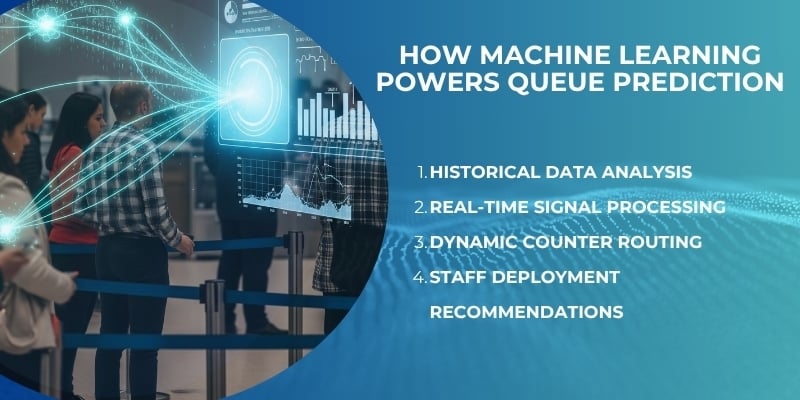
Machine learning brings several capabilities to queue management that are impossible with traditional systems. Each capability builds on the others to create a continuously improving platform.
Historical Data Analysis
The AI system first trains on months or years of historical service data. It analyzes arrival patterns by hour, day of week, season, and even weather conditions.
A bank branch might see that Mondays after payday have 40% higher volume. A clinic might learn that flu season adds 25% more walk-in patients. The system encodes these patterns into its prediction models.
Real-Time Signal Processing
While the historical model provides a baseline, real-time data allows the system to adjust.
The AI continuously ingests live information: how many tickets have been issued in the last 15 minutes, how long each service is taking, how many staff are actively serving customers, and whether any counters are idle.
When actual conditions deviate from historical patterns, the AI updates its predictions instantly.
Dynamic Counter Routing
Based on the predicted load for each service type, the AI can suggest or automatically route customers to the least busy or most appropriate counter.
A customer with a simple cash withdrawal is directed to a teller who handles that transaction quickly. A customer with a complex loan question is routed to a specialist. This prevents simple transactions from being delayed behind complex ones.
Staff Deployment Recommendations
The AI system can alert managers when predicted wait times exceed a threshold. It might recommend opening an additional counter, calling in a backup staff member, or adjusting break schedules.
Some advanced systems integrate directly with staff scheduling platforms to automate these recommendations.
Key Benefits of an AI Queue Management System
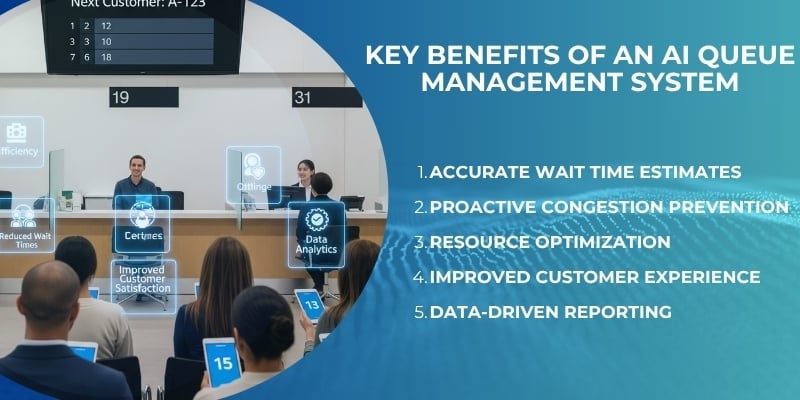
The benefits of AI-powered queuing extend across customer experience, staff efficiency, and operational analytics.
- Accurate wait time estimates build trust. When a digital display says “Estimated wait 12 minutes” and the customer is called in 11 minutes, they feel respected. Inaccurate estimates, where a 10-minute wait becomes 25 minutes, destroy trust.
- Proactive congestion prevention allows managers to act before lines form. The AI predicts peak periods and recommends staffing adjustments in advance. This prevents the reactive scramble that characterizes most queue management.
- Resource optimization ensures that staff are deployed where they are needed most. The AI can identify which service types create bottlenecks and recommend cross-training or dedicated counters.
- Improved customer experience follows from shorter waits and accurate estimates. Customers who trust the wait time are less likely to abandon the queue.
- Data-driven reporting provides managers with insights they never had before. Heat maps show peak periods by day and hour. Trend analysis reveals seasonal patterns. Staff performance metrics identify top performers and training opportunities.
The global AI in customer service market is projected to reach $7.6 billion by 2030, with queue and flow management representing one of the fastest-growing application segments, driven by retail, banking, and healthcare adoption. This growth reflects the clear ROI that AI queue systems deliver.
AI Queue Management Across Industries
Different industries apply AI queue management to their specific challenges.
- Banking: Branches use AI to predict teller demand, balance workloads across counters, and integrate appointment scheduling with walk-in flow. Peak-hour wait times drop significantly.
- Retail: Stores use AI to manage checkout lines, service desks, and fitting rooms. The system predicts when additional cashiers are needed and can direct customers to less busy registers.
- Healthcare: Hospitals and clinics use AI to manage patient check-in, consultation queues, lab work, and pharmacy pickup. The system predicts wait times for each step and coordinates flow across departments.
- Government: DMV and licensing offices use AI to handle unpredictable walk-in volumes and appointment integration. Citizens receive accurate wait estimates and can join virtual queues remotely.
- Airports and transport: Terminals use AI to manage security screening, check-in counters, and boarding gates. The system predicts congestion and adjusts staffing and lane openings in real time.
How AI Integrates with Physical Queue Infrastructure
AI queue management is not an independent software. It works alongside the physical infrastructure of kiosks, ticketing printers, counter displays, and digital signage.
The AI layer sits on top of the existing queue platform. It ingests data from every touchpoint. Self-service kiosks report check-in times. Staff terminals report service start and end times. Digital signage displays the AI’s predictions.
The data feedback loop is continuous. Every service interaction feeds back into the machine learning model. The system learns from today’s data to improve tomorrow’s predictions. Over time, the AI becomes more accurate as it accumulates more data.
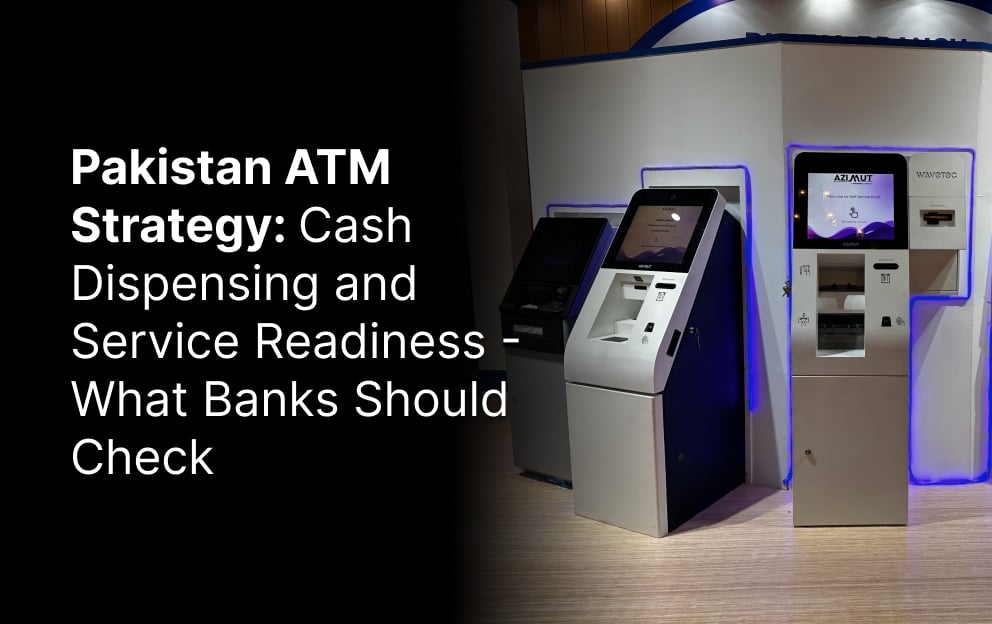
Wavetec’s self-service kiosks integrate directly with the AI queue platform, capturing check-in data that feeds the prediction models.
Real-Time Analytics and Reporting in AI Queue Systems
AI queue systems provide dashboards that show current and predicted conditions. Managers see live queue management analytics: average wait time, longest wait time, queue length by service type, staff utilization, and abandonment rate.
Heat maps visualize peak periods across days and weeks. A manager can see that Tuesdays at 10 AM consistently have longer waits and adjust staffing accordingly.
Predictive analytics show forecasted demand for the next hour, day, or week based on historical patterns and current trends.
Reports can be automated and scheduled. A weekly operations report might show average wait time by branch, service type, and time of day. This data supports continuous improvement and justifies staffing changes.
Case Study – Banks Reduce Peak-Hour Wait with AI Queue System
Financial service environments experience heavy fluctuations in customer traffic throughout the day.
Peak-hour congestion at consultation counters, customer service desks, and transaction areas often leads to long wait times, uneven staff workloads, and declining customer satisfaction.
Wavetec’s intelligent queue management deployments demonstrate how predictive queue orchestration and centralized visibility help service organizations manage high-volume customer flow more efficiently.
Allianz Saudi Fransi – Optimizing Customer Flow Across Multiple Branches
Allianz Saudi Fransi implemented Wavetec’s Queue Management Solution across branches in Jeddah, Riyadh, and Dammam to improve customer flow and reduce excessive waiting times during peak service hours.
The deployment included self-service kiosks, WebTSU counter management, Donatello digital signage, centralized reporting software, and real-time queue orchestration.
Customers received structured ticketing and were routed to the appropriate counters based on service requirements, while staff gained operational visibility into queue conditions across branches.
The centralized reporting system enabled management teams to monitor customer flow patterns, analyze service demand, and identify operational bottlenecks in real time.
Queue visibility and workload balancing improved significantly, helping staff respond faster during high-traffic periods.
The deployment resulted in:
- Reduced customer waiting times during peak hours
- Improved service coordination across branches
- Better workload distribution among staff
- Increased operational visibility through centralized analytics
- Higher customer satisfaction through more structured service delivery
This deployment reflects how intelligent queue management systems create the operational foundation for AI-powered queue optimization, where predictive analytics, real-time monitoring, and dynamic staff allocation help financial institutions move from reactive queue handling to proactive service management.
FAQs
What is an AI queue management system?
An AI queue management system uses machine learning to analyze service data, predict wait times, and optimize customer flow.
It learns from historical patterns and real-time conditions to reduce congestion, improve staff allocation, and provide accurate wait estimates to customers.
How does machine learning predict queue wait times?
The ML model trains on historical data including arrival times, service durations, staff availability, and day-of-week patterns.
It then uses real-time inputs such as current queue length and service progress to continuously update predictions. The model improves over time as more data is collected.
Is AI queue management suitable for small businesses?
Yes. AI queue systems are scalable and affordable. A small pharmacy, coffee shop, or retail store can implement basic predictive queuing with a cloud-based subscription. The ROI from reduced walkaways and improved efficiency often justifies the investment.
What data does an AI queue system need to work effectively?
The system needs historical service data: ticket times, service start and end times, staff assignments, and service types. More data improves accuracy. Most AI systems become reasonably accurate within 2–4 weeks and significantly improve after 3–6 months of learning.
How does AI queue management improve staff efficiency?
AI recommends optimal staff deployment based on predicted demand. It can suggest opening extra counters, adjusting break schedules, or cross-training staff for peak periods. This eliminates guesswork and reduces both customer wait times and staff idle time.
Author Bio: This article was written by the customer experience technology team at Wavetec, a global provider of AI-driven queue management, appointment scheduling, and digital signage solutions. Wavetec has helped over 20,000 businesses across banking, healthcare, retail, and government sectors reduce wait times and improve operational efficiency.
Conclusion
AI-powered queue management represents a fundamental shift from reactive to predictive service operations.
By learning from historical patterns and responding to real-time conditions, machine learning systems deliver accurate wait time estimates, prevent congestion before it forms, and optimize staff deployment.
The results are measurable: up to 40% reduction in wait times and 25% improvement in service throughput.
For banks, hospitals, retail stores, and government offices, the question is no longer whether to adopt AI queue management, but how quickly it can be implemented.
Wavetec offers AI queue solutions integrated with kiosks, digital signage, and appointment booking. Ready to predict wait times instead of just measuring them?
BOOK A FREE DEMO