You might have seen one without thinking about it: a machine near the supermarket entrance that swallows your empty bottles and cans and hands back money. That’s a reverse vending machine, and a new EU law is about to make it a much more familiar sight.
What is a reverse vending machine?
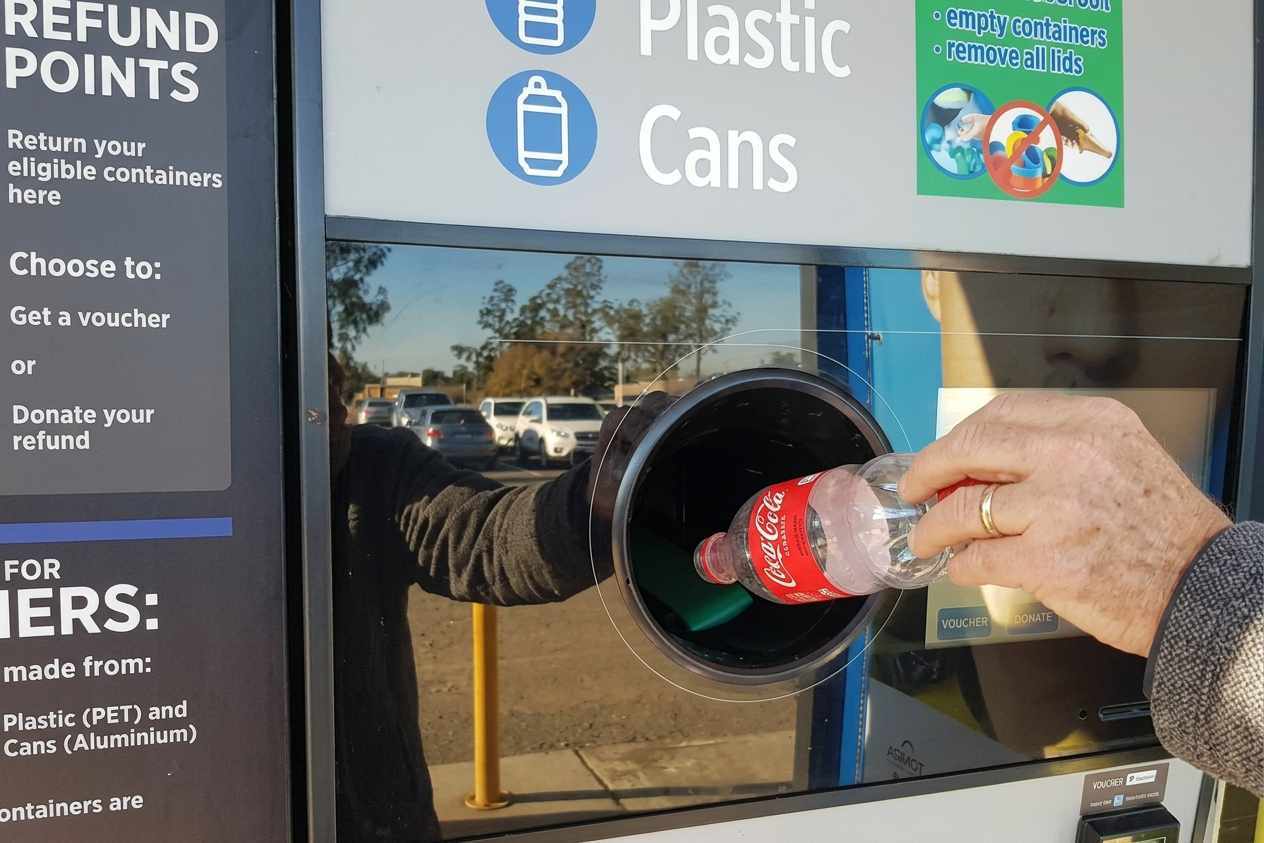
A reverse vending machine (RVM) does the opposite of a normal vending machine. A regular one takes the customers’ money and gives them a drink. An RVM takes the empty container and gives the customer something back, usually a deposit refund, a voucher, or a donation to charity.
RVMs are the return point for deposit return systems (DRS), schemes where the customers pay a small deposit on a drink at purchase and get it back when they return the empty bottle or can.
How does an RVM work?
From the customer side it takes a few seconds. Inside the machine, quite a lot happens:
- The customer inserts the container. Most machines take bottles and cans one at a time, or let the customer load several in a row.
- The RVM identifies the container. Sensors and cameras read the barcode and check the shape, size, and material.
- The RVM verifies it. The machine confirms the container belongs to the deposit scheme, so only eligible packaging is paid out.
- The RVM sorts and stores it. Plastic and metal go into separate storage, and many machines crush or shred the containers to save space.
- The RVM pays the customer back. The customer presses a button and gets their deposit as a printed receipt, a voucher, a digital credit, or a charity donation.
The stored containers are then collected and sent for recycling.
What types of RVM are there?
Not every machine looks the same. The most common kinds are:
- Compact in-store machines. The kind most people know, built into a supermarket wall or placed by the entrance.
- Large high-capacity machines. Used in busy shops or at central collection points, handling a high volume of containers.
- Bag-drop or automated points. The customer drops off a bag of containers and the system counts and credits them afterwards.
- Manual return points. Not a machine at all: a staffed counter in a smaller shop that takes containers by hand.
Which types you see depends on your country and on how its deposit scheme is set up.
Why use them?
RVMs help shoppers and the businesses that host them.
- Clean, high-quality material. Each container is collected on its own, so it isn’t mixed with food waste or other rubbish. That makes the recycled PET and aluminium good enough to go back into new bottles and cans.
- Less litter. A deposit gives every container a value, so fewer end up in streets, parks, and waterways.
- A reason to visit: a return point brings paying customers into the shop and can lead to extra spending, especially where vouchers are redeemed in store.
- Less work for staff: the machine takes, checks, sorts and compacts containers, so staff aren’t handling them by hand and they take up less back-of-house space.
- Visibility and compliance: counted returns, remote monitoring and reports help retailers track volumes and meet their obligations under a deposit scheme.
Why RVM’s are becoming essential for businesses: the new EU law
This is where the law comes in. Regulation (EU) 2025/40, the Packaging and Packaging Waste Regulation (PPWR), became binding on 11 February 2025 and generally applies from 12 August 2026. It replaces the old Packaging and Packaging Waste Directive (94/62/EC), and because it is a regulation, it applies directly across the EU.
The key rule for RVMs: by 1 January 2029, most member states must introduce a deposit return system, aiming to collect 90% of eligible single-use plastic bottles and metal cans. Reaching that target means getting a lot of containers back, which is exactly what RVMs are built for.
Wavetec’s Loop range: built for deposit returns
Wavetec’s Loop range is a family of four reverse vending machines for shops and collection points: Loop Slim, Loop Core, Loop Plus and Loop Max. They run from the compact Slim, designed for shops with limited floor space, up to the high-capacity Max for busier sites. All four accept PET bottles and metal cans, check each return using barcode reading and weight sensing, compact what they collect, and print vouchers and receipts. Operators can monitor machines remotely, with alerts and reports, and optional extras include AI recognition, a QR reader, anti-fraud features and POS integration.
With the law now in force, the best time to buy is now. The EU’s 2029 deadline and the UK’s October 2027 launch are closer than they sound: machines have to be chosen, installed, connected to the scheme and tested before they can take a single deposit.
What about the UK?
From 1 October 2027, drinks sold in England and Northern Ireland in single-use plastic (PET), aluminium or steel containers of 150ml to 3 litres will need to include a deposit, and Scotland is launching its own scheme in the same month, Reed Smith. The England and Northern Ireland scheme is set to reach 70% returns in 2028, rising to 80% in 2029 and 90% in 2030. Wales is developing its own scheme, which is planned to include glass, Just Drinks
What the future looks like
Returning packaging becomes a habit. In countries without a deposit scheme, an empty bottle or can will soon carry a small deposit, and returning it will be part of the weekly shop, like bringing your own bag.
RVMs become everyday infrastructure. Expect them in supermarkets, convenience stores, transport hubs, and petrol stations, with more machines and smarter ones. Many will connect to apps and digital wallets, so your refund can be paid straight to your phone.
Businesses get ready. Beverage producers and retailers will need to make sure their packaging works with deposit schemes, and plan for the return infrastructure ahead of 2029.
The bottom line
The reverse vending machine is a simple idea: put in an empty container, get your money back, and the material goes on to become something new. With the EU’s 2029 deposit return deadline and its 90% collection target, it is about to move from a feature of a few countries to everyday infrastructure across Europe.
BOOK A FREE DEMO