Citizen experience management is the strategic practice of designing, measuring, and continuously improving every interaction between a government agency and the citizens it serves. It applies private-sector customer experience principles including omnichannel service delivery, digital self-service, queue management, and satisfaction measurement to the public sector context.
Citizens today live in a world of seamless digital experiences. They bank from their phones, order groceries with a tap, and track packages in real time. Then they interact with a government agency and the experience is different.
Long queues, confusing paperwork, and no visibility into wait times. The contrast is jarring.
Citizens are comparing government services to the best private-sector experiences they have, and the government is coming up short.
Forrester’s 2024 US Customer Experience Index found that the average score for federal agencies is 61.9 out of 100, making the federal government the weakest-performing sector among the 13 verticals studied, lower than healthcare, banking, and retail.
This gap between citizen expectations and government service delivery is significant. But it is closing.
Agencies are investing in citizen experience management as a strategic discipline, applying private-sector CX principles to the unique constraints of government. The result is faster service, shorter queues, and higher citizen satisfaction.
Wavetec’s queue management system is a key enabler of this transformation.
What Is Citizen Experience Management?
Citizen experience management is the strategic practice of designing, measuring, and continuously improving every interaction between a government agency and the citizens it serves.
It borrows from private-sector customer experience frameworks but applies them to the unique context of government.
The constraints are real. Government agencies must serve all citizens equitably, regardless of language, ability, or access to technology.
- They operate under regulatory requirements that limit flexibility.
- They serve diverse populations with varying needs and expectations.
They must be transparent and accountable in ways that private businesses are not.
Citizen experience management navigates these constraints while still delivering better service.
Critically, citizen experience management is not the same as basic digitalization. Digitalization is about moving paper processes online.
Citizen experience management is about redesigning the entire service journey around the citizen’s needs. It is a strategic, ongoing discipline, not a one-time IT project. It requires leadership commitment, cross-agency coordination, and continuous measurement.
Citizens are not satisfied with current service levels. They expect more. Agencies that ignore this risk destroying public trust.
Why Citizen Experience Has Become a Government Priority
Several forces are pushing citizen experience to the top of government agendas.
- Rising public expectations are the most visible driver. Citizens experience seamless digital service from banks, retailers, and tech companies every day. They bring those expectations to government interactions. A citizen who can track a package in real time expects to track a passport application the same way. A citizen who can book a restaurant reservation online expects to book a driving test the same way. Government agencies that fail to meet these expectations are judged harshly.
- Accountability pressures add political weight. Poor citizen experience has reputational consequences for elected officials and agency leaders. Long queues at a DMV or a backlog at a passport office become news stories. The political cost of poor service is real.
- Budget efficiency is a pragmatic driver. Better-designed service journeys reduce staff costs and rework. A citizen who can complete a transaction online does not need to visit an office. A citizen who receives clear instructions the first time does not need to return with missing documents. Agencies that invest in citizen experience often see operational cost reductions.
McKinsey research shows that good CX can reduce negative media coverage of state agencies by up to 75%, creating a direct reputational ROI. While the exact figure varies, the principle is clear: better service generates fewer complaints, and fewer complaints generate fewer negative headlines.
This creates a virtuous cycle: better experience, better reputation, more trust, more resources to invest in further improvement.
The Five Pillars of Modern Citizen Experience Management
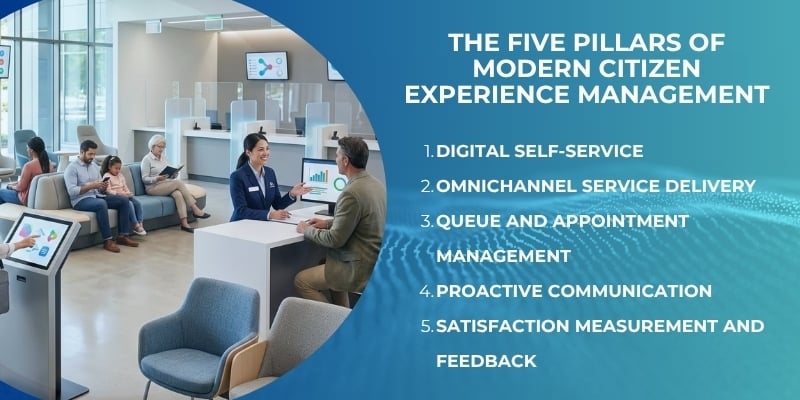
Modern citizen experience management rests on five pillars, each essential to a complete strategy.
Pillar 1: Digital Self-Service
Digital self-service allows citizens to complete transactions online without requiring an in-person visit. This is the most visible element of citizen experience modernization.
Citizens can renew licenses, apply for permits, pay fees, and check application status from their phones or computers.
The investment in this area is substantial. Grand View Research data found that the global citizen services AI market covering government use of AI for licensing, benefits, healthcare, and public safety delivery was estimated at USD 9.32 billion in 2023 and is projected to grow at a CAGR of 44.4% from 2024 to 2030.
This reflects the scale of public sector investment in service modernization. AI-powered chatbots, virtual assistants, and automated portals are becoming standard.
Pillar 2: Omnichannel Service Delivery
Omnichannel service delivery allows citizens to move seamlessly between online, telephone, kiosk, and in-person service without starting over each time.
- A citizen who starts an application online should be able to finish it at a service center without re-entering information.
- A citizen who calls for help should not need to explain their situation again in person.
Omnichannel delivery requires integrated systems and shared data across channels.
Pillar 3: Queue and Appointment Management
Queue and appointment management delivers structured, predictable service that eliminates unpredictable waiting. Citizens should know when they will be seen and how long they will wait.
Appointment systems spread demand across the day. Digital signage provides real-time visibility. Virtual queuing allows citizens to wait anywhere.
Pillar 4: Proactive Communication
Proactive communication means agencies notify citizens of status changes, reminders, and document requirements before they ask.
A citizen who applies for a passport should receive updates at each stage of processing. A citizen with a pending renewal should receive a reminder before the deadline. Proactive communication reduces anxiety and prevents last-minute rushes.
Pillar 5: Satisfaction Measurement and Feedback
Satisfaction measurement and feedback involves systematic capture of citizen satisfaction data to drive continuous improvement.
Agencies collect feedback at service points, analyze trends, and make changes based on what citizens tell them. This closes the loop between service delivery and service improvement.
Wavetec’s customer journey management supports all five pillars, with particular strength in queue management, appointment scheduling, and feedback capture.
How Queue Management Sits at the Heart of Citizen Experience
Even as digital channels grow, the in-person service interaction remains the most emotionally significant citizen touchpoint.
A visit to a government office is often high-stakes. The citizen may be anxious about the outcome. They may have taken time off work to be there. They may have limited English proficiency or other barriers. The quality of that in-person experience shapes their perception of the entire agency.
Queue management directly impacts satisfaction at this critical moment. A citizen who waits 10 minutes with clear visibility into their position is far more satisfied than a citizen who waits 30 minutes in confusion. A citizen who is called promptly and served efficiently leaves with a positive impression. A citizen who waits without information leaves frustrated.
The link between wait time, citizen effort, and satisfaction scores is well established.
- Shorter waits reduce effort.
- Lower effort increases satisfaction.
- Higher satisfaction builds trust.
Queue management is not just an operational tool. It is a trust-building mechanism.
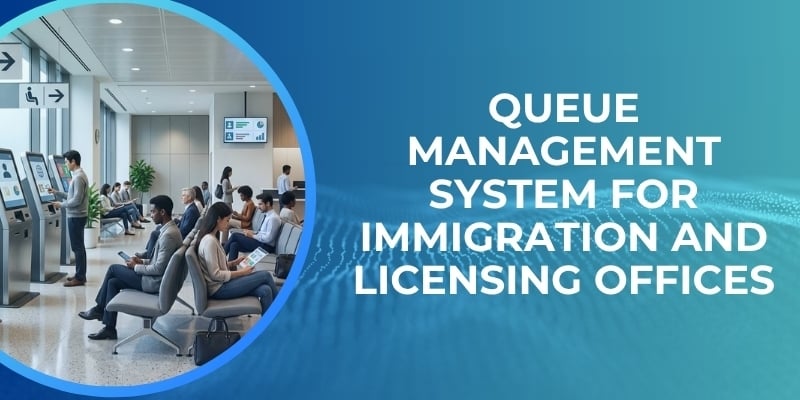
Wavetec’s queue management system provides the infrastructure for this trust. Virtual ticketing, appointment scheduling, and real-time displays create order and transparency. Citizens know where they stand. Staff know who is next. The experience is predictable and fair.
Digital Signage as a Citizen Communication Tool
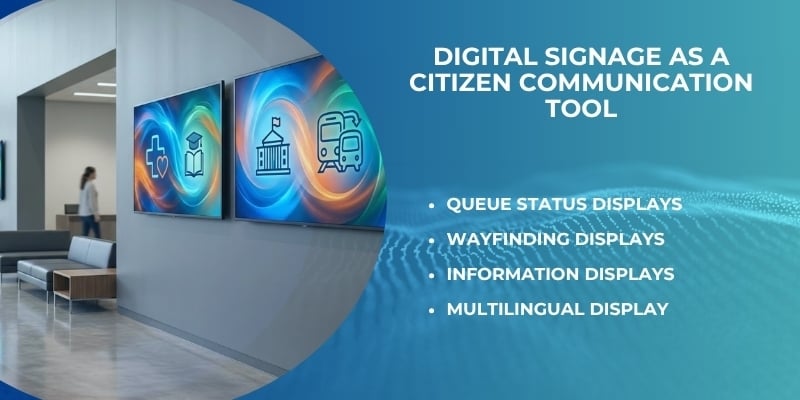
Digital signage is an essential complement to queue management in government offices. Displays communicate queue status, wayfinding, appointment progress, and important notices.
- Queue status displays show current ticket numbers, estimated wait times, and counter assignments. Citizens see their position in the queue without approaching the counter. This visibility reduces anxiety and eliminates the “how much longer?” interruptions that plague staff.
- Wayfinding displays guide citizens through complex multi-floor or multi-wing government buildings. Screens at entrances, elevator lobbies, and corridor junctions direct citizens to the correct department.
- Information displays communicate document requirements, preparation steps, and important notices. A citizen waiting for a licensing appointment might see a checklist of required documents. A citizen waiting for an immigration interview might see information about the process.
- Multilingual display capability is a requirement for diverse citizen populations. Screens can rotate between languages, ensuring that all citizens can access information.
Wavetec’s digital signage solutions integrate with the queue management system, providing real-time, accurate information to waiting citizens.
Measuring Citizen Experience: KPIs and Frameworks
Measuring citizen experience requires a balanced set of metrics that capture different aspects of the service journey.
- Citizen Satisfaction Score (CSAT) measures satisfaction with a specific interaction. It is collected immediately after service, often through a feedback kiosk.
- Citizen Effort Score (CES) measures how easy it was to complete the interaction. Low effort correlates with high satisfaction and loyalty.
- Net Promoter Score (NPS) measures the likelihood that the citizen would recommend the agency to others. It is a proxy for trust and advocacy.
- Wait time measures how long citizens wait before service. It is the most direct operational metric for queue management.
- First-contact resolution measures whether the citizen’s issue was resolved in a single interaction. High first-contact resolution reduces repeat visits.
- Service completion rate measures the percentage of citizens who complete their intended transaction. Low completion rates indicate process friction.
- Digital self-service adoption rate measures how many citizens use online channels rather than in-person visits. High adoption indicates successful digital transformation.
Measurement matters. Daily operational metrics (wait time, queue length, service volume) support rapid course correction. Weekly satisfaction metrics (CSAT, CES) reveal trends before they become problems. Quarterly strategic reviews (NPS, digital adoption, completion rates) guide long-term investment.
Case Study: UAE Federal Authority for Identity and Citizenship Elevates Citizen Experience Through Digital Service Delivery
The UAE Federal Authority for Identity and Citizenship (ICA) modernized citizen services by deploying Wavetec’s integrated customer journey platform across 55 service centres.
The deployment combined online appointment scheduling, electronic queue management, digital signage, SMS and WhatsApp notifications, and centralized operational dashboards to create a more seamless experience for citizens accessing passport, residency, and identity services.
A key element of the project was the integration of Wavetec’s queue management system with the Prime Minister’s Office Happiness Meter, allowing ICA to capture citizen feedback while monitoring service quality across branches.
Combined with real-time analytics, demand forecasting, and branch performance monitoring, the platform enabled ICA to reduce waiting and service times, improve staff productivity, and deliver a more consistent, transparent, and citizen-centric service experience across its nationwide network.
This deployment demonstrates how digital service delivery and real-time performance management can strengthen citizen satisfaction while improving operational efficiency.
FAQs
What is citizen experience management?
Citizen experience management is the strategic practice of designing, measuring, and continuously improving every interaction between a government agency and the citizens it serves. It applies private-sector customer experience principles to the public sector context.
How does citizen experience management differ from customer experience management?
Citizen experience management operates within government constraints including equity mandates, regulatory requirements, diverse populations, and multiple channels. The principles are similar, but the context is more complex and the stakes include public trust and democratic accountability.
What is the biggest CX challenge for government agencies?
The biggest challenge is often legacy systems and fragmented data. Citizens interact with multiple departments that do not share information. This forces citizens to repeat themselves and creates friction. Integration and data sharing are foundational to improvement.
How do government agencies measure citizen satisfaction?
Agencies use CSAT (satisfaction with specific interactions), CES (effort to complete a task), NPS (likelihood to recommend), wait time, first-contact resolution, service completion rate, and digital self-service adoption. Measurement cadence ranges from daily operational metrics to quarterly strategic reviews.
How does queue management improve citizen experience?
Queue management reduces wait times, provides real-time visibility into queue position, and eliminates the frustration of unpredictable waiting. Citizens who can see their position and estimated wait time feel more in control, which reduces anxiety and improves satisfaction.
Conclusion
Citizen experience management is shifting from aspiration to operational reality across government agencies globally.
The forces driving this shift are powerful: rising public expectations, accountability pressures, and budget efficiency demands.
The five pillars of modern citizen experience management provide a framework for action: digital self-service, omnichannel delivery, queue and appointment management, proactive communication, and satisfaction measurement.
Wavetec provides the queue management, kiosk, and digital signage infrastructure that makes modernized citizen service delivery possible. For agencies ready to close the gap between citizen expectations and government service delivery, the path forward is clear.
BOOK A FREE DEMO