Latin America’s Banks Are Going Mobile-First. What Happens to the Branch?
Direct answer
Mobile-first banking does not close the bank branch. It shifts the branch to identity checks, complex transactions and advice, and makes bank branch queue management the link between app and branch: customers take a ticket in the app and arrive at their turn.
Published 17/09/2026 · 14 min read
Key takeaways
- Galileo’s 2026 Adaptive Banking Report found that 52.7% of Mexican businesses name security and fraud as their biggest barrier to faster digital finance, the highest share of the four countries surveyed.
- Open finance is moving at different speeds: Mexico and Brazil have rules in force, Colombia made open finance mandatory in April 2026, and Peru and Argentina are still drafting.
- BBVA Peru connected its mobile app to the queue in 278 branches and reported average waits about 35% shorter and 57% lower customer abandonment.
In this article
- What does mobile-first banking change in Latin America?
- How far has open finance regulation gone in each country?
- Why does the bank branch still matter in a mobile-first market?
- Why did first-in-first-out branch queues stop working?
- How does a mobile-to-branch queue work?
- What results have Latin American banks reported?
- What architecture and security does a regional rollout need?
- How should a Latin American bank choose a branch queue management system?
- Frequently asked questions
What does mobile-first banking change in Latin America?
Mobile-first banking changes where a customer starts a bank interaction, not whether the branch is needed. The app becomes the front door for routine tasks, while the branch keeps the transactions that need identity, judgment or a signature. Adoption is real across the region, but it is uneven, and security is the brake.
Galileo’s 2026 Adaptive Banking Report surveyed 337 technology leaders (CTOs and CIOs) at companies in Brazil, Mexico, Colombia and Argentina, according to Startupi’s July 2026 coverage. The Global Economics reported in July 2026 that 90.9% of Mexican companies said real-time financial services had improved their revenue, and nearly 80% of Mexican businesses now treat integrated finance as a primary driver of growth. The appetite is not uniform: only 55.9% of Argentine and 54.4% of Colombian companies reported the same revenue benefit.
Appetite does not equal execution. The same July 2026 report coverage found that just 14.5% of Mexican enterprises constantly test and deploy new financial products, compared with 25.0% in Brazil. Latin American banking is several markets moving at different speeds, which is why a single regional digital strategy rarely fits every country.
Security and fraud are the most-cited brake on digital finance in Mexico. According to The Global Economics’ July 2026 summary of the Galileo survey, 52.7% of Mexican businesses cited security as their biggest obstacle to moving faster, the highest share of any country in the study. For a bank, every new digital channel has to meet the same security standard as the branch.
Traditional financial institutions adopt real-time transaction data more slowly than other sectors. The same Galileo report found that 78.9% of companies in travel and hospitality already prefer real-time transaction data for immediate customer support, more than double the 38.5% adoption rate among traditional financial institutions. Banks are not behind because the technology is missing or customers do not want it; the security and compliance bar for handling money is, correctly, higher than for a hotel booking.
How far has open finance regulation gone in each country?
Open finance regulation in Latin America is in force in Mexico and Brazil, newly mandatory in Colombia, and still in draft in Peru and Argentina. Open finance is a regulated framework that lets customers share their financial data with other providers through secure APIs, with their consent. The table below shows where each market stood in September 2026.
Open finance status by country, September 2026
| Country | Framework | Status | Key date |
| Mexico | Fintech Law, including open API provisions | In force | Published March 9, 2018 |
| Brazil | Open finance led by Banco Central do Brasil | In force, phased rollout | Joint Resolution No. 1, May 4, 2020; rollout from February 2021 |
| Colombia | Decree 0368 of 2026 | Mandatory, standards being set | Issued April 7, 2026 |
| Peru | SBS draft open finance guidelines | Draft, consultation closed August 7, 2026 | General rule expected early 2027; data exchange from 2028 |
| Argentina | BCRA voluntary open finance | In preparation | Announced May 2025; launch expected 2026 or 2027 |
The regulatory gap matters to branch strategy. A bank in Mexico or Brazil can already connect third-party services through regulated APIs, while a bank in Peru is planning for rules expected in 2027. Branch technology bought today has to connect to the bank’s own app now and to open finance APIs later. The integration side is covered in the role of APIs in digital banking.
Why does the bank branch still matter in a mobile-first market?
The bank branch still matters because it is where identity, trust and complex transactions are handled in person. Mobile-first banking moves routine requests to the phone, which leaves the branch with the visits that carry the most risk and the most value. The comparison below shows what mobile-first threatens and what it does not.
What mobile-first banking threatens, and what it leaves to the branch
| Mobile-first threatens | Mobile-first leaves to the branch |
| Walk-in visits for routine transactions | Identity checks and account opening |
| Queues with no data on who is arriving | High-value and complex transactions |
| Staffing planned after congestion forms | Advice and problem-solving with a person |
| Separate systems for app and branch | Building trust in person |
What mobile-first threatens
Mobile-first banking threatens the branch that treats every visitor as a stranger. A branch with no data on who is arriving, why they are coming or how urgent their transaction is cannot plan staff or service. Customers who already bank on their phone notice the difference between an app that knows them and a branch that does not. The two channels are compared in in-branch banking vs digital banking.
What mobile-first does not threaten
Mobile-first banking does not threaten the branch’s core role: proving identity, handling high-value or complex transactions, and giving customers a person to talk to when a request falls outside the app. None of the Latin American banks in this article closed branches to go mobile. Each one rebuilt how the branch and the app work together, a project covered in banking channels of the future.
Why did first-in-first-out branch queues stop working?
First-in-first-out branch queues stopped working because they only know about a customer once the customer is standing in the branch. A queue management system is software, usually paired with kiosks and displays, that issues tickets, routes each customer to the right counter and measures waiting and service times. A first-in-first-out (FIFO) queue serves customers strictly in arrival order, whatever they came for.
A FIFO queue cannot see demand before it arrives. At BBVA Peru, according to the BBVA Peru case study, the previous model had no digital pre-arrival option and systems that did not share data across touchpoints. All demand piled up inside the branch, and bottlenecks formed around the most complex services.
Staffing in a FIFO branch is reactive because managers only see congestion after it forms. BBVA Peru’s branch managers made staffing decisions after queues built up, rather than ahead of them. Queue management analytics replace that guesswork with live and historical data on arrivals, waits and service times.
How does a mobile-to-branch queue work?
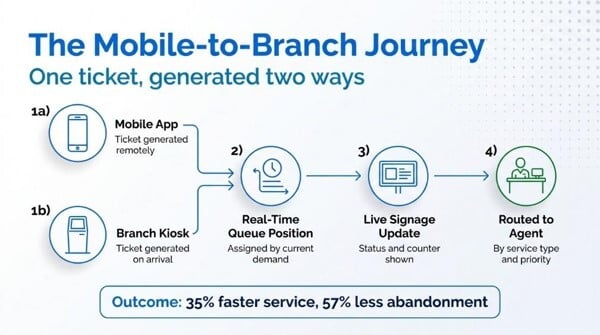
A mobile-to-branch queue lets a customer take a ticket in the bank’s app, arrive at the right time and be routed to the right staff member. BBVA Peru’s deployment of Wavetec’s Spectra QMS, run as a cloud-based queue system, follows five steps.
1. The customer takes a ticket in the bank’s app
The customer generates a ticket remotely in BBVA’s own mobile banking app, a feature BBVA calls Digital Turn. The app requests the ticket from the queue system through secure REST APIs. Customers who prefer the branch can still take a ticket at a self-service kiosk on arrival.
2. The system assigns a queue position from real-time demand
The queue system assigns each digital ticket a position based on real-time demand across the branch. The customer can time the trip to match their turn instead of sitting in the waiting area, the same principle behind virtual queuing.
3. Digital signage shows live queue status
Inside the branch, digital signage shows live queue status and the counter each customer should go to. Customers see where they stand without asking staff.
4. Routing matches the customer to the right staff member
The system routes each customer by service type, priority tier and the staff member with the right skills for the transaction, not simply the next free counter. CRM integration identifies the customer’s tier and weights priority accordingly.
5. Managers watch every branch from one dashboard
Centralized dashboards give managers live visibility across all 278 BBVA Peru branches. Staffing decisions can follow demand as it happens instead of reports read after the day ends.
What results have Latin American banks reported?
Latin American banks that connected digital channels to branch queues report shorter waits, fewer abandoned visits and fast rollouts. The deployments below are documented in published bank case studies.
BBVA Peru: 278 branches connected to the mobile app
BBVA Peru redesigned queue management across 278 branches to connect its mobile app and its branches. The BBVA Peru case study reports the results below. The case study does not state the baseline or the measurement period.
BBVA Peru results reported in Wavetec’s case study
| Metric | Result |
| Branches deployed | 278 |
| Average wait time | About 35% shorter |
| Customer abandonment rate | 57% lower |
| System uptime | 99.93% |
Customer abandonment is the share of customers who leave the queue before being served. A 57% drop means far fewer customers giving up on a branch visit, as explained in queue abandonment rate and how to improve it.
MiBanco: 100 branches in about 2.5 weeks, in 2020
In 2020, MiBanco, Peru’s largest microfinance bank by asset size in Latin America, had Wavetec power 100 branches with an integrated queue management and digital signage solution in roughly 2.5 weeks. The MiBanco rollout was announced in January 2020, and the MiBanco case study covers the deployment.
Interbank: service redesign first, technology second
Interbank, a Peruvian bank that serves more than 2 million customers according to its own website, took a design-first approach in an earlier branch redesign. It worked with the design consultancy IDEO to research what customers wanted from a branch visit, then brought Wavetec in to build the queue management layer for that journey, as described in the Interbank case study.
Banorte: a 1,216-branch network in Mexico
Banorte, one of Mexico’s largest banks, had 1,216 branches at the end of 2025, El Cronista reported in January 2026. Banorte runs Wavetec customer flow management across its branch network, according to the Banorte case study, making it one of the largest branch queue deployments in the region.
HSBC Mexico and a foothold in Chile
HSBC Mexico, which had 767 branches in September 2025 according to Moody’s Local Mexico, has also deployed Wavetec’s platform in its branch network, as the HSBC Mexico case study describes.
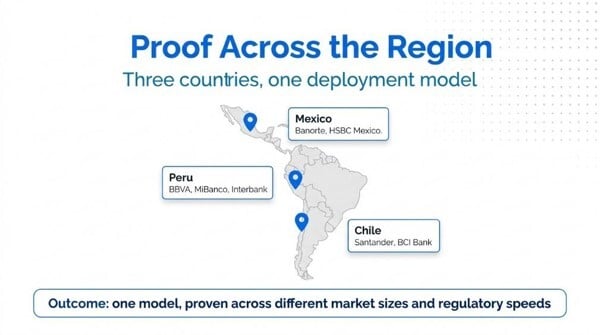
In Chile, Wavetec works with Santander Bank Chile and BCI Bank (Santander Chile case study, BCI Bank case study). Deployments across Peru, Mexico and Chile, three markets with different regulatory speeds and bank sizes, show that the mobile-and-branch model is not a Peru-specific fix.
What architecture and security does a regional rollout need?
A regional rollout needs a layered architecture that keeps the app, the branch and the bank’s core systems connected under one security standard. BBVA Peru’s deployment is built in three layers, according to the BBVA Peru case study: a channel layer, a middleware layer and an enterprise integration layer.
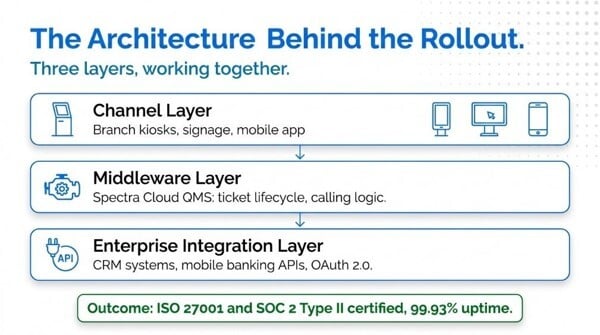
The channel layer is everything the customer touches: branch kiosks, digital signage and the mobile app. Each channel issues and displays tickets from the same queue.
The middleware layer runs Spectra’s cloud queue engine, which manages the ticket lifecycle and calling logic in real time for every branch.
The enterprise integration layer connects the queue to the CRM and the mobile banking app through an API gateway that uses OAuth 2.0 authentication. OAuth 2.0 is an authorization standard that lets one system access another on a user’s behalf without sharing passwords.
Security controls in the BBVA Peru deployment
| Layer | What it covers |
| Data security | TLS 1.2/1.3 encryption in transit, AES-256 encryption at rest |
| Access control | Role-based access control (RBAC) with multi-factor authentication |
| Network security | Dedicated VLAN network segmentation |
| Compliance | ISO 27001 and SOC 2 Type II certified |
| Availability | Centralized monitoring, automated health checks and failover, 99.93% measured uptime |
These controls answer the security concern that the Galileo survey placed at the top of Mexico’s list. A customer who takes a ticket in the app has to be protected to the same standard as a customer standing at the kiosk. Kiosk-specific risks are covered in security and privacy considerations in self-service kiosks.
How should a Latin American bank choose a branch queue management system?
A Latin American bank should choose a branch queue system that connects to its own app, meets its regulator’s security bar and can be rolled out and supported locally. The criteria below come from the deployments in this article.
1. Integration with the bank’s own app
Check that the queue system can issue tickets inside the bank’s existing app through documented APIs, as BBVA Peru’s Digital Turn does, rather than forcing customers into a separate app. Mobile queuing and WhatsApp appointments are further options for markets where messaging apps dominate.
2. Security and compliance evidence
Ask for certifications and architecture, not promises. Wavetec holds ISO 27001 and SOC 2 Type II certification, and the BBVA Peru deployment documents TLS encryption, AES-256 encryption at rest, role-based access with multi-factor authentication and network segmentation.
3. Rollout speed and local support
Rollout speed decides how fast a network sees results. In 2020, MiBanco’s 100 branches went live in approximately 2.5 weeks. Wavetec supports Latin American banks from a dedicated regional office in Lima, Peru, part of a network of 10 offices across 9 countries, and has more than 30,000 installations in 80+ countries.
4. Design the service model before the technology
In its earlier branch redesign, Interbank designed its service model with IDEO first and fitted technology to it second. Banks that map the journey first avoid automating a broken process. The planning steps are covered in how banks use queue management software.
5. Put AI on the same controls
AI works best on top of a verified, auditable queue architecture, not as a replacement for it. Wavetec’s platform includes AI capabilities such as Nexia-Q, an AI digital human for self-service, alongside routing that assigns customers by service type, priority tier and staff skill; the wider options are covered in AI queue management systems. In a region where security is the top barrier, AI features should follow the same access controls and audit trail as the rest of the system.
Frequently asked questions
What is mobile-first banking?
Mobile-first banking is a strategy in which the bank’s app is the customer’s first point of contact for routine banking. The branch remains for identity checks, complex transactions and advice.
Does mobile-first banking mean fewer bank branches in Latin America?
Mobile-first banking changes what branches do more than how many exist. The banks in this article, including BBVA Peru, Interbank, Banorte and HSBC Mexico, kept their branches and connected them to digital channels.
What is a mobile-to-branch queue?
A mobile-to-branch queue lets a customer take a branch queue ticket in the bank’s app before arriving. BBVA Peru’s Digital Turn feature issues these tickets through secure APIs connected to Spectra QMS.
What results did BBVA Peru report?
BBVA Peru reported average waits about 35% shorter, 57% lower customer abandonment and 99.93% system uptime across 278 branches. The figures come from the BBVA Peru case study, which does not state the measurement period.
Which countries in Latin America have open finance rules?
Mexico has had its Fintech Law since 2018 and Brazil has run open finance since 2021. Colombia made open finance mandatory in April 2026, Peru’s regulator published draft rules in July 2026, and Argentina’s central bank expects a launch in 2026 or 2027.
Why does security matter for branch queue systems?
Bank branch queue management systems that connect to mobile apps handle customer and account data. Galileo’s 2026 survey found security was the top barrier for 52.7% of Mexican businesses, so the queue system must meet the bank’s app-level security standard.
How long does a branch queue rollout take?
Rollout time depends on scope and integration. In 2020, MiBanco’s queue management and digital signage went live in 100 branches in approximately 2.5 weeks, according to the MiBanco case study.
Which Latin American banks use Wavetec?
BBVA Peru, Interbank, Banorte, HSBC Mexico, Santander Bank Chile and BCI Bank work with Wavetec across the region, and Wavetec delivered a 100-branch rollout for MiBanco in 2020. The full list is on the banking industry page.
Mobile-first banking in Latin America is shrinking the routine branch visit, not the branch. The banks gaining ground are the ones connecting the app to the queue, so every customer who does walk in arrives expected, on time and routed to the right person.
Related reading
- How to reduce waiting times in banks
- Digital transformation tips for banks
- How banks can balance compliance and customer experience
- Customer trust in banks
- The shortage of bank tellers
- WhatsApp for banking
- Digital signage solutions for banks
- Hyper-personalization in banking
- Different types of queue management systems
- Average wait times in banks, hospitals and retail
- Retail banking challenges and opportunities
- Virtual queuing in customer service
- Self-service kiosks for banking
- Online appointment booking and scheduling
- Customer feedback