Inside the Banking Overhaul: How Chile Executed Four Deployments from One Playbook
See how Wavetec’s digital signage and queue management solutions work across Chile’s financial sector.
Wavetec has run a dedicated office in Santiago since its early years in Latin America, one of 10 offices across 9 countries worldwide, which means the company’s presence in Chile isn’t a single opportunistic deal. It’s sustained, local, and long enough to have worked with several of the country’s financial institutions independently over time, not as one bundled sale.
That matters because Chile’s financial sector isn’t chasing disruption right now. The Fintech Times’ 2026 overview of Chile’s digital landscape describes it as “a measured, institutional approach to digital transformation… less about disruption at scale, and more about strengthening an already mature financial system through innovation, regulation and competition.” Chile is widely regarded as one of Latin America’s most stable, advanced economies, with an economy valued at roughly $350 billion, anchored by mining, particularly copper, which accounts for more than half of exports, alongside agriculture, fisheries, manufacturing, and a growing services sector. Its financial institutions are modernizing accordingly: steadily, deliberately, branch by branch and system by system, driven in large part by growth in digital payments and mobile wallets, expanding e-commerce, and greater use of data analytics for lending and personalization.
That pace is also regulatory, not just cultural. Chile’s Fintech Law (No. 21,521) was adopted in January 2023, establishing a formal Open Finance framework. The country’s Financial Market Commission (CMF) published a first draft regulation for public consultation in early 2024, then formally established the Open Finance framework through General Rule No. 514 that July. Financial institutions are required to eventually join the system, but only following user consent, and implementation, originally set for mid-2026, has since been pushed to July 2027, a delay reportedly requested by traditional banks, a sign of an institutional system prioritizing getting the infrastructure right over moving fast.
Against that backdrop, four real deployments across three Chilean financial institutions tell a consistent story: modernization here isn’t one flashy project, it’s steady infrastructure work happening across the sector at once.
Santander Chile: Seeing the Whole Network at Once
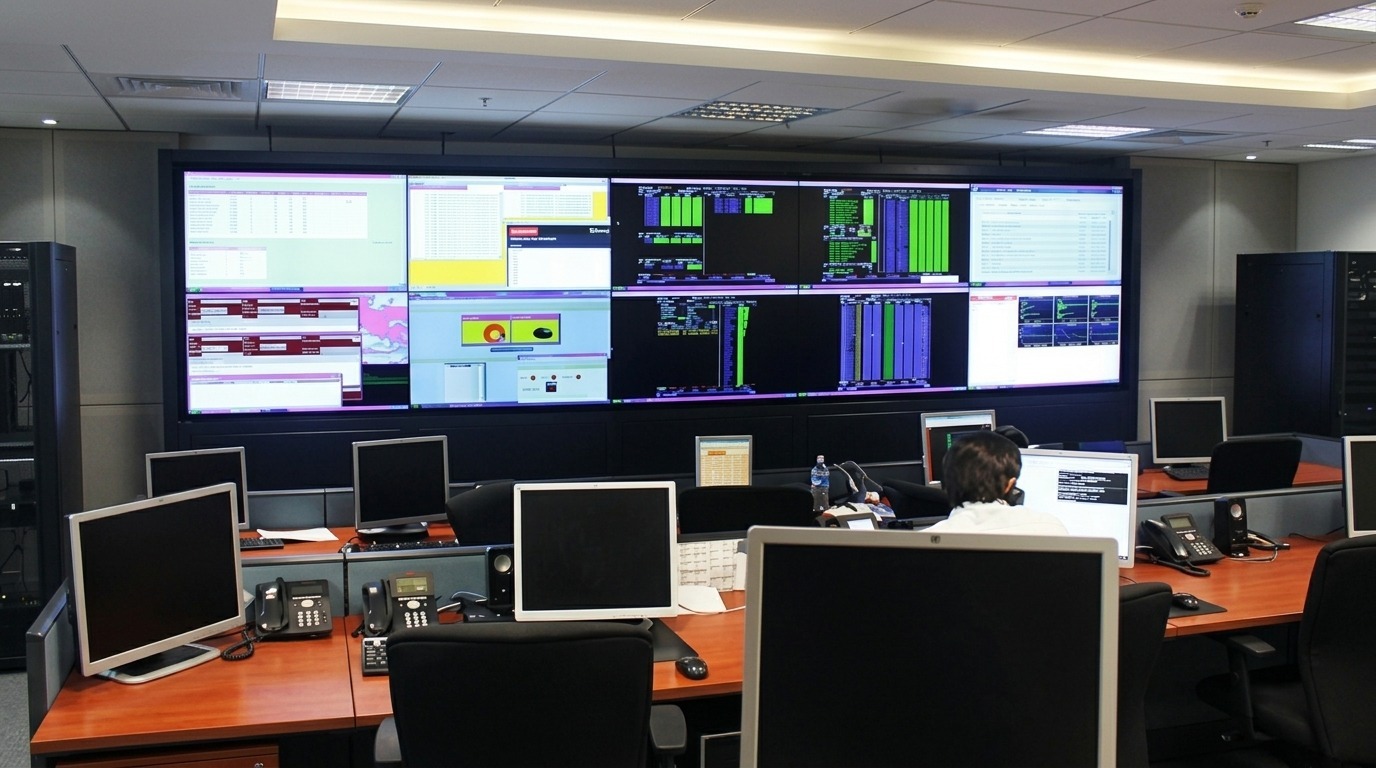
Santander Chile identified a specific operational gap: no unified way to monitor branch activity across the country in real time. Wavetec’s response was a video wall for the bank’s monitoring room, 16 professional high-definition displays running 24/7, connected to a video processor handling up to 32 video inputs simultaneously. The wall tracks payment and transfer status, payroll processing, server status nationwide, ATM activity, and system errors, prioritizing and regrouping information depending on the day or month.
This isn’t a customer-facing deployment, it’s operational infrastructure. The value is entirely about giving Santander’s management a single, real-time view of a countrywide network that would otherwise require piecing together reports from individual branches after the fact, a difference that matters most in the moments when something is actually going wrong somewhere in the network.
Why a Video Wall, Not a Dashboard on a Screen
The distinction matters more than it might seem. A dashboard on a single monitor forces someone to choose what to look at, and switch between views to see everything else. A 16-screen wall, fed by a processor handling 32 simultaneous inputs, lets an operations team see payment status, ATM health, and system errors all at once, continuously, without anyone having to click through tabs to notice a problem developing. For a bank operating branches nationwide, that difference is the gap between spotting an issue as it happens and discovering it after a customer has already been affected.
BCI: Signage at the Branch, and at the Academy
BCI, a financial institution with more than 300 banking centers and roughly 10,500 employees, deployed Wavetec’s Donatello digital signage solution across its branch network, focused on engagement and entertainment for customers moving through the branch.
The bank then extended the same approach internally. BCI Bank Academy, the institution’s leadership training center in Santiago (launched in 2008, growing from around 100 participating managers), also runs Wavetec’s digital signage, used to reinforce corporate values and leadership culture in the space where BCI trains the people who run its branches. It’s the same signage technology solving two different problems for the same institution: customer engagement on one side, internal culture on the other.
EuroAmérica: Real-Time Financial Data at the Building Scale
EuroAmérica took the idea of visible, real-time information further than any single screen: a 90-meter LED ticker wrapping the full perimeter of its Santiago headquarters, 48 centimeters high, built to broadcast financial information continuously, including the value of Chile’s Unidad de Fomento (UF, the country’s inflation-indexed unit of account) and foreign exchange rates. Beyond the aesthetic impact, it’s a public, always-on statement of commitment to real-time information and transparency, the same principle Chile’s Open Finance regulation is now formalizing at the industry level.
The project covered the full design, production, and installation of the display, handled end to end as a single scope rather than separate hardware and software vendors, wrapped around the building’s entire perimeter rather than mounted as a single sign. For a financial company, putting live currency and exchange data on permanent public display is a specific kind of statement: the numbers are accurate right now, and anyone walking past can check.
What Makes One Platform Work for Two Different Rooms
BCI’s branch signage and its Academy signage run the same underlying Donatello platform, but that only works because the platform itself is built around centralized, flexible content control rather than a single fixed message. Content can be scheduled by hour, day, or month, and managed centrally rather than screen by screen, which is what lets the same technology serve a branch lobby (where the priority is customer engagement and wait-time information) and a leadership training room (where the priority is reinforcing culture and values) without needing two separate systems. Multilingual support is built in as well, relevant across a country where financial institutions serve both domestic customers and Chile’s international business relationships.
Why This Timing Isn’t a Coincidence
Chile’s Fintech Law and Open Finance framework are built around a specific principle: financial data should move between institutions, and be visible to the people it concerns, in a governed, real-time way, not locked inside internal systems that only surface information after the fact. That’s precisely the operational shift each of these four deployments makes at a smaller scale. Santander’s video wall replaces after-the-fact branch reports with live network visibility. BCI’s signage replaces static branch information with real-time content, in both the customer-facing branch and the internal training space. EuroAmérica’s ticker replaces a static rate sheet with a continuously updated public display.
None of these four institutions built their systems because of the Open Finance mandate specifically, several of these deployments predate the regulation. But the direction is the same one Chile’s regulators are now writing into law: real-time, visible, and governed data, rather than static reports produced after the fact.
What Ties These Four Deployments Together
| Institution | Deployment | What It Solves |
| Santander Chile | 16-screen video wall, monitoring room | Real-time visibility across the national branch network |
| BCI | Donatello digital signage, 300+ branches | Customer engagement at the point of service |
| BCI Bank Academy | Donatello digital signage, training center | Reinforcing leadership culture internally |
| EuroAmérica | 90-meter LED ticker, headquarters | Public, continuous financial transparency |
None of these four projects were bundled into a single sale, and none of them solve the same problem. What they share is a common underlying need: turning information that used to live in a report, a spreadsheet, or a single manager’s head into something visible, live, and shared, whether the audience is a customer, an employee, or the investing public. That’s the actual through-line of Chile’s “measured, institutional” modernization described above, it isn’t one big transformation project, it’s this same pattern, repeated independently across the sector, by institutions that never coordinated with each other on the decision.
That independence is itself worth noting. Santander, BCI, and EuroAmérica are not the same company, they don’t share a board, a technology strategy, or a procurement process. Each one arrived separately at the same conclusion: that operational or financial information needed to stop living in static reports and start being visible in real time. When three unrelated institutions in the same country make the same call within a similar window, that’s a stronger signal than any one of them could send alone.
Built In-House, End to End
Every one of these deployments, the video wall, the branch signage, the training center signage, the building-length ticker, was designed, built, and delivered by Wavetec directly, not assembled from third-party hardware and software. That consistency is part of why the same underlying technology, Donatello digital signage, could solve four genuinely different problems for three different institutions without four different vendors, four different support contracts, or four different points of failure involved.
Where AI Fits
The same push toward real-time, governed visibility that shows up in these four deployments is also the logic behind Wavetec’s next layer of AI. Nexia Reports, available today, turns the kind of operational data these systems already generate, branch activity, ATM status, service performance, into governed, prompt-generated reporting rather than a manually assembled spreadsheet. Two products further out on the roadmap extend that idea: Nexia Journeys, designed to track and coordinate a customer’s full interaction across a bank’s different touchpoints rather than treating each visit in isolation, and Nexia Avatar, a planned conversational, voice-guided interface with human handoff built into the design from the outset. None of these three sit inside the four Chilean deployments described in this piece today, but the direction fits the same pattern already visible across Santander, BCI, and EuroAmérica: turning information that used to sit static and after-the-fact into something live, visible, and actionable.
FAQs
Which Chilean financial institutions use Wavetec’s solutions?
Santander Chile, BCI (including its branch network and its BCI Bank Academy training center), and EuroAmérica all run Wavetec deployments.
What does Santander Chile’s video wall do?
It gives the bank’s management a real-time, countrywide view of branch activity, payments, ATM status, and system health, through 16 HD displays connected to a video processor handling up to 32 inputs at once.
Is BCI’s signage deployment only for customers?
No. BCI runs Wavetec’s Donatello signage both across its branch network for customer engagement, and separately at its leadership training academy for internal culture reinforcement.
Why does Chile’s financial sector describe its digital transformation as “measured” rather than disruptive?
Per The Fintech Times’ 2026 overview, Chile is strengthening an already mature, stable financial system through regulation and steady innovation, rather than pursuing rapid disruption, reflected in its own Open Finance rollout being extended from 2026 to 2027 to get the implementation right.
Did these deployments happen because of Chile’s Open Finance law?
No, several predate the regulation. But they reflect the same underlying direction the law is now formalizing: real-time, visible financial data, rather than static reports produced after the fact.
What’s the difference between Wavetec’s work at BCI’s branches versus BCI Bank Academy?
Both use the same Donatello digital signage technology, but for different audiences: branch signage engages customers during service, while the Academy’s signage reinforces leadership culture for the staff being trained to run those branches.
Suggested Internal Links
For whoever publishes this: consider linking to Wavetec’s banking industry page and the Spectra analytics platform page if relevant to this piece, alongside the company’s broader Latin America case study library for readers who want the wider regional picture. Exact URLs for those specific pages weren’t independently re-verified in this session and should be confirmed before publishing.
Explore Wavetec’s digital signage and queue management solutions, or book a demo to see them running in a branch network like Chile’s.
BOOK A FREE DEMO