How Secure Audit and Logging Trails Regulate Cheque Processing Workflows for Banks
Direct answer
Automating cheque processing does not eliminate operational risk, it changes where scrutiny is required. Secure logging and role-based access make bank transaction logging the bridge between AI automation and compliance: systems extract data at speed, while audit trails prove exactly who, what, and when every action was validated or modified.
Published 23/09/2026 · 12 min read
Key takeaways
- Rising Fraud Risks: Generative AI-driven banking fraud is projected to reach US$40 billion in the US alone by 2027 (Deloitte), making complete, tamper-proof transaction logging essential for detective controls.
- Traceable Human-AI Handoffs: ChequeDB preserves the complete chain of custody—retaining the original image, initial AI-extracted values, confidence scores, and reviewer modifications to eliminate “black box” decisions.
- End-to-End Hardware & Software Integration: Wavetec’s full-stack approach links physical kiosk events (MICR reads, door sensors, deposit hardware) directly to digital backend records and core banking API integrations.
In this article
- What is a secure audit trail in banking?
- Why does auditability matter more as cheque processing becomes automated?
- What key operational stages and events should ChequeDB record?
- How do you audit AI-assisted decisions and manual data overrides?
- How do role-based access control and segregation of duties strengthen security?
- What logging controls are required across REST APIs and external integrations?
- How does ChequeDB connect physical kiosk hardware events to digital transaction records?
- Frequently asked questions

How Can Banks Automate Cheque Processing Without Losing Operational Accountability?
Deposits, cheque processing and card issuance may appear to be separate banking operations, but they share one critical requirement: every material action must be traceable.
A customer submits a cheque. An AI model extracts the handwritten information. The system flags a discrepancy. A reviewer edits a field. Another employee approves the transaction. The cheque image is exported to a downstream system. If the bank later receives a dispute or regulatory request, it must be able to reconstruct what happened, when it happened and who was responsible.
That is the purpose of secure logging and audit trails. They turn an automated banking workflow into a verifiable chain of events.
For banks adopting intelligent cheque processing, Wavetec’s ChequeDB provides a modular platform for cheque capture, AI-powered data extraction, automated validation, human review, reporting and integration. When combined with role-based access, controlled approvals and appropriately configured audit logging, it can help banks automate cheque operations without losing operational accountability.
What Is a Secure Audit Trail in Banking?
A secure banking audit trail is a chronological record of system, user and transaction activity associated with a financial workflow.
For cheque processing, it should answer questions such as:
- When was the cheque submitted?
- Which channel captured it?
- Which customer or account was associated with the transaction?
- What information did the system extract?
- Which automated checks were performed?
- What exceptions or discrepancies were identified?
- Did an employee modify any extracted information?
- Who approved, rejected or escalated the cheque?
- Was cheque data exported to another system?
- Did the integration succeed or fail?
- Which user viewed or downloaded the cheque image?
- Which system rules and model versions were applied?
A useful audit trail does more than record that an event occurred. It provides enough context to reconstruct the sequence of events without unnecessarily exposing sensitive banking information.
Why Auditability Matters More as Banking Becomes Automated
Automation reduces manual work, but it can also distribute a single transaction across kiosks, scanners, AI services, middleware, review teams and core banking systems.
Without centralized event logging, a bank may know the final transaction status but not the path that produced it.
The risks are becoming more significant. Recent research highlights the scale of the challenge:
- The Association of Certified Fraud Examiners analyzed 1,921 fraud cases across 138 countries and territories, representing US$3.1 billion in total losses.
- Certified Fraud Examiners estimate that organizations lose approximately 5% of annual revenue to fraud.
- A typical occupational fraud case lasted approximately 12 months before detection.
- Median fraud losses increased by 24% compared with the ACFE’s previous report. ACFE’s 2024 Report to the Nations
- Deloitte projects that generative AI-enabled fraud losses in the United States could increase from US12.3billionin2023toUS40 billion by 2027, representing a compound annual growth rate of 32%. Deloitte’s research on AI-driven banking fraud
These figures do not mean logging alone prevents fraud. They demonstrate why banks need strong detective and investigative controls alongside authentication, validation and transaction-monitoring measures.
When something unusual occurs, a complete audit trail can reduce the time needed to investigate the event, identify affected transactions and establish whether it resulted from customer error, operational error, malicious activity or a system issue.
Introducing Wavetec ChequeDB
ChequeDB is Wavetec’s modular, AI-powered cheque management software. It is designed to capture, interpret, validate and process cheques through an integrated digital workflow.
The platform can accept cheque information from multiple sources, including:
- Wavetec cheque deposit kiosks
- Dedicated cheque scanners
- Branch counters
- Desktop capture
- Customer mobile cameras
- Existing digital cheque channels
ChequeDB uses AI-powered OCR and handwriting recognition to extract key fields such as the payee name, date, written amount, numerical amount and signature.
The platform can then apply configurable validation rules, including:
- Payee-name verification against the beneficiary account
- Date validation for expired or post-dated cheques
- Written and numerical amount matching
- Minimum and maximum amount-limit checks
- Signature capture and comparison
- Duplicate-cheque detection
- Cheque-type-specific validation rules
ChequeDB can be deployed on-premises or in the cloud and is designed to integrate with existing cheque workflows through REST-based APIs, middleware and established transfer methods such as SFTP.
Its backend software provides cheque queues, detailed transaction views, approval and rejection actions, data editing, status monitoring, user management, role-based access and data export.
What Should ChequeDB Record?
A secure ChequeDB implementation should record activity at each important stage of the cheque lifecycle. The exact fields, retention periods and access rules should be agreed with the bank’s security, compliance and legal teams.
| Workflow stage | Events that should be logged |
| Capture | Channel, kiosk or scanner ID, branch, timestamp, transaction reference and capture result |
| Image processing | Image type, extraction status, OCR result, validation response and processing errors |
| Automated checks | Rule applied, result, exception code, confidence indicator and escalation status |
| Human review | Reviewer identity, fields viewed, data changed, original value, revised value and reason |
| Approval | Approver identity, approval level, timestamp, decision and segregation-of-duties check |
| Integration | API request reference, destination system, response status, retries and reconciliation result |
| Export | User, file or record exported, purpose, timestamp and delivery status |
| Administration | User creation, role change, configuration update, rule change and access-policy modification |
Sensitive data does not need to be copied indiscriminately into every log entry. Where possible, audit records should use transaction identifiers, masked account references and controlled links to protected source data.
Logging AI-Assisted Decisions
AI introduces a new auditability question: how did the system reach its output?
For cheque processing, the bank may need more than the final extracted value. An appropriate record could include:
- The source cheque image reference
- The OCR or handwriting-recognition result
- The model or service version used
- The confidence level returned
- The validation rules applied
- Any field that required manual correction
- The original AI-extracted value
- The corrected or approved value
- The identity of the reviewer
- The final disposition of the cheque
This creates a distinction between AI extraction, automated validation and human authorization.
ChequeDB can automate the reading and preliminary checking of cheque information, but the bank can configure review thresholds and approval processes according to its risk policies. Low-confidence extraction, signature discrepancies, amount mismatches or duplicate indicators can be routed to authorized employees rather than being processed without oversight.
The audit trail should clearly show where automation ended and human judgment began.
“AI can accelerate cheque extraction and validation, but in regulated banking, speed must be supported by traceability. Banks need a clear record of what the model identified, which rules were applied, where human intervention occurred and how the final decision was reached. That transparency is what turns AI from a black box into an accountable operational tool.”
– Nicolás Ochoa, Data Scientist, Wavetec
Preserving the Original and Revised Values
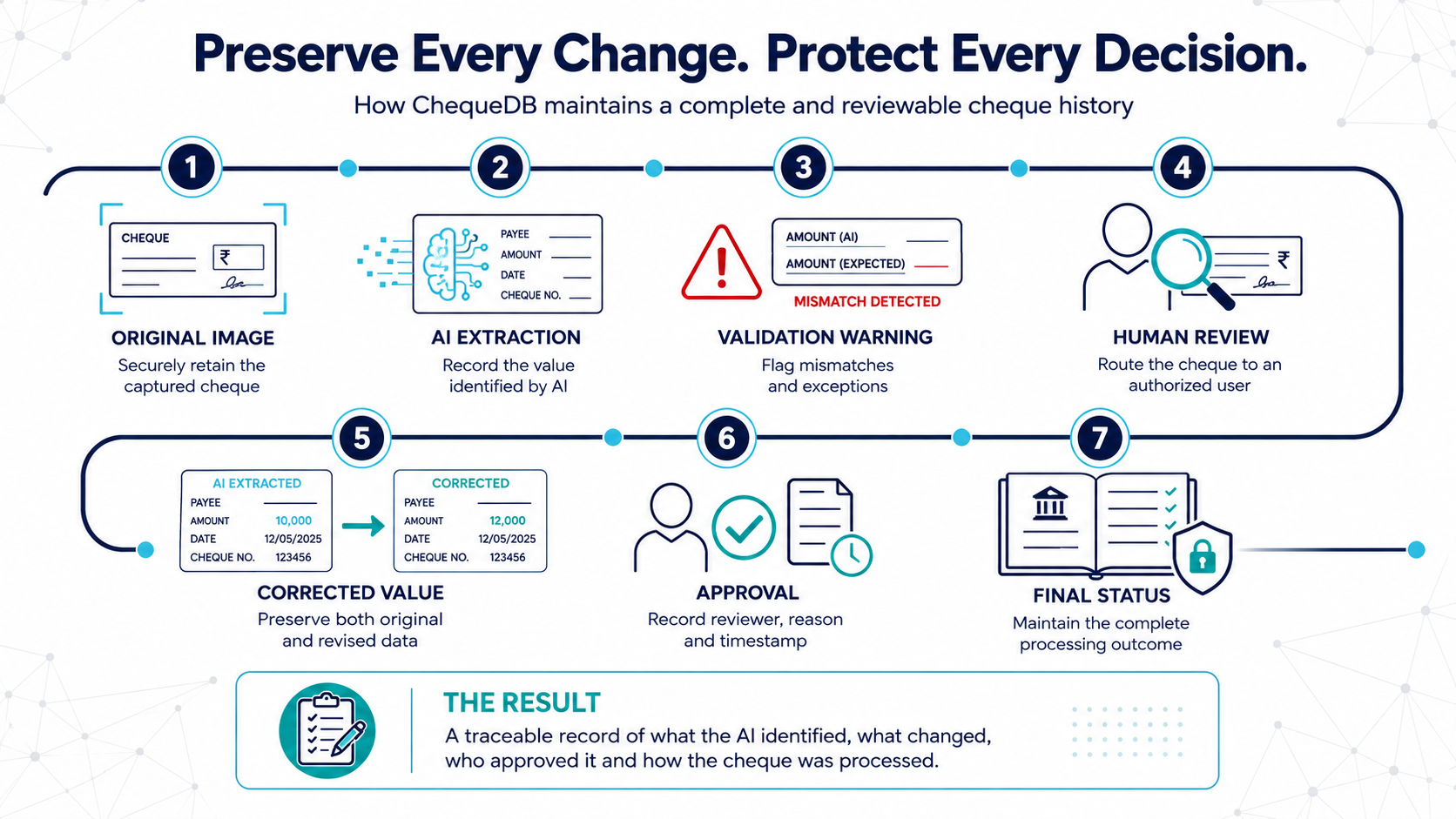
A common audit weakness occurs when an employee corrects extracted information and the system retains only the final value.
Suppose ChequeDB reads a numerical amount as 15,000 while the written amount indicates 75,000. A reviewer checks the image and updates the numerical field. If only the updated value is preserved, an investigator cannot determine whether the discrepancy came from the cheque, the capture quality, the AI extraction or the reviewer.
A stronger record retains:
- The original captured image
- The AI-extracted value
- The validation warning
- The reviewer’s corrected value
- The reason for the correction
- The approving user
- The final processing status
This approach supports investigation, model-quality assessment and operational improvement without allowing the history to disappear when a record is edited.
Role-Based Access and Segregation of Duties
Audit trails are most effective when combined with role-based access control.
ChequeDB includes user management, permissions, user levels and role-based access. These capabilities can be configured so that employees only see and perform actions relevant to their responsibilities.
A bank might establish roles such as:
- Kiosk or branch operator
- Cheque reviewer
- Senior approver
- Operations supervisor
- Fraud investigator
- System administrator
- Auditor
- Read-only compliance user
The same employee should not necessarily be able to capture, edit and approve a high-risk cheque without secondary oversight. This is especially important for high-value deposits, unusual beneficiary changes, signature exceptions or transactions that cross predefined risk thresholds.
Segregation of duties can be reinforced by logging:
- Failed attempts to perform restricted actions
- Approval overrides
- Temporary privilege elevations
- Role and permission changes
- Administrative access
- Emergency or break-glass activity
Logging permission changes is particularly important. An audit trail is incomplete if it records transaction activity but not the administrative actions that determined who was allowed to perform it.
Secure Logging Across Integrations
Cheque processing rarely ends inside one application. ChequeDB may exchange information with:
- Core banking systems
- Customer account platforms
- Signature databases
- KYC services
- Fraud and risk engines
- Image archives
- Clearing systems
- Enterprise reporting platforms
- Case-management applications
A modern REST API makes integration more flexible, but each exchange introduces another point at which data can fail, be duplicated or become difficult to reconcile.
Secure integration logging should capture:
- A unique transaction or correlation ID
- The sending and receiving systems
- The time of the request and response
- The processing status
- Relevant error codes
- Retry activity
- Duplicate-prevention checks
- Reconciliation status
Logs should not expose full authentication tokens, passwords, unmasked account numbers or unnecessary cheque data. Security teams should define which fields are stored, masked, tokenized or excluded.
This is where Wavetec’s full-stack model is valuable. Wavetec develops the kiosk hardware, cheque-processing software, middleware and enterprise monitoring capabilities as part of one connected solution. That makes it easier to design consistent transaction references and operational controls across the physical and digital workflow.
Connecting the Physical Cheque to Its Digital History
Cheque processing remains partly physical even when the workflow is digitized.
Wavetec’s Digital Cheque Deposit Kiosk can include:
- A 15-inch HD touchscreen
- Windows controller
- HD transaction camera
- Secure storage for up to 500 cheques
- OTP-triggered electronic locks
- Alarms and sensors
- An 80 mm thermal receipt printer
- Optional fingerprint authentication
- A single-cheque acceptor
- MICR and UV reading
- TIFF, JPEG and UV image capture
- Cheque endorsement and rear-side printing
This hardware creates additional events that may need to be correlated with ChequeDB, such as:
- Kiosk access
- Cheque insertion
- Acceptance or rejection
- MICR read result
- Image-capture completion
- Endorsement status
- Receipt generation
- Secure-box access
- Door or intrusion alarms
- Device or peripheral failure
The transaction record should connect the physical cheque, captured images, customer receipt, validation result and final backend decision through one consistent reference.
Extending the Same Principles to Deposits and Issuance
The same audit principles apply beyond cheques.
For the WT CQuick24 Bulk Cash Deposit Machine, logs can support traceability across note acceptance, reject handling, deposit confirmation, cash-bag status, user authentication, vault access, device alarms and backend posting.
For account-opening or card-issuance kiosks, logs may cover customer consent, document capture, identity verification, biometric checks, approval steps, card inventory, printing, dispensing, reject-bin activity and transaction completion.
The underlying control questions remain consistent:
- Who initiated the transaction?
- What did the system receive?
- Which controls were applied?
- What exceptions occurred?
- Who changed or approved the record?
- What physical item was accepted or issued?
- Which downstream system received the result?
A consistent logging framework across cheque, deposit and issuance workflows can give the bank a more unified control environment.
From Logging to Actionable Monitoring
Logs create value only when banks can interpret and act on them.
ChequeDB’s backend provides dashboards, processing-status views and queue-based review. Authorized users can monitor:
- Total cheques processed
- Approved and rejected cheques
- Pending reviews
- Processing outcomes
- Transaction details
- Exception categories
- User activity
- Exported cheque data
This information can support real-time operations as well as historical investigation.
AI can add another layer by identifying unusual patterns, such as:
- Repeated corrections by one user
- An unexpected increase in rejected cheques
- Multiple cheque submissions with similar attributes
- Abnormal activity from one kiosk or branch
- Repeated attempts to override approval rules
- Changes in handwriting-recognition confidence
- Unusual access outside normal working patterns
These indicators should support human investigation rather than automatically proving wrongdoing. Explainable alerts, supporting evidence and controlled case handling remain essential.
Wavetec’s Banking Automation Experience
Wavetec combines global delivery experience with in-house ownership of hardware, software, integration and support. The company operates through 11 international offices and has exported its solutions to more than 80 countries.
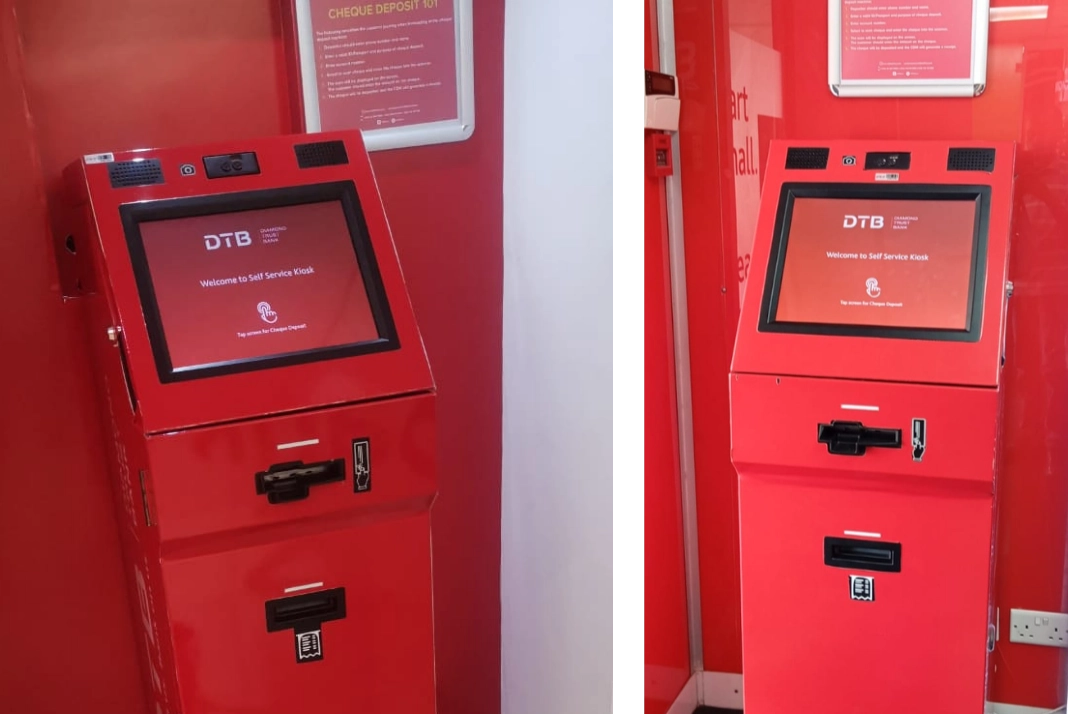
In Kenya, Diamond Trust Bank deployed Wavetec cheque deposit machines integrated with Azimut cheque-processing software. The project introduced self-service cheque deposits alongside account-opening capabilities and strengthened automation, KYC and fraud-detection processes.
Wavetec has also supported large-scale banking transformation programs such as Interbank’s branch modernization in Peru, where centralized software, kiosks, customer identification and enterprise reporting connect physical branch interactions with operational data.
These projects demonstrate Wavetec’s ability to support regulated institutions across different banking processes, deployment architectures and regional requirements.
Wavetec’s enterprise security positioning includes a SOC 2 / ISO 27001 posture, supported by capabilities such as role-based access, audit logging, controlled integrations and centralized monitoring. Final security controls, certifications, data boundaries and retention policies should always be validated against the bank’s jurisdiction and approved architecture.
Secure Audit Trail Checklist
Before implementing ChequeDB, banks should confirm:
- Every transaction has a unique reference across capture, review and integration.
- Original AI-extracted values are preserved when employees make corrections.
- User identities are recorded for approvals, rejections and overrides.
- Role and permission changes are logged.
- Sensitive values are masked or tokenized in operational logs.
- API activity can be correlated with the originating cheque transaction.
- Physical kiosk events can be linked to backend processing records.
- Failed access attempts and security events are retained.
- Log retention matches regulatory and legal requirements.
- Audit access is restricted and monitored.
- Time sources are synchronized across devices and systems.
- Alerts exist for suspicious changes, repeated failures and unusual activity.
- Logs are tested through periodic investigations and control reviews.
- AI model and validation-rule versions can be identified when required.
Conclusion
Secure logging is not an administrative feature added after a banking workflow is automated. It is part of the control architecture that makes automation suitable for regulated financial operations.
ChequeDB brings together multi-channel cheque capture, AI-powered handwriting recognition, configurable validation, review queues, user permissions, dashboards and open integration. When these capabilities are implemented with secure logging, controlled access and well-designed approval workflows, banks gain both operational efficiency and a clearer record of every decision.
The result is a cheque-processing environment where automation remains explainable, exceptions remain reviewable and every important action can be traced from physical capture to final processing.
Contact Wavetec to discuss ChequeDB, Digital Cheque Deposit Kiosks and secure banking automation.
Frequently Asked Questions
What is an audit trail in cheque processing?
An audit trail is a chronological record of the events associated with a cheque, including capture, AI extraction, automated validation, manual corrections, approvals, rejections, integration activity and final status.
Does ChequeDB support role-based access?
Yes. ChequeDB includes user management, permissions, user levels and role-based access capabilities. Banks can configure roles according to their operational, security and approval requirements.
Can ChequeDB record changes made by reviewers?
A secure implementation should preserve the original extracted value, revised value, reviewer identity, timestamp and reason for the change. The exact logging configuration should be agreed during implementation.
Can ChequeDB integrate with existing banking systems?
Yes. ChequeDB is designed to work with existing cheque workflows through REST-based APIs, middleware and established transfer methods such as SFTP.
Can AI make the final cheque-approval decision?
ChequeDB can automate extraction and configurable validation. Banks can determine which transactions are processed automatically and which exceptions require human review based on confidence levels, risk thresholds and internal policies.
BOOK A FREE DEMO