A virtual order queue is a digital system that allows customers to join a service or order queue remotely via smartphone, web, or kiosk without physically waiting in line. Businesses use it to manage demand, reduce congestion, send status updates, and serve customers more efficiently.
Customer expectations for service have shifted permanently. People want convenience, speed, and minimal physical contact. They will not stand in long lines if a better option exists.
Traditional physical queues belong to a different era. They frustrate customers, waste staff time, and drive walkaways.
Whether it is a busy coffee shop at lunch, a pharmacy counter during flu season, or a retail store on Black Friday, the sight of a long line discourages potential customers and damages brand perception.
Virtual order queue systems solve this problem. They allow customers to claim a spot in line remotely, receive real time updates, and arrive exactly when it is their turn.
This approach reduces crowding, improves the customer experience, and helps businesses serve more people with the same staff.
Wavetec provides virtual queuing solutions across retail, healthcare, banking, and government sectors, helping organizations transition from chaotic physical lines to smooth digital flows.
What Is a Virtual Order Queue?
A virtual order queue is a digital system that replaces physical waiting lines with remote queue management. Instead of standing in a line, customers join a queue using their smartphone, a web browser, a self service kiosk, or even a text message.
The system assigns them a virtual ticket number and provides an estimated wait time. As their turn approaches, they receive automated notifications via SMS, app alert, or email. When it is their turn, they are called to the service point.
The key difference from a physical queue is location independence. Customers do not need to be present in the waiting area. They can wait in their car, run an errand, or continue shopping. This flexibility reduces congestion in the service area and improves the customer’s experience.
The business benefits from lower walkaway rates, better staff utilization, and valuable data on customer flow patterns.
Virtual queueing software manages the entire process. It tracks who is in line, how long they have waited, and when they are served. It integrates with digital signage, appointment systems, and customer feedback tools.
For businesses that serve high volumes of walk in customers, a virtual queue is a practical alternative to traditional lines.
How Virtual Order Queuing Works: Step by Step
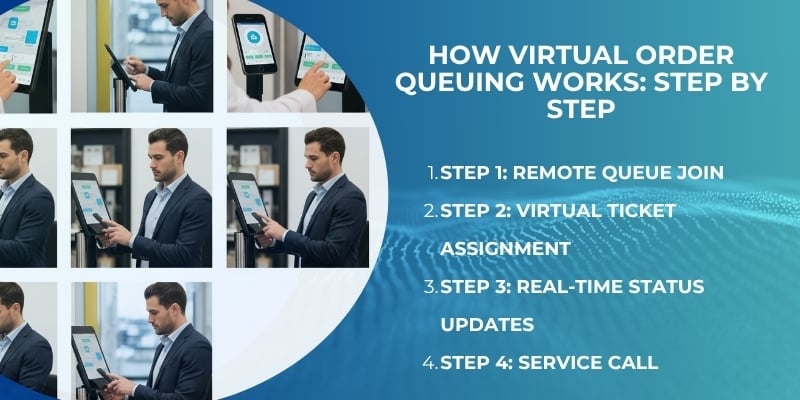
The process is straightforward for both customers and staff. Each step is designed to reduce friction and keep everyone informed.
Step 1: Remote Queue Join
The customer joins the queue from anywhere. They scan a QR code on a store window, visit a website, send a text message, or use a mobile app. Some systems also allow check in via self service kiosk for customers already on site. The join process takes less than 10 seconds.
Step 2: Virtual Ticket Assignment
The system assigns a ticket number and calculates an estimated wait time based on current queue length and average service duration. The customer sees their position and expected wait immediately. This transparency sets clear expectations.
Step 3: Real-Time Status Updates
As the queue moves, the system sends updates. A text message might say “You are now third in line. Estimated wait 5 minutes.” Another message says “Your turn is next. Please proceed to counter 2.” These updates keep customers informed and reduce anxiety.
Step 4: Service Call
When the customer reaches the front of the queue, they are called to a specific counter or service zone. The staff member sees the customer’s name and service request on their screen. The transaction is completed quickly because staff are prepared.
Industries Where Virtual Order Queues Transform Operations
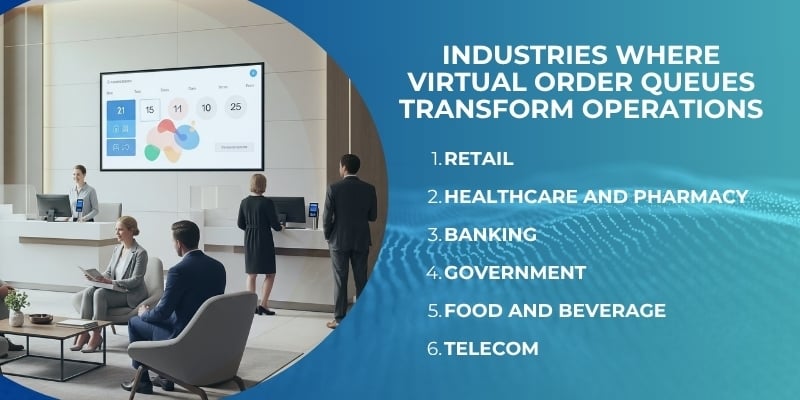
Virtual queuing works across nearly every customer service industry. Each sector adapts the concept to its specific needs. Following are the industries where Wavetec’s Queue Management System is working effectively:
- Retail: Customers join a queue for fitting rooms, service desks, or checkout during peak hours. They can continue shopping while waiting, increasing potential sales.
- Healthcare and Pharmacy: Patients join a virtual queue for prescription pickup or pharmacist consultation. They wait in their car or at home, reducing lobby crowding. Research shows that customers who can wait virtually are 49% more satisfied with their service experience compared to those forced to wait physically in line, significantly improving brand perception.
- Banking: Branch customers join a virtual queue via mobile app before arriving. They receive a notification when a teller is ready, eliminating lobby waits.
- Government: DMV and licensing offices use virtual queuing to manage unpredictable walk in volumes. Citizens join the queue from home and arrive only when their turn approaches.
- Food and Beverage: Quick service restaurants use virtual queues for order pickup during busy periods. Customers order ahead, join the queue, and receive a notification when their food is ready.
- Telecom: Retail stores use virtual queues for device activation and troubleshooting. Customers join remotely and wait elsewhere, freeing up store space.
Virtual Queue vs. Physical Queue: Key Differences
The differences between virtual and physical queues affect every aspect of operations.
- Customer Experience: Physical queues force customers to stand and wait, often in crowded spaces. Virtual queues let customers wait anywhere, reducing frustration.
- Abandonment Rate: Physical queues see high walkaway rates, especially when lines look long. Virtual queues keep customers engaged with updates, reducing abandonment.
- Data Collection: Physical queues provide no data on wait times or customer flow. Virtual queues generate rich analytics on peak periods, average wait, and service duration.
- Staff Efficiency: Physical queues require staff to manage lines and answer “how much longer” questions. Virtual queues automate these tasks, freeing staff for service.
- Scalability: Physical queues are limited by physical space. Virtual queues scale infinitely, handling hundreds of customers without crowding.
- Investment: Physical queues cost nothing to set up but waste time and revenue daily. Virtual queues require software investment but pay back through reduced walkaways and improved throughput.
Key Benefits of a Virtual Order Queue System
Businesses that implement virtual queuing see measurable improvements across customer satisfaction, revenue, and operations.
- Eliminated physical crowding: The service area remains clear and comfortable. Customers who are waiting are not taking up space.
- Reduced walkaway rates: Businesses that deploy virtual queuing solutions see an average 25–35% reduction in customer walkaway rates, directly protecting revenue that would otherwise be lost to queue abandonment. Customers who know their position and wait time are far less likely to leave.
- Improved NPS: Customers rate virtual queue experiences higher because they feel respected. Their time is not wasted standing in line.
- Staff load optimization: Managers see real time queue data and can adjust staffing levels instantly. No more guessing where to put people.
- Analytics and insights: Historical queue data reveals peak hours, average service times, and patterns by day of week. This information supports better scheduling and capacity planning.
Essential Features of a Virtual Order Queue Platform
Not all virtual queue platforms are equal. Look for these capabilities.
- Multi channel join options: Customers should be able to join via QR code, website, SMS, mobile app, or kiosk. Different customers prefer different methods.
- SMS, WhatsApp, and email notifications: Automated updates keep customers informed without requiring them to check a screen. Notifications reduce anxiety and walkaways.
- Real time dashboard: Managers need a clear view of current queue length, wait times, staff status, and service completion rates.
- Appointment integration: Virtual queues should work alongside appointment booking. A customer with an appointment gets priority, but walk-ins are still served.
- Multi location support: A single platform should manage virtual queues across all branches or stores. Centralized reporting and configuration save time.
- Analytics and reporting: Historical data on wait times, abandonment, and service duration supports continuous improvement. Wavetec’s self-service kiosks integrate with virtual queue platforms to provide a seamless check in experience.
Virtual Order Queue and Digital Signage: The Perfect Pairing
Digital signage and virtual queuing work together to create a complete customer communication system. While virtual queues handle remote customers, digital signage manages those who are on site.
Lobby displays show current ticket numbers and estimated wait times for walk in customers who prefer to wait in the building. The display reduces the number of people approaching the counter to ask for status.
Directional signage guides customers to the correct service area when their turn is called. This is especially useful in large stores or multi department facilities.
Queue status boards above each counter show which ticket number is being served, so customers can see progress even if they do not have their phone.
Wavetec’s digital signage solutions integrate directly with virtual queue platforms, ensuring that on screen information matches mobile notifications. This consistency builds trust.
Case Study – Telecom Retailers Eliminates Physical Walk-ins Through Virtual Order Queue
Telecom retailers often experience high customer footfall for SIM services, billing, device support, activations, and account-related queries. During peak hours, unmanaged walk-ins can quickly create congestion, long wait times, and inconsistent customer experiences.
Wavetec’s telecom deployments show how virtual queue management helps operators digitize walk-in traffic and guide customers through a smoother, more transparent service journey.
Orange Sierra Leone – Paperless Virtual Queuing Across 8 Locations
Orange Sierra Leone implemented Wavetec’s virtual queuing solution across 8 locations to manage customer flow without issuing single-use paper tickets. The solution combined Wavetec’s web ticketing system with Orange’s SMS gateway, allowing customers to receive their queue ticket directly on their mobile phones.
Customers arriving at the store shared their mobile number and reason for visit. They then received an SMS with their ticket number, position in line, and estimated wait time. As their turn approached, the system sent another SMS directing them to the correct counter, while digital signage displayed live queue updates inside the branch.
This created a more flexible and paperless journey, reducing physical congestion while keeping customers informed throughout the waiting process. The deployment helped Orange achieve shorter wait times, lower churn, improved customer satisfaction, and more optimized staff allocation.
AsiaCell – Scaling Virtual and Self-Service Journeys Across Telecom Outlets
AsiaCell deployed Wavetec’s queue management and self-service solutions to improve customer flow across its large telecom service network in Iraq. With high customer volumes across branches and franchise outlets, the company needed a centralized system that could reduce complaints caused by service delays and provide better visibility into branch performance.
Wavetec implemented queue management systems across dozens of branches, supported by self-service kiosks for services such as new SIM purchase, SIM swap, bill payment, top-up, line reconnection, roaming bundles, internet bundles, support ticketing, and audio call center assistance.
By digitizing service access and reducing dependency on manual walk-in handling, AsiaCell enabled a more structured and scalable customer journey. Customers could complete common telecom services more efficiently, while management gained real-time visibility into customer arrival rates, staff performance, and branch operations.
Zain Saudi Arabia – Managing High-Volume Retail Traffic with Digital Queue Control
Zain Saudi Arabia used Wavetec’s Electronic Queue Management System across its flagship retail and customer service centers to manage customer flow nationwide. The system supported more than 60 service categories through touchscreen kiosks, allowing customers to select the exact service they required before entering the queue.
Ticket information was displayed across customized screens, counter displays, and digital signage, while staff managed customer calling through web-based teller interfaces. Central reporting enabled senior management to monitor queue performance across remote locations in real time.
This deployment helped Zain transform physical walk-ins into structured digital service journeys. Customers were guided step by step, staff could manage queues more efficiently, and leadership gained visibility into nationwide service performance.
These telecom implementations demonstrate how virtual order queues help retailers reduce physical congestion, improve transparency, and create more controlled service environments.
Frequently Asked Questions About Virtual Order Queue
What is a virtual order queue?
A virtual order queue is a digital system that lets customers join a service line remotely via smartphone, web, or kiosk. They receive real time updates and are called when it is their turn, eliminating the need to stand in a physical line.
How do customers join a virtual queue?
Customers join by scanning a QR code, visiting a website link, sending a text message, or using a mobile app. Some systems also allow check in at a self service kiosk inside the location.
Is a virtual queue system suitable for small businesses?
Yes. Virtual queue platforms are affordable and scalable. A small coffee shop, pharmacy, or boutique can implement a basic system using QR codes and SMS notifications without heavy investment.
Can virtual queues work without a mobile app?
Absolutely. Most virtual queue systems work through web browsers and SMS. Customers do not need to download an app. A simple text message or website link is sufficient.
What industries benefit most from virtual queuing?
Retail, healthcare, banking, government services, food and beverage, and telecommunications all benefit. Any business that experiences peak hour congestion and walk in customers can use virtual queuing.
Author Bio: This article was written by the customer experience team at Wavetec, a global provider of queue management, digital signage, and customer journey solutions. Wavetec has helped over 20,000 businesses across retail, healthcare, banking, and government sectors reduce wait times and improve service efficiency.
Conclusion
Virtual order queues are not a futuristic concept. They are a practical, proven solution for the everyday problem of customer waiting.
By replacing physical lines with digital flow, businesses reduce congestion, lower walkaway rates, and improve satisfaction scores. The technology is mature, the ROI is clear, and the implementation is straightforward.
Customers expect to join queues from their phones. They expect real time updates and the freedom to wait elsewhere.
Wavetec provides virtual queue solutions that work across industries, integrating with kiosks, digital signage, and appointment systems.
Ready to eliminate physical lines? Explore the Wavetec queue management system page and see how virtual queuing can transform your customer experience.
BOOK A FREE DEMO