Cheque processing is no longer just a back-office paper-handling function. It is becoming a controlled digital workflow: image capture, AI cheque verification, fraud scoring, maker-checker approvals, core banking integration, and audit-ready records.
This matters because cheques still carry meaningful financial value even as digital payments grow. The Federal Reserve Payments Study reported that checks paid in the United States declined by volume from 13.6 billion in 2018 to 11.1 billion in 2021, but their value remained roughly stable at $27.44 trillion. The same report found that 52% of consumer and business checks were deposited as images in 2021 – more than double the 2015 share.
For banks, this creates a practical challenge: how do you modernise cheque acceptance without weakening controls?
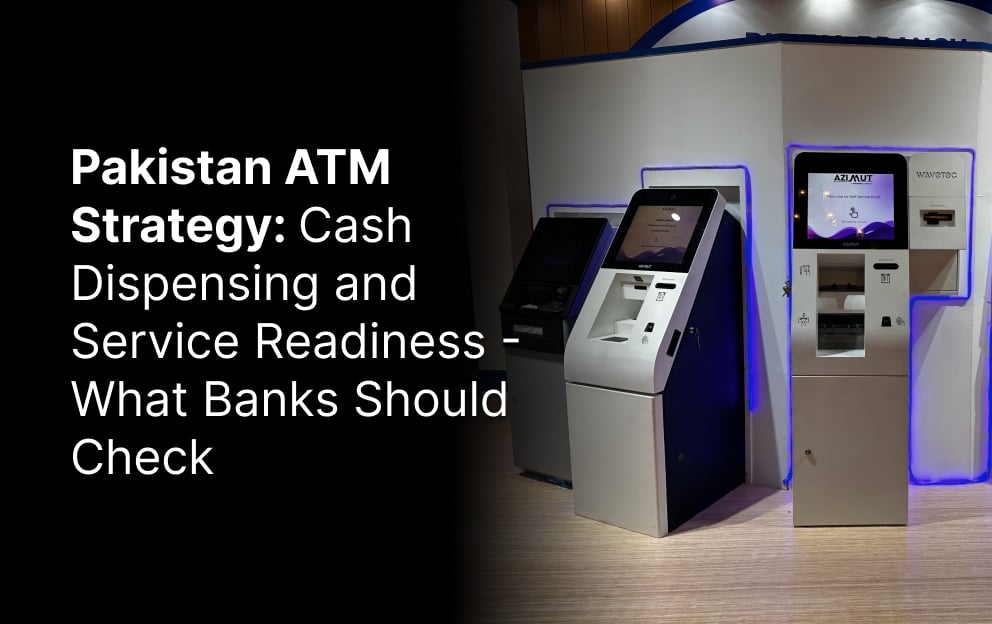
Wavetec’s approach brings cheque acceptance into an enterprise self-service banking environment, combining Cheque Deposit Machines, Azimut EDK Software, AI-assisted cheque recognition, configurable approval workflows, core banking integration, centralized monitoring, and full auditability.
The objective is not to auto-approve every cheque. The objective is to approve the right cheques faster, escalate the risky ones earlier, and make every decision traceable
Why Cheque Acceptance Needs AI Verification
Cheque volumes may be declining in many markets, but the risk has not disappeared. In fact, fraud pressure has made cheque controls more important.
Federal Reserve Financial Services, summarizing the 2025 AFP Payments Fraud and Control Survey, states: “Checks repeatedly top the list of payment methods most susceptible to fraud.” The same survey found that 63% of respondents experienced attempted or actual check fraud in 2024, while 91% still used checks and more than 75% had no immediate plans to stop using them.
That is the operating reality for banks: cheques remain useful, but manual cheque review is slow, inconsistent, and difficult to scale.
AI verification helps by turning cheque acceptance into a structured decision workflow. Instead of relying only on staff inspection, the system can read the cheque image, extract key fields, validate rules, detect exceptions, assign risk scores, and route cheques for automated approval or human review.
The Shift from Paper Cheques to Image-Based Workflows
The global direction is clear: cheque processing is becoming image-based.
In the UK, Pay.UK states that the Image Clearing System enables cheques and credits to be exchanged, cleared, and settled as digital images between participating banks and building societies. In 2023, UK image cheque clearing processed 112.033 million cheques worth £165.127 billion, while the paper clearing system had already been replaced by the Image Clearing System.
This is exactly where AI cheque verification becomes valuable. Once a cheque is captured as an image, banks can apply machine vision, OCR, handwriting recognition, MICR extraction, duplicate detection, signature checks, fraud scoring, and automated approval rules – before the cheque moves deeper into the banking workflow. For a full technical breakdown of how CDM-to-core-banking connectivity works in practice, see Wavetec’s guide on CDM and core banking integration.
The Ideal AI Cheque Acceptance Workflow
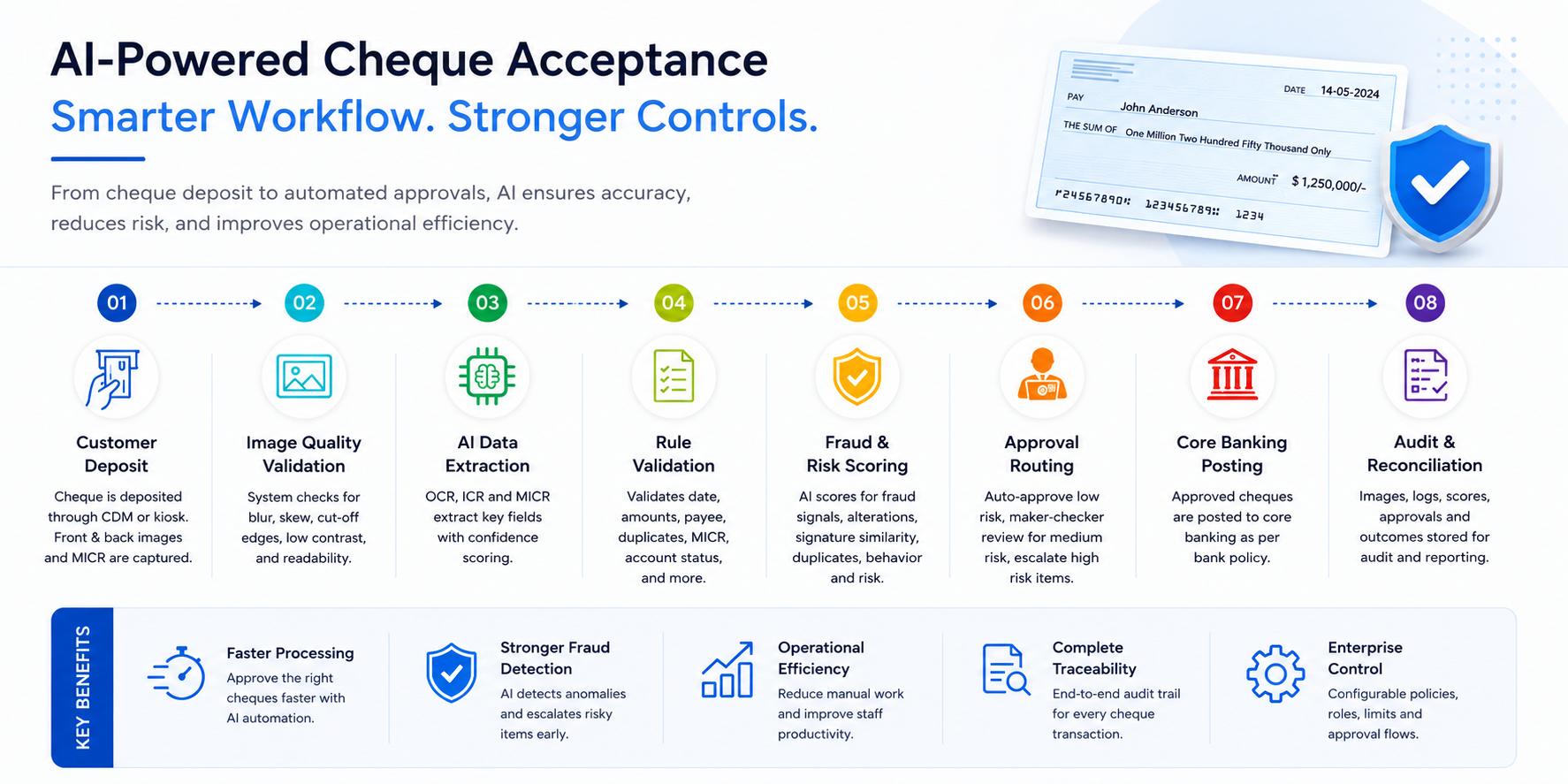
1. Customer Capture
The customer deposits a cheque through a Wavetec Cheque Deposit Machine, self-service banking kiosk, or assisted branch touchpoint. The system captures the front and back image, confirms image quality, reads MICR information, and collects transaction details such as deposit account, cheque number, amount, date, and payee.
This step should be simple for the customer but controlled in the background.
2. Image Quality Validation
Before AI extraction begins, the system checks whether the cheque image is usable. Poor image quality should not enter the approval workflow.
The system should detect:
- Blurred cheque images
- Cut-off edges
- Skewed capture
- Low contrast
- Missing front or back image
- Unreadable MICR line
- Physical damage or suspected tampering
This control reduces downstream errors and prevents poor-quality cheque images from creating manual exceptions later.
3. AI Data Extraction
The AI layer extracts cheque data using OCR, handwriting recognition, MICR reading, and image analysis.
The key fields include:
- Cheque number
- Account number
- Routing or bank code
- Date
- Payee name
- Amount in figures
- Amount in words
- Signature presence
- Endorsement status
- Front and back image references
ChequeDB describes this kind of AI-powered cheque processing as a workflow that automates scanning, OCR and handwriting recognition, fraud detection, approval workflows, and core banking integration, with options for cloud or on-premise deployment.
The critical control here is confidence scoring. The system should not just extract “amount = 25,000.” It should say how confident it is in that extraction. A high-confidence cheque can move forward. A low-confidence cheque should move to review.
The Control Layer: What Banks Should Validate
AI cheque acceptance should be governed by rules that the bank controls.
The most important controls include:
| Control | Purpose |
| Image Quality Check | Ensures the cheque image is clear enough for processing |
| MICR Validation | Confirms cheque/account/bank code readability |
| Date Validation | Flags stale, post-dated, missing-date, or altered-date cheques |
| Amount Matching | Compares amount in words with amount in figures |
| Duplicate Detection | Prevents the same cheque from being deposited more than once |
| Signature Verification | Checks signature presence and similarity where specimen data is available |
| Payee Validation | Confirms payee details against deposit rules |
| Risk Scoring | Assigns low, medium, or high-risk status |
| Maker-Checker Workflow | Routes higher-risk cheques for dual approval |
| Audit Trail | Logs every system and user decision |
This is where banks should avoid a “black box AI” model. AI should assist decisioning, but the final workflow must remain policy-driven, explainable, and auditable.
Automated Approval Logic
The strongest model is not full automation. It is risk-based automation.
A cheque can be auto-approved when:
- Image quality is high
- MICR is readable
- Date is valid
- Amount in words and figures match
- No duplicate is found
- Signature check passes or is within policy
- Cheque value is within auto-approval limit
- AI confidence score is high
- No fraud signal is detected
A cheque should go to maker-checker review when:
- Amount is above threshold
- OCR confidence is low
- Signature score is borderline
- Date appears altered
- Payee name is unclear
- There is a possible duplicate
- Customer or account risk rules require review
A cheque should be blocked or escalated when:
- Duplicate presentment is confirmed
- MICR is invalid
- Amount mismatch is material
- Signature verification fails
- Fraud score is high
- Cheque image appears altered
- Stop-payment or blacklist rules are triggered
This gives banks speed without losing control.
Where Wavetec Fits
Wavetec’s value is not only in the cheque deposit machine. It is in the full-stack banking automation layer around cheque acceptance.
A Wavetec cheque acceptance environment can combine:
- Cheque Deposit Machines
- Azimut EDK Software
- AI-assisted cheque image recognition
- Real-time cheque validation
- Configurable approval workflows
- Core banking integration
- Customer receipts and notifications
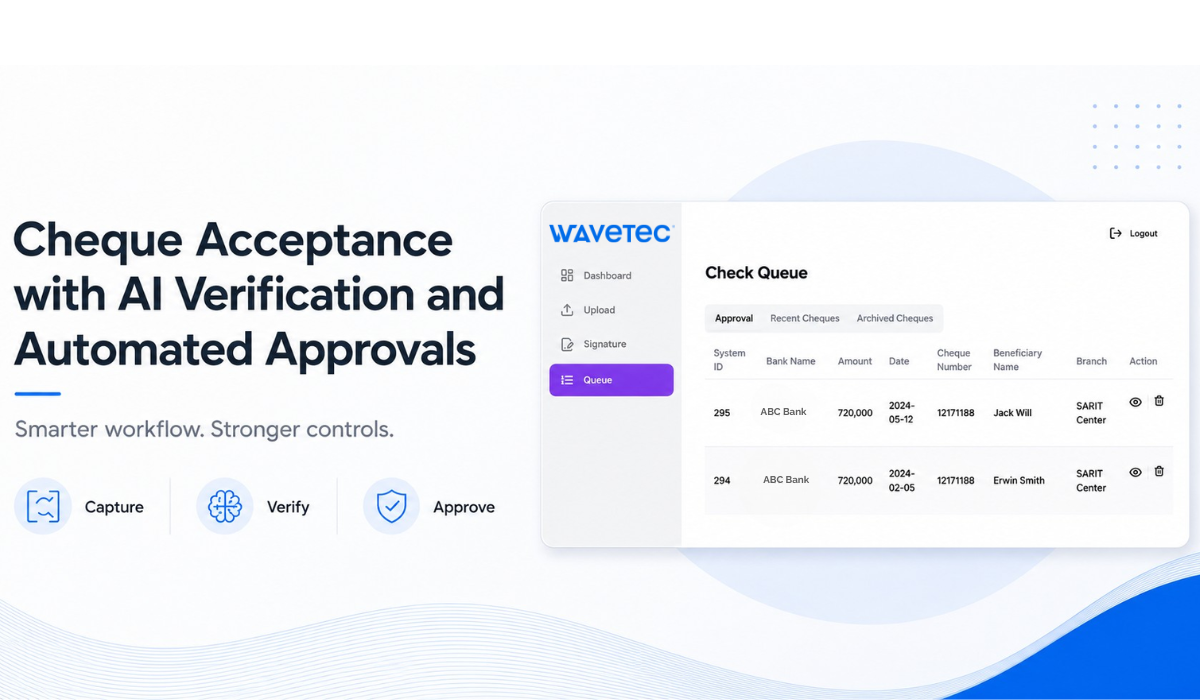
- Back-office review queues
- Centralized monitoring
- Reporting dashboards
- Audit logs and exception history
This aligns with Wavetec’s broader positioning across digital banking: innovation-first banking automation delivered through in-house hardware, in-house software, enterprise-grade governance, global deployment capability, and local implementation support.
Real-World Deployment: Diamond Trust Bank Kenya
A live example is Diamond Trust Bank Kenya, where Wavetec deployed 5 Cheque Deposit machines across 5 locations. The solution integrated Wavetec self-service kiosks with Azimut EDK Software and delivered real-time cheque processing, KYC-enabled account opening, reduced manual intervention, and stronger cheque deposit operations. Other solutions that Wavetec has offered to its clients namely DU Telecom and United Bank Limited (UBL) also possess Cheque Deposit Capabilities.
Why This Matters for Banking Leaders
For operating executives, AI cheque acceptance can reduce branch pressure, speed up routine deposit handling, improve customer convenience, and shift staff away from repetitive verification tasks. Banks that have moved to after-hours self-service banking report that a significant share of cheque deposits now happen outside traditional branch hours, making automated processing essential, not optional.
For technical evaluators, the value is in the architecture: secure image capture, OCR and handwriting recognition, MICR extraction, confidence scoring, fraud rules, maker-checker controls, API integration, audit trails, and data-residency options.
McKinsey estimates that generative AI could create $200 billion to $340 billion in annual value for banking, equivalent to 9% to 15% of operating profits, largely through productivity gains. Cheque acceptance is one of the workflow categories where that productivity logic applies because it is document-heavy, rule-driven, and exception-based.
Recommended Workflow Architecture
A strong cheque acceptance architecture should include the following layers:
- Customer Layer
The customer deposits the cheque through a self-service banking kiosk, CDM, assisted branch station, or mobile capture channel. - Capture Layer
The system captures cheque images, validates image quality, reads MICR, and creates the initial transaction record. - AI Cheque Verification Layer
OCR, handwriting recognition, signature checks, amount matching, duplicate detection, and fraud scoring are applied. - Rules & Controls Layer
Bank-defined policies determine whether the cheque moves to auto-approval, maker-checker review, fraud review, or rejection. - Integration Layer
Approved transactions connect with core banking, notification systems, clearing systems, and document archives. - Monitoring & Governance Layer
Dashboards track transaction volume, exception rates, approval time, fraud flags, user actions, and device health.
This turns cheque acceptance from a branch task into an enterprise-controlled workflow.
Key Definitions
| Term | Meaning |
| Cheque Acceptance | The process of receiving and validating a cheque through a branch, kiosk, or digital channel. |
| AI Verification | Use of AI to read cheque images, extract fields, detect mismatches, and assign risk scores. |
| OCR | Optical Character Recognition used to read printed cheque fields. |
| ICR | Intelligent Character Recognition used to read handwritten cheque fields. |
| MICR | Machine-readable cheque code line used for cheque, account, and bank identification. |
| Maker-Checker | Dual-control approval where one user reviews and another authorizes. |
| Straight-Through Processing | Automated processing without manual intervention when all checks pass. |
| Exception Queue | A controlled workflow for cheques requiring manual review. |
Key Takeaways
Cheque acceptance is not disappearing. It is becoming more digital, more image-based, and more control-driven.
AI Cheque verification helps banks automate routine cheque handling while escalating risky items earlier.
The strongest workflow combines image capture, AI extraction, fraud scoring, configurable rules, maker-checker approvals, core banking integration, and audit logs.
Wavetec’s cheque acceptance ecosystem brings this into self-service banking through Cheque Deposit Machines, Azimut EDK Software, monitoring dashboards, and enterprise workflow integration.
The right model is not “AI approves everything.” The right model is AI-assisted controls with automated approvals where risk is low, and human oversight where risk is high.
Frequently Asked Questions
What is AI cheque verification?
AI cheque verification uses image analysis, OCR, handwriting recognition, MICR reading, signature checks, duplicate detection, and fraud scoring to validate cheque information before approval or posting.
Can AI approve cheques automatically?
Yes, but only under bank-defined rules. Low-risk cheques with clean images, valid MICR, matched amounts, high confidence scores, and no fraud flags can be auto-approved. Higher-risk cheques should move to maker-checker review.
What makes Wavetec’s approach different from basic cheque scanning?
Basic scanning captures an image. Wavetec’s approach supports a full cheque acceptance workflow: self-service capture via Cheque Deposit Machines, AI-assisted validation using Azimut EDK Software, approval routing, back-office integration, reporting, centralized monitoring, and audit trails.
What controls should banks apply before approving cheques?
Banks should apply image quality validation, MICR checks, date validation, amount matching, duplicate detection, signature verification, payee validation, risk scoring, approval thresholds, maker-checker routing, and audit logging.
Why is cheque automation still relevant?
Cheque volume may be declining, but cheque value and fraud exposure remain significant. That makes automation valuable not only for speed, but also for control, traceability, and operational efficiency in digital banking environments.
Author: Clinton John, Asistant Brand Manager – Wavetec
BOOK A FREE DEMO