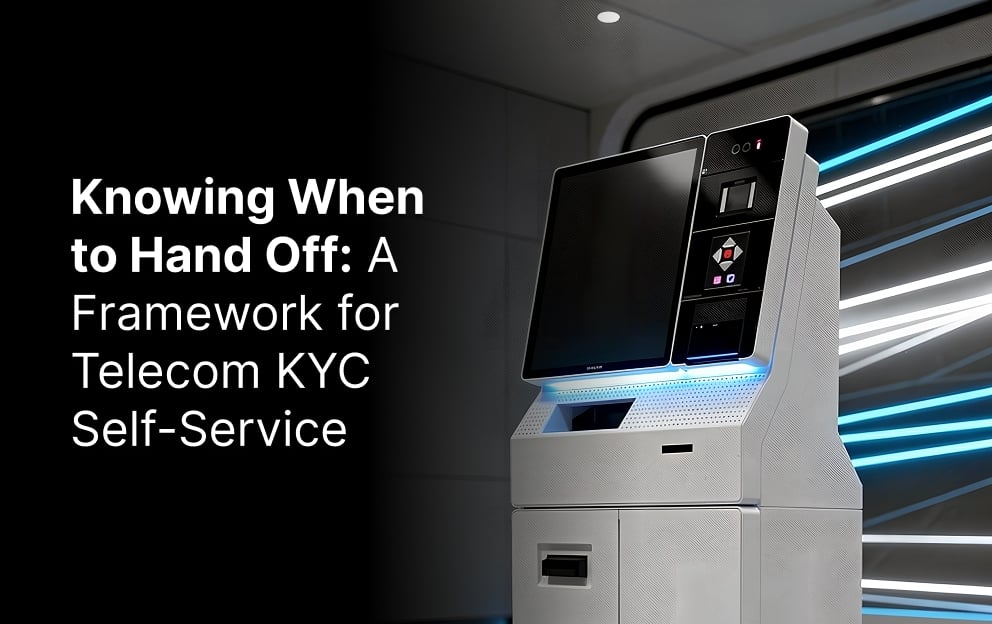
A customer feedback kiosk is a physical or digital terminal placed at the point of service, at a branch exit, counter, or waiting area, that captures immediate customer satisfaction ratings after an interaction. Unlike survey emails, feedback kiosks capture honest, in-the-moment sentiment with response rates significantly higher than traditional form-based methods.
A customer leaves a bank branch. They have just been helped with a loan application. The experience was good, not great. They walk to their car and drive away.
Later that day, an email arrives: “How was your experience?” They delete it. Or they click through, but the moment has passed. The emotion has faded.
The feedback, if they give any, is a pale reflection of what they felt at the counter. This is the failure of traditional survey forms. They arrive too late. They capture the memory of an experience, not the experience itself.
SurveySparrow’s 2025 benchmark analysis shows that current email-based customer surveys achieve 15–25% response rates on average. This means that 75–85% of customers are not heard at all. Those who do respond are often the extremes: very happy or very unhappy. The middle, where most customers sit, is silent.
Real-time customer feedback kiosks solve this problem. They capture sentiment at the moment of service, when the experience is fresh and honest. They achieve response rates of 85–95%, providing a dramatically more representative and actionable data set.
Wavetec’s self-service kiosks include integrated feedback capture capabilities that close the loop between service and satisfaction.
Why Traditional Survey Forms Are Failing CX Teams
Traditional surveys suffer from four fundamental problems that make them increasingly inadequate for modern CX management.
- Low response rates are the most visible failure. Email survey response rates of 15–25% mean that the vast majority of customers are not providing feedback. This creates a data set that is statistically unreliable. Decisions based on a quarter of your customer base are decisions made in the dark.
- Time-lag bias distorts the data. A customer who waits three hours to fill out a survey is not reporting on their experience at the moment. They are reporting on their memory of the experience, filtered through subsequent interactions, mood, and time. This memory is often less accurate and less actionable than immediate feedback.
- Self-selection bias means that the people who respond to surveys are not representative of the broader customer base. Very happy customers want to praise. Very unhappy customers want to complain. The middle, where most customers sit, is silent. This creates a feedback loop that overrepresents extremes and underrepresents the typical experience.
- Inability to act on delayed data is the final failure. A survey response that arrives three days after a negative experience is too late for service recovery. The customer has already left, perhaps permanently. The opportunity to fix the problem and retain the customer is gone.
What Is a Customer Feedback Kiosk?
A customer feedback kiosk is a physical or digital terminal placed at the point of service that captures immediate customer satisfaction ratings after an interaction.
Unlike survey emails that arrive hours or days later, feedback kiosks are present at the moment of service completion. They capture sentiment while it is still fresh.
Feedback kiosks come in several forms.
- Physical terminals are units placed at branch exits, service counters, or waiting areas.
- Tablet-based kiosks are mounted on counters or stands, offering a familiar touch interface.
- Screen prompts integrated into digital signage or self-service kiosks present feedback questions as part of the service flow.
- Mobile feedback options allow customers to scan a QR code and complete the survey on their own phone.
The common thread is immediacy. The customer provides feedback at the point of experience, before they have left the building or moved on to the next task. This captures honest, unfiltered sentiment that is far more valuable than delayed survey responses.
How Real-Time Feedback Kiosks Work
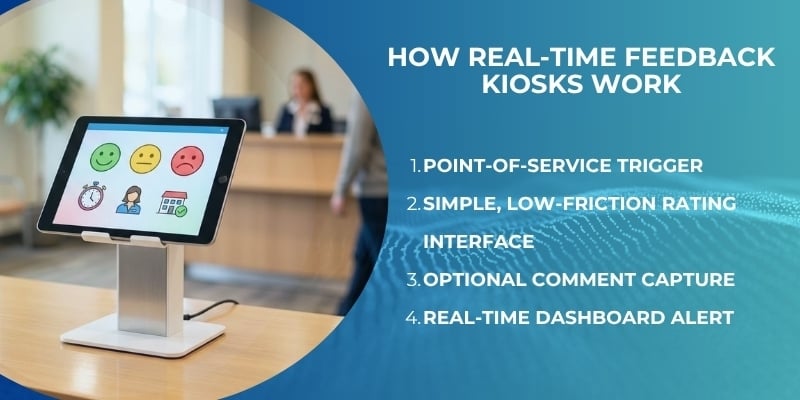
The feedback kiosk experience is designed to be simple, fast, and frictionless. The goal is to capture honest sentiment without burdening the customer.
Point-of-Service Trigger
The kiosk prompts the customer immediately after service completion. This might be at the counter after a transaction, at the exit as the customer leaves, or on a digital screen as part of the check-out flow. The timing is critical: immediate capture yields the most accurate data.
Simple, Low-Friction Rating Interface
The rating interface uses a simple format that maximises response rate by minimising effort. A 1–5 star rating, emoji-based selection (happy face to sad face), or thumbs-up/thumbs-down format takes seconds to complete. Customers are far more willing to provide feedback when the process is quick and intuitive.
Optional Comment Capture
For customers who want to explain their rating, an optional text field or voice note option is available. This captures the “why” behind the rating.
- What specifically went wrong?
- What made the experience exceptional?
This qualitative data is invaluable for service improvement.
Real-Time Dashboard Alert
When a negative rating is submitted, the system triggers an immediate manager notification. The branch manager receives an alert on their dashboard or mobile device. They can intervene before the customer leaves, apologising, addressing the issue, and recovering the relationship. This real-time capability is a direct retention mechanism.
The Business Case for Real-Time Feedback Over Surveys
The business case for real-time feedback kiosks rests on four pillars: response rate, actionability, response speed, and recall accuracy.
- Response rate is the most dramatic difference. Traditional email surveys achieve 15–25% response rates. In-person point-of-experience collection achieves completion rates of 85–95%. This means that feedback kiosks capture data from nearly all customers, not just a self-selected minority. The data is statistically reliable and representative.
- Actionability is the second advantage. Real-time feedback arrives while the experience is still fresh. If a customer reports a problem, the business can act immediately. If a trend emerges, it can be addressed before it becomes systemic.
- Response speed matters for retention. Harvard Business Review’s analysis of Bain & Company loyalty research shows that organisations which respond to negative customer experiences within 24–48 hours recover the customer relationship in approximately 70% of cases. Real-time feedback capture enables response times measured in minutes, not days.
- Recall accuracy is the final advantage. Customers who provide feedback immediately after service report accurately on their experience. Customers who wait hours or days report on their memory, which is filtered and less reliable.
Integrating Feedback Kiosks with Queue Management Systems
Feedback kiosks are most effective when they are integrated with the queue management system. This integration makes feedback capture automatic and seamless.
The service journey follows a natural sequence: check-in, wait, service, feedback.
The queue management system tracks each step. When service is completed, the system triggers a feedback prompt. The customer is invited to rate their experience before they leave.
This integration ensures that feedback is captured consistently for every customer. There is no need for staff to remember to ask. There is no gap between service and feedback. The process is automatic and reliable.
Integration also enables segmentation. The system knows which service type, which staff member, and which branch the customer visited. Feedback can be analysed by these dimensions, revealing patterns that would otherwise be invisible.
Wavetec’s queue management system includes integrated feedback capture, making it easy to collect and act on real-time customer sentiment.
Feedback Analytics: Turning Real-Time Ratings into Service Improvements
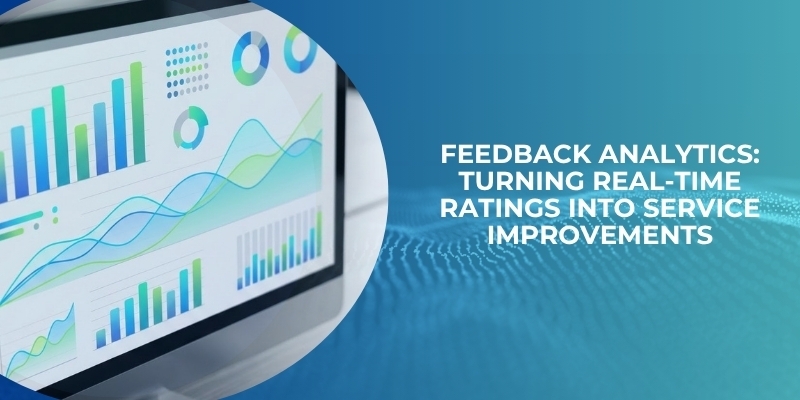
Collecting feedback is only the first step. The real value comes from analysing and acting on the data.
An analytics dashboard provides visibility across multiple dimensions.
- Branch-level performance shows which locations are excelling and which are struggling.
- Staff-level performance identifies top performers and those who need additional training.
- Service-type performance reveals which transactions generate the highest and lowest satisfaction.
- Time-of-day analysis shows when satisfaction peaks and dips.
Trend analysis tracks performance over time. Is satisfaction improving or declining? Are specific issues recurring? This data supports continuous improvement.
Negative rating heatmaps show where problems are concentrated. If a particular branch consistently receives low ratings for wait time, the solution might be additional staffing or queue management improvements. If a particular staff member consistently receives low ratings, the solution might be additional training or coaching.
Manager escalation workflows ensure that negative feedback is addressed promptly. When a rating falls below a threshold, an alert is sent to the appropriate manager. The manager can view the feedback, contact the customer if needed, and document the resolution.
Industries Where Feedback Kiosks Deliver the Most Value
Feedback kiosks are valuable across industries where in-person service is delivered.
- Banking: Branches use feedback kiosks at exits and counters to capture satisfaction after transactions. The data reveals which branches need improvement and which staff members excel.
- Healthcare: Clinics and hospitals use feedback kiosks in waiting areas and at check-out to capture patient satisfaction. The data supports patient experience improvement and regulatory reporting.
- Retail: Stores use feedback kiosks at checkout and service desks to capture satisfaction. The data reveals operational issues and training needs.
- Government services: DMV and licensing offices use feedback kiosks to capture citizen satisfaction. The data supports service improvement and accountability.
- Telecom retail: Carrier stores use feedback kiosks at counters and exits to capture satisfaction after device activations, contract renewals, and troubleshooting.
FAQs
What is a customer feedback kiosk?
A customer feedback kiosk is a physical or digital terminal placed at the point of service that captures immediate customer satisfaction ratings.
It uses a simple interface such as stars or emojis and is integrated with queue management systems to trigger feedback prompts automatically.
Why do feedback kiosks have higher response rates than surveys?
Feedback kiosks capture feedback immediately after service, when the experience is fresh and the customer is still present.
The interface is simple and takes seconds to complete. In contrast, email surveys arrive hours later, are easily ignored, and take more effort to complete.
How do real-time feedback kiosks integrate with queue management systems?
Integration is achieved through APIs that connect the feedback kiosk to the queue management platform.
When a service interaction is completed, the queue system triggers a feedback prompt. The response is linked to the service record, enabling segmentation by branch, staff, service type, and time.
What metrics can a customer feedback kiosk track?
Feedback kiosks typically track CSAT (Customer Satisfaction Score) through star ratings or emojis. They can also collect NPS (Net Promoter Score) through the “likelihood to recommend” question.
Optional comment fields capture qualitative data. All metrics can be segmented by branch, staff, service type, and time.
How quickly can managers see and act on feedback kiosk data?
Managers can see feedback data in real time through a dashboard. When a negative rating is submitted, an immediate alert is sent to the manager.
The manager can view the feedback, contact the customer, and address the issue before the customer leaves.
Author Bio: This article was written by the customer experience solutions team at Wavetec, a global provider of queue management, digital signage, and feedback capture platforms. Wavetec helps organisations across banking, healthcare, retail, and government sectors collect real-time feedback and drive service improvement.
Conclusion
Real-time customer feedback kiosks have superseded survey forms as the gold standard for CX measurement.
- They capture honest, in-the-moment sentiment with response rates of 85–95%, compared to the 15–25% typical of email surveys.
- They enable immediate service recovery, turning negative experiences into retention opportunities.
- They provide data that is statistically reliable, actionable, and timely.
For organisations serious about customer experience, the choice is clear: feedback kiosks deliver better data, faster responses, and more meaningful insights.
Wavetec’s integrated feedback and queue management platform makes it easy to collect, analyse, and act on customer sentiment.
BOOK A FREE DEMO