An AI appointment scheduling system uses machine learning and behavioral data to automate booking, send predictive reminders, and optimize service slot allocation. By identifying no-show risk patterns and triggering personalized follow-ups, it significantly reduces missed appointments and maximizes operational capacity.
No-shows and walk-aways are silent revenue killers. A patient books a specialist appointment and never arrives. A banking customer schedules a loan consultation but fails to show. A retail client checks in for service, then leaves because the wait is too long.
Each missed appointment represents lost revenue, wasted staff time, and a frustrated customer who may not return.
Traditional appointment booking systems do little to prevent these losses. They send basic reminders, but cannot predict which customers are likely to cancel or simply not show. They also fail to connect with real-time queue management, so customers who do arrive often face unexpected waits.
AI appointment scheduling system technology changes this.
By applying machine learning to booking behavior, these systems identify high-risk appointments, trigger personalized interventions, and dynamically optimize service slots.
For healthcare clinics, bank branches, government offices, and retail service centers, AI scheduling reduces no-shows by up to 29% and improves staff utilization by over 30%.
Wavetec integrates AI scheduling with its queue management system to create a complete solution for appointment-based and walk-in service environments.
The No-Show and Walk-Away Problem: Why It Costs More Than You Think
Service businesses face two distinct but related problems.
- No-shows are appointments that customers book but never attend.
- Walk-aways are customers who arrive but leave before service because the wait is too long.
Both drain revenue and damage customer relationships.
The scale of the problem is substantial. No-show rates in service industries average between 20–30%, costing businesses thousands in lost revenue per week.
A medical practice losing 25% of appointments leaves exam rooms empty and physicians idle while patients on waiting lists go untreated. A bank branch with high no-show rates wastes loan officer time that could be used for walk-in business.
Walk-aways are equally damaging.
A customer who walks into a store or clinic, sees a long line, and leaves may never return. They may go to a competitor. They may complain on social media. Even customers who wait but experience unexplained delays are far less likely to book again.
Traditional systems cannot solve these problems. They send generic reminders that customers ignore. They cannot predict which appointments are at risk. They have no way to adjust booking availability based on real-time service capacity.
As a result, businesses accept high no-show rates as a cost of operation. But with AI, that acceptance is no longer necessary.
What Makes AI Appointment Scheduling Different from Traditional Systems?
Traditional appointment scheduling is reactive. It records bookings, sends basic email or SMS reminders, and tracks cancellations. The system does not learn from past behavior. It does not identify patterns. It treats every appointment the same.
AI appointment scheduling is proactive and adaptive. It uses machine learning to analyze historical booking data, customer behavior, and service patterns. Over time, the system identifies which factors predict no-shows: a customer who has missed appointments before, a time slot with historically low attendance, a service type with high cancellation rates.
Based on these predictions, the AI system triggers different actions. A high-risk appointment might receive an additional reminder or a personalized message asking the customer to confirm. A low-risk appointment might receive a standard reminder. When a cancellation occurs early, the system can automatically offer the slot to waiting list customers.
AI systems also integrate with real-time service data. If the queue is running behind schedule, the system can automatically notify upcoming appointments of the delay and offer rescheduling options. This prevents customers from arriving and finding an unexpected wait, reducing walk-aways.
Core AI Features That Reduce No-Shows
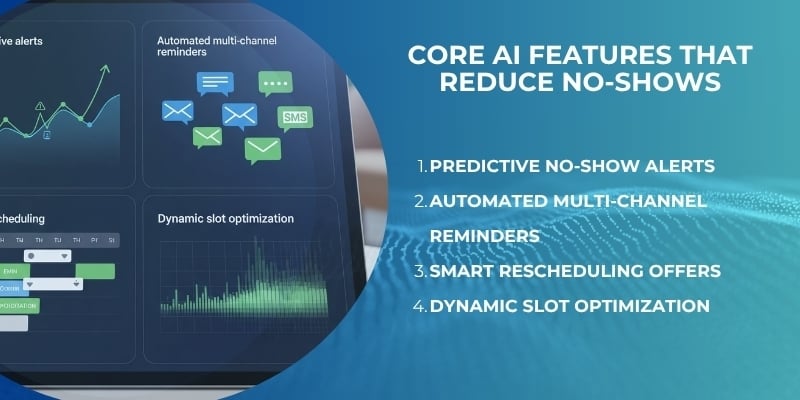
AI scheduling systems include several specific capabilities that directly reduce missed appointments.
Predictive No-Show Alerts
The system uses machine learning models trained on historical appointment data. It analyzes variables such as customer history, appointment type, day of week, time of day, lead time between booking and appointment, and even weather patterns.
Each appointment receives a risk score. When the score exceeds a configurable threshold, the system triggers an alert. Staff can see which upcoming appointments are most likely to no-show and intervene proactively.
Automated Multi-Channel Reminders
Generic reminders sent at the same time to every customer are not effective. AI systems send personalized reminders based on individual customer preferences and response patterns.
A customer who always opens WhatsApp messages but ignores emails receives a WhatsApp reminder. A customer who booked through a mobile app receives an app notification. Reminder timing is also optimized based on when the customer is most likely to read it.
Smart Rescheduling Offers
When a cancellation is detected, the AI system can automatically offer the freed slot to customers on a waiting list.
The system selects candidates based on their service urgency, appointment history, and location proximity. The offer is sent via the customer’s preferred channel, and the slot can be rebooked without staff intervention.
Dynamic Slot Optimization
Traditional systems have fixed appointment lengths. An AI system learns actual service times from historical data. It can allocate shorter or longer slots based on the specific service and customer history. This increases daily capacity without adding staff hours.
How AI Reduces Walk-Away Rates During Service Delivery
No-shows are not the only problem. Walk-aways happen when customers arrive, see a long wait, and leave. This is common in environments that mix appointments with walk-ins or where service times are unpredictable.
AI scheduling connects appointment booking with real-time queue management.
When a customer books an appointment, the system reserves a place in the service queue. But if earlier appointments run long, the system updates the estimated wait time and notifies the customer before they arrive. They can reschedule or adjust their arrival.
Businesses using AI scheduling tools report 23% higher booking completion rates and a 31% improvement in staff utilization compared to those relying on manual appointment processes. The integration with live queue data is key. A customer who knows exactly when they will be served is far less likely to walk away.
Wavetec’s customer journey management platform bridges appointment scheduling and queue management, ensuring that booked customers are served on time and walk-ins are integrated fairly.
Industry Applications of AI Appointment Scheduling
Different industries face different no-show challenges, and AI scheduling adapts to each.
- Healthcare: Clinics and hospitals have the highest no-show rates. AI scheduling identifies patients with a history of missed appointments and triggers extra reminders. It can also prioritize high-risk patients for confirmation calls. Stat 1 is particularly relevant here.
- Banking: Loan officers and advisors have valuable time. AI scheduling reduces no-shows for consultation appointments, and smart rescheduling fills cancelled slots from waiting lists.
- Government: Licensing offices and service centers use AI scheduling to manage appointment-based services. The system learns peak demand patterns and adjusts available slots accordingly.
- Retail: Service desks, repair centers, and fitting rooms use AI scheduling to manage appointments alongside walk-ins. The system predicts walk-in volume and reserves appropriate staff capacity.
- Fitness and wellness: Gyms, spas, and salons use AI scheduling to reduce last-minute cancellations and no-shows. Automated reminders and easy rescheduling options improve attendance.
Integrating AI Scheduling with Queue Management Systems
Appointment scheduling and queue management are often separate systems. This creates problems.
A customer with an appointment may arrive to find a long line of walk-ins being served first. A walk-in may be delayed because appointment slots are not visible to the queue system.
Integration solves these problems. When a customer books an appointment, the queue management system reserves a place in line. The estimated wait time for that appointment is calculated based on real-time queue conditions. If the queue becomes congested, appointment holders are protected.
At arrival, customers check in at a self-service kiosk. The kiosk recognizes their appointment and adds them to the correct queue. Staff see the customer’s name and service request. The entire experience is seamless.
Wavetec’s self-service kiosks integrate with AI scheduling, allowing customers to check in for appointments, join walk-in queues, or book future appointments on the spot.
Case Study – Private Clinic Reduces No-Shows in Healthcare with AI Scheduling
Private clinics manage a mix of scheduled appointments, walk-ins, triage cases, consultations, and follow-up visits.
Without an intelligent scheduling and queue management process, patients may miss appointments, arrive at the wrong time, or leave due to unclear wait expectations.
Wavetec’s healthcare deployments show how digital appointment workflows, real-time notifications, and queue integration help reduce no-shows and improve patient flow.
Nahdi Care Clinics – Reducing Missed Visits with WhatsApp-Based Patient Updates
Nahdi Care Clinics partnered with Wavetec to streamline patient flow and improve the overall clinic experience.
The solution integrated Wavetec’s Spectra API with Nahdi’s Hospital Information System, enabling a connected journey from check-in to triage, doctor consultation, and feedback collection.
Patients received WhatsApp updates throughout their visit, including queue status, turn notifications, room guidance, and post-service feedback messages.
The workflow-based ticketing system automatically transferred patients from triage to the assigned doctor, reducing confusion and improving service continuity.
This approach supports AI scheduling principles by keeping patients informed, reducing uncertainty, and ensuring that appointment and queue data work together to prevent missed visits and walk-aways.
Liberty Regional Medical Center – Improving Attendance Through Integrated Check-In and SMS Alerts
Liberty Regional Medical Center implemented Wavetec’s Queue Management System to improve patient management and reduce long waiting times. The solution included self-service kiosks, SMS notifications, integration with the patient information system, and analytics dashboards.
Patients checked in through kiosks and received estimated wait times via SMS. Because the system was integrated with hospital operations, patient information was ready before they reached the service point, reducing delays and improving throughput.
The implementation reduced average wait times by over 30%, improved patient satisfaction, and enabled better staff allocation.
For appointment-based healthcare environments, this type of integrated scheduling and queue visibility helps reduce walk-aways by giving patients accurate updates and a clearer service journey.
Villa Betania Clinic – Preparing for Appointment-Driven Patient Flow
Villa Betania Clinic in Rome deployed Wavetec’s queue management ecosystem to simplify patient movement across multiple healthcare departments.
The solution included self-service kiosks, multilingual WhatsApp queuing, grouped digital signage, and Spectra analytics.
The clinic planned a phased rollout, with web appointment integration included in the next phase. This made the system flexible enough to support future appointment-based workflows, where patients can check in digitally, receive updates, and be routed to the right department with minimal manual coordination.
By combining queue visibility, multilingual communication, and future appointment integration, Villa Betania created the foundation for intelligent scheduling that can reduce no-shows, improve arrival accuracy, and enhance patient experience.
These healthcare deployments show that reducing no-shows is not only about sending reminders. It requires a connected scheduling and queue management ecosystem.
FAQs About AI Appoinment Scheduling System
What is an AI appointment scheduling system?
An AI appointment scheduling system uses machine learning to automate booking, predict no-show risks, send personalized reminders, and optimize service slot allocation. It learns from historical data to reduce missed appointments and improve staff utilization.
How does AI predict which appointments will result in no-shows?
The AI analyzes historical appointment data including customer history, appointment type, lead time, day of week, and other variables. It identifies patterns associated with no-shows and assigns a risk score to each new booking. High-risk appointments trigger additional reminders or confirmation requests.
Can AI scheduling work for walk-in businesses?
Yes. AI scheduling can be used alongside walk-in traffic. The system predicts walk-in volumes based on historical patterns and allocates staff capacity accordingly. It can also offer appointment options during peak hours to reduce walk-in congestion.
What reminder channels does AI scheduling typically use?
AI scheduling systems support multiple channels including SMS, WhatsApp, email, push notifications from mobile apps, and automated voice calls. The system selects the channel based on the customer’s past response behavior and stated preferences.
How long does it take to implement an AI scheduling system?
Basic AI scheduling with automated reminders can be deployed in days or weeks. Full predictive modeling requires 3–6 months of historical appointment data to train the machine learning algorithms. Most providers offer phased implementation.
Author Bio: This article was written by the customer experience technology team at Wavetec, a global provider of AI-driven queue management, appointment scheduling, and digital signage solutions. Wavetec has helped over 20,000 businesses across healthcare, banking, retail, and government sectors reduce wait times and improve operational efficiency.
Conclusion
No-shows and walk-aways are not inevitable. An AI appointment scheduling system turns missed appointments from a cost of doing business into a solvable operational problem.
By predicting which bookings are at risk, sending personalized reminders, and dynamically reallocating cancelled slots, AI reduces no-shows by nearly 30% and improves staff utilization by over 30%.
For healthcare clinics, bank branches, government offices, and retail service centers, the financial impact is substantial. The technology exists. The data supports it. The only question is whether your organization will continue to accept preventable revenue loss or adopt intelligent scheduling that works.
Wavetec provides AI appointment scheduling integrated with queue management, self-service kiosks, and digital signage. Ready to reduce no-shows and walk-aways? Explore the Wavetec queue management system page to learn more.
BOOK A FREE DEMO