Pakistan ATM Strategy: The ATM network in Pakistan is expanding, but installing more machines does not automatically create a reliable self-service banking channel. An ATM only delivers value when customers can access cash securely, transactions are completed successfully, incidents are detected quickly and the required technical support is available throughout the machine’s lifecycle.
Pakistan’s ATM strategy and What Does It Take to Ensure True 24/7 Availability?
According to the State Bank of Pakistan’s Annual Payment Systems Review for FY2024–25, Pakistan’s ATM network grew by more than 7% to 20,341 machines, with each ATM processing an average of approximately 140 transactions per day. These figures demonstrate that ATMs remain important even as digital payments expand. The same report found that digital channels accounted for 88% of retail payments, but cash access continues to connect digital accounts with everyday economic activity.
The question for banks is therefore not whether customers will become more digital. It is whether their ATM strategy can provide dependable cash access while meeting expectations for availability, security and seamless service.
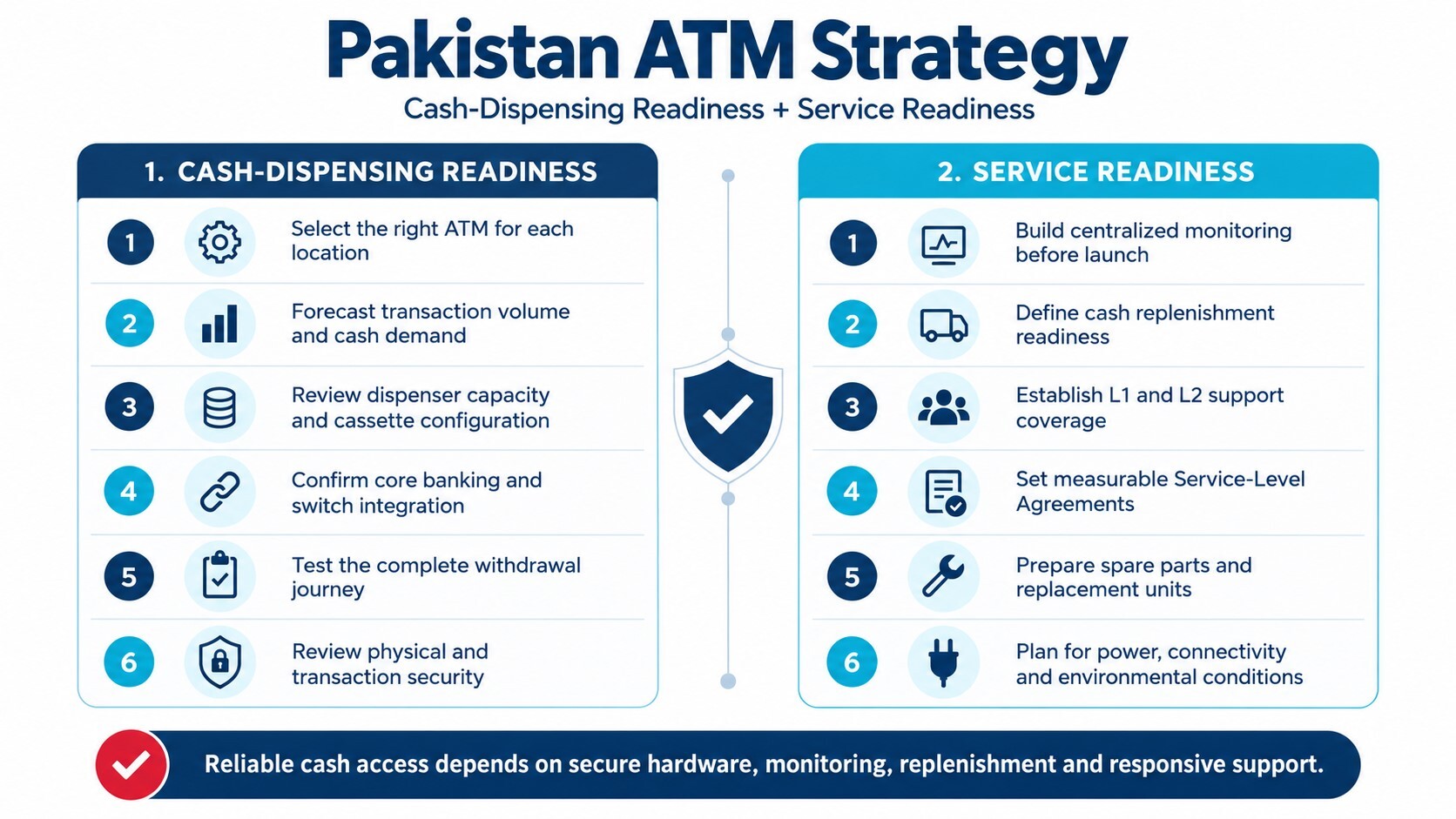
A successful strategy must address two connected areas:
- Cash-dispensing readiness: Is the ATM appropriate for the location, expected transaction volume, security environment and customer journey?
- Service readiness: Can the bank monitor, maintain, replenish and support the machine consistently after deployment?
Wavetec’s Full-Stack Approach to ATM Deployment
Wavetec is a global full-stack banking automation and customer experience technology company with more than three decades of industry experience. Its solutions are deployed across more than 30,000 systems in over 80 countries, supported through regional offices in New York City, Mexico City, Lima, London, Barcelona, Dubai, Riyadh, Nairobi, Karachi and Beijing.
As an NCR Atleos Gold Channel Partner, Wavetec combines internationally established ATM technology with local integration, deployment and lifecycle support in Pakistan. Its capabilities extend beyond supplying the physical machine to include site assessment, configuration, delivery, installation, commissioning, banking-switch integration, monitoring, preventive maintenance, field support, incident escalation and SLA reporting.
This full-stack model gives banks one accountable partner across the ATM lifecycle. Wavetec’s local L1 and L2 support network covers Pakistan’s four provinces, helping financial institutions manage geographically distributed machines through coordinated technical and operational services. Its wider banking portfolio including the State Bank of Pakistan Certified WT CQuick24 Cash Deposit Machines, ViaOS, Smart Connect Middleware, ChequeDB and Card Issuance Kiosks—also allows banks to plan ATM investments as part of a broader self-service strategy rather than as an isolated cash-dispensing project.
Why ATMs Still Matter in a Digital Banking Market
Digital banking has changed how customers transfer money, pay bills and manage accounts, but it has not removed the requirement for cash access.
Pakistan recorded 9.1 billion retail payment transactions worth PKR 612 trillion during FY2024–25, representing year-on-year growth of 38% in volume and 12% in value. Mobile banking applications processed more than 6.2 billion transactions, while the ATM network continued to expand. SBP’s payment-systems data illustrates a market in which digital payments and cash infrastructure are developing simultaneously.
This is important for banks designing channel strategies. Customers may receive funds digitally but withdraw them as cash. Businesses may use mobile banking for transfers while still requiring physical currency for suppliers, wages or daily operations. ATMs therefore remain part of an omnichannel banking environment.
Consumer research also demonstrates the continued importance of physical access. Accenture’s Global Banking Consumer Study, based on responses from 49,000 consumers, found that 67% appreciate seeing bank branches in their communities because they represent stability and availability, while 63% use branches for specific or complicated requirements.
A dependable ATM network supports this physical presence while allowing branches to automate routine withdrawals and reserve employees for advisory and exception-based services.
1. How Should Pakistani Banks Choose the Right ATM Model for Each Location
Banks should begin with the location and customer requirement—not with a standard hardware specification applied across the entire network.
A machine installed inside a branch lobby has different environmental, security and servicing requirements from one installed through an exterior wall or placed as a freestanding outdoor ATM.
Wavetec can provide cash-dispensing ATMs from the NCR Atleos SelfServ 20 Series, including models designed for different deployment environments.
NCR Atleos SelfServ 21
The NCR Atleos SelfServ 21 is a compact lobby cash dispenser suited to controlled indoor locations where floor space is limited.
Its capabilities include:
- 15-inch LCD touchscreen or function display keys
- S2 Media Dispense Module
- Dispensing of up to 60 notes in one transaction
- Anti-overfill cash cassettes
- Integrated contactless card reader
- NCR Atleos Skimming Protection Solution
- Compact indoor footprint
NCR Atleos SelfServ 23
The NCR Atleos SelfServ 23 is a premium freestanding lobby ATM designed for locations with higher customer traffic.
It combines a 15-inch touchscreen, S2 Media Dispense Module, contactless card reader and security capabilities within a freestanding indoor format. Its design supports availability, usability, performance and ease of servicing.
NCR Atleos SelfServ 24
The NCR Atleos SelfServ 24 is a through-the-wall cash dispenser designed for deployment at branches and self-service zones.
Features include:
- 15-inch LCD touchscreen
- S2 Media Dispense Module
- Up to 60-note bunch dispensing
- Anti-overfill cassettes
- Integrated contactless card reader
- Skimming protection
- Through-the-wall installation
NCR Atleos SelfServ 27
The NCR Atleos SelfServ 27 is a premium exterior through-the-wall ATM designed for outdoor-facing branch locations and higher transaction volumes.
Its exterior configuration allows customers to access cash outside normal branch hours while authorized teams service the ATM from a controlled internal area.
NCR Atleos SelfServ 28
The NCR Atleos SelfServ 28 is a fully weatherproof, freestanding ATM intended for locations where a conventional booth or through-the-wall structure may not be practical.
It supports wired and wireless connectivity and can be installed indoors or outdoors with limited infrastructure requirements. This makes it relevant for off-site locations, commercial areas and other points where banks want to extend their physical reach.
The NCR Atleos cash-dispensing ATM portfolio allows banks to match the machine format with the proposed site rather than forcing every location into one deployment model.
2. Forecast Transaction Volume and Cash Demand
ATM selection should be based on expected transaction demand, not only customer footfall.
Banks should evaluate:
- Historical withdrawals in the area
- Number of active customers
- Payroll and salary cycles
- Pension and government-payment dates
- Weekends and public holidays
- Seasonal demand
- Nearby branch and ATM capacity
- Denomination preferences
- Commercial activity
- Availability of competing ATMs
An ATM at a salary-disbursement location may experience concentrated demand within a few days. A machine at a shopping centre may see more consistent daily usage, while an ATM in a remote location may process fewer transactions but serve an essential access requirement.
Cash demand should be forecast at the denomination level. An ATM can hold sufficient total value and still become unavailable if the denomination most frequently requested by customers is depleted.
3. Review Dispenser Capacity and Cassette Configuration
The cash dispenser is central to ATM availability. Banks must confirm whether its capacity and cassette configuration can support the expected withdrawal pattern between replenishment visits.
The NCR Atleos SelfServ 20 Series uses the S2 Media Dispense Module, with selected models supporting a bunch size of up to 60 notes. Anti-overfill cassette functionality helps maintain controlled cassette loading.
Banks should review:
- Number of available cassettes
- Notes held per cassette
- Supported denominations
- Maximum notes per withdrawal
- Reject-bin capacity
- Note-quality requirements
- Replenishment frequency
- Expected daily cash value
- Peak-period demand
- Cash-in-transit arrangements
The objective is not necessarily to maximize cash inside every ATM. Higher cash holdings increase idle-cash exposure and security considerations. The appropriate capacity balances customer availability with replenishment cost, cash utilization and physical risk.
4. Confirm Core Banking and Switch Integration
A reliable ATM requires secure connectivity with the bank’s card-management, switching and core banking environment.
The integration must support:
- Card authentication
- PIN verification
- Account validation
- Balance inquiries
- Withdrawal authorization
- Transaction limits
- Real-time account debit
- Reversal handling
- Receipt generation
- Customer notifications
- Transaction journaling
- Interbank routing
- Reconciliation
- Dispute investigation
The integration design must also define what happens when communication is interrupted. A machine should not dispense cash unless the transaction has reached the correct authorization state.
Banks need documented workflows for timeouts, partial failures, delayed responses and reversals. A failed message must not create a situation in which cash is dispensed without the account being debited—or the account is debited without the customer receiving cash.
5. Test the Complete Withdrawal Journey
Technical connectivity does not guarantee a reliable customer journey. Banks should test the complete withdrawal process under normal and exceptional conditions.
A standard transaction should confirm that:
- The card is read correctly.
- The customer is authenticated.
- The account and available balance are verified.
- The requested amount is authorized.
- The correct notes are dispensed.
- The account is debited accurately.
- A receipt or digital notification is generated.
- The electronic journal records the completed transaction.
- The switch and core banking records match.
- The ATM returns safely to the welcome screen.
Exception testing should include:
- Insufficient funds
- Incorrect PIN attempts
- Expired or blocked cards
- Unsupported withdrawal values
- Insufficient notes
- Empty denomination cassettes
- Note-pick errors
- Partial dispensing
- Cash retraction
- Communication failures
- Host timeouts
- Power interruptions
- Receipt-printer failures
- Customer disputes
Each scenario should have a defined system response and operational resolution process.
6. Build Centralized Monitoring Before Launch
Banks should not wait for a customer or branch employee to report that an ATM has stopped working.
The State Bank of Pakistan’s operational guidelines for ATMs require banks to establish centralized monitoring capable of identifying out-of-cash and out-of-order incidents around the clock.
An ATM monitoring environment should provide visibility into:
- Machine availability
- Network connectivity
- Application status
- Card-reader condition
- Cash-dispenser status
- Cassette cash levels
- Reject-bin levels
- Receipt-paper levels
- Printer condition
- Sensor and door status
- Transaction failures
- Security events
- Software versions
- Open incidents
Alerts should be assigned according to severity. A complete ATM outage, suspected security incident or repeated failed dispensing event requires a different response from a low receipt-paper warning.
The monitoring platform should therefore connect every alert with an owner, response time and escalation path.
7. Define Cash Replenishment Readiness
Cash replenishment is not simply a logistics activity. It directly affects customer availability, physical security, reconciliation and operating cost.
Before deployment, banks should define:
- Who prepares and verifies the cash
- Who has authority to access the ATM safe
- How cassette exchange is controlled
- Whether dual custody is required
- Which cash-in-transit provider is responsible
- How visits are scheduled and authenticated
- How ATM balances are reconciled
- How rejected and retracted notes are handled
- How discrepancies are investigated
- How access events are logged
Static replenishment schedules may create unnecessary visits at low-volume locations while still allowing high-volume ATMs to run out of cash.
AI-assisted forecasting can improve this process by analysing historical withdrawals, cash levels, salary cycles, holidays, location patterns and previous out-of-cash incidents. The resulting forecast can help cash-management teams plan visits according to expected demand.
AI should support operational decisions, while final replenishment plans remain subject to authorized review and the bank’s cash-security policies.
8. Establish L1 and L2 Support Coverage
A nationwide ATM network requires different levels of technical support.
L1 Support
L1 support addresses routine on-site requirements such as:
- Checking power and network availability
- Replenishing receipt paper
- Removing basic obstructions
- Restarting approved components
- Inspecting visible hardware conditions
- Confirming booth accessibility
- Reporting cash or cassette conditions
- Completing approved first-line procedures
L2 Support
L2 support handles technical incidents that require trained engineers, including:
- Dispenser faults
- Card-reader failures
- Printer replacement
- Sensor failures
- PC-core or power-supply issues
- Software recovery
- Component replacement
- Diagnostic testing
- Security-device faults
- Recurring technical incidents
Wavetec’s local support coverage across Pakistan’s four provinces enables banks to define response arrangements for urban, regional and remote ATM locations.
Before rollout, the bank should verify technician locations, spare-parts availability, escalation contacts, travel times and coverage during weekends and public holidays.
9. Set Measurable Service-Level Agreements
SBP’s ATM operating guidelines state that banks should maintain comprehensive service-level agreements with vendors covering the ATM and its network.
An effective SLA should define measurable commitments for:
- Service availability
- Incident acknowledgement
- Remote diagnosis
- Engineer dispatch
- On-site arrival
- Machine restoration
- Parts replacement
- Preventive maintenance
- Repeat-failure investigation
- Escalation
- Reporting
Important performance indicators include:
- Overall ATM availability
- Successful withdrawal rate
- Out-of-cash time
- Mean Time to Repair
- Mean Time Between Failures
- First-time fix rate
- Repeat incident rate
- Remote resolution rate
- Preventive maintenance completion
- Response-time compliance
- Customer complaints
- Cash-replenishment performance
Availability should be defined carefully. A machine that is powered on but unable to dispense cash is not meaningfully available to the customer.
Banks should also avoid relying only on an overall network average. A strong national availability figure can hide recurring problems at individual branches or remote locations.
10. Prepare Spare Parts and Replacement Units
Service readiness depends on the availability of components and replacement machines.
Banks should confirm that the support model includes appropriate stocks of:
- Card readers
- Receipt printers
- Power supplies
- Display components
- Dispenser components
- Sensors
- Control boards
- Communication hardware
- Locks and security modules
- Approved replacement PCs
- Complete replacement machines where required
Spare-parts planning should consider the installed machine population, failure history, supplier lead times and geographic distribution.
Wavetec’s local inventory and deployment capabilities can reduce dependence on international shipping for every incident. This becomes especially important when a bank is opening new branches against fixed regulatory or commercial timelines.
11. Review Physical and Transaction Security
ATM security requires protection across the machine, site, application, communication and operating process.
Physical Security
Banks should assess:
- Safe and vault construction
- Physical anchoring
- Booth access
- Lighting
- CCTV coverage
- Door and tamper sensors
- Secure servicing access
- Cash loading procedures
- Protection against forced entry
- Environmental risks
SBP’s guidelines require CCTV surveillance, appropriate lighting and suitable locking arrangements around ATM booths to support customer safety and privacy.
Card and PIN Security
The NCR Atleos SelfServ 20 Series can support integrated contactless card readers and the NCR Atleos Skimming Protection Solution. The final security configuration should also include the bank’s approved PIN protection, encryption and card-handling controls.
Network and Application Security
The deployment should address:
- Encrypted communication
- Network segmentation
- Firewalls
- Secure remote access
- Approved software deployment
- Operating-system hardening
- Patch management
- Malware protection
- Role-based administration
- Audit logging
- Security-event monitoring
Operational Security
The bank should define who can:
- Access the safe
- Replace cassettes
- perform maintenance
- restart or update the machine
- view electronic journals
- change configurations
- close security incidents
- investigate disputed transactions
Every privileged action should be authenticated and recorded.
12. Plan for Power, Connectivity and Environmental Conditions
ATM availability can be affected by infrastructure outside the machine.
Banks should assess:
- Primary power reliability
- Uninterruptible power supply capacity
- Backup power arrangements
- Voltage stability
- Primary and secondary connectivity
- Mobile-network coverage
- Temperature and humidity
- Dust exposure
- Rain and water ingress
- Direct sunlight
- Ventilation
- Physical accessibility
Indoor, through-the-wall and freestanding outdoor machines require different environmental planning.
The fully weatherproof NCR Atleos SelfServ 28, for example, is designed for indoor or outdoor deployment with wired and wireless connectivity. However, weather resistance does not remove the need for secure foundations, appropriate power, connectivity testing and operational access.
13. Connect Mobile and ATM Channels
Modern ATM strategies should connect digital banking with physical cash access.
Possible journeys include:
- Cardless cash withdrawal
- QR-initiated withdrawals
- One-time withdrawal codes
- Mobile-prestaged transactions
- Digital receipts
- Real-time transaction alerts
- Location and availability information
- Personalized withdrawal limits
- Remote customer assistance
Connecting mobile and ATM channels can reduce dependence on physical cards and shorten interaction time. It also allows digitally initiated transactions to be completed through the cash network.
The integration must include strong authentication, time-limited credentials, transaction limits, encryption and fraud controls.
14. Use AI for Operational Readiness
AI can improve ATM operations when it is connected to clearly defined service workflows.
Potential applications include:
Predictive Maintenance
Models can analyse dispenser errors, transaction failures, sensor events and previous incidents to identify machines showing signs of deteriorating performance.
Cash-Demand Forecasting
Historical withdrawals, salary periods, holidays and location patterns can help predict when each cassette may approach depletion.
Anomaly Detection
The platform can identify unusual changes in withdrawal values, failed authentications, transaction reversals, device behaviour or access activity.
Service Prioritization
Incidents can be prioritized according to transaction volume, customer impact, security risk and the availability of nearby ATMs.
Network Planning
Banks can compare ATM utilization, branch traffic, service costs and customer demand when deciding where to deploy, replace or relocate machines.
McKinsey’s Global Banking Annual Review 2025 reports that banks spend approximately US$600 billion annually on technology, yet productivity improvements remain difficult to achieve. Its recommendation is to focus technology investment on specific applications that improve workflows, customer engagement or operating models.
For ATM operations, this means AI should not remain a disconnected dashboard. Its alerts and forecasts should lead to clear maintenance, replenishment or risk-management actions.
15. Measure Business Value After Deployment
A bank should evaluate its ATM strategy through performance outcomes rather than installation numbers alone.
Relevant measures include:
- Transactions per ATM
- Unique customers served
- Successful withdrawal rate
- Average withdrawal value
- Peak-hour utilization
- Cash replenishment frequency
- Out-of-cash incidents
- Technical availability
- Incident-response time
- Mean Time to Repair
- First-time fix rate
- Cost per successful transaction
- Customer complaints
- Branch-counter withdrawals migrated
- Security incidents
- Energy and infrastructure costs
Banks should compare performance by branch type, location, machine model and transaction volume. A low-volume ATM may still be strategically valuable if it provides essential access in an underserved area, while a high-volume machine with frequent outages may require a different capacity or service model.
Beyond Cash Dispensing: Building a Wider Self-Service Strategy
Cash dispensing is only one part of branch automation.
Banks should consider how their ATM network relates to other Wavetec technologies:
WT CQuick24 Cash Deposit Machine
The WT CQuick24 enables customers to deposit bulk banknotes through a teller-independent journey. The system can count and validate notes, separate rejected currency, secure accepted cash and integrate with the bank’s processing environment.
ViaOS
ViaOS supports the development, deployment and centralized management of customer journeys across Wavetec’s self-service kiosk network.
Smart Connect Middleware
Smart Connect Middleware provides integration, dashboards, alerts, transaction visibility, device monitoring and reporting across supported self-service environments.
ChequeDB
ChequeDB uses AI-powered OCR and handwriting recognition to extract and validate cheque information before routing exceptions for authorized review.
Card Issuance Kiosks
Wavetec’s Card Issuance Kiosks can support identity verification, biometric authentication, instant card printing, encoding and secure dispensing.
Together, these solutions allow banks to create self-service environments covering cash withdrawals, cash deposits, cheque processing, account opening and card issuance.
Wavetec and NCR Atleos Support Bank AL Habib’s Expansion
Wavetec’s work with Bank AL Habib demonstrates why ATM strategy must connect hardware availability with deployment and service readiness.
When Bank AL Habib required ATMs for new branch locations within tight timelines, Wavetec used its position as an NCR Atleos Gold Channel Partner to provide machines from available inventory and coordinate delivery, installation, commissioning and integration.
The Bank AL Habib, Wavetec and NCR Atleos deployment helped the bank maintain its branch-expansion schedule while giving customers access to 24/7 self-service facilities.
The project also includes 173 WT CQuick24 Cash Deposit Machines, extending the bank’s self-service strategy beyond withdrawals to teller-independent cash deposits.
This combined deployment reflects the value of working with a partner capable of supporting ATM dispensing, cash acceptance, integration and lifecycle services within a coordinated operating model.
Similar Wavetec Banking Projects
Wavetec’s wider banking deployments provide additional examples of its full-stack capabilities.
Bank Alfalah
Bank Alfalah’s self-service transformation combines Wavetec CQuick Cash Deposit Machines, software, integration and centralized operational capabilities across a large banking network.
Meezan Bank
Meezan Bank deployed Wavetec Cash Deposit Machines to support secure, teller-independent deposits and real-time account credit.
UBL Pakistan
UBL’s customer journey transformation demonstrates Wavetec’s experience integrating customer identification, queue management and branch technology across a major financial institution.
Diamond Trust Bank Kenya
Diamond Trust Bank Kenya introduced Wavetec’s cheque deposit and account-opening technology, connecting self-service hardware with cheque processing, KYC and enterprise integration.
These projects demonstrate Wavetec’s ability to support banks across hardware deployment, application development, integration, monitoring and long-term technical services.
Wavetec’s Security and Quality Certifications
ATM and self-service deployments handle financial transactions, customer information and connections with core banking systems. Banks should therefore evaluate the organizational security and quality framework of their technology provider alongside product-level features.
Wavetec’s framework is supported by:
- SOC 2: Wavetec has completed a SOC 2 examination covering controls relevant to the security and reliability of its enterprise technology environment.
- ISO/IEC 27001: Wavetec maintains an information security management system aligned with the internationally recognized ISO/IEC 27001 standard.
- ISO 9001:2015: Wavetec’s quality management framework supports structured design, development, implementation and service-delivery processes.
- GDPR compliance: Wavetec follows applicable data-protection principles aligned with the General Data Protection Regulation.
More information is available through Wavetec’s SOC 2 announcement and ISO 27001 renewal announcement.
These organizational credentials support Wavetec’s overall security and governance posture. Final compliance depends on the bank’s approved architecture, deployed controls, operational procedures and applicable regulatory requirements.
Pakistan ATM Readiness Checklist
Before approving an ATM deployment, banks should confirm:
- The ATM model matches the proposed location.
- Expected transaction volume has been assessed.
- Cash and denomination demand has been forecast.
- Cassette capacity supports peak periods.
- Core banking and switch integration has been tested.
- Timeout, reversal and partial-dispense scenarios are documented.
- Centralized monitoring is operational.
- Out-of-cash and out-of-order alerts are configured.
- Cash-replenishment responsibilities are defined.
- L1 and L2 support coverage is available.
- Spare parts are held within practical reach.
- Preventive maintenance schedules are established.
- SLA metrics and escalation paths are documented.
- CCTV, lighting and booth security meet requirements.
- Skimming protection and card security controls are enabled.
- Network communication is encrypted.
- Backup power and connectivity have been tested.
- Electronic journals support reconciliation and disputes.
- AI alerts lead to defined operational actions.
- Performance will be reviewed by machine and location.
Conclusion
Pakistan’s ATM network continues to expand because cash access remains an essential part of the banking experience. However, reliable access depends on much more than installing cash-dispensing hardware.
Banks need to select the right ATM for each location, forecast demand, configure sufficient capacity, complete secure integration and test the full withdrawal journey. They also need centralized monitoring, cash-replenishment planning, local engineering coverage, spare parts, security controls and measurable service-level commitments.
Through its partnership with NCR Atleos, Wavetec can provide NCR Atleos SelfServ cash-dispensing ATMs together with local deployment, integration and lifecycle support. Its broader portfolio—including WT CQuick24, ViaOS, Smart Connect Middleware, ChequeDB and Card Issuance Kiosks—allows banks to connect ATM investments with a wider self-service transformation strategy.
The strongest ATM strategy is therefore not defined only by how much cash a machine can dispense. It is defined by whether the bank can keep that machine secure, available, replenished, monitored and supported when customers need it.
Contact Wavetec to discuss ATM deployment, cash automation and integrated self-service banking in Pakistan.
Frequently Asked Questions
What should a bank check before deploying an ATM in Pakistan?
The bank should assess the location, expected transaction volume, cash demand, ATM format, dispenser capacity, integration, power, connectivity, physical security and customer accessibility. It should also confirm centralized monitoring, cash replenishment, local engineering support, spare-parts availability and measurable SLAs before launch.
Which NCR Atleos ATMs are suitable for cash dispensing?
The NCR Atleos SelfServ 20 Series includes indoor lobby, freestanding, through-the-wall, exterior and weatherproof cash-dispensing models. Options include the SelfServ 21, 23, 24, 27, 28 and 29. The appropriate model depends on location, security, servicing access, infrastructure and expected transaction demand.
Why is centralized ATM monitoring important?
Centralized monitoring helps banks identify out-of-cash, out-of-order, connectivity and hardware incidents without waiting for customer reports. It allows alerts to be assigned to the correct team, measured against SLAs and escalated before they cause prolonged service disruption.
How can AI improve ATM operations?
AI can support cash-demand forecasting, predictive maintenance, anomaly detection, incident prioritization and ATM location planning. These capabilities should be integrated with defined operational workflows and human oversight rather than used as isolated alerts.
What is the difference between ATM availability and uptime?
Technical uptime may indicate that the machine is powered on and connected. True service availability means customers can successfully complete the intended transaction. An ATM that is online but unable to dispense cash should not be treated as fully available.
Does Wavetec provide ATM support across Pakistan?
Wavetec provides ATM deployment, integration and lifecycle support through its local service structure in Pakistan. The specific geographic coverage, response time and SLA commitments should be agreed according to the bank’s machine locations and operating requirements.
BOOK A FREE DEMO