Quick answer: In Italy, a pharmacy queue management system, usually called an eliminacode, gives each customer a numbered ticket for the service they need, from collecting an electronic prescription to booking a CUP visit or an ECG. It then calls them by number to the right counter or service room, so quick pickups keep moving while the longer farmacia dei servizi work happens in parallel.
In a hurry?
- Italian pharmacies now book CUP visits, run ECGs and give vaccinations, so one shared line no longer works.
- Give prescription pickups their own ticket letter, send CUP bookings and tests to the service room, and add a priority button for older customers.
- Due Leoni in Rome and Rossi in Lugo each run six categories on six desks with Wavetec, in Italian and English or with WhatsApp tickets.
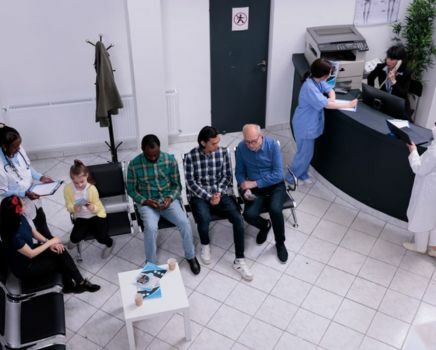
An Italian pharmacy at seven in the evening is a busy place. Some people are collecting a repeat prescription on the way home, some want advice on a cold remedy, one is booking a cardiology visit through the CUP, and another is waiting for a blood pressure check. Federfarma’s report “La farmacia italiana 2025” counts 20,160 pharmacies serving about 4 million people a day, and names the evening as the busiest time.
This guide is written for that reality. It covers why queues in Italian pharmacies are getting harder to manage, whether a basic eliminacode kit is enough, how to split the queue by service, how to respect Italian privacy rules at the counter, and what two Italian pharmacies did. If you are looking for a general introduction outside Italy, start with Wavetec’s guide to the pharmacy queue management system.
Why Are Queues Getting Longer in Italian Pharmacies?
Because the Italian pharmacy has become a small health center. Under the farmacia dei servizi program, more than 70% of pharmacies now offer health services beyond medicines, according to the same Federfarma report, and 79% offered CUP booking for public hospital and specialist visits in 2024.
Telemedicine is growing quickly on top of that. Federfarma data published in April 2026 shows Italian pharmacies delivered more than 1.16 million telemedicine services in 2025, up 28% on 2024, most of them ECGs and Holter tests. Each one occupies a pharmacist far longer than a prescription pickup does.
People also come for conversation, not just products. Around 800,000 of the daily visitors are looking for health advice, Federfarma says. In the Cittadinanzattiva and Federfarma report of April 2026, about 7 in 10 people said they often ask the pharmacist before buying a medicine, about half of pharmacies give flu vaccinations, and about three in four have a separate room for services.
Put together, the same counter now handles one-minute tasks and twenty-minute tasks. With a single line, the slow ones set the pace for everyone.
An Older Customer Base
Italy has one of the oldest populations in Europe. ISTAT’s demographic indicators, released in March 2026, put 25.1% of residents, about 14.8 million people, at 65 or older on January 1, 2026. Many are regular customers with chronic prescriptions. They need a priority option, a queue kiosk with few steps and screens they can read from a chair.
Tourists at the Counter
ISTAT counted more than 535 million tourist nights in Italy in 2025, 55.3% of them by foreign visitors, and in Rome foreign visitors account for more than three quarters of nights. In city centers and holiday towns, a share of customers cannot read an Italian-only menu, and staff end up explaining the system instead of serving.
The After-Work Rush
Most Italian pharmacies see their peak in the early evening, when people stop in after work. Planning staff for peak hours only works if you can see when and for which service the line builds, which a paper roll of numbers cannot tell you. A line that never seems to shrink also wears down the team behind the banco, one of the drivers of burnout in healthcare.
Italian pharmacy terms used in this guide
- Eliminacode: a queue management system (literally “queue eliminator”).
- Totem: the self-service kiosk where customers take a ticket.
- Banco: the pharmacy counter.
- Ricetta elettronica (NRE): the electronic prescription and its code.
- Tessera sanitaria: the national health card customers show at pickup.
- CUP: the regional booking system for public hospital and specialist visits.
- Farmacia dei servizi: the program that lets pharmacies offer tests, telemedicine and other health services.
Is a Basic Eliminacode Kit Enough?
For a pharmacy with one counter and one kind of service, sometimes yes. Search for eliminacode farmacia in Italy and the first results include kits sold online: a roll ticket dispenser, a number display and a remote, from under 20 euros to around 200 euros. They work like the classic “take a number” roll.
The limits show up as soon as the pharmacy offers more than one service. A kit runs one number sequence, so the person booking a CUP visit and the person collecting a prescription still share the same line. It cannot take tickets from home, cannot call by service and records nothing about waiting times.
| Basic kit | Full queue system | |
|---|---|---|
| Ticket | Paper roll, one sequence | Printed by a touchscreen totem, one letter per service |
| Services | All in one line | Pickups, advice, CUP, tests and orders in separate queues |
| Calling | Remote control, one display | Staff call from the counter PC; screens show ticket and counter |
| Remote tickets | No | WhatsApp or app, before arrival |
| Languages | Numbers only | Italian plus English or other languages on totem and screens |
| Data | None | Waiting and service times by hour and service |
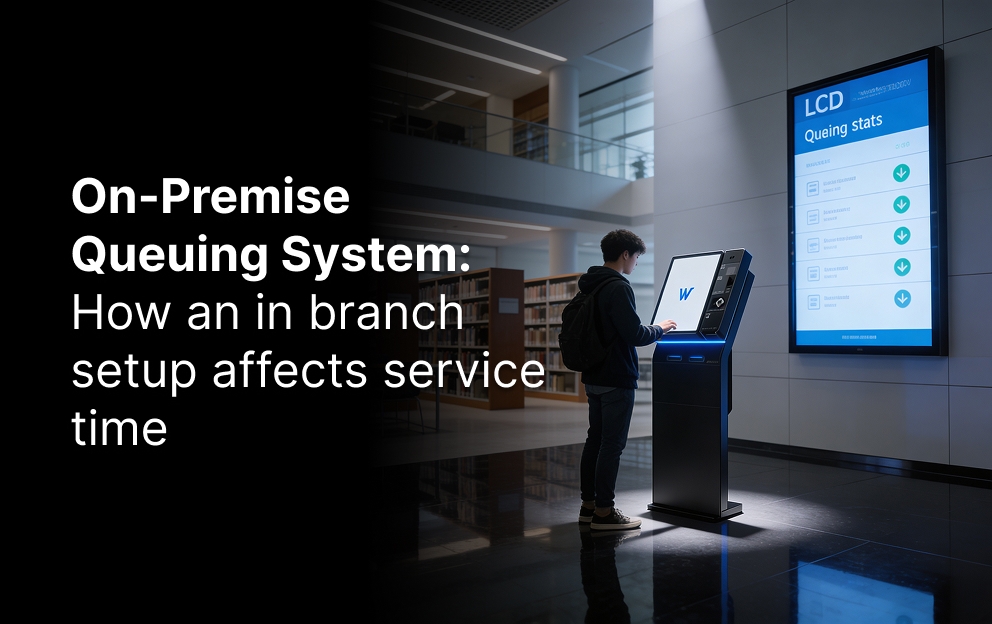
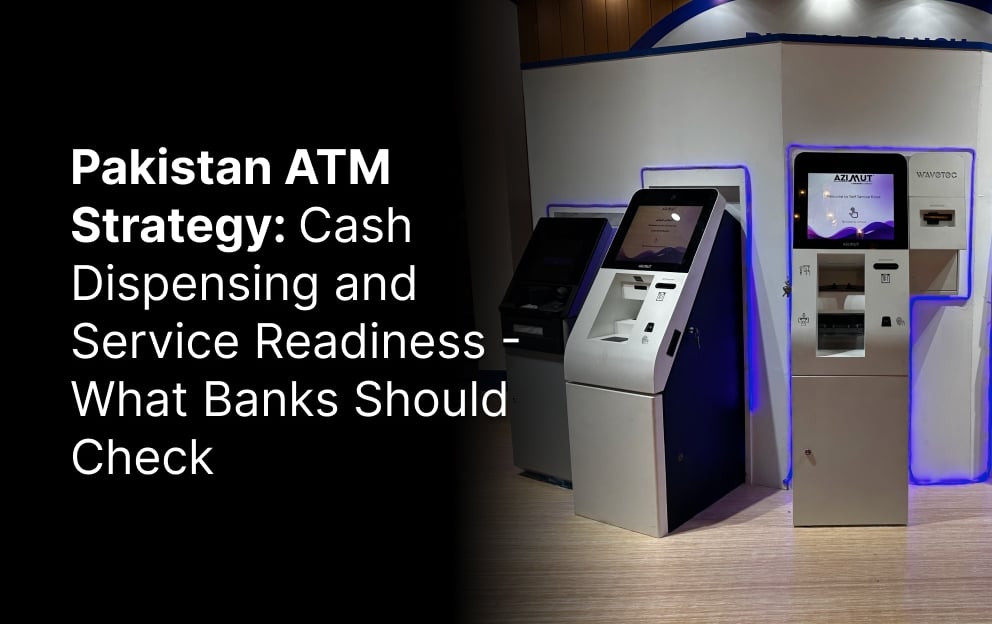
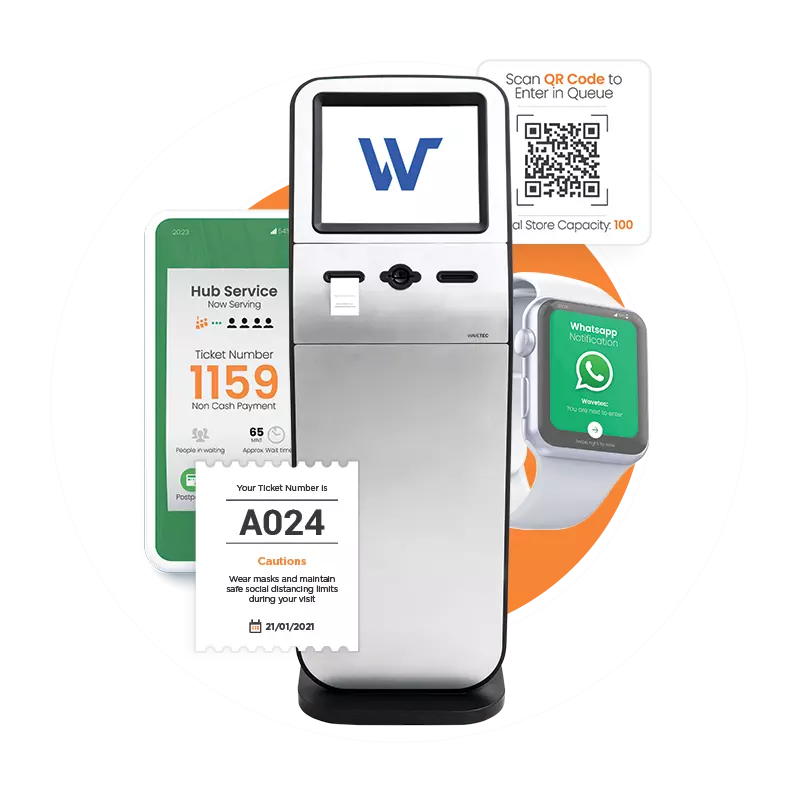
Wavetec’s full system is built from a ticketing totem (the compact M-18 or the larger F-19), the Spectra queue management system that decides who is next, a web screen staff use to call tickets, and Donatello screens in the waiting area.
How Should an Italian Pharmacy Split Its Queue?
By the time each service takes, not by the product sold. Pickups take about a minute and arrive constantly; CUP bookings and tests take ten minutes or more and arrive less often. A common Italian split looks like this, with Italian labels on the totem and English underneath in tourist areas:
| Ticket | Totem button | What it covers | Typical time at the counter |
|---|---|---|---|
| A | Ritiro ricette | Electronic prescription pickup with NRE code and health card | About a minute |
| B | Banco / Consiglio | Over-the-counter purchases and quick advice | A few minutes |
| C | Dermocosmesi | Skincare and cosmetics advice | Several minutes |
| D | Prenotazioni CUP | Booking public hospital and specialist visits | Often 10 minutes or more |
| E | Autoanalisi / ECG | Blood tests, blood pressure, ECG and Holter | 10 to 20 minutes, in the service room |
| F | Ritiro ordini | Medicines ordered in advance by phone, online or WhatsApp | About a minute |
Times are indicative and vary by pharmacy. Three rules make the split work:
- Keep A and F at the main banco. They are the bulk of visits and clear fastest.
- Send D and E to the service room. Three in four Italian pharmacies already have one; the screen simply calls “E004, sala servizi”.
- Add a priority button. Older customers, pregnant women and people with disabilities get served sooner without anyone having to argue their case at the counter.
In Wavetec installations each category gets its own letter followed by three digits, so staff can tell the service at a glance. The article on single versus multiple queues explains when more categories help and when they slow things down.
What Does a Visit Look Like From the Door to the Banco?
Here is a typical evening visit in a pharmacy set up this way:
- At the totem. At digital check-in, a customer taps the flag for English or stays in Italian, chooses Ritiro ricette and gets ticket A031. A neighbor behind her chooses Prenotazioni CUP and gets D007.
- In the waiting area. The screen shows the last numbers called for each service and how many people are ahead. The CUP customer can see her wait will be longer and sits down. Seeing a number move is what makes a wait feel shorter.
- At the banco. A pharmacist finishes a sale and clicks “next” on the counter PC. A031 appears on the screen with “Banco 2” and an announcement plays. The customer hands over her health card and NRE code and leaves with her medicine.
- In the service room. A colleague handling CUP bookings calls D007 to the service room without holding up the pickups.
- From home. A customer who ordered medicine on WhatsApp in the afternoon takes an F ticket on her phone before leaving the house and arrives as her number comes up.
- After closing. The manager checks the dashboard: how long each service waited, which hour was busiest, and how many tickets were never called.
The calls come from Wavetec’s staff screen, which runs in a browser on the counter PC, and the screens use Donatello so the same displays can show live ticket calls alongside your own content, such as vaccination campaigns.
See this setup working in a six-desk Italian pharmacy.
How Do You Call Customers Without Using Their Name?
By number. Italy’s data protection authority, the Garante, asked healthcare facilities in 2005 not to call waiting patients by name and to use a number assigned at booking or check-in instead. The guidance is aimed at hospitals, clinics and health authorities rather than pharmacies, but a customer waiting for a Holter test or a sensitive prescription expects the same discretion.
A queue system does this by design: the screen shows “A031, Banco 2”, the announcement repeats the number, and no health information appears in public. The service categories on the totem should also stay neutral, for example “Autoanalisi” rather than the name of a condition.
For the data behind the screens, Wavetec holds ISO/IEC 27001:2022 certification, is SOC 2 certified and is GDPR compliant under the EU’s General Data Protection Regulation. More on the topic in Wavetec’s article on data security in healthcare.
Can Customers Take a Ticket on WhatsApp Before They Arrive?
Yes. Some Italian pharmacies already take medicine orders by message, and with WhatsApp Queueing the same chat can give them a ticket and tell them when to come in.
Rossi Pharmacy in Lugo uses it for priority services such as medicine bookings, so those customers skip the waiting room at busy times. It also helps families: an adult child can take a ticket for an elderly parent and bring them in when the number is close, the idea behind a virtual waiting room.
For customers who prefer an app, Wavetec’s Mobile-Q does the same job, and pharmacies that book consultations by time slot can add WhatsApp appointment booking or online appointment scheduling, so booked visits and walk-ins share the same queue. Wavetec’s comparison of walk-in and same-day appointments shows how to balance the two.
Which Setup Fits Your Pharmacy?
Size the system to your counters and services, not to the floor area. These are indicative starting points:
| Pharmacy | Suggested setup | Why |
|---|---|---|
| Town pharmacy, 1 to 2 banchi | Compact totem, one screen, pickups plus one other category | Stops a long service blocking prescription pickups |
| 3 to 4 banchi, CUP and tests | Totem with service menu, screen in the waiting area, service room calls | Separates fast and slow work and uses the service room |
| 5 to 6 banchi, city center | Bilingual totem, six categories, several screens, WhatsApp tickets, dashboard | The setup used at Rossi (M-18) and Due Leoni (F-19) |
| Group of pharmacies | Central software with reporting across branches | Compare waits and staffing between sites |
The same platform scales to large chains, such as the Nahdi pharmacy network in Saudi Arabia.
What Does a Queue System Cost an Italian Pharmacy?
A basic kit costs from a few euros to a couple of hundred; a full system is quoted per project. What moves the price:
- Number of banchi and service categories
- Totem type (compact M-18 or 17-inch F-19) and number of screens
- Remote tickets on WhatsApp or the app
- Languages on the totem and screens
- Reporting needs, installation, training and support
The fairest comparison is not kit versus system but what each one fixes. If your problem is one shared line for six kinds of service, only categories solve it. Ask for a quote based on your services and counters, and check what support covers: the Rossi and Due Leoni installations include remote support Monday to Friday, 9:00 to 17:00.
Which Italian Pharmacies Use Wavetec?
Due Leoni, Rome
Due Leoni is a retail pharmacy in Rome with about 300 customers a day, designed by the architecture studio Sartoretto Verna. Before the project it had no ticket categories, no queue screens and no interface for customers who do not speak Italian.
Wavetec installed an F-19 totem with a 17-inch touchscreen, the Spectra controller, the browser-based staff screen at six desks, and Donatello screens. The totem and the displays run in Italian and English, and tickets carry one letter per category followed by three digits. The project moved through discovery, configuration, a pilot and full rollout at the main branch, and was designed to fit the pharmacy’s look rather than change it. Staff now run six categories centrally, and customers can follow their place on the screens. Full details are in the Due Leoni case study.
Rossi, Lugo
Rossi Pharmacy in Lugo, in Emilia-Romagna, serves about 350 clients a day. Besides medicines and cosmetics, it offers diagnostics and health checks, public hospital visit bookings and a section for celiac-friendly products.
Wavetec set up a 10-inch M-18 totem with a Bixolon printer, Spectra across six service desks, Donatello screens with a custom layout showing the ticket and desk, and WhatsApp Queueing for medicine bookings. The result is clearer service organization and better queue visibility at peak times. Read the Rossi Pharmacy case study.
Beyond Pharmacies
In Rome, Villa Betania Clinic runs Wavetec’s system across 13 patient service categories in Italian, English and Spanish, the same approach applied to a private healthcare facility. Wavetec’s wider healthcare solutions serve hospitals and clinics, and the company works in more than 80 countries.
How Do You Roll Out a Queue System in an Italian Pharmacy?
- Write down your services in Italian first. Group them into five or six categories with plain names customers recognize, then add the English label.
- Time a normal week. Note how long each service takes and when the evening rush starts, so you have a baseline.
- Place the totem near the entrance and the screens where seated customers can read them. Check font size with an older customer, not just with staff.
- Pilot for one to two weeks. Adjust categories, priority rules and which banco serves what, and train staff on calling and transferring tickets.
- Go live before a busy season. Many pharmacies prefer to be settled before autumn flu vaccinations start.
- Review monthly. Look at waits by service and hour, and tickets never called.
What Should You Measure After Go-Live?
- Average wait by category, especially pickups (A) at the evening peak. Compare with average wait times in other sectors.
- Service time for CUP bookings and tests, to size the service room.
- Tickets never called, an early sign of queue abandonment.
- Share of WhatsApp tickets, to see whether customers use remote queuing.
- Customer opinion, with a short feedback survey on a tablet or by message.
Spectra’s analytics report these by hour and service, and Wavetec’s guide to queue management analytics explains which numbers to watch first.
Frequently Asked Questions
Where to Start
Start with the evening rush: give prescription pickups their own ticket, move CUP bookings and tests to the service room, and show everyone their wait on a screen. Wavetec’s pharmacy queue management solution adds bilingual totems, WhatsApp tickets and reporting as your pharmacy grows.
Shorter lines at your pharmacy counter
See kiosks, WhatsApp tickets and waiting-room screens set up for your services in a 30-minute demo.