A branch visit rarely begins when the customer reaches the counter. By that point, the most expensive part of the journey has already unfolded: the customer has arrived, searched for the right place to go, waited for direction, joined a line, answered basic questions, and often ended up at the wrong counter without the context needed to be served properly.
That is why the real queue is not always the one shown on the display screen. A modern enterprise queue management system closes that gap before it opens, sometimes by completing part of the transaction itself. On WhatsApp, a customer can now fill in transaction data before a ticket is even issued. In Samsung’s appointment system, the branch already knows key details about the customer before they arrive. Small moves, but they cut real time off the counter, not just off the wait.
For banks, telecom stores, government service centers, healthcare facilities, universities, and other high-volume service environments, this “queue before the queue” is where counter time is either protected or wasted.
This isn’t just a hunch. McKinsey’s research on banking journeys found that onboarding and problem-resolution moments disproportionately drive a customer’s overall experience, more than everyday interactions do, and that satisfied customers are six times more likely to stay with their bank. The pattern holds in healthcare too: MGMA’s most recent survey of practice leaders found no-shows, online scheduling, and wait times are the top patient-access priorities heading into 2026, with 71% of medical groups still having fewer than one in four patients scheduling digitally. The problem, and the opportunity, isn’t industry-specific.
Banorte has already put this same logic to work at scale, using real-time dashboards to adjust counter-calling logic across 1,000+ branches in Mexico.
Our Enterprise Queue Management System is built around this full customer journey, spanning appointment scheduling, virtual queuing, WhatsApp Queuing, Mobile-Q, ticketing, digital signage, customer feedback, analytics, and centralized service flow management. Positioned this way, it functions as a connected customer experience platform rather than a simple ticket dispenser.
The Counter Should not be the First Point of Clarity
In many service environments, the counter is the first place where the organization actually finds out what the customer needs, and that creates a real problem. When a customer only explains their purpose after waiting, the employee ends up doing three jobs at once: understanding the request, confirming the right service path, and beginning the actual transaction. In busy branches, this compounds into longer service times, unnecessary transfers, repeat questions, and frustrated customers.
A better journey starts earlier. Customers can already book, check in, reschedule, or cancel appointments online, selecting a branch, time, and required service before arrival, then checking in once they reach the branch, a flow covered on our banking page. That may sound simple, but operationally it changes the entire visit: the branch is no longer learning everything at the counter. It has a signal before the customer even arrives.
The Best Queue is Already Informed
A smart pre-service journey does not mean replacing staff. It means removing the avoidable work that slows them down. Before the customer reaches the counter, the system can already support the following:
| Pre-service moment | What it helps clarify | How we support it |
| Appointment booking | Who is coming, when, and for which service | Online appointment booking and scheduling |
| Mobile queue joining | Customer can join before physically arriving | Mobile-Q virtual queuing |
| WhatsApp Queuing | Customer can join, select service, and receive updates through WhatsApp | WhatsApp Virtual Queuing |
| Check-in | Customer confirms arrival before being called | Appointment and banking journey support |
| Queue status updates | Customer knows estimated wait and counter information | WhatsApp Queuing and QMS notifications |
| Analytics | Operations teams can review service flow and performance | Spectra reporting and dashboards |
Mobile-Q lets customers virtually join a queue before physically arriving at the branch, and WhatsApp Queuing offers the same head start over chat: scan a QR code, pick the right service, and get real-time updates while waiting.
None of this is about adding more screens. It is about helping the customer reach the right service point with less confusion.
“Take a number” is no Longer Enough
Traditional queuing starts the moment a person takes a ticket, but modern service flow starts well before that. A customer might book online, arrive at the branch, check in, receive status updates, and move to the right counter when called, while a walk-in customer might join through a QR code, SMS or text, a bank app, or a WhatsApp-powered queue, depending on which journey is available. These options already come with queue status, estimated wait time, and counter number updates built in.
That shift matters because the queue stops being just a waiting line and becomes a managed journey instead. For operating teams, every unclear arrival creates front-desk pressure, every wrong queue selection creates avoidable rework, and every uninformed customer generates another “how long will this take?” moment. The answer is not always more staff; often, it is simply better flow before service begins.
Where Counter Time Is Lost (and What an Enterprise Queue Management System Fixes)
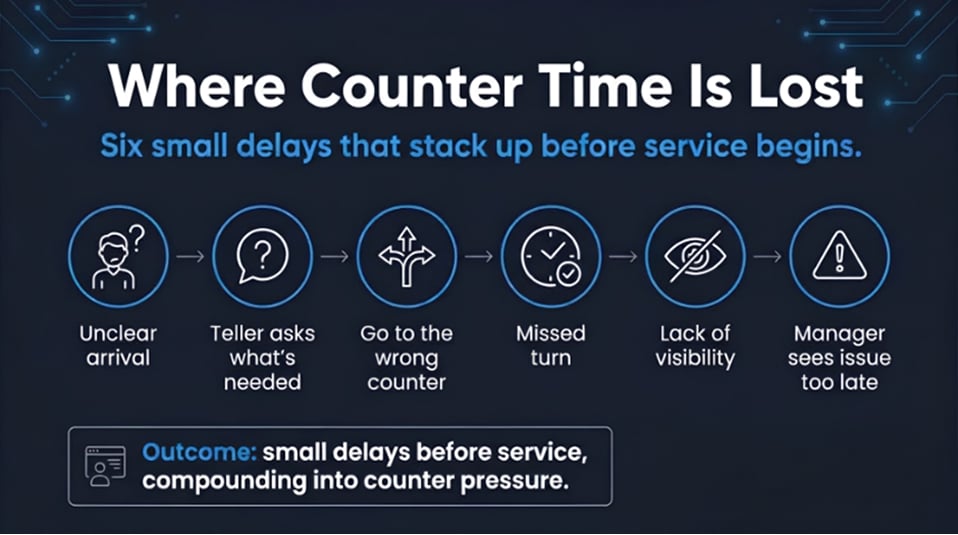
Counter time is rarely lost in one dramatic failure. It is usually lost in small pieces: a customer arrives without knowing where to go, a teller has to ask what service they need, a request gets routed to the wrong counter, the customer waits but misses their turn, the lobby team has no clear view of incoming demand, and managers only find out once the queue is already full.
Pre-service design attacks these small delays before they have a chance to stack up. Enterprise queue management is built to reduce wait times, automate customer flow, scale across industries, and keep customers informed through real-time updates, notifications, and messages. That focus has built a footprint of 20,000+ installations across 70+ countries, and delivered a 35% reduction in customer waiting times and a 30% reduction in operational cost across 150+ enterprise-level customers.
This is the same logic HSBC Mexico applied when it rolled out our queue management solution nationally: around 250 installations across its 948-branch network, using self-service kiosks and centralized dashboards to cut wait times for a customer base of 40 million.
AI is Already Doing Part of this Work
Some of this no longer runs on fixed rules; it runs on AI directly. Nexia-Q is Wavetec’s AI digital human, deployed on the QMS kiosk. It greets customers by voice, understands what they need through natural conversation, and routes them to the right counter, all without a staff member at the front desk. Behind the counter, an AI-powered routing engine does something similar automatically: it assigns each customer to a counter based on service type, that counter’s current load, and staff role, and rebalances in real time if one counter backs up.
The Role of WhatsApp in the Pre-service Journey
WhatsApp is not just a reminder channel; in a queuing journey, it can become the entry point itself. A customer scans a QR code, opens the designated chat, selects the relevant service, joins the queue, and receives updates as they wait. That flow is fully integrated with real-time queue information, which is especially useful in high-footfall locations where customers would rather not stand in a physical line just to be told what happens next.
For the customer, this reduces uncertainty. For the branch, it reduces front-desk interruptions. And for operations, it creates earlier visibility into demand.
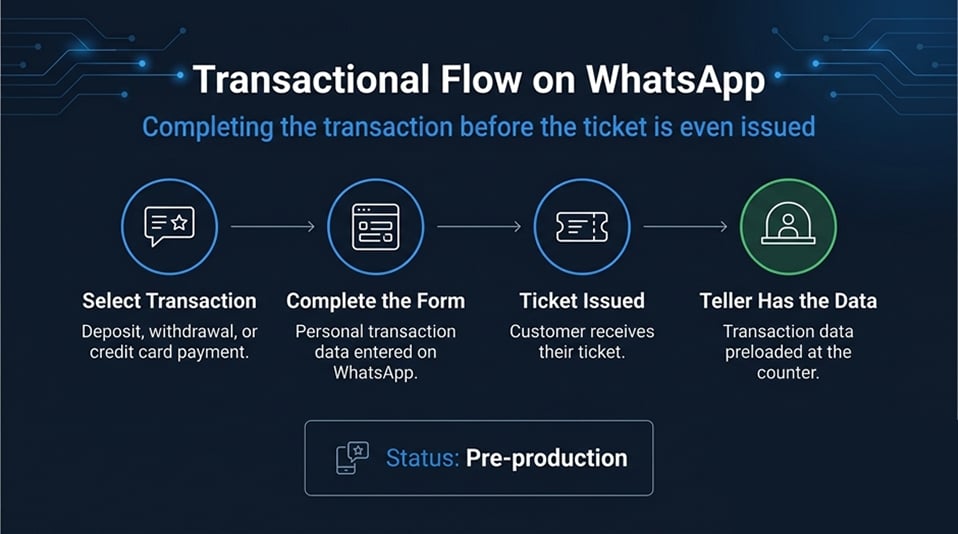
One feature pushes this further: transactional flow. Instead of just joining a queue, the customer completes their personal transaction data directly in a WhatsApp form before a ticket is even issued, for deposits, withdrawals, or credit card payments. That data is then shared with the same system the bank teller uses, so it is already preloaded by the time the customer reaches the counter, cutting service time and reducing repeat work at the window.
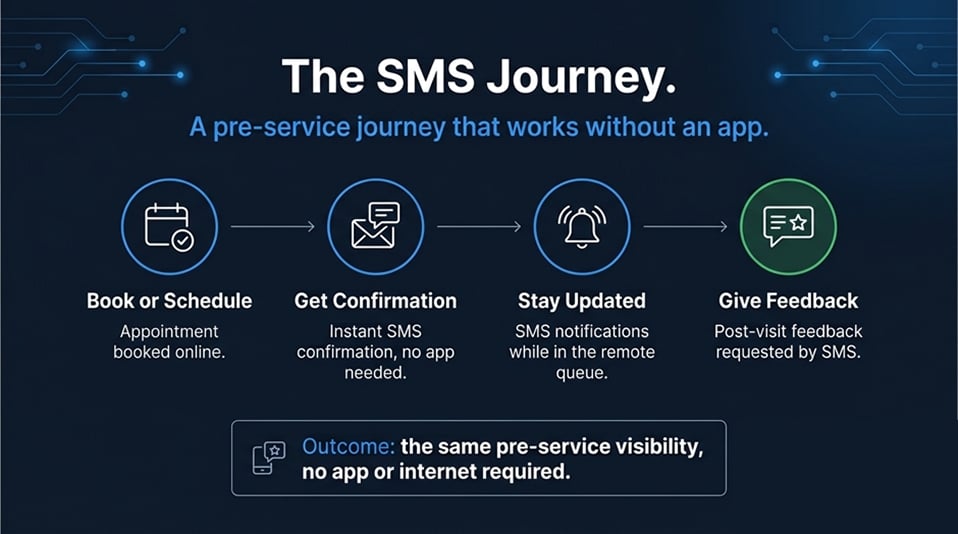
The channel shifts by market, but the logic doesn’t. In the US specifically, WhatsApp hasn’t reached the same scale it has elsewhere: Pew Research Center’s most recent survey found only 32% of US adults use WhatsApp at all, still a minority even after years of growth. SMS, by contrast, works on every mobile phone without needing an app or a data connection. CalPERS, which manages benefits for 1.5 million California members, runs on that logic, using SMS for appointment confirmations and post-visit feedback. The same pre-arrival approach carries over to Canada too: DriveTest, which runs Ontario’s official driver testing centers, also confirms road test appointments and manages remote queuing over SMS.
Samsung’s Appointment System
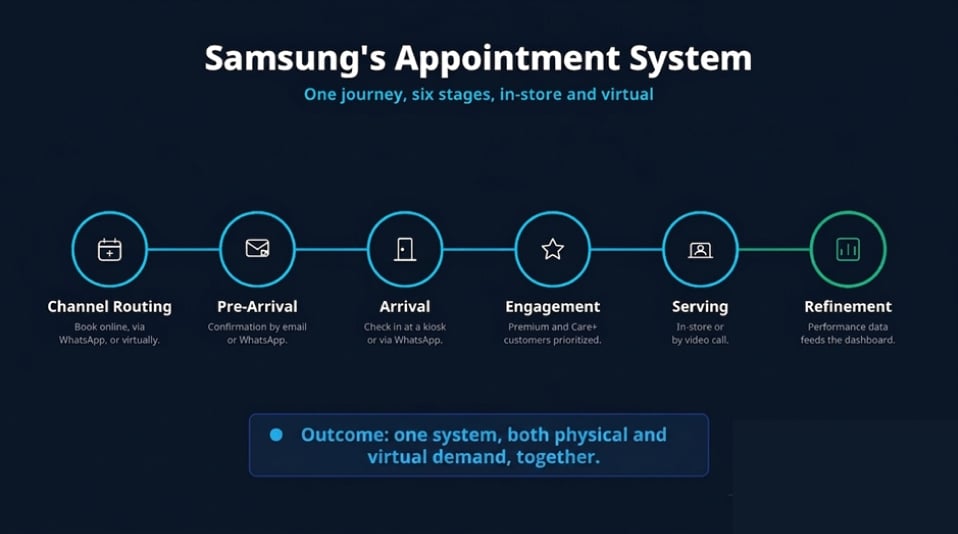
Samsung Spain runs a version of this same journey end to end. Customers route in through online booking, WhatsApp queuing, or a virtual appointment on Samsung’s website, then get a confirmation by email or WhatsApp, complete with a secure Google Meet link if it’s a video appointment. On arrival, they check in at a Wavetec-powered kiosk or skip it entirely and check in through WhatsApp. From there, the system triages automatically: premium device owners and Samsung Care+ customers get routed for prioritized service, while everyone else is managed through real-time queuing, whether they are in-store or joining by video call. The full loop closes with a dashboard that turns all of that appointment and queuing data into ongoing performance insight, all of it built around the customer data protection standards Samsung requires.
Appointments Make Demand Less Random
Walk-ins will always exist, but not every visit has to be a surprise. Appointment scheduling gives the organization a better view of expected arrivals: customers can book, check in, reschedule, or cancel appointments online, and WhatsApp appointment management supports the same actions directly from WhatsApp.
This matters because branches often struggle with demand spikes that feel random. Appointments do not remove all of that volatility, but they help teams prepare for it. A scheduled customer is not just a name on a calendar; they represent expected demand for a specific service, at a specific location, at a specific time, which is operationally valuable in its own right.
Analytics Turns The Journey Into a Management System
A queue is not only something to manage in real time. It is also something to study once the day ends. Spectra analytics connects appointment scheduling, visitor management, and digital signage into one view, and includes Spectra Reporting and Dashboards covering appointment totals, employee performance, self-service device status, and branch performance.
That makes the pre-service journey measurable, and it lets operations leaders move past “the lobby was busy” toward sharper questions: which services create the most pressure, which arrival channels are growing, where customers wait longest, which branches need staffing changes, and where appointments are helping while walk-ins are still overwhelming the floor. This is where queue management stops being just a customer-facing system and becomes a genuine management discipline.
It also stops being purely retrospective. Spectra uses AI to forecast peak hours from historical data, so a branch manager can staff up before a rush hits instead of reacting to one already underway.
Banorte applied this same logic at scale, deploying our queue management and reporting system across 1,000+ branches in Mexico, and using real-time dashboards to adjust counter-calling logic dynamically throughout the day based on customer inflow.
Security Cannot be Added Later
Pre-service journeys involve customer data, appointment data, queue activity, channel updates, staff access, and operational records, and in regulated environments, that data has to be protected and traceable from the start. That means secure-by-design principles: structured audit trails, role-based access control, encrypted communication, monitoring, and incident response readiness, backed by SOC 2 Type II, ISO 27001, and GDPR-aligned data protection practices.
That is really the right way to think about pre-service journeys: they should not introduce a new layer of risk, but instead create a more controlled, auditable experience across every channel.
What to Measure
Pre-service journeys should be judged by operational results, not by how modern they look. The right KPI set depends on the industry, but a few measures tend to matter most across the board:
| KPI | Why it matters |
| Average wait time | Shows whether customers are spending less time before service |
| Average service time | Shows whether counter interactions are becoming faster |
| No-show rate | Helps assess appointment discipline and reminder effectiveness |
| Queue abandonment / walkaways | Shows whether customers leave before service |
| Customer satisfaction | Shows whether the journey feels easier |
| Staff productivity | Shows whether teams are serving more effectively |
| Branch performance | Helps compare locations and identify bottlenecks |
These capabilities already support this kind of measurement: Spectra reporting, dashboards, branch performance monitoring, employee performance monitoring, and customer feedback tools. The goal here is not to claim a universal percentage improvement; it is to give each operation a clearer way to see exactly where time is being lost.
The Real Win: Less Work at the Wrong Moment
The counter is the most valuable point in the entire service journey. It is where the employee should be solving the customer’s actual need, not figuring out which queue they should have joined, explaining basic next steps, or correcting a poor arrival experience. Smart pre-service journeys exist to protect that moment: they help customers choose the right path earlier, keep them informed while they wait, give branches better visibility into demand, and give managers data they can actually act on, all of which reduces the avoidable work that reaches the counter in the first place.
That is the queue before the queue. And for high-volume service environments, fixing that layer may be one of the fastest ways to cut counter pressure without cutting service quality.
“I’m delighted to have led this innovative project for Europcar, focused on improving queue management across the company’s network and enhancing the vehicle pick-up experience for customers. A huge thank you to my colleagues Vincent Bois, Melanie Gomez de Miranda and Alexandru Siladi for their dedication and teamwork as well as Kunza Rizvi from Wavetec for her outstanding customer-centric mindset! The ultimate goal? To make waiting a thing of the past. But until we crack that code, the focus remains on making the experience as smooth and customer-friendly as possible.”
– Rachel Claudel, Group Head of Operational Excellence, Europcar
FAQs
What is a pre-service journey?
A pre-service journey is everything that happens before the customer reaches the counter. It can include appointment booking, service selection, virtual queue joining, check-in, queue updates, and customer routing.
How does Wavetec support pre-service journeys?
We support pre-service journeys through online appointment booking, WhatsApp Appointment Management, WhatsApp Queuing, Mobile-Q, virtual queuing, ticketing, digital signage, customer feedback, and Spectra analytics/reporting.
Does this replace staff?
No. The goal is to reduce avoidable work before the customer reaches staff. A better pre-service journey helps employees spend more time handling the actual service request.
Which KPIs should teams track?
Useful KPIs include average wait time, average service time, no-show rate, queue abandonment, customer satisfaction, staff productivity, and branch performance. Spectra reporting and dashboards support visibility into appointment totals, employee performance, self-service device status, and branch performance.
Why does security matter in pre-service journeys?
Pre-service journeys may involve appointment data, queue data, channel updates, and staff access. Compliance-ready CX material supports secure-by-design principles, RBAC, audit trails, encrypted communication, monitoring, and GDPR-aligned data protection practices.
BOOK A FREE DEMO