Telecom operators worldwide are under growing pressure to deliver faster onboarding, reduced store congestion, and seamless digital customer experiences – without increasing operational complexity.
This is why SIM dispensing kiosks are rapidly becoming a strategic investment for telecom providers looking to scale self-service operations.
However, not all SIM dispensing kiosks are built for enterprise telecom environments.
The right solution must combine:
- Secure identity verification
- Intelligent software orchestration
- Centralized fleet management
- High uptime reliability
- Seamless telecom integrations
For operators evaluating next-generation telecom automation, choosing the right platform requires looking beyond hardware specifications alone.
1. Prioritize End-to-End SIM, Onboarding Speed
The primary purpose of a SIM dispensing kiosk is simple:
Reduce onboarding friction.
Modern telecom users expect activation journeys to be:
- Fast
- Intuitive
- Self-service driven
- Available beyond traditional branch hours
According to McKinsey & Company’s research on telecom digital transformation, telecom customers are 76% satisfied with fully digital service journeys compared to 57% for traditional channels, and in leading markets, 89% of service journeys now happen partly or entirely online.
A strong SIM dispensing kiosk platform should support:
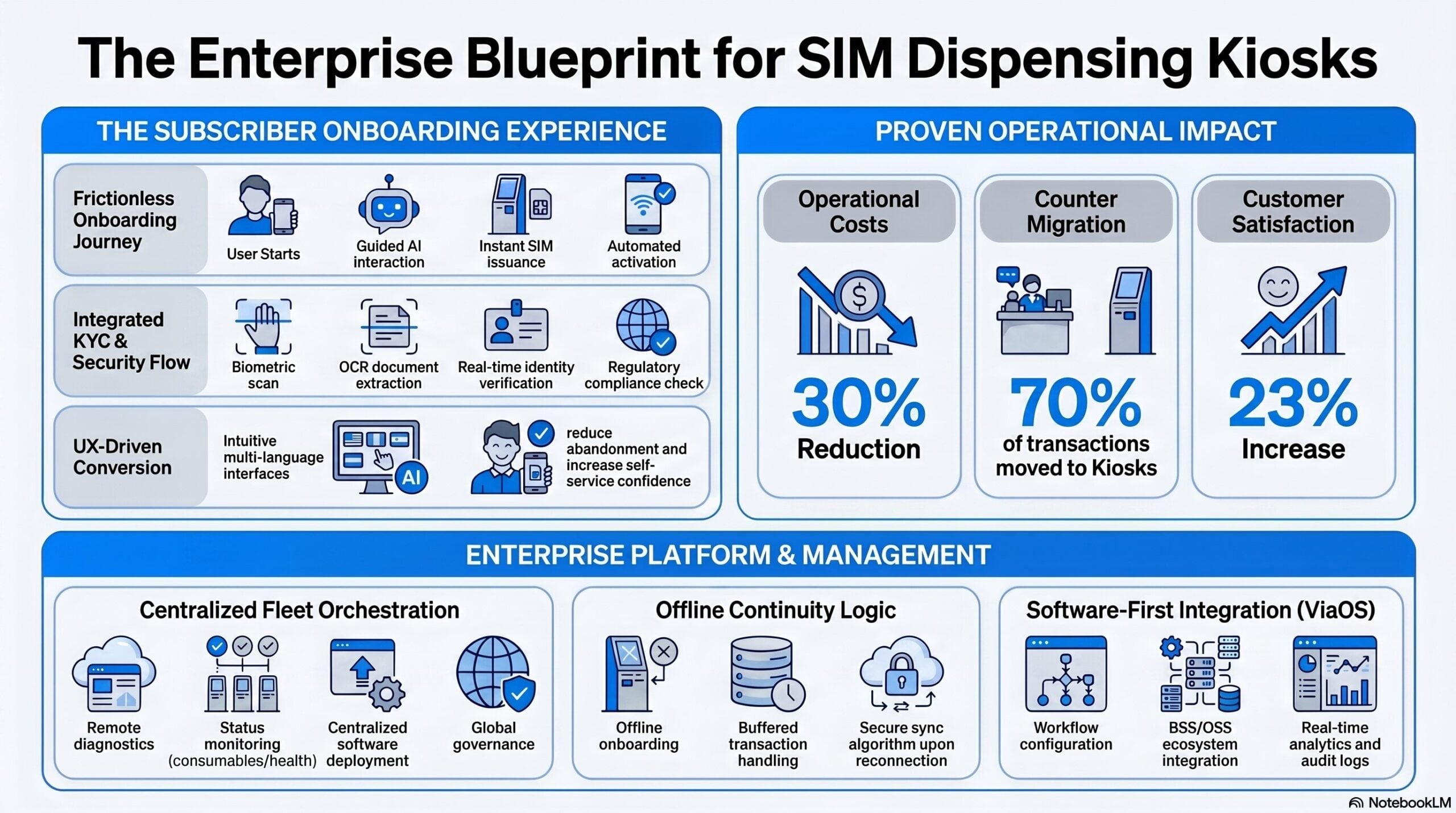
- Instant SIM issuance
- Automated activation workflows
- Guided onboarding journeys
- Real-time verification processes
Wavetec’s telecom self-service kiosk is built precisely around this model: instant SIM issuance, automated activation, and guided journeys that reduce counter dependency.
The goal is not just automation – it is faster customer conversion with lower operational dependency.
2. Evaluate KYC and Biometric Identity Verification Capabilities
For telecom operators, compliance and identity verification are non-negotiable.
A modern SIM dispensing kiosk should support biometric verification, OCR-based data extraction, and real-time KYC validation workflows, all of which are core to Wavetec’s SIM registration and verification solution.
In many regions, telecom regulations continue to tighten around subscriber identity management and fraud prevention.
Conventional SIM dispensing kiosk systems often rely heavily on manual intervention. Enterprise-grade platforms instead integrate compliance directly into the onboarding workflow.
3. Look Beyond Hardware: Evaluate the Kiosk Software Platform
Many telecom operators focus heavily on kiosk hardware while underestimating the importance of the software ecosystem behind it.
The software layer determines:
- Workflow flexibility
- Remote updates
- Analytics visibility
- Integration capability
- Customer experience consistency
ViaOS, Wavetec’s enterprise kiosk software platform, delivers exactly these central management dashboards, remote configuration, multi-site orchestration, RBAC, and audit logs in one purpose-built layer.
This is where telecom operators differentiate between device vendors and enterprise platform providers.
For a deeper breakdown of what to look for in a kiosk software platform, see Wavetec’s guide to how to choose the best kiosk software.
4. Centralized Fleet Management Is Critical at Scale
Managing 5 kiosks is different from managing 500.
As deployments grow across cities and countries, telecom operators need centralized visibility into kiosk uptime, consumable status, device health, transaction activity, software versions, and incident alerts. Without centralized fleet management, operational complexity rises rapidly.
Enterprise telecom environments require platforms capable of supporting remote diagnostics, predictive maintenance, centralized software deployment, and multi-country governance.
For telecom operators running large-scale deployments, this is where the distinction between a hardware vendor and a platform provider becomes clear. The ViaOS features page outlines how centralized monitoring, remote deployment, and telemetry work in practice.
5. Ensure Offline Capability for Business Continuity in Any Market
In many operating environments, connectivity interruptions are still a reality.
A telecom kiosk should support offline onboarding workflows, buffered transaction handling, secure data synchronization after reconnection, and transaction recovery mechanisms. This is particularly important in high-footfall retail environments, emerging markets, and remote deployment locations.
Wavetec’s SIM registration and verification platform is specifically built for developing markets, combining offline capability, optimized packet handling, and a synchronization algorithm that keeps operations running without coverage.
Operators evaluating long-term scalability should treat offline resilience as a core requirement, not an optional feature.
6. Focus on Customer Experience Throughout the SIM Journey
A kiosk that automates poorly still creates friction.
Modern telecom self-service should prioritize:
- Intuitive UI/UX
- Multi-language support
- Guided customer journeys
- AI-assisted interaction layers
- Accessible onboarding flows
Deloitte’s research on customer loyalty backs this up: up to 40% of a brand’s perceived value now comes from factors like service quality and experience, not price, meaning a frustrating self-service journey carries a real cost beyond the immediate transaction.
Advanced platforms now incorporate AI guidance layers, smart assistance workflows, and personalized onboarding paths. These capabilities help reduce abandonment rates while improving customer confidence during self-service interactions, a model explored in detail in Wavetec’s blog on top-ups to new SIMs: self-service retail at scale.
7. Evaluate BSS/OSS Integration and Ecosystem Flexibility
A telecom kiosk should integrate seamlessly into the operator’s broader digital ecosystem, including CRM systems, subscriber management systems, KYC databases, payment gateways, analytics platforms, and identity verification engines.
The best solutions are API-ready and designed for enterprise interoperability. Rigid, closed systems often become operational bottlenecks as telecom operators expand digital services. Wavetec’s telecom solutions are built to connect with these systems from day one, supporting operators across onboarding, service delivery, and analytics workflows.
8. Security and Governance Must Be Enterprise-Grade for Regulated Telecom Environments
Telecom operators handle sensitive customer data at scale.
The right platform should support:
- Secure transaction encryption
- RBAC access controls
- Audit trails
- Data governance policies
- Centralized compliance visibility
Enterprise buyers should also evaluate:
- ISO 27001 readiness
- SOC 2 alignment
- Regional compliance support
Security must extend across:
- Hardware
- Software
- User access
- Operational workflows
What to Look for in a SIM Dispensing Kiosk
| Evaluation Area | Basic Kiosk Approach | Enterprise Telecom Standard |
| SIM Issuance | Manual-assisted | Fully automated onboarding |
| KYC | Limited verification | Integrated biometric + OCR validation |
| Fleet Management | Local monitoring | Centralized multi-site control |
| Software Updates | Manual updates | Remote deployment & orchestration |
| Customer Experience | Static workflow | AI-guided, multilingual journeys |
| Analytics | Basic reporting | Real-time operational dashboards |
Industry Perspective
“Telecom self-service is no longer just about automation—it is about delivering scalable customer onboarding with operational intelligence and enterprise control.”
— Telecom Automation Specialist, Wavetec
Global Deployments Require More Than Hardware
Leading telecom operators are increasingly choosing partners that combine:
- Intelligent software
- Scalable hardware
- Centralized management
- Operational support
- Compliance readiness
Wavetec’s telecom solutions support operators in delivering faster SIM onboarding, streamlined service delivery, and scalable self-service experiences across high-volume environments.
Trusted by leading operators, including du Telecom, Wavetec continues to help telecom providers modernize customer engagement through enterprise-grade self-service infrastructure.
Conclusion
Choosing the right SIM dispensing kiosk is not simply a hardware decision. It is a decision about customer experience, operational scalability, compliance readiness, and long-term telecom automation strategy.
The most successful telecom operators are investing in platforms that combine intelligent onboarding, enterprise-grade governance, centralized operational control, and seamless digital integration.
As telecom environments continue evolving toward self-service and AI-assisted interactions, the right SIM dispensing kiosk platform becomes a strategic growth enabler, not just a deployment.
Explore Telecom Automation Solutions
Looking to modernize SIM onboarding and telecom self-service operations?
Explore Wavetec’s SIM Dispensing Kiosk, an enterprise-grade telecom automation designed for scalability, KYC compliance, and high-volume customer environments.
[Mapping: CTA requirement fulfilled]
FAQ
Q1. What is a SIM dispensing kiosk?
A SIM dispensing kiosk is a self-service telecom solution that automates SIM issuance, KYC verification, and customer onboarding.
Q2. Why are telecom operators investing in SIM dispensing kiosks?
To reduce onboarding time, lower branch congestion, improve customer experience, and scale self-service operations.
Q3. What features should telecom operators prioritize?
Key features include biometric verification, remote fleet management, offline capability, analytics dashboards, and API integrations.
Q4. Why is centralized fleet management important?
It allows operators to monitor, update, and manage large SIM dispensing kiosk deployments across multiple locations efficiently.
Related Reading
- SIM Dispensing Kiosk
- SIM Registration and Verification Solution
- Telecom Self-Service Kiosk
- Self-Service Kiosk Software / ViaOS
- Telecom Industry Solutions
- The Future of SIM Cards and SIM Dispensing Kiosks
- Top-Ups to New SIMs: Self-Service Retail at Scale
- How to Choose the Best Kiosk Software
Author: Clinton John, Asistant Brand Manager – Wavetec
BOOK A FREE DEMO