White glove customer service is a premium, highly personalized support model where businesses go beyond standard assistance to anticipate customer needs, tailor every interaction, and deliver a seamless, end-to-end experience. It is common in banking, healthcare, luxury retail, and enterprise SaaS, where high-value customers expect proactive, attentive care.
Standard customer service no longer differentiates brands in competitive markets. Customers have experienced what good service looks like, and they now expect more.
They want to be known, not just processed.
They want problems solved before they have to ask.
They want interactions that feel personal, not scripted.
This shift in expectations has pushed businesses to rethink their service models. The answer for many is white glove customer service.
The term comes from the white gloves worn by English butlers when handling fine silver, a symbol of care and respect for valuable items.
In business, it means treating every customer interaction with that same level of attention. Zendesk’s 2025 CX Trends research found that 95% of consumers say customer service directly impacts their brand loyalty, and 89% are more likely to make a repeat purchase after a positive service experience.
Service quality is no longer just a differentiator. It is a direct revenue driver. This guide explains what white glove service is, how it works, and how businesses can implement it effectively.
Wavetec customer journey management provides the operational foundation for delivering consistent white glove experiences.
What Is White Glove Customer Service?
White glove customer service is a premium support model where every interaction is handled with proactive care, attention to detail, and a personalized touch that anticipates needs before they arise.
It is sometimes called concierge-style service, though white glove typically implies a higher degree of ongoing proactive attention rather than on-demand assistance.
The term traces back to English household staff who wore white gloves when handling fine silver and delicate valuables, keeping the oils from their skin from tarnishing what they touched. That image of care, precision, and respect for what matters to the recipient defines the standard today.
The distinction from standard customer service comes down to three shifts in approach.
- Standard service is reactive, resolving issues after they are raised. White glove service is proactive, anticipating potential issues and reaching out first.
- Standard service is generic, applying a consistent process to every customer. White glove service is personalized, adapting to each customer’s individual history, preferences, and context.
- Standard service is transactional, closing the ticket or inquiry. White glove service is relational, maintaining the relationship through follow-up, check-ins, and ongoing attentiveness beyond the immediate interaction.
A concrete example makes the difference clear. Standard service: a customer calls a helpdesk, waits on hold, explains their issue, receives a solution, and the call ends.
- White glove service: a customer receives a proactive email before their subscription renews, offering to review usage and recommend optimizations.
- A dedicated account manager reaches out quarterly with insights. When the customer does need help, they are connected immediately to someone who knows their history. The experience feels effortless because the work happens behind the scenes.
Key Characteristics of White Glove Service
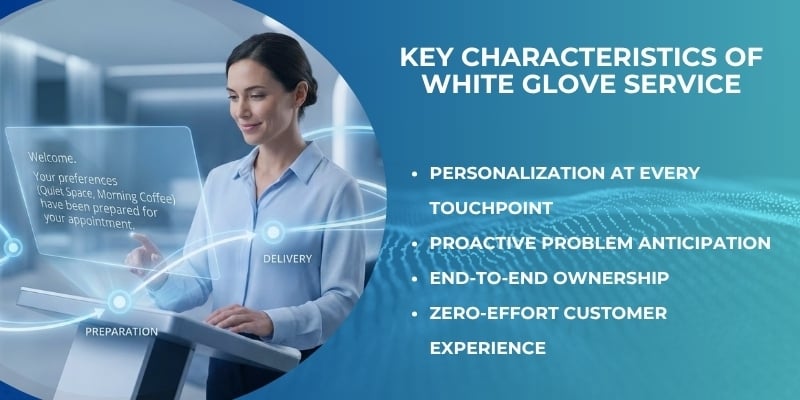
White glove service is defined by four core characteristics that distinguish it from standard support.
Personalization at Every Touchpoint
Every interaction is tailored to the individual customer’s history, preferences, and context, not a scripted template. A white glove provider knows who the customer is before they speak. They remember past interactions, preferences, and pain points. They use this knowledge to make every interaction feel personal.
Twilio Segment’s State of Personalization research found that 57% of customers say they will spend more with a brand that delivers a personalized experience, directly validating the business case for white glove service models that prioritise individual attention over standardized support.
Proactive Problem Anticipation
White glove teams identify and resolve issues before the customer raises them. They monitor usage patterns, service history, and customer behaviour for signs of potential problems.
When a customer’s usage drops, they reach out to check in. When a service disruption is imminent, they notify affected customers before they notice the issue. This proactive stance transforms service from a cost centre into a relationship builder.
End-to-End Ownership
One team or person owns the customer’s journey from enquiry to resolution, removing handoff frustration. The customer never needs to repeat themselves to different departments. The person who answers the first call stays with the customer until the issue is fully resolved.
This continuity builds trust and eliminates the friction of being passed around.
Zero-Effort Customer Experience
The customer is never asked to repeat themselves or chase for updates. Information is captured once and shared across the team. Updates are provided proactively. The customer feels like the system works for them, not the other way around. This zero-effort experience is the hallmark of true white glove service.
Industries Where White Glove Service Matters Most
White glove service has expanded from its luxury origins into any business where customer relationships are high-value and retention matters.
- Banking and Private Wealth: High-net-worth clients expect personalized financial advice, priority access, and a dedicated relationship manager. A private bank that makes a client wait for basic service undermines the trust that underpins the relationship. White glove service in banking means the client never waits, their history is always known, and their advisor reaches out proactively with relevant opportunities.
- Enterprise SaaS: Software platforms with enterprise customers face intense competition. Switching costs are high, but so are the stakes. White glove service in SaaS means dedicated customer success managers, proactive usage reviews, and priority support. The goal is to make the customer feel like a partner, not a revenue source.
- Healthcare: Patients with complex conditions or high-value insurance plans expect coordinated, attentive care. White glove service in healthcare means appointment scheduling that works around the patient, proactive communication about test results, and a care coordinator who owns the entire journey.
- Luxury Retail: High-end brands have always understood white glove service. Personal shoppers, private appointments, and seamless returns are standard. The expectation is that the service matches the quality of the product.
- Hospitality: Five-star hotels and premium travel services have built their reputations on white glove service. personalized welcome, recognition of returning guests, and anticipatory service are the norm.
- Government VIP Services: Some government agencies offer priority service for diplomats, elected officials, or citizens with special needs. White glove service ensures these individuals receive efficient, respectful treatment.
Wavetec’s customer journey management platform supports white glove service delivery across these industries by providing the operational visibility needed to personalise every interaction.
White Glove Service vs. Standard Customer Service
The differences between white glove and standard service are clear across every dimension.
| Dimension | Standard Customer Service | White Glove Service |
| Response Time | Hours or days, standard queue | Immediate, priority access |
| Personalization | Generic scripts, one-size-fits-all | Tailored to individual history and preferences |
| Stance | Reactive, waits for issues to be raised | Proactive, anticipates and prevents issues |
| Ownership | Handoffs between departments | End-to-end ownership by one team |
| Staff Training | Product knowledge focus | Emotional intelligence and relationship skills |
| Business Outcome | Cost minimization | Customer retention and lifetime value |
The operational implications are significant. Standard service is designed for efficiency and scale. White glove service is designed for relationship and retention. Standard service handles high volumes. White glove service handles high-value relationships. Both have their place, but the expectations and outcomes are fundamentally different.
How to Implement White Glove Customer Service
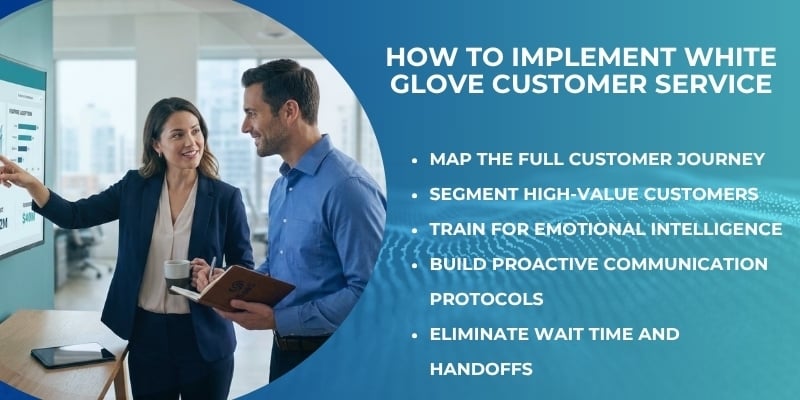
Implementing white glove service requires a systematic approach that touches every part of the organization.
Step 1: Map the Full Customer Journey
Identify every touchpoint where friction currently exists.
- Where do customers wait?
- Where do they repeat themselves?
- Where do they receive inconsistent information?
Mapping the journey reveals the gaps that white glove service must address. This is not a one-time exercise. The journey map should be reviewed and updated regularly.
Step 2: Segment High-Value Customers
Not every customer needs white glove service. Identify your top tier first.
- In banking, this might be high-net-worth clients.
- In SaaS, enterprise customers with significant contracts.
- In healthcare, patients with complex conditions.
Start with the segment where the ROI is highest and expand as capabilities grow.
Step 3: Train for Emotional Intelligence
White glove staff need empathy skills as much as product knowledge. They must be able to read customer emotions, de-escalate tension, and build rapport quickly.
Training should cover active listening, tone management, and conflict resolution. Product knowledge is table stakes. Emotional intelligence is the differentiator.
Step 4: Build Proactive Communication Protocols
Define when staff reach out first, before the customer contacts you. This might be a quarterly check-in call, a usage review email, or a notification about an upcoming renewal.
Proactive communication signals that you are paying attention and that the customer matters.
Step 5: Eliminate Wait Time and Handoffs
Use queue management and appointment systems to ensure service is ready when the customer arrives.
- A customer who waits unexpectedly does not feel like a VIP.
- A customer who is passed between departments feels like a burden.
Eliminating these friction points is the operational foundation of white glove service.
Wavetec’s queue management system enables zero-wait experiences through appointment scheduling, priority queuing, and real-time staff alerts.
How Queue Management Supports White Glove Service Delivery
A seamless queue or appointment experience is the operational foundation of white glove service. No matter how skilled the staff or how personalized the interaction, a customer who waits unexpectedly does not feel like a VIP.
- Pre-arrival appointment booking allows customers to schedule service at their convenience. The system reserves time and resources, ensuring that the customer is expected and prepared for.
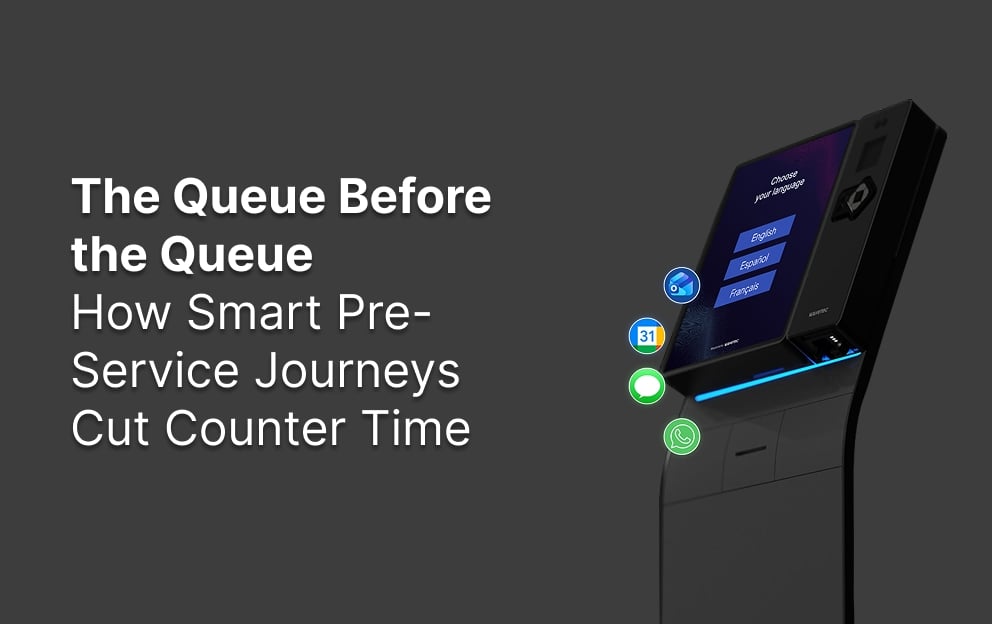
- Zero-wait kiosk check-in eliminates the frustration of standing in line. Customers check in at a self-service kiosk and are immediately added to a priority queue. Staff are notified of their arrival and can prepare for the interaction.
- Real-time staff alerts ensure that the right person is ready when the customer arrives. The queue management system notifies the assigned staff member, giving them time to review the customer’s history and prepare.
- Digital signage for status updates keeps customers informed without requiring them to approach the counter. They can see their position in the queue and estimated wait time, reducing anxiety and eliminating “how much longer?” interruptions.
Wavetec’s self-service kiosks provide the frictionless check-in experience that white glove customers expect.
Measuring the ROI of White Glove Customer Service
White glove service is an investment, and like any investment, it must deliver returns. Several metrics are essential for tracking performance.
- NPS uplift measures the improvement in customer advocacy. A customer who experiences white glove service is more likely to recommend the brand. Tracking NPS by service tier reveals the impact of white glove investment.
- Customer lifetime value measures the total revenue from a customer over their relationship with the brand. White glove service should increase CLV through higher retention, more frequent purchases, and larger transaction sizes.
- Churn reduction measures how many customers leave. White glove service should reduce churn among high-value customers. Even a small reduction in churn can generate significant revenue.
- Referral rate measures how many new customers come from existing customers. Satisfied white glove customers are powerful advocates.
To calculate the revenue value of a one-point NPS improvement, estimate the average revenue per customer, multiply by the number of customers, and apply the correlation between NPS and retention.
According to Harvard Business Review, a 5% increase in retention can increase profits by 25–95%. White glove service that reduces churn delivers measurable ROI.
Case Study – BBVA Peru Elevates Premium Banking Through Intelligent Queue Management
As customer expectations evolved, BBVA Peru needed to deliver a faster, more personalized branch experience across its nationwide network while reducing unnecessary waiting and operational bottlenecks.
Traditional first-in, first-out queues offered little flexibility for premium customers and limited visibility into branch demand.
BBVA Peru Creates a White Glove Banking Experience with Smart Queue Orchestration
BBVA Peru partnered with Wavetec to deploy its cloud-based Spectra Queue Management System across 278 branches, creating a seamless customer journey that begins even before customers enter the branch.
Through mobile app integration, customers can generate a digital turn in advance, reducing physical waiting while allowing the bank to prepare for each visit before arrival.
The platform combines kiosk-based ticketing, CRM-integrated priority logic, digital signage, virtual queue management, and real-time analytics to personalize every interaction.
Premium customers receive intelligent queue prioritization, while branch staff gain complete visibility into customer history and service requirements before the interaction begins.
Real-time dashboards also allow managers to monitor branch traffic, predict peak demand, and allocate staff proactively.
The results demonstrate how operational excellence supports white glove service delivery at scale.
BBVA Peru reduced average wait times by approximately 35%, decreased queue abandonment by 57%, and maintained 99.93% system uptime across its nationwide branch network.
By removing uncertainty, minimising wait times, and ensuring personalized service from arrival to completion, the bank created a premium branch experience that strengthens customer loyalty while improving operational efficiency.
This deployment illustrates that white glove customer service depends not only on highly trained staff, but also on intelligent customer journey technology that enables personalized, frictionless experiences at every touchpoint.
FAQs
What is white glove customer service?
White glove customer service is a premium, highly personalized support model where businesses anticipate customer needs, tailor every interaction, and deliver proactive, end-to-end service.
It goes beyond standard support to create effortless, memorable experiences for high-value customers.
What industries use white glove service?
White glove service is common in banking and private wealth, enterprise SaaS, healthcare, luxury retail, hospitality, and government VIP services.
Any business where customer relationships are high-value and retention matters can benefit from a white glove approach.
How does white glove service differ from standard support?
Standard support is reactive, generic, and transactional. White glove service is proactive, personalized, and relational.
White glove customers receive priority access, dedicated ownership, and anticipatory communication. Standard support handles volume; white glove service handles relationships.
How do you measure white glove customer service?
Key metrics include NPS uplift, customer lifetime value, churn reduction, and referral rate. A one-point NPS improvement can translate to significant revenue through increased retention and advocacy. White glove service should deliver measurable improvements across these metrics.
Can small businesses offer white glove service?
Yes. White glove service is about attitude and attention, not budget. A small business can assign dedicated account managers, send personalized follow-ups, and proactively reach out to customers. The key is to focus on a defined segment and deliver consistently exceptional service.
Conclusion
White glove customer service has expanded from luxury sectors to any business where customer relationships are high-value and retention matters.
The core principles remain the same: personalization, proactivity, ownership, and zero-effort experiences.
Implementing white glove service requires a systematic approach: mapping the customer journey, segmenting high-value customers, training for emotional intelligence, building proactive communication protocols, and eliminating wait time and handoffs.
Wavetec’s queue, appointment, and journey management platform provides the operational foundation for white glove delivery.
By ensuring that customers are expected, prepared for, and never left waiting, Wavetec enables businesses to deliver the kind of service that builds loyalty and drives revenue.
BOOK A FREE DEMO