“Two-way SMS in queue systems enables interactive communication between businesses and customers. Customers receive updates about queue position or appointment status and can reply to confirm, reschedule, cancel, or ask questions: all through simple text messages.”
Customer communication is the backbone of effective queue management. When customers know where they stand, how long they will wait, and when it is their turn, their experience improves dramatically.
Traditional queue systems often rely on one-way notifications: a message is sent, but the customer cannot respond. This limitation creates frustration when plans change, appointments are missed, or customers have simple questions that require a reply.
Real-time, interactive communication is no longer a luxury. Customers expect to confirm, reschedule, or cancel with a simple text. They want updates pushed to their phones and the ability to respond without downloading an app or waiting on hold.
Two way SMS systems solve this problem by enabling bidirectional messaging between businesses and customers. This article explores how two-way SMS works in queue environments, its key use cases, and the measurable benefits for customer engagement.
Wavetec integrates two-way SMS into its queue management system, helping organizations communicate smarter.
What Is Two-Way SMS in Queue Systems?
Two-way SMS in queue systems refers to the ability for businesses and customers to exchange text messages in real time as part of the queuing and service process.
Unlike one-way notifications, where a business sends a message (such as “Your ticket number is 42”) and the customer cannot reply, two-way SMS allows customers to respond.
The response is automatically processed by the queue management system, triggering actions such as confirming an appointment, canceling a booking, requesting a status update, or providing feedback.
In a queue environment, two-way SMS works by integrating a messaging gateway with the queue management platform.
- When a customer checks in or books an appointment, the system captures their mobile number.
- Throughout the service journey, the system sends automated messages: appointment reminders, queue position updates, wait time estimates, or service readiness alerts.
- Each message includes a simple reply option, such as “Reply 1 to confirm, 2 to reschedule, 3 to cancel.”
- The customer’s response is processed instantly, updating the queue, notifying staff, or rescheduling the appointment without any human intervention.
- This interactive capability transforms the customer experience from passive waiting to active engagement.
Customers feel in control because they can communicate their needs directly through a channel they already use daily: text messaging. No app download, no login, no phone tree. Just simple, familiar, and fast SMS.
How Two-Way SMS Works in Queue Management Systems
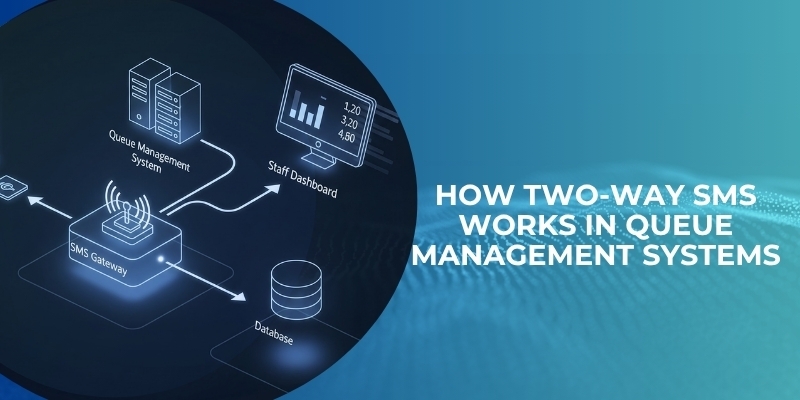
Understanding the technical flow helps appreciate the seamlessness of two-way SMS. When a customer interacts with a queue system, several steps occur automatically.
- First, the customer provides their mobile number. This can happen during online appointment booking, at a self-service kiosk check-in, or when a staff member registers them. The queue management system stores the number along with the customer’s ticket or appointment record.
- Second, the system triggers automated messages based on predefined rules. For example, an appointment reminder may be sent 24 hours before a scheduled visit. A queue position update may be sent every 15 minutes for customers in a virtual queue. A “your turn is approaching” message may be sent when the customer is third in line.
- Third, the customer replies to the message using a simple keyword or number. The system receives the reply through an SMS gateway, parses the response, and matches it to the customer’s active record. A reply of “1” might confirm an appointment. “2” might request a 30-minute delay. “3” might cancel entirely. The system updates the queue or appointment calendar instantly.
- Fourth, any changes are reflected in real time across all connected systems. Staff dashboards show updated appointment status. Queue displays adjust positions. Other customers may move up if a cancellation occurs. The customer receives a confirmation reply: “Your appointment has been confirmed for Tuesday at 10 AM.”
All of this happens without any human staff member reading or responding to individual messages. The automation handles routine interactions, freeing staff to focus on complex customer needs.
Why Two-Way SMS Is Essential for Customer Engagement
Real-time communication is the foundation of positive customer experiences in service environments. Two-way SMS addresses several critical needs that one-way notifications cannot.
- Customers want convenience. They do not want to call a business to confirm an appointment or check their queue status. They want to send a quick text. SMS is universal, works on any phone, and does not require an internet connection. Two-way SMS meets customers where they already are.
- Missed appointments and no-shows are costly. Research shows that appointment reminders reduce no-show rates significantly, but one-way reminders only inform. Two-way reminders allow customers to actively confirm or cancel, giving businesses accurate counts and the ability to fill cancelled slots.
- Confusion during waiting is a major source of frustration. Customers who receive a queue position update but cannot respond may still have questions: “How much longer?” “Can I step out for coffee?” “Is the wait shorter if I use a different counter?” Two-way SMS lets them ask, and automated replies can answer common questions instantly.
- Two-way SMS does not require customers to download an app, create an account, or learn a new interface. The barrier to entry is zero. This makes it accessible to all demographics, including older adults who may be less comfortable with mobile apps but are perfectly capable of sending a text.
Key Use Cases of Two-Way SMS in Queue Systems
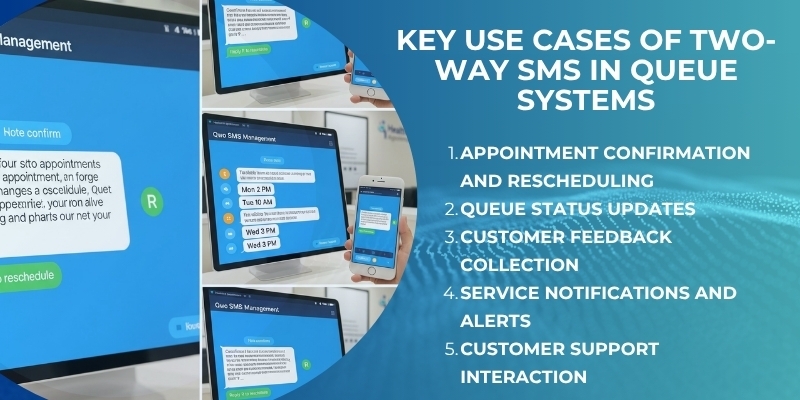
Two-way SMS can be applied across many scenarios in queue management. Each use case addresses a specific customer need or operational challenge.
Appointment Confirmation and Rescheduling
Appointment-based services are common in banking, healthcare, and government offices. Two-way SMS allows customers to confirm, reschedule, or cancel appointments with a simple reply.
In appointment-based settings, this lets customers confirm, cancel, or reschedule via reply, smoothing staff planning. The system automatically updates the appointment calendar, frees up slots for other customers, and reduces no-show rates.
Customers appreciate the flexibility to adjust plans without making a phone call.
Queue Status Updates
For walk-in customers, two-way SMS provides real-time visibility into their queue position and estimated wait time.
A customer checks in at a kiosk and receives a text: “You are number 12 in line. Estimated wait: 15 minutes.” Ten minutes later, another text: “You are now number 5. Estimated wait: 5 minutes.” When they are next, a final text: “Your turn is now. Please proceed to counter 3.”
The customer never needs to stand in a physical line or watch a display nervously. They can wait comfortably elsewhere and return when ready.
Customer Feedback Collection
After service is completed, two-way SMS can collect satisfaction feedback. A message asks: “How was your service today? Reply 1 for Excellent, 2 for Good, 3 for Poor.” The customer’s reply is logged in the system, providing real-time feedback metrics.
Negative responses can trigger automatic alerts for managers to follow up. This immediate, low-effort feedback collection yields higher response rates than email surveys.
Service Notifications and Alerts
Delays happen. A service counter may be short-staffed. A piece of equipment may be down.
Two-way SMS allows businesses to proactively notify waiting customers: “We are experiencing delays. Your wait time has increased by 10 minutes. Reply 1 to keep your place, 2 to reschedule.“
Customers who cannot wait can reschedule immediately, reducing walkouts and frustration.
Customer Support Interaction
Simple customer queries can be handled via two-way SMS without tying up phone lines. A customer might ask: “What documents do I need for a passport renewal?” The system can be programmed to recognize keywords and reply with standard answers.
If the query is too complex, the system can escalate by providing a phone number or transferring to a live agent. This hybrid approach improves efficiency while maintaining service quality.
Benefits of Two-Way SMS in Queue Management Systems
Organizations that implement two-way SMS realize multiple benefits that directly impact customer satisfaction and operational costs.
- Improved customer engagement is the most obvious benefit. Customers feel informed, respected, and in control when they can communicate interactively. Engagement metrics such as message open rates for SMS are over 90%, far exceeding email. Customers actually read and respond to SMS, making it a highly effective engagement channel.
- Reduced no-shows result from confirmation and reminder capabilities. When customers must actively confirm or cancel, they are less likely to forget or skip appointments. Those who cannot attend cancel, allowing the business to offer the slot to someone else. No-show rates typically drop by 30–50% with two-way SMS reminders.
- Faster communication compared to phone calls or email. An SMS exchange takes seconds. Customers do not wait on hold. Staff do not spend time on routine calls. Automation handles the bulk of interactions, so response times are immediate.
- Increased operational efficiency follows from reduced manual work. Staff no longer need to call customers to confirm appointments or answer simple questions. The system handles these tasks automatically, freeing staff for higher-value activities.
- Better customer satisfaction is the ultimate result. Customers who experience fast, convenient, and interactive communication rate their service experience higher. Satisfaction scores improve, and negative reviews decrease.
The cost difference is substantial: the average phone support call runs about $16 per interaction, while SMS conversations typically cost $1 to $5.
Two-Way SMS in Wavetec Queue Management Solutions
Wavetec integrates two-way SMS communication directly into its queue management, appointment booking, and customer journey platforms.
The solution is designed for organizations that need reliable, automated, and scalable messaging capabilities.
- Queue management systems from Wavetec capture customer mobile numbers at check-in points including self-service kiosks, staff tablets, and online portals. The system then sends automated SMS updates throughout the service journey. Customers receive their ticket number, queue position, and wait time estimates. When their turn approaches, they receive a final notification. All messages include reply options for common actions such as requesting an update or notifying of a delay.
- Appointment booking solutions integrate two-way SMS for confirmation, reminder, and rescheduling workflows. When a customer books online, they receive an immediate confirmation text. Reminders are sent 24 hours and 1 hour before the appointment. Customers can reply to confirm, reschedule to a later time, or cancel entirely. The system updates the appointment calendar in real time and sends confirmation of any changes.
- Customer journey management platforms from Wavetec use two-way SMS to maintain engagement across the entire service lifecycle. Pre-visit, in-queue, and post-visit messaging creates a continuous communication thread. Customers feel connected to the business even when they are not physically present.
- All SMS workflows are configured through an easy-to-use dashboard. Managers set message templates, scheduling rules, and reply handling logic. No coding is required. The system integrates with leading SMS gateways to ensure reliable delivery and compliance with messaging regulations.
Case Study – Improving Customer Engagement with Two-Way SMS
Organizations implementing Wavetec’s queue management solutions have enhanced customer engagement by integrating real-time, interactive communication into their service journeys.
These deployments demonstrate how two-way SMS, combined with a virtual queuing solution, enables greater flexibility, reduces uncertainty, and improves overall service experience.
Nasfund – Enabling Customer Interaction Through WhatsApp and Messaging Channels
Nasfund, the largest private pension fund in Papua New Guinea, implemented Wavetec’s queue management system with integrated messaging capabilities, including WhatsApp-based interaction.
Customers could join queues remotely, receive updates on their service status, and communicate directly through familiar messaging channels. This reduced the need for physical waiting and allowed customers to manage their visits more efficiently.
The integration of messaging into the queue journey enabled customers to stay informed and take action without visiting the branch prematurely. By allowing customers to engage remotely and interact with the system, Nasfund significantly improved accessibility and customer convenience.
BCI Bank – Enhancing Customer Communication with Real-Time Updates
BCI Bank leveraged Wavetec’s queue management and digital engagement solutions to improve communication with customers during branch visits.
Customers received timely updates about their queue status, reducing uncertainty and improving transparency during waiting periods. While traditional systems relied on passive displays, this implementation extended communication directly to customers, enabling a more connected and responsive experience.
By keeping customers informed and engaged throughout their journey, the bank improved satisfaction and reduced perceived wait times.
Maduro & Curiel Bank – Improving Responsiveness in Customer Service Journeys
Maduro & Curiel Bank implemented Wavetec’s queue management system to optimize service delivery and enhance customer interaction.
The system enabled better communication between the bank and its customers by providing timely service updates and structured service flows. Customers were no longer left uncertain about their wait times or service status, as the system ensured continuous engagement throughout the process.
This improved responsiveness reduced frustration, increased trust, and created a more predictable and controlled service environment.
Challenges of Implementing Two-Way SMS Systems
While two-way SMS offers significant benefits, organizations may face challenges during implementation.
- Integration with existing systems is the most common technical hurdle. The SMS gateway must connect to the queue management platform, appointment calendar, and customer database. APIs and middleware may be required to ensure smooth data flow. Organizations should choose solutions with pre-built integrations or robust API documentation.
- Managing message volumes can become complex for large organizations. Thousands of customers may receive messages daily, and each reply must be processed and matched to the correct record. The system must handle peak loads without delays. Scalable SMS gateways and well-architected queue systems are essential.
- Ensuring data privacy is a legal requirement. Customer mobile numbers are personal data. Organizations must comply with regulations such as GDPR, TCPA, or local data protection laws. Consent must be obtained before sending messages. Opt-out mechanisms must be provided. Data must be stored securely and not shared improperly.
- Handling customer responses effectively requires careful design of reply logic. Simple keywords like “1” or “CONFIRM” are easy for customers but may be misunderstood if the system expects a specific format. The system should be forgiving, using natural language processing or flexible matching. Unrecognized replies should be escalated to a human agent or trigger a help message.
Future of SMS in Customer Experience and Queue Systems
The role of SMS in customer experience will continue to evolve alongside advancements in messaging technology and customer expectations.
- AI-powered messaging will enable more sophisticated interactions. Instead of simple keyword replies, AI will understand natural language. A customer who texts “I’m going to be 20 minutes late” will trigger an automatic rescheduling workflow. The system will understand intent, not just specific commands.
- Chatbots via SMS will handle more complex queries without human intervention. A customer might ask, “What is the current wait time for passport renewal?” The chatbot will query the queue system and reply with the answer. If the query is beyond its scope, it will seamlessly transfer to a live agent via SMS or phone.
- Omnichannel communication integration will connect SMS with other channels such as WhatsApp, web chat, and mobile apps. Customers will be able to start a conversation on one channel and continue on another. The queue system will maintain context across channels, providing a truly seamless experience.
- Personalized messaging will use customer data to tailor SMS content. A frequent visitor might receive a VIP notification. A customer with a known preference for morning appointments might receive reminders at different times. Personalization increases engagement and satisfaction.
FAQs
What is two-way SMS in queue management systems?
Two-way SMS in queue management systems enables interactive text messaging between businesses and customers. Customers receive updates about queue position, wait times, or appointments and can reply to confirm, reschedule, cancel, or ask questions.
How does two-way SMS improve customer engagement?
Two-way SMS improves engagement by giving customers a direct, convenient channel to communicate. They feel informed and in control. Response rates are high because SMS is familiar and immediate, and customers appreciate not having to call or visit in person for simple interactions.
Can customers reschedule appointments via SMS?
Yes. With two-way SMS, customers can reply to an appointment reminder with a keyword such as “RESCHEDULE” or a number like “2.” The system then guides them through available time slots or sends a link to reschedule online. The entire process is automated.
Is two-way SMS better than email or calls?
For time-sensitive communications like queue updates and appointment reminders, SMS is better because messages are read within minutes, not hours or days. SMS is also less intrusive than a phone call and more accessible than email for many customers. Cost per interaction is lower than voice calls.
Which industries use two-way SMS in queue systems?
Banking, healthcare, retail, government services, hospitality, and transportation all use two-way SMS. Any organization that manages customer queues or appointments can benefit from interactive messaging to reduce no-shows, improve communication, and enhance customer satisfaction.
Conclusion
Two way SMS systems transform queue management from a passive waiting experience into an active, engaging conversation.
Customers appreciate the ability to confirm, reschedule, or check their status with a simple text. Businesses benefit from reduced no-shows, lower operational costs, and higher satisfaction scores.
The integration of two-way SMS into queue systems is no longer a nice-to-have; it is a competitive necessity for organizations that serve customers in person.
Wavetec provides advanced, communication-enabled queue solutions that incorporate two-way SMS alongside appointment booking, self-service kiosks, and digital signage.
For organizations ready to modernize their customer engagement, two-way SMS offers a proven, high-ROI path forward.
BOOK A FREE DEMO