Arrival management is the practice of planning, communicating, and structuring how customers or citizens arrive for a scheduled service, beginning before they leave their home or office. It uses appointment scheduling, pre-arrival reminders, digital check-in, and real-time routing to ensure every visitor arrives prepared, on time, and directed to the right service point without unnecessary waiting.
Many businesses assume that customer experience starts when a person walks through the door.
- A bank branch manager focuses on the lobby.
- A clinic administrator watches the waiting room.
- A government office manager monitors the queue at the counter.
This assumption is understandable but costly. The customer’s experience does not begin at the entrance. It begins when they schedule the appointment, when they receive the confirmation, when they wonder what to bring, and when they worry about finding the right building.
The anxiety, confusion, and disorganization that drive service dissatisfaction often start in the journey before arrival. By the time the customer reaches the door, their perception of the experience is already forming.
Arrival management is the discipline of structuring this pre-arrival experience. It uses appointment scheduling, pre-arrival reminders, digital check-in, and real-time routing to ensure every visitor arrives prepared, on time, and directed to the right service point.
This guide explains what arrival management is, why it matters, and how to implement it. Wavetec’s queue management system includes appointment and pre-arrival tools that make arrival management practical and effective.
What Is Arrival Management?
Arrival management is the practice of planning, communicating, and structuring how customers or citizens arrive for a scheduled service, beginning before they leave their home or office. It covers every step from the moment a customer books an appointment to the moment they are seated and ready for service.
The scope of arrival management includes several key elements.
- Appointment booking is the first step, where customers select a date, time, service type, and location.
- Confirmation is sent immediately with a calendar invite and basic instructions.
- Pre-arrival reminders follow, typically at 24 hours and 2 hours before the appointment, including what to bring, where to go, and what to expect on arrival.
- Document preparation prompts help customers gather required paperwork, reducing incomplete submissions at the counter.
- Digital pre-check-in allows customers to confirm arrival via a mobile link before entering the building.
- Wayfinding instructions guide customers to the correct entrance, floor, or department. Expected wait time communication sets realistic expectations.
Arrival management is distinct from queue management. Queue management begins when the person is already on-site, organizing the order of service and managing the physical waiting experience.
Arrival management starts earlier, shaping the customer’s experience before they arrive. Both are essential, but they operate at different stages of the customer journey.
Why the Customer Experience Starts Before They Walk In
The psychology of anticipation is well understood. Anxiety builds before arrival, not only during waiting.
A customer who is uncertain about what to bring, where to go, or how long it will take experiences stress that colors their entire perception of the service. This pre-visit emotion is often more powerful than the in-person experience itself.
Uncertainty is the primary driver of negative pre-visit emotion. A customer who does not know whether they need to bring identification, whether they need to fill out forms in advance, or whether they need to arrive early for parking feels unsettled.
A customer who is unsure about the location, particularly in a large medical campus or government complex, feels anxious about being late. A customer who does not know how long the appointment will take cannot plan their day, adding to their stress.
PwC’s Future of Customer Experience survey found that 73% of consumers say customer experience is an important factor in their purchasing decisions, and the moments of highest anxiety in a service journey, including arrival, waiting, and uncertainty about what happens next, are the most decisive in shaping overall perception of a brand. This finding frames the case for managing the pre-arrival phase proactively.
If the most decisive moments are the ones where anxiety is highest, then reducing that anxiety through clear communication and structured arrival processes is a direct path to higher satisfaction.
The cost of ignoring the pre-arrival phase is significant. Customers who arrive anxious are more likely to be dissatisfied, even if the service itself is good. Customers who arrive unprepared may need to reschedule, creating operational inefficiency.
Customers who arrive late disrupt the schedule for everyone. Arrival management addresses these problems before they occur.
The Five Stages of an Arrival Management Workflow
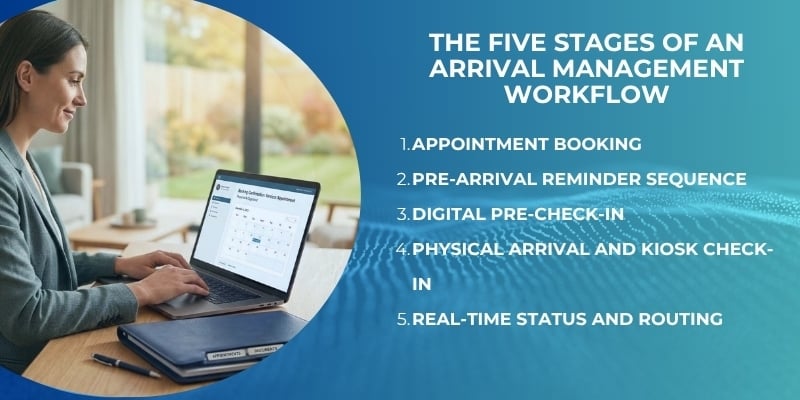
An effective arrival management workflow follows five stages, each with specific benefits for the customer and the service provider.
Stage 1: Appointment Booking
The customer selects a date, time, service type, and location. The system confirms the booking immediately and sends a calendar invite with basic details.
For the customer, this provides certainty and a record of the commitment. For the provider, it creates a predictable demand stream that enables capacity planning.
Stage 2: Pre-Arrival Reminder Sequence
Reminders at 24 hours and 2 hours before the appointment include what to bring, where to go, and what to expect on arrival. The 24-hour reminder gives customers time to prepare. The 2-hour reminder catches those who might have forgotten.
Multi-channel delivery, including SMS, WhatsApp, and email, ensures the message is received. For the customer, this reduces anxiety and ensures preparedness. For the provider, it reduces no-shows and incomplete submissions.
Stage 3: Digital Pre-Check-In
The customer confirms arrival via a mobile link before entering the building. This might be a simple “I’m on my way” button or a more detailed confirmation.
For the customer, this provides a sense of progress and reduces uncertainty. For the provider, it provides early visibility into who will actually arrive, enabling better resource allocation.
Stage 4: Physical Arrival and Kiosk Check-In
A self-service kiosk validates the appointment and issues a queue ticket. The customer checks in, confirms their details, and receives a ticket number.
For the customer, this is a frictionless transition from digital to physical. For the provider, it captures arrival data and routes the customer into the queue system.
Stage 5: Real-Time Status and Routing
Digital displays show queue position and direct the customer to the correct waiting area. The customer can see their status without approaching the counter.
For the customer, this provides transparency and reduces anxiety. For the provider, it eliminates the “how much longer?” interruptions that plague staff.
How Arrival Management Reduces Wait Times and No-Shows
Arrival management reduces wait times through a simple operational logic: pre-arrival workflow organizes demand before it arrives, reducing walk-in surges and unplanned queues.
When customers book appointments and receive reminders, their arrivals are spread across the day rather than concentrated at opening time.
When customers complete digital pre-check-in, the provider knows exactly who is coming and can prepare accordingly. When customers arrive with the right documents and information, service is faster.
The connection to no-show reduction is equally direct. Customers who complete a digital pre-check-in are significantly less likely to skip the appointment.
- The act of confirming creates a psychological commitment.
- The reminders reinforce that commitment.
- The preparation prompts make the appointment feel more real and more important.
McKinsey research on customer journey redesign consistently finds that addressing the full end-to-end journey, including pre-arrival touchpoints, improves customer satisfaction by up to 20% and reduces cost to serve by 15-20%, compared to optimizing individual service touchpoints in isolation without addressing what happens before the customer walks in. This establishes the ROI framework for arrival management.
The investment in pre-arrival tools pays for itself through reduced no-shows, shorter service times, and higher satisfaction.
Wavetec customer journey management integrates arrival management with queue management, creating a seamless flow from booking to service completion.
Arrival Management Across Key Industries
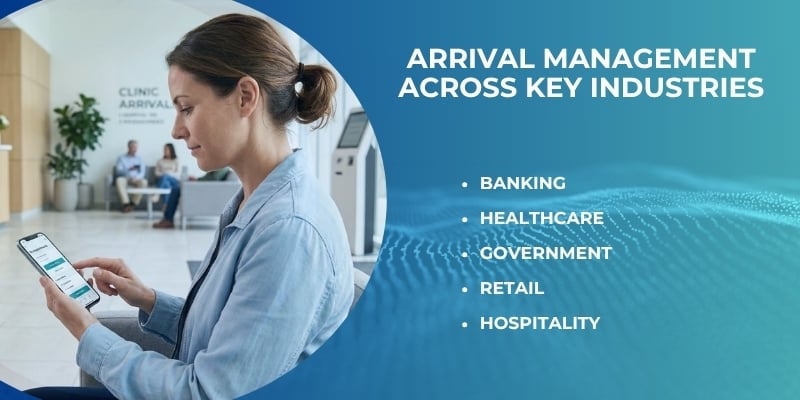
Arrival management applies across industries where customers schedule appointments or visits.
- Banking: Appointment arrival for loan consultations and account openings includes pre-arrival document checklists. A customer applying for a mortgage receives a list of required documents before they arrive, ensuring they do not waste time gathering papers at the counter.
- Healthcare: Clinic pre-check-in, insurance verification prompts, and preparation reminders reduce anxiety and improve patient flow. A patient scheduled for a procedure receives instructions on fasting, medication, and arrival time.
- Government: Immigration and licensing pre-visit preparation reduces incomplete submissions at the counter. A citizen applying for a passport receives a checklist of required documents and a reminder to bring payment.
- Retail: Fitting room booking, personal shopping appointments, and product reservation confirmation create a personalized arrival experience. A customer booking a personal shopping appointment receives a confirmation with the stylist’s name and a pre-arrival questionnaire about preferences.
- Hospitality: Hotel check-in, restaurant reservations, and spa appointments benefit from arrival management. A guest receives a pre-arrival text with room upgrade options and a link to check in digitally.
Technology That Enables Arrival Management
Several technologies work together to create a complete arrival management workflow.
- Appointment scheduling software allows customers to book, reschedule, and cancel appointments online. The system shows real-time availability and sends confirmations automatically.
- SMS and WhatsApp reminder engine delivers multi-channel reminders at configurable intervals. The system tracks delivery and open rates, ensuring messages are received.
- Digital pre-check-in portal allows customers to confirm arrival via a mobile link. The portal can also collect additional information, such as insurance details or service preferences.
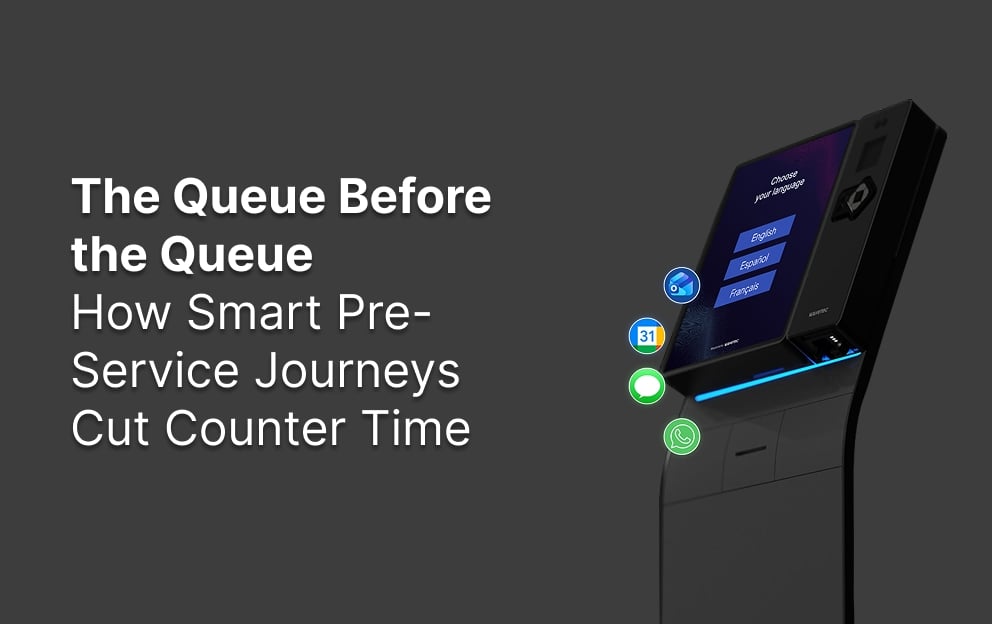
- Self-service kiosks validate appointments and issue queue tickets on arrival. The kiosk integrates with the appointment system, recognizing the customer and their service type.
- Digital signage for routing displays queue position and directs customers to the correct waiting area. The signage integrates with the queue system, showing real-time information.
These technologies connect into a single arrival management workflow rather than operating as disconnected tools.
The appointment system feeds the reminder engine.
- The reminder engine drives pre-check-in.
- Pre-check-in informs the kiosk.
- The kiosk updates the queue system.
- The queue system powers the signage.
Real-time data flow between systems is essential for a seamless experience.
Wavetec’s self-service kiosks integrate with appointment scheduling and queue management, creating a unified arrival management platform.
Case Study: BBVA Peru Streamlines Branch Arrivals with Pre-Arrival Queue Management
BBVA Peru partnered with Wavetec to modernize the customer arrival experience across its nationwide branch network by enabling customers to join the queue before entering the branch.
Through the bank’s mobile application, customers can generate a digital queue ticket in advance, allowing staff to prepare for each visit before the customer arrives.
The deployment combines mobile queueing, CRM integration, digital signage, and intelligent queue management into a single customer journey.
Branch teams gain visibility into expected arrivals while customers spend less time waiting in the lobby and move directly into the service process.
The solution also provides real-time operational insights, helping managers balance branch workloads and improve service efficiency.
By shifting queue management to the pre-arrival stage, BBVA Peru created a more organized, personalized, and frictionless banking experience for both customers and staff.
FAQs
What is arrival management?
Arrival management is the practice of planning, communicating, and structuring how customers arrive for a scheduled service, beginning before they leave their home.
It includes appointment booking, pre-arrival reminders, digital check-in, and real-time routing to ensure visitors arrive prepared and on time.
How does arrival management differ from queue management?
Arrival management covers the pre-arrival phase: booking, reminders, preparation, and check-in.
Queue management begins when the person is on-site, organizing the order of service and managing the physical waiting experience. Both are essential but operate at different stages.
What tools are needed for arrival management?
Key tools include appointment scheduling software, SMS and WhatsApp reminder engines, digital pre-check-in portals, self-service kiosks, and digital signage for routing.
These connect into a single workflow with real-time data flow between systems.
Which industries benefit most from arrival management?
Banking, healthcare, government services, retail, and hospitality all benefit significantly. Any industry where customers schedule appointments or visits can reduce no-shows, shorten service times, and improve satisfaction through arrival management.
How does digital pre-check-in work?
Digital pre-check-in allows customers to confirm arrival via a mobile link before entering the building. The link is sent in a reminder message.
The customer clicks to confirm, and the system updates their appointment status. This reduces uncertainty and provides early visibility into arrivals.
Conclusion
Arrival management shifts the service experience from reactive to proactive, beginning before the customer arrives and ensuring every visit is organized, efficient, and low-anxiety.
By structuring the pre-arrival experience through appointment booking, reminders, digital check-in, and real-time routing, organizations reduce no-shows, shorten wait times, and improve satisfaction.
The customer’s experience does not start at the door. It starts when they book the appointment, when they receive the reminder, and when they check in digitally. Managing that pre-arrival journey is one of the highest-ROI investments a service organization can make.
Wavetec’s appointment, kiosk, and signage ecosystem provides a complete arrival management platform.
BOOK A FREE DEMO