An AI voice agent is a conversational AI system that handles inbound calls, appointment bookings, routine enquiries, and service routing using natural language processing without human intervention. In banks and clinics, AI voice agents are reducing front-desk call volumes significantly, freeing staff for complex interactions that require human empathy and judgment.
The phone never stops ringing. Patients call to book appointments, refill prescriptions, and confirm hours. Banking customers call to check balances, ask about branch locations, and schedule meetings with advisors.
These are routine queries. They follow predictable patterns. They do not require clinical judgment or financial expertise. Yet they consume the majority of front-desk staff time in banks and clinics across the country.
A McKinsey survey of 406 US and Canadian bankers conducted in October 2025 found that 85% reported already using AI in some form, with AI agents specifically being adopted for front-line sales automation, service routing, and enquiry handling, confirming that AI-assisted customer interaction has crossed from pilot to mainstream in financial services.
The technology is no longer experimental. It is operational, scalable, and delivers measurable results.
AI voice agents are handling the routine calls that have long overwhelmed front-desk staff, freeing humans to focus on complex, empathy-intensive interactions. This is not about eliminating jobs. It is about rescaling them.
Wavetec’s self-service kiosks and queue management systems integrate with AI voice agent workflows, creating a seamless experience from phone call to in-person service.
What Is an AI Voice Agent?
An AI voice agent is a conversational AI system that handles inbound calls using natural language processing without human intervention.
Unlike traditional Interactive Voice Response (IVR) systems that force callers to navigate rigid menus by pressing numbers, AI voice agents understand spoken language. They interpret intent, maintain context across multiple exchanges, and complete tasks just as a human receptionist would.
The distinction from basic IVR is critical. Traditional IVR systems are frustrating because they are rigid. “Press 1 for appointments. Press 2 for billing. Press 3 for hours.” If you do not fit neatly into one of the options, you are stuck. If you make a mistake, you start over.
AI voice agents are different. They understand natural language. A caller can say “I need to reschedule my appointment for next Tuesday” and the agent understands the intent, checks availability, and offers options. The caller does not need to navigate a menu. They just speak.
Modern AI voice agents rely on several technologies working together.
- Natural language understanding interprets what the caller says, not just the words but the meaning.
- Intent detection identifies what the caller wants to do: book an appointment, check a balance, or confirm hours.
- Multi-turn conversation maintains context across exchanges, so the agent remembers that the caller is rescheduling an appointment even after several back-and-forth exchanges.
- Appointment booking integration connects the voice agent directly to the scheduling system, so bookings made by phone appear instantly in the calendar.
- Call routing directs complex calls to human staff when the AI determines the query is beyond its capability.
- Escalation to human staff is seamless, with the context of the call transferred so the human does not need to ask the caller to repeat themselves.
This combination of capabilities makes AI voice agents a genuine replacement for many front-desk phone functions, not a frustrating automation gimmick.
How AI Voice Agents Are Being Deployed in Banking
Banks are deploying AI voice agents across a growing range of use cases. The pattern is consistent: routine, predictable queries are automated, freeing human staff for complex advisory work.
- Balance enquiries are the most common banking call. Customers call to check their account balance, often multiple times per month. An AI voice agent can handle this instantly, connecting to the core banking system and returning the balance in seconds.
- Account status checks follow a similar pattern. Customers ask about pending transactions, recent deposits, or payment due dates. The AI agent retrieves the information and provides a clear response.
- Appointment booking for advisors is another high-volume use case. Customers call to schedule meetings with loan officers, financial advisors, or relationship managers. The AI agent checks availability, offers options, and books the appointment without human involvement. The booking appears in the advisor’s calendar, and the customer receives a confirmation.
- Branch location and hours are simple but frequent queries. The AI agent provides the address, directions, and operating hours of the nearest branch. It can also check for holiday closures or special hours.
- Fraud alert confirmation is a more sensitive use case. When a bank detects suspicious activity, it may call the customer to confirm whether a transaction was legitimate. An AI voice agent can handle this initial confirmation, asking yes/no questions and escalating to a human fraud specialist if the customer reports unauthorized activity.
Wavetec’s queue management system integrates with AI voice agents, ensuring that customers who book appointments by phone are seamlessly added to the branch queue and recognized when they arrive.
How AI Voice Agents Are Being Deployed in Clinics and Healthcare
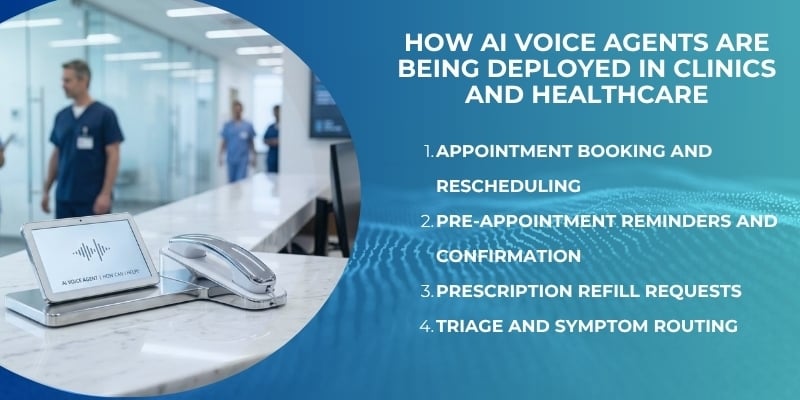
Healthcare is following a similar trajectory. Clinics and hospitals are deploying AI voice agents to handle the high volume of routine calls that overwhelm front-desk staff.
Appointment Booking and Rescheduling
AI voice agents handle incoming booking calls 24/7, reducing missed calls outside office hours. Patients can call at 10 PM to book an appointment for the next day. The agent checks availability, books the slot, and sends a confirmation. No human receptionist is needed.
Pre-Appointment Reminders and Confirmation
Outbound AI calls confirm appointments and collect pre-visit information. The agent calls the patient, confirms the appointment time, and asks about insurance, symptoms, or preparation requirements. This reduces no-show rates and ensures patients arrive prepared.
Prescription Refill Requests
Routine refill routing to pharmacy without taking up clinical staff time. The patient calls, requests a refill, and the AI agent routes the request to the pharmacy system. The patient receives confirmation when the prescription is ready.
Triage and Symptom Routing
First-level screening directs callers to the right service: urgent care, GP, or specialist. The AI agent asks a few basic questions about symptoms and severity, then routes the patient appropriately.
This ensures that urgent cases are prioritized and routine cases are directed to the right service without overwhelming the front desk.
The operational benefit is significant. A clinic that receives 200 calls per day for appointment bookings and refill requests can redirect 60-70% of those calls to an AI voice agent, freeing front-desk staff to focus on in-person patient care and complex enquiries.
What AI Voice Agents Cannot Replace
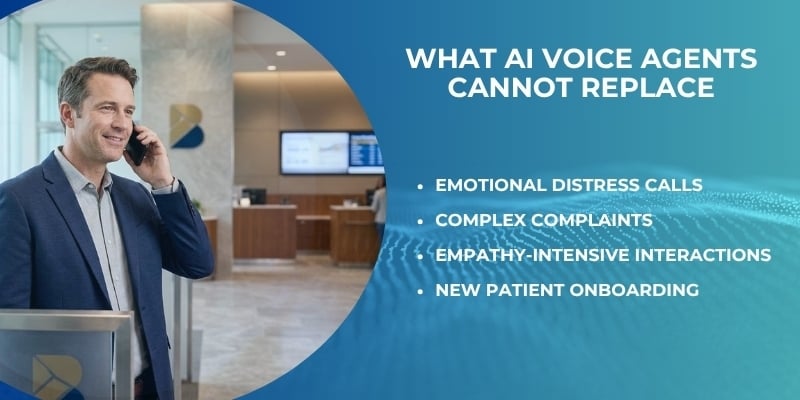
AI voice agents are powerful, but they have limits. Being direct and honest about these limits is essential for successful implementation.
- Emotional distress calls require human empathy. A patient calling with bad news, a banking customer reporting fraud, or a citizen dealing with a sensitive government issue needs a human who can listen, validate, and respond with compassion. AI agents cannot replicate this.
- Complex complaints often require human judgment. A customer who is angry about a service failure needs to feel heard. An AI agent can log the complaint, but it cannot de-escalate the situation or offer the nuanced apology that a human can.
- Empathy-intensive interactions are the core of human service. Patients explaining complex symptoms, banking customers discussing major financial decisions, and citizens navigating bureaucratic processes all benefit from human presence. AI voice agents are not designed to replace these interactions.
- New patient onboarding requiring explanation is another area where humans excel. A new patient who does not understand the healthcare system needs a human to guide them. A banking customer opening their first account needs explanation and reassurance.
The human-AI handoff design is the most important part of implementation. The system must recognize when a call exceeds the AI’s capability and transfer seamlessly to a human.
The human must receive the call context, so they do not need to ask the caller to repeat themselves. This handoff must be smooth, or the caller will become frustrated.
Integration with Queue Management and Appointment Systems
AI voice agents are most effective when they connect with the scheduling and queue management systems that organize in-person service. This integration ensures that bookings made by voice automatically populate the appointment queue and that customers who book by phone are recognized when they arrive.
The end-to-end flow is simple.
- A customer calls the clinic or bank.
- The AI voice agent handles the call, booking an appointment or confirming service details.
- The appointment is written directly to the scheduling system.
- The customer receives a confirmation via SMS or email.
- On the day of the appointment, the customer checks in at a self-service kiosk. The kiosk recognizes their appointment and adds them to the queue.
- Digital signage displays their position and estimated wait time.
- When their turn arrives, they are called to the counter.
Real-time sync between the voice agent and the queue system is essential. If the voice agent books an appointment, the queue system must know about it immediately. If the queue system is experiencing delays, the voice agent should be able to inform the caller of expected wait times. This integration prevents overbooking and ensures that customers receive accurate information.
Wavetec customer journey management connects AI voice agents with queue management, appointment scheduling, and self-service kiosks, creating a seamless experience from the first phone call to the final service interaction.
Key Considerations When Deploying an AI Voice Agent
Deploying an AI voice agent requires careful planning across several dimensions.
- Language and accent recognition quality is critical. The AI must understand the range of accents and dialects your customers use. A system that works well with one accent may struggle with another. Testing across your customer base is essential.
- Multi-lingual capability is a requirement in many communities. The voice agent should support every language your customer base requires. This is not just about translation. The agent must understand natural speech patterns in each language.
- Escalation design defines exactly when and how the agent transfers to a human. The trigger might be a specific phrase (“I want to speak to a person”), a sentiment indicator (frustration in the caller’s voice), or a task complexity threshold. The human must receive the call context, including what has already been discussed.
- Data privacy compliance is non-negotiable. The voice agent must meet relevant data protection regulations for your sector and region. In healthcare, this means HIPAA compliance. In banking, it means adherence to financial privacy regulations. Call recordings and transcripts must be stored securely.
- Continuous training ensures the agent improves over time. Call transcripts should be reviewed regularly. Flagged failure cases should be used to retrain the model. The agent should evolve as customer language and service offerings change.
FAQs
What is an AI voice agent?
An AI voice agent is a conversational AI system that handles inbound calls using natural language processing. It understands spoken language, interprets intent, and completes tasks such as appointment booking, balance enquiries, and service routing without human intervention.
How is an AI voice agent different from an IVR phone system?
Traditional IVR systems force callers to navigate rigid menus by pressing numbers. AI voice agents understand natural spoken language. Callers can speak naturally, and the agent understands their intent. This makes the experience faster and less frustrating.
Can AI voice agents handle appointment bookings?
Yes. AI voice agents connect directly to appointment scheduling systems. A caller can book, reschedule, or cancel an appointment by speaking naturally. The agent checks availability, offers options, and confirms the booking without human involvement.
Are AI voice agents safe to use in healthcare?
Yes, when properly configured. Healthcare deployments must meet HIPAA compliance requirements for data privacy and security. The voice agent must be designed to handle protected health information appropriately and escalate sensitive calls to human staff.
How do AI voice agents integrate with existing systems?
AI voice agents connect through APIs to appointment scheduling systems, queue management platforms, electronic health records, and core banking systems.
This integration ensures that bookings made by phone appear instantly in the scheduling system and that customer information is available to staff.
Conclusion
AI voice agents are not replacing human service. They are rescaling it.
By handling high-volume routine interactions, they free skilled front-desk staff to focus on the complex, empathy-intensive work that only humans can do. The technology is mature. The adoption is accelerating.
The question is not whether to adopt AI voice agents, but how quickly. The answer depends on the quality of the technology, the integration with existing systems, and the design of the human-AI handoff.
Wavetec provides AI-enabled kiosk and scheduling platforms that integrate with AI voice agent workflows, creating a seamless experience from phone call to in-person service.
Ready to rescale your front desk? Visit the Wavetec self-service kiosks page to learn more.
BOOK A FREE DEMO