A telecom queue management system is a digital platform that organises walk-in customer flow at carrier retail stores and service centres. It uses virtual ticketing, service-type routing, digital displays, and SMS notifications to reduce wait times, prevent walkaway losses, and improve the overall in-store experience for mobile operator customers.
Carrier retail stores have a split personality problem. One customer walks in needing a quick SIM swap; a 90-second transaction. Another walks in with a billing dispute or a complex device setup requiring a 30-minute consultation.
Both are sent to the same counter. Both wait in the same line. The result is chaos.
Customers with quick transactions grow frustrated waiting behind complex issues. Staff handling complex consultations are interrupted by impatient customers asking “how much longer?” Meanwhile, customers who cannot estimate their wait time simply leave. Many never come back.
The paradox is striking: telecoms invest billions in digital channels, apps, and online support, yet the in-store walk-in experience remains neglected. This neglect is costly.
Research cited by iQmetrix on wireless retail customer behaviour shows that 86% of consumers have left a store due to frustration about slow lines, 74% will go to a competitor’s store if they feel queues are shorter there, and 73% will leave without making a purchase if they have to wait more than five minutes; directly threatening contract renewals and device sales.
A telecom queue management system fixes this broken walk-in experience. It organises customer flow by service type, provides real-time wait visibility, and frees staff to focus on selling rather than managing lines. Wavetec’s queue management system is purpose-built for telecom retail environments.
The Walk-In Problem at Carrier Retail Locations
Telecom stores are uniquely challenging compared to other retail environments. The mix of transaction types is extreme.
- At one end, customers need simple services: SIM card swaps, bill payments, prepaid top-ups, and basic account enquiries. These take two to three minutes.
- At the other end, customers need complex consultations: contract renewals, device setup, technical troubleshooting, family plan changes, and complaints. These can take 20 to 40 minutes.
When both types of customers are forced into a single queue, the system breaks down. A customer with a 30-second SIM swap waits behind a customer with a 30-minute device setup. The quick customer grows frustrated and may leave.
The walkaway rate is particularly damaging because telecom customers often have multiple carriers to choose from. A customer who leaves a store due to a long queue may never return. They may switch carriers at the next contract renewal. They may tell friends and family about their negative experience. The cost of a lost customer extends far beyond the immediate sale.
How a Telecom Queue Management System Works
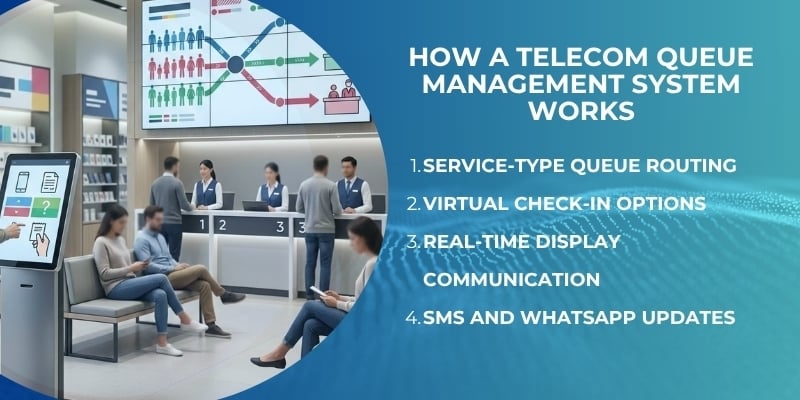
A telecom queue management system transforms the walk-in experience from chaos to order. The system manages the entire customer journey from arrival to service completion.
Service-Type Queue Routing
The most important feature is service-type routing.
- When a customer checks in, they select their service type from a menu.
- The system places them in the appropriate queue: quick transactions go to one queue, consultations go to another.
- Staff are assigned to specific queues based on their skills.
- A staff member who handles SIM swaps quickly is assigned to the quick queue.
- A staff member who excels at contract consultations is assigned to the consultation queue.
This prevents quick transactions from being delayed behind complex ones.
Virtual Check-In Options
Customers can join the queue through multiple channels.
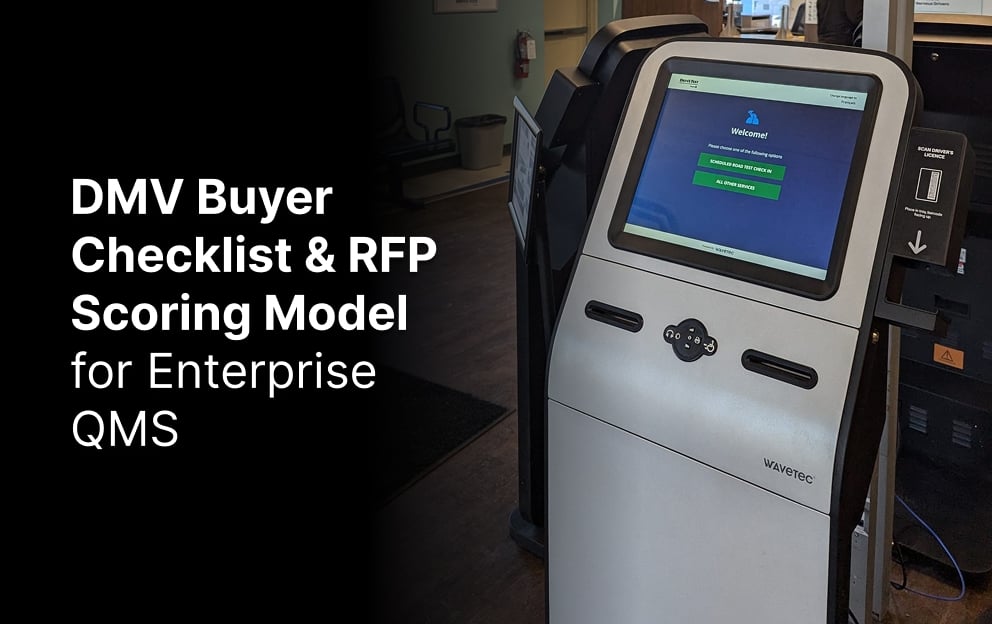
- A floor kiosk at the entrance allows walk-in customers to check in immediately.
- A QR code displayed on the store window lets customers join the queue from their phone before entering.
- WhatsApp integration allows customers to send a message and receive a queue ticket.
These virtual check-in options reduce physical crowding at the service counter.
Real-Time Display Communication
Overhead digital signage shows the current ticket number, estimated wait time, and service counter number.
Customers can see their position in the queue without approaching the counter. This visibility reduces anxiety and eliminates the “how much longer?” interruptions that plague staff.
SMS and WhatsApp Updates
Customers who provide their phone number receive automated updates. A text message might say “You are now third in line. Estimated wait: 5 minutes.” Another message says “Your turn is next. Please proceed to counter 3.” These updates allow customers to wait comfortably anywhere in the store.
Why Telecom Customers Walk Away — And How to Stop It
Walkaway behaviour in telecom stores follows a predictable pattern.
- A customer enters a store, sees a line, and has no idea how long they will wait.
- They are not sure if they are in the right line.
- They see other customers being served but cannot tell why some transactions are fast and others are slow.
- After a few minutes of uncertainty, they leave.
- If they have a simple need like a SIM swap, they may never return.
J.D. Power’s 2024 U.S. Wireless Retail Experience Study (based on responses from 12,743 customers) evaluates satisfaction across store visits, phone, and digital channels, finding that the in-store purchase process and ease of service are the primary differentiators between the highest and lowest-scoring carrier locations. Walkaways directly impact these satisfaction scores.
Queue visibility is the solution. When customers can see their position in the queue, estimated wait time, and service type, they make informed decisions. A customer who knows they are fourth in line for the quick queue and will wait five minutes will stay. A customer who knows they need a consultation and will wait 20 minutes can decide whether to wait or return later. The transparency reduces anxiety and builds trust.
Digital signage is the primary tool for providing this visibility. Overhead screens display the current ticket being served, the next tickets, and estimated wait times.
For customers who prefer mobile updates, SMS notifications provide the same information. The combination of visual and mobile communication ensures that every customer stays informed.
Wavetec’s digital signage solutions integrate with the queue management system to provide real-time, accurate information to waiting customers.
Appointment Scheduling in Telecom Retail: Complementing Walk-In Flow
Appointment scheduling is a powerful tool for walk-in queue management. When customers can book appointments for complex services, they avoid the uncertainty of walk-in waits. The store can manage demand by spreading appointments across the day.
A well-designed system blends appointments and walk-ins seamlessly. Appointment holders receive priority in the queue. Walk-ins are served in the same queue but with lower priority. The system ensures that appointment holders are not delayed while still serving walk-ins efficiently.
For telecom stores, appointments are ideal for complex services: contract renewals, device setup, and technical troubleshooting. These services benefit from dedicated time and preparation. When a customer books an appointment, the store can prepare the necessary devices, documents, and information before the customer arrives.
Simple transactions remain walk-in friendly. A customer who needs a SIM swap does not need an appointment. They can join the quick queue and be served within minutes. This hybrid model serves all customers efficiently.
Customer journey management integrates appointment scheduling with walk-in queue management, creating a unified flow.
Key Features of a Telecoms-Grade Queue Management System
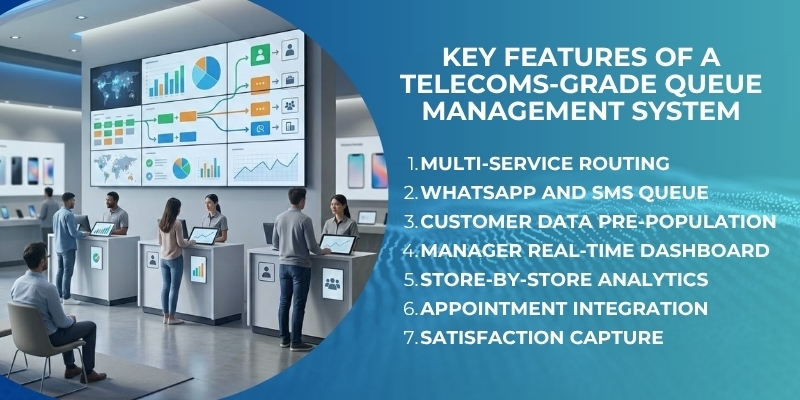
A queue management system for telecom retail needs specific features to handle the unique demands of carrier stores.
- Multi-service routing is essential. The system must support separate queues for quick transactions, consultations, and technical support. Each queue can have different staffing levels and service rules.
- WhatsApp and SMS queue join allows customers to check in without approaching a kiosk. This is particularly valuable during peak hours when the kiosk itself may have a line.
- Customer data pre-population speeds up service. When a customer checks in, the system can pull their account information from the carrier’s customer database. The staff member sees the customer’s name, account type, and recent activity before they reach the counter.
- Manager real-time dashboard provides visibility into queue length, wait time, and staff performance across all counters. Managers can see which queues are backing up and make adjustments.
- Store-by-store analytics reveals patterns. Which days have the longest waits? Which service types cause the most delays? This data supports staffing decisions and process improvements.
- Appointment integration allows booking and management of appointments alongside walk-in traffic.
- Satisfaction capture collects feedback after service. A quick NPS question on a tablet or via SMS provides real-time insights into customer experience.
Digital Signage as a Walk-In Experience Tool in Telecom Stores
Digital signage in telecom stores does triple duty. It manages the queue, promotes products, and communicates service offers. This combination of functions makes signage a high-value investment.
- Queue status displays are the primary function. Screens show current ticket numbers, estimated wait times, and counter assignments. Customers see their position in the queue without approaching the counter. This reduces interruptions and improves the waiting experience.
- Product promotion is the secondary function. While customers wait, screens can display the latest devices, plan offers, and accessories. A customer waiting for a contract consultation might see a promotion for a new phone. This turns waiting time into a sales opportunity.
- Service offer communication is the third function. Screens can display information about available services: device trade-in programs, insurance plans, and digital support options. This educates customers and encourages additional purchases.
Entertainment content can also be displayed. Short videos, news, or social media feeds keep customers engaged during longer waits. This reduces perceived wait time and improves satisfaction.
Case Study – Mobile Operator Reduces Walkaway Rate
Long queues are one of the biggest reasons customers leave telecom retail stores without completing their transaction.
Wavetec’s telecom queue management solutions help operators organize these complex journeys through virtual queuing, digital signage, service-based routing, and centralized queue management, enabling customers to spend less time waiting and more time receiving service.
Orange Sierra Leone Creates a Paperless Walk-In Experience Across Eight Service Centers
Orange Sierra Leone partnered with Wavetec to modernize customer flow across eight retail locations by replacing traditional paper ticketing with a fully digital virtual queuing solution.
Customers simply provided their mobile number and purpose of visit when arriving at the branch. Instead of receiving a paper ticket, they received an SMS containing their queue number, estimated waiting time, and live queue status.
Throughout the wait, customers remained informed through automated SMS updates while digital signage displayed real-time ticket progression and counter assignments inside the store.
This combination of virtual ticketing and live queue visibility allowed customers to wait comfortably without uncertainty while giving staff better control over customer flow during busy periods.
The deployment delivered measurable operational improvements, including shorter waiting times, lower customer churn, optimized staff allocation, and significantly higher customer satisfaction across Orange’s service centers.
QCell Modernizes Walk-In Customer Service
QCell, one of The Gambia’s leading telecommunications providers, also implemented Wavetec’s Queue Management Solution to organize customer flow across its service centers.
The deployment introduced digital ticketing, customer routing, real-time queue monitoring, customer calling displays, and centralized reporting.
Customers gained greater visibility into the service process while branch teams benefited from structured queue management and improved operational oversight.
By replacing manual customer handling with an intelligent queue management platform, QCell reduced congestion, improved service consistency, and created a more transparent walk-in experience that helped customers move through service centers more efficiently.
These telecom deployments demonstrate that reducing walkaway rates requires more than shortening queues. Success comes from giving customers visibility, predictable wait times, and structured service journeys.
By combining virtual queuing, SMS notifications, digital signage, and intelligent service routing, Wavetec enables telecom operators to reduce customer frustration, improve branch efficiency, and create a modern retail experience that keeps customers engaged until they are served.
FAQs
What is a telecom queue management system?
A telecom queue management system is a digital platform that organises walk-in customer flow at carrier retail stores and service centres.
It uses virtual ticketing, service-type routing, digital displays, and SMS notifications to reduce wait times, prevent walkaway losses, and improve the in-store experience.
How does virtual queuing improve the telecom in-store experience?
Virtual queuing allows customers to check in via kiosk, QR code, or WhatsApp without standing in a physical line.
They receive SMS updates about their queue position and estimated wait time, allowing them to wait comfortably anywhere in the store.
Can telecom stores manage appointments and walk-ins simultaneously?
Yes. A well-designed queue system blends appointments and walk-ins in a single, prioritised flow. Appointment holders receive priority, while walk-ins are served in the same queue. This ensures appointment customers are seen on time while walk-ins are still served efficiently.
What is the average walkaway rate in telecom retail stores?
Research shows that 73% of customers will leave without making a purchase if they have to wait more than five minutes. In stores without queue management, walkaway rates often exceed 30% during peak hours.
How does digital signage support telecoms queue management?
Digital signage displays current ticket numbers, estimated wait times, and counter assignments. This reduces customer anxiety, eliminates “how much longer?” interruptions to staff, and can also display product promotions and service offers to waiting customers.
Author Bio: This article was written by the telecom solutions team at Wavetec, a global provider of queue management, digital signage, and customer journey platforms. Wavetec has helped mobile operators across the world reduce walkaway rates, improve NPS, and optimise retail operations.
Conclusion
Telecom queue management systems directly protect walk-in revenue, improve NPS, and free staff to focus on high-value consultations.
Carrier retail locations face unique challenges: a mix of quick and complex transactions, unpredictable walk-in volumes, and customers who will walk away if they cannot estimate their wait.
A digital queue system solves these problems by routing customers by service type, providing real-time wait visibility, and integrating appointments with walk-in flow.
The results are measurable: walkaway rates drop from over 30% to single digits, contract renewals increase, and staff shift from line management to selling. Wavetec offers telecom-grade queue management solutions designed for the unique demands of carrier retail locations.
Ready to fix your walk-in experience? Visit the Wavetec queue management system page to learn more.
BOOK A FREE DEMO