Retail queue management is a digital approach to organising and optimising customer flow at checkout, service desks, and returns counters in retail environments. Smart queuing systems use virtual ticketing, self-checkout integration, and real-time analytics to reduce wait times, prevent queue abandonment, and improve the overall shopping experience.
The moment of truth in any retail store is the checkout. Customers have browsed, selected, and filled their baskets. They are ready to pay. And then they see the line.
Long queues at the checkout remain one of the most friction-heavy moments in the retail customer journey.
A single bad queuing experience can undo all the goodwill built by store design, product selection, and staff friendliness.
In fact, checkout queues have been identified as the single biggest source of frustration, responsible for 21.3 percent of all negative feedback in retail. With nearly 75% of customers abandoning their purchases if faced with more than a five-minute wait, retailers can no longer afford to treat queue management as an afterthought.
The solution is a combination of smart technology and strategic thinking. Retail queue management systems, integrated with self-checkout and digital signage, are transforming how stores handle customer flow.
These systems blend physical and digital queuing to reduce wait times, prevent queue abandonment, and turn the checkout experience from a point of friction into a moment of efficiency.
Wavetec’s queue management system is purpose-built for retail environments, helping stores of all sizes optimise their customer flow.
Why Checkout Queues Are Still Retail’s Biggest Pain Point
Retailers invest heavily in store design, visual merchandising, and customer experience. They spend millions on creating inviting spaces that encourage browsing and buying. Yet the checkout area, the final and most critical step of the journey, is often neglected. Long queues are allowed to form while staff are stretched thin and customers grow frustrated.
The cost of this neglect is staggering. PwC’s Global Consumer Insights Survey found that 30% of consumers cite larger queues and busier store locations as a top in-store shopping frustration, ranking third overall, behind only rising prices (56%) and product availability (26%).
By one estimate, 86% of consumers have left a store or retail business because of the queue, translating to $38 billion in lost revenue for operators annually. Customers who experience a long wait once are far less likely to return. A significant 70% of shoppers are less likely to return to a store after just one long waiting experience.
The problem is compounded by changing customer expectations. In 2025, over 60% of shoppers now expect an alternative to queuing up in a line behind a manned counter. The checkout process has emerged as the single biggest source of frustration, responsible for 21.3 percent of all negative feedback in retail.
Customers who wait in a physical line are nearly 5x more likely to wait 30+ minutes when they are freed from a physical line, but their patience is wearing thin. Only 75% of consumers are now willing to wait 15 minutes, down from 81% in 2024.
Peak-hour chaos is another driver. In high-traffic retail environments, average peak queue times exceed 11–15 minutes. After five minutes, 58% of customers abandon their purchase; after ten minutes, this rises to 82%. These numbers represent direct revenue loss and long-term damage to brand loyalty.
How Smart Retail Queue Management Works
Smart retail queue management systems transform the checkout experience from a source of frustration into a moment of efficiency. The approach is systematic and data-driven.
Virtual Ticketing for Service Desks
Returns, exchanges, and customer service desks are often the source of the longest queues in retail. Virtual queuing eliminates physical lines at these counters.
Customers check in at a kiosk or via a mobile app, receive a digital ticket, and wait anywhere in the store. They are notified by SMS or app notification when their turn approaches. This reduces crowding at the service desk and allows customers to continue shopping while they wait.
Cashier Load Balancing
Real-time dashboards show queue depth at each lane. The system alerts managers when queues are building at specific lanes, allowing them to open new lanes before congestion becomes critical.
This proactive approach prevents the “rush hour” chaos that characterises many retail stores. Some advanced systems use IoT and real-time monitoring to decrease wait times and increase resource efficiency.
Express Lane Management
Smart algorithms route customers with fewer items to available express lanes automatically. This prevents customers with small baskets from being delayed behind those with full trolleys. The system can also direct customers to the shortest queue based on real-time data.
Self-Checkout Integration
Self-checkout doesn’t eliminate the queue; it shifts it. Smart queuing manages self-checkout station assignment, reducing bottlenecks at payment terminals and preventing staff supervision overload.
When self-checkout stations are full, the system can direct customers to staffed lanes or alert staff to open additional stations.
Self-Checkout and Queue Management: Partners in Retail CX
Self-checkout has become a fixture of the modern retail store. The global self-checkout system market is estimated at USD 5.84 billion in 2025 and is expected to reach USD 11.09 billion by 2030.
However, self-checkout does not eliminate the need for queue management. It simply transforms the nature of the queue.
Without proper management, self-checkout areas can become bottlenecks of their own. Customers may cluster around a limited number of stations, waiting for an available machine. Staff may be overwhelmed by supervision duties. The result is a different type of queue, but a queue nonetheless.
Smart retail queue management addresses this by integrating self-checkout into the overall customer flow. The system monitors self-checkout station availability and directs customers accordingly. It can alert staff when additional stations need to be opened or when supervision is required.
Some retailers are introducing “flexi checkouts” that can switch between self-service or staffed operation depending on customer preference, a concept being rolled out by Co-op across 150 stores.
The most innovative retailers are going further. Amazon’s “Just Walk Out” technology uses computer vision and AI to track shoppers and the products they select, eliminating the checkout queue entirely.
Smart trolleys with integrated billing and packing systems are being deployed, allowing customers to complete the checkout experience directly within their cart. These technologies represent the frontier of retail queue management, where the queue itself is designed out of the experience.
The Role of Digital Signage in Retail Queue Management
Digital signage is an often overlooked but essential component of retail queue management. Overhead screens placed above checkout lanes or in waiting areas serve multiple functions that support queue management and enhance the customer experience.
- First, queue status displays show lane availability, estimated wait times, and queue directions. This visibility reduces the “how much longer?” questions that interrupt staff and allow customers to make informed decisions about which lane to join. When customers see accurate wait times, their perceived wait is shorter than when they have no information.
- Second, digital signage can route customers to the shortest queue. Screens can display messages like “Lane 3 is now open” or “Express lane available for customers with 10 items or fewer.” This dynamic guidance balances load across lanes and reduces congestion.
- Third, digital signage serves a dual purpose. While customers wait, screens can display promotional content, new product announcements, or loyalty program information. This turns waiting time into a marketing opportunity. The global digital signage market is projected to reach $52.1 billion by 2030, with in-branch applications representing one of the highest-growth vertical segments.
Wavetec’s digital signage solutions integrate seamlessly with queue management systems, providing real-time, accurate information to waiting customers while delivering marketing value.
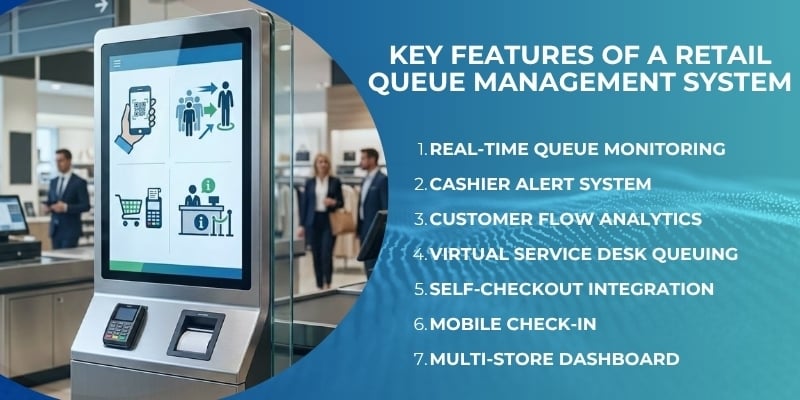
Key Features of a Retail Queue Management System
An effective retail queue management system includes several essential features that work together to optimise customer flow.
- Real-time queue monitoring provides visibility into queue length, wait time, and service speed at every lane. Managers can see which lanes are congested and take action.
- Cashier alert system notifies staff when queues exceed a threshold. This prevents congestion from becoming critical.
- Customer flow analytics tracks patterns by hour, day, and season. This data supports staffing decisions and promotional timing.
- Virtual service desk queuing eliminates physical lines at returns and customer service counters.
- Self-checkout integration manages station assignment and supervision load.
- Mobile check-in allows customers to join a virtual queue from their phone.
- Multi-store dashboard provides centralised visibility across all locations, enabling regional managers to compare performance and share best practices.
PwC’s Global Consumer Insights Survey 2023 found that 39% of consumers cited the hassle of standing in longer queues as a major frustration in their in-store shopping experience; ranking it third behind only rising prices and out-of-stock products as the top drivers of in-store dissatisfaction. A retail queue management system directly addresses this top-three frustration.
Retail Queue Analytics: Using Data to Prevent Peak-Hour Bottlenecks
Data is the foundation of effective queue management. A retail queue management system collects detailed information on customer flow, wait times, and service speed. This data transforms queue management from a reactive scramble into a proactive strategy.
Historical queue data reveals patterns that drive better decisions.
- Which hours have the longest queues?
- Which days of the week are most congested?
- Which service types cause the most delays?
With this information, managers can schedule staff to match demand, open additional lanes during predictable peaks, and adjust promotional timing to distribute traffic.
Queue analytics also support continuous improvement. By tracking wait time trends, managers can measure the impact of changes.
- Did the new express lane reduce overall wait times?
- Did the virtual service desk reduce abandonment?
Data answers these questions with precision.
Wavetec’s customer journey management includes advanced queue analytics, providing retailers with the insights they need to prevent bottlenecks before they form.
Case Study – Supermarket Chain Reduces Checkout Wait with Smart Queuing
Supermarkets experience highly variable customer traffic throughout the day. Peak shopping hours, promotional campaigns, and weekend demand often create long checkout queues that lead to customer frustration and abandoned purchases.
Traditional checkout operations rely heavily on staff manually responding to congestion, often after queues have already formed.
Smart queue management changes this approach by providing real-time visibility into customer flow, enabling retailers to organize service more efficiently while giving shoppers clear information about their waiting journey.
Consum Supermarkets Streamlines Customer Flow Across Busy Retail Locations
Consum, one of Spain’s leading supermarket chains, partnered with Wavetec to improve customer flow and create a more organized shopping experience across its retail stores.
Wavetec implemented an integrated queue management solution that combined self-service ticketing, centralized queue orchestration, real-time digital signage, and staff queue management into a single platform.
Customers could easily join the appropriate service queue while digital displays continuously updated ticket progression and counter availability, reducing uncertainty throughout the waiting process.
The centralized system gave store teams real-time visibility into customer demand, allowing them to respond more effectively during peak shopping periods and distribute workloads across available service points.
Queue visibility also reduced the number of customers approaching staff simply to ask about waiting times, allowing employees to focus on serving shoppers rather than managing queues.
By replacing unmanaged physical lines with a structured digital queuing process, Consum created a more predictable checkout experience that improved operational efficiency while helping customers feel informed throughout their visit.
Carrefour Kenya Improves Queue Visibility During Peak Shopping Hours
Carrefour Kenya also adopted Wavetec’s queue management technology to better manage customer flow in high-footfall retail environments.
The deployment introduced centralized queue control and digital customer guidance that helped organize service across busy checkout and customer service areas. Real-time queue visibility enabled staff to identify congestion earlier, improve lane utilization, and maintain smoother customer movement during busy trading periods.
The combination of queue management and digital communication reduced perceived waiting time by keeping customers informed throughout the checkout journey while giving store management actionable insights into customer flow and operational performance.
These supermarket deployments demonstrate that reducing checkout wait times is not simply about opening more checkout lanes. Success comes from intelligently managing customer flow through real-time queue visibility, centralized monitoring, and digital communication.
FAQs
What is retail queue management?
Retail queue management is a digital approach to organising and optimising customer flow at checkout, service desks, and returns counters. It uses virtual ticketing, self-checkout integration, and real-time analytics to reduce wait times, prevent queue abandonment, and improve the shopping experience.
How does smart queuing technology reduce checkout wait times?
Smart queuing uses real-time data to balance customer load across available lanes. It alerts managers when queues are building, routes customers to the shortest queue, and integrates with self-checkout to manage station assignment. This proactive approach prevents congestion before it becomes critical.
Can retail queue management work for small stores?
Yes. Cloud-based retail queue management systems are scalable and affordable. A small boutique, pharmacy, or convenience store can implement virtual queuing and digital signage without significant hardware investment.
How does digital signage help with retail queue management?
Digital signage displays queue status, estimated wait times, and lane availability. This reduces customer anxiety, prevents interruptions to staff, and guides customers to the shortest queue. It can also display promotional content, turning waiting time into a marketing opportunity.
What data does a retail queue management system collect?
The system collects data on queue length, wait time, service speed, staff performance, and abandonment rates. This data supports staffing decisions, promotional timing, and continuous improvement.
Author Bio: This article was written by the retail solutions team at Wavetec, a global provider of queue management, digital signage, and customer journey platforms. Wavetec has helped retailers worldwide reduce wait times, improve customer satisfaction, and optimise store operations.
Conclusion
Smart retail queue management has evolved from a customer service nicety to a strategic CX investment that directly impacts conversion and loyalty.
Long checkout queues drive customers away, damage brand perception, and cost retailers billions in lost revenue annually.
The solution lies in technology that replaces guesswork with data, chaos with order, and frustration with transparency.
Whether through self-checkout integration, virtual queuing, digital signage, or real-time analytics, modern retail queue management systems deliver measurable results: shorter wait times, higher customer satisfaction, and improved staff efficiency.
As customer expectations continue to rise, retailers that invest in queue management will be the ones that thrive. Wavetec offers retail-ready queue and signage solutions designed to handle the complexities of modern store operations.
BOOK A FREE DEMO