Most DMV procurement teams write a queue management RFP (Request For Proposal) the same way they would for any government software purchase, then discover midway through evaluation that a DMV-grade QMS (Queue Management System) carries requirements a generic scoring template does not cover. A DMV buyer checklist for enterprise QMS is a structured set of evaluation criteria covering eligibility and service-priority logic, accessibility compliance, transparency to the public, integration depth with existing DMV systems, security evidence, and governance at statewide or agency-wide scale. Paired with a weighted RFP scoring model, it gives procurement and operations teams a defensible, apples-to-apples way to compare vendors instead of relying on demo impressions.
Talk to Wavetec about DMV procurement
This guide breaks down what belongs in that checklist, how to weight it in an RFP, and where DMV evaluations most often go wrong.
The stakes of getting this wrong are not abstract. North Carolina’s Office of the State Auditor found in August 2025 that average DMV wait times had climbed to 1 hour and 15 minutes, up more than 15 percent since 2019, with nearly 14 percent of visits running past 2.5 hours, a 79 percent jump over the same period. That is the operational failure mode a well-scoped RFP is meant to prevent.
Why Generic QMS RFPs Fail DMV Procurement
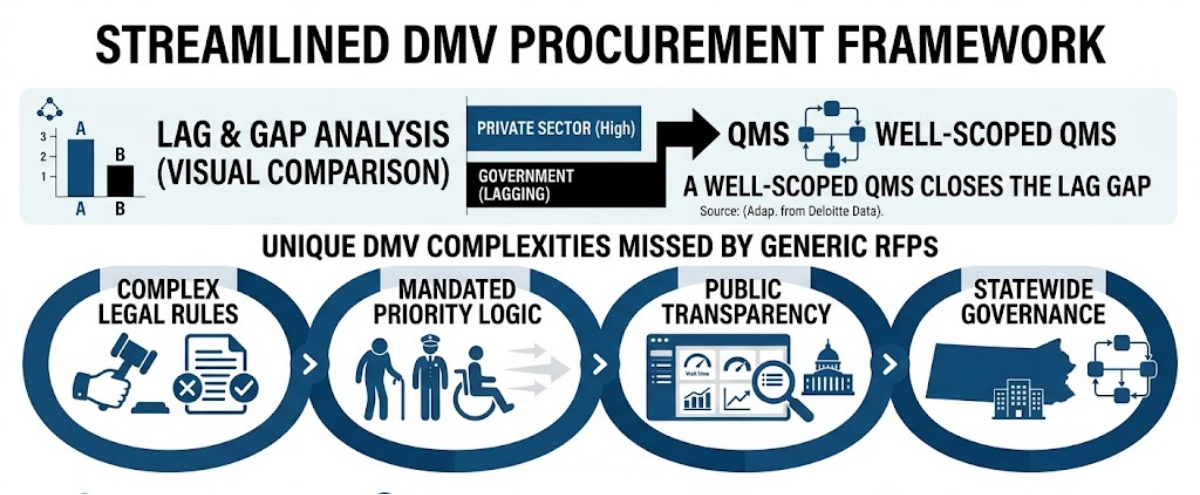
Deloitte’s Government Trends 2025 report identifies public service modernization as one of the defining delivery challenges facing government agencies, noting that services involving both digital and physical interactions can present significant delivery challenges and disproportionately affect citizen satisfaction when they go wrong. The DMV is the report’s own example of the government experience most citizens remember. Deloitte’s research also confirms that government digital services generally still lag the private sector, which is exactly the gap a well-scoped QMS is meant to close.
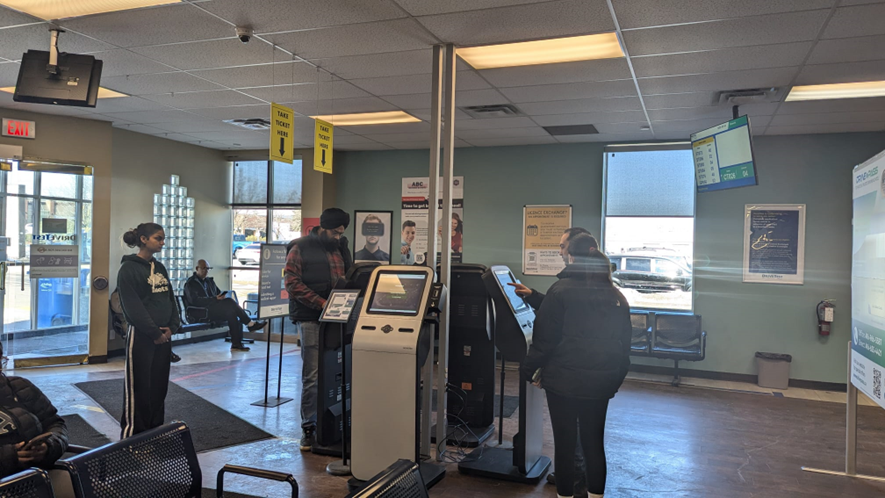
DMVs are not typical service environments. A single office may handle license renewals, vehicle registration, road tests, commercial licensing, and disability accommodations, often under different legal eligibility rules for each. A generic RFP built for retail or banking QMS misses the requirements that matter most in a DMV context.
- Eligibility logic is legally defined, not just operationally convenient. A customer without the required documents may not be eligible for a service at all, and the system needs to reflect that before they take a ticket.
- Priority rules are frequently mandated by law, covering veterans, seniors, and customers with disabilities.
- Transparency is a public accountability requirement, since wait times and service performance are often subject to public reporting or legislative oversight.
- Governance at scale means the same configuration has to work consistently across dozens or hundreds of offices under a single statewide standard.
Boston Consulting Group’s 2025 analysis of DMV modernization makes a related point directly relevant to how an RFP should be scoped: successful transformation requires a customer-centric, digital-first approach, while recognizing that digital-first does not mean digital-only. The most effective operating model blends enhanced online services with optimized in-person processes, supported by redesigned customer journeys and empowered staff, not a technology upgrade in isolation. An RFP that scores only digital self-service capability, without weighing how well a vendor connects that self-service to in-person staff workflows, misses exactly the gap BCG’s research points to.
The DMV Buyer Checklist
1. Eligibility and Priority Rules
- Does the system support configurable eligibility logic per service type, so ineligible customers are redirected before joining a queue?
- Can priority rules for veterans, seniors, disability accommodations, and appointment holders be configured without custom development?
- Does the system support multiple concurrent priority tiers, rather than a single priority flag?
- Can eligibility and priority rules be updated centrally and pushed to all locations without a re-implementation project?
2. Accessibility
- Is the customer-facing kiosk and ticketing interface compliant with WCAG and applicable ADA standards, or AODA where Canadian provincial requirements apply?
- Does the system support screen readers, audio announcements, and adjustable text size at self-service points?
- Are physical kiosk formats available in ADA-compliant heights and approach clearances?
- Does virtual queuing and mobile ticketing reduce the need for customers with mobility constraints to stand in a physical line at all?
- Has the full journey, not just the kiosk, been independently reviewed for accessibility, covering the appointment website, notifications, and staff-assisted fallback paths?
3. Transparency
- Does the system provide real-time public-facing wait time information, on-site, online, or both?
- Can the agency generate standardized public reporting on service levels across all locations?
- Is ticket and service-status information visible to the customer throughout their visit, not just at intake?
- Does the audit trail support answering a legislative or public records inquiry about a specific customer’s wait time or service path?
4. Integrations
- Does the vendor provide documented APIs for integration with existing DMV case management, licensing, and payment systems?
- Can the system integrate with appointment scheduling already in use, rather than requiring a full replacement?
- Is data exchange with state or national identity verification systems supported, and under what security model?
- What is the typical integration timeline for a deployment of this scale, based on past government rollouts?
- Does the kiosk hardware itself have a resilience design, such as dual-printer failover, so a single component fault does not take an entire check-in point offline during peak hours?
5. Security Evidence
- What certifications or audit reports can the vendor provide, such as SOC 2 Type II, ISO/IEC 27001 information security management, or ISO 9001 quality management, covering the QMS platform specifically rather than the vendor’s business in general?
- How is customer data, including identity documents referenced during service, encrypted in transit and at rest?
- What is the vendor’s process and timeline for patching disclosed vulnerabilities?
- Does the vendor support data residency requirements where applicable to government procurement rules?
6. Governance at Scale
- Can configuration changes, such as new service types or updated priority rules, be deployed centrally across all locations from a single console?
- What is the vendor’s model for role-based access control (RBAC) across state, regional, and branch-level administrators?
- How does the system handle version control and rollback if a configuration change causes issues at scale?
- What reporting exists for a central program office to monitor consistency and compliance across every location, not just aggregate averages?
- Does the vendor provide centralized device health monitoring across the kiosk fleet, so hardware issues at one location surface to a central operations team rather than depending on a local staff report?
PwC’s research on AI in government services points to workflow automation and multilingual digital platforms as two of the clearest levers agencies have for improving citizen services efficiency and accessibility at the same time, which is precisely what a modern QMS with configurable eligibility logic and multi-language kiosk support is built to deliver.
The RFP Scoring Model
A weighted scoring model turns this checklist into a comparable evaluation across vendors. The weighting below reflects how most DMV evaluations prioritize these categories, though agencies should adjust weights to their own legal and operational priorities.
| Category | Suggested weight | What it measures |
| Eligibility and priority rules | 20% | Configurability without custom code, support for legally mandated priority tiers |
| Accessibility | 15% | WCAG and ADA compliance depth, reduction of in-person burden for constrained customers |
| Transparency | 10% | Public reporting capability and audit trail completeness |
| Integrations | 20% | Documented APIs, compatibility with existing systems, integration timeline |
| Security evidence | 20% | Certifications, encryption model, vulnerability response, data residency |
| Governance at scale | 15% | Central configuration control, RBAC, consistency monitoring |
Each category should be scored on a defined scale, such as 0 to 5, with scoring anchors written into the RFP so every evaluator applies the same standard. No single category should be weighted above 20 percent, so a vendor that scores well on one dimension cannot outscore one that performs consistently across all six.
Common Mistakes in DMV QMS Procurement
- Scoring the demo, not the checklist. A polished kiosk demo does not confirm eligibility logic, integration depth, or governance controls. Score every vendor against the same written checklist, not a general impression.
- Treating accessibility as a checkbox. Accessibility compliance should be demonstrated on the actual proposed kiosk hardware, not just claimed in a vendor’s written response.
- Underweighting governance at scale. A system that works in a pilot office can still fail at statewide rollout if configuration changes require per-location work. Score governance on the vendor’s actual multi-location deployment history, not platform capability on paper.
- Skipping security evidence for smaller vendors. Security certifications should be a hard requirement regardless of vendor size.
What This Means for DMV Procurement Teams
A defensible DMV QMS RFP needs six weighted categories, eligibility and priority rules, accessibility, transparency, integrations, security evidence, and governance at scale, none exceeding 20 percent of the total score. Scoring against a written checklist, rather than a demo impression, is what protects the evaluation from being decided by presentation polish instead of operational fit.
Proof From Wavetec DMV Deployments
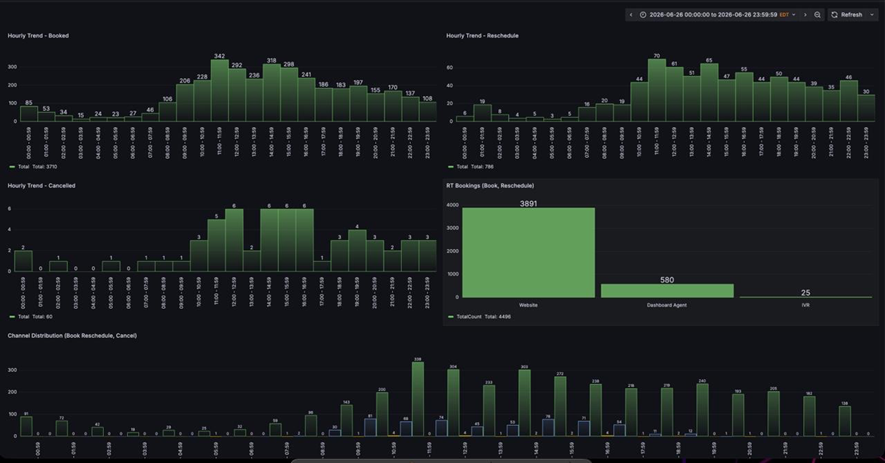
DriveTest Ontario, the driver licensing network Serco operates on behalf of Ontario’s Ministry of Transportation, is the clearest illustration of this checklist working at scale. Wavetec’s connected customer-flow platform runs across more than 90 centres, unifying three customer journeys, remote queue entry, scheduled in-centre service, and road-test appointments, under a single orchestration layer.
| Metric | Evidence |
| Locations covered | 90+ DriveTest Centres across Ontario |
| 30-day transaction volume | 93,783 booking, rescheduling, and cancellation transactions |
| Digital self-service share | 89.3% completed through the public website |
| Assisted channels | 10.3% agent-assisted, 0.4% IVR |
| Accessibility | AODA and WCAG-aligned journey, independently reviewed |
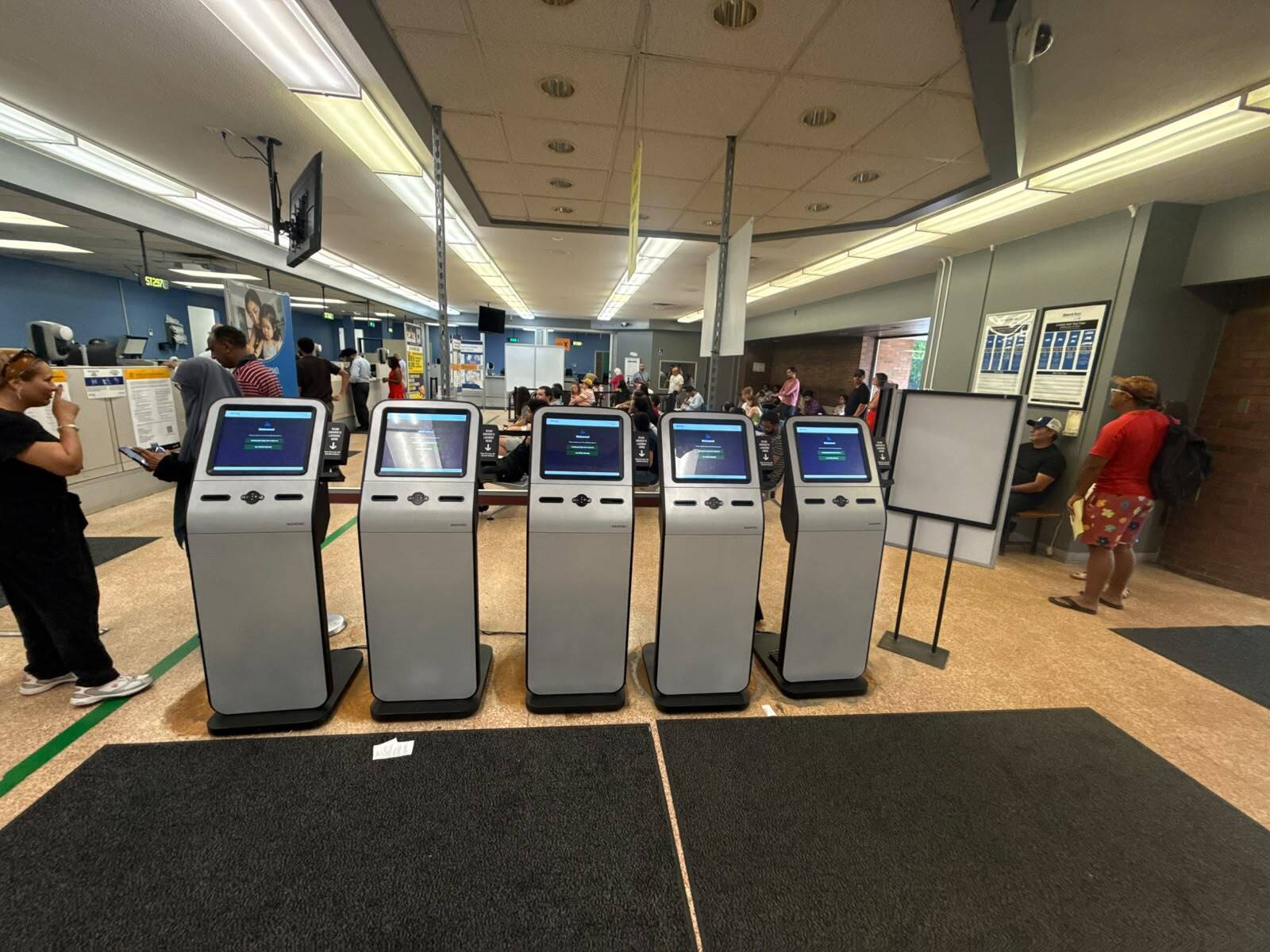
| Kiosk resilience | M-13 self-service kiosk with dual thermal printers and automatic failover |
The eligibility and priority checklist items in this guide show up directly in that deployment. The M-13 kiosk handles onsite check-in and driver’s licence scanning, Spectra applies the appointment and service rules, Lobby Leader gives staff live control to validate and route customers, and ActiveHub centralizes device health monitoring across the fleet, the same governance-at-scale question this checklist asks vendors to answer. The dual-printer design also answers the integrations checklist item on hardware resilience directly: a single printer fault no longer takes the entire check-in point offline.
Salman Agha, Director of Sales and Business Development at Wavetec North America, describes the approach this way: “Successful public-sector modernization isn’t about replacing legacy systems with new technology, it’s about designing a platform around the way people actually deliver and receive services. With DriveTest Ontario, we customized every layer of the solution to match operational requirements while creating a foundation for future innovation, including AI-driven operational intelligence, predictive analytics, and smarter branch management.”
Tennessee Department of Safety and Homeland Security worked with Wavetec, in partnership with Alico Technologies USA, to redesign the customer journey across 44 DMV stations. The deployment let citizens join a virtual queue by SMS, the DMV website, IVR, or an on-site kiosk, balancing load across information desks, examiner counters, and self-service driver license kiosks. Waiting times dropped by close to 20 percent following the rollout.
Schenectady County DMV in New York implemented Wavetec’s Enterprise Queuing System to reduce wait times and give staff more efficient QMS, alongside a customer feedback survey system feeding directly into service improvements.
FAQs
What should a DMV include in a QMS RFP that a typical retail RFP would not?
Legally defined eligibility and priority rules, accessibility compliance specific to government and ADA standards, public transparency and reporting requirements, and governance controls for consistent configuration across many locations.
How should eligibility and priority rules be evaluated in vendor scoring?
Score whether these rules can be configured without custom development, whether multiple priority tiers can run concurrently, and whether updates can be pushed centrally to all locations without a new implementation project.
What security evidence should a DMV require from a QMS vendor?
Recognized certifications such as SOC 2 Type II, ISO/IEC 27001, and ISO 9001 for the specific platform proposed, a documented encryption model for data in transit and at rest, a defined vulnerability response process, and data residency compliance where required.
How should categories be weighted in a DMV QMS RFP scoring model?
Most agencies weight eligibility and priority rules, integrations, and security evidence around 20 percent each, with accessibility and governance at scale around 15 percent, and transparency around 10 percent, adjusted to the agency’s specific legal and operational requirements.
Why does governance at scale matter more for DMVs than for a single-location business?
A DMV deployment typically spans dozens to hundreds of offices operating under one legal and policy standard. Without central governance, configuration drift between offices creates inconsistent service and compliance risk across the network.
Where does AI fit into a DMV QMS evaluation?
AI forecasting and simulation help predict walk-in surges around registration deadlines and seasonal renewal peaks, while AI-assisted routing can direct citizens to the correct service queue at intake. This is an active direction for the category rather than a hypothetical one: Wavetec’s own roadmap for its DMV deployments includes AI-driven forecasting and simulation to help transportation agencies anticipate branch footfall and identify capacity constraints before they occur. Evaluate current AI capability and near-term roadmap as configurable features within the eligibility and integrations categories rather than as a separate line item.
Conclusion
A DMV QMS RFP is not a scaled-up version of a retail evaluation. Eligibility rules carry legal weight, accessibility is a compliance requirement, transparency is a public accountability standard, and governance has to hold consistently across every office in the network. A checklist built around these six categories, backed by a weighted scoring model, gives procurement teams a defensible basis for their decision and gives agencies confidence the system chosen will still work as designed a hundred offices and several years into the deployment.
Related reading: DMV Digital Solutions | Queue Management System | Business Analytics
BOOK A FREE DEMO