

DriveTest Ontario Modernizes Driver Licensing, Appointments, and Road-Test Check-In with Wavetec
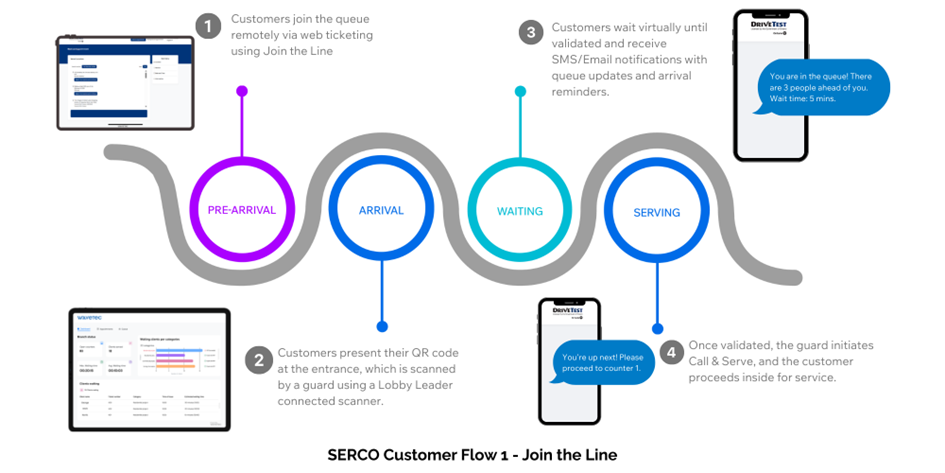
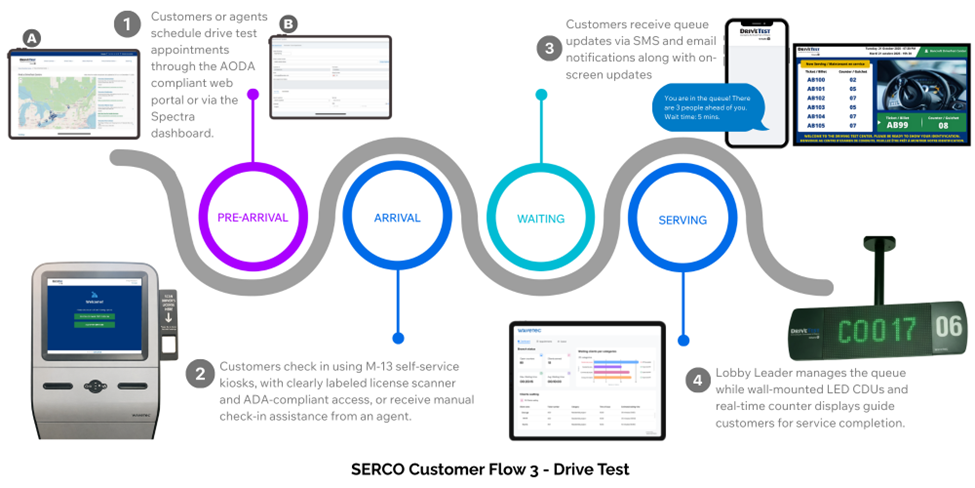
Journey diagram from the DriveTest Ontario deployment: remote queue entry, arrival validation, virtual waiting, and service routing.
Executive Summary
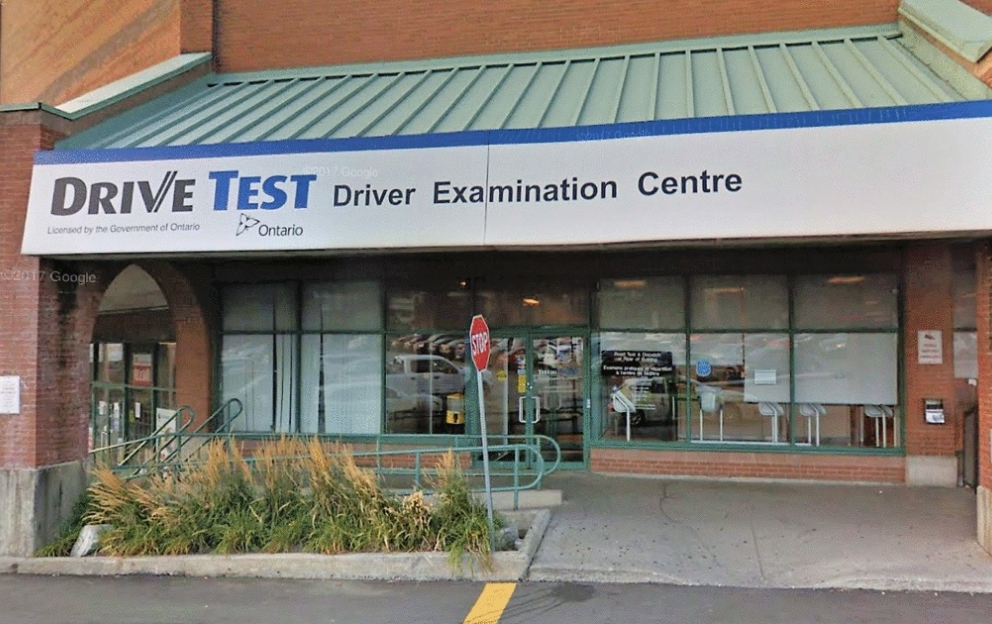
DriveTest Ontario, the driver licensing network operated by Serco on behalf of Ontario’s Ministry of Transportation, faced a familiar public-sector modernization challenge: infrastructure across more than 90 centers had to support digital-first customer expectations, regulatory complexity, accessibility obligations, and demand that could surge without warning. Appointments, remote queue entry, and road-test check-in could not remain fragmented experiences. The service model needed one configurable operating layer that could control demand before arrival, validate customers at arrival, route them during service, and measure performance after completion.
Wavetec replaced the limitations of a traditional ticketing setup with a connected customer-flow platform. The deployment brings together the M-13 self-service kiosk with dual-printer redundancy and integrated driver’s license scanning, Spectra for queue and appointment orchestration, Lobby Leader for staff-side validation and routing, Donatello digital signage, ActiveHub device monitoring, WaveSphere analytics, SMS and email communications, web ticketing, and appointment booking. The result is not a generic queuing system; it is a resilient, modular service infrastructure designed for high-volume public-sector environments.
The case also demonstrates Wavetec’s full-stack advantage: in-house hardware, in-house software, centralized configuration, enterprise integrations, local support planning, and governance controls working as one platform. That combination matters for buyers who need innovation, operational continuity, accessibility, auditability, and implementation control in the same solution.
Looking ahead, Wavetec is extending the platform with next-generation Dashboards powered by AI-driven forecasting and simulation capabilities. These upcoming enhancements will enable transportation agencies to anticipate branch footfall, forecast customer demand, simulate operational scenarios, and identify capacity constraints before they occur. Executives will gain network-wide visibility into expected demand trends, while branch managers will be able to make proactive staffing decisions by allocating personnel where demand is forecast to increase. By moving from historical reporting to predictive operational intelligence, Wavetec is helping DMV and driver licensing agencies transition from reactive queue management to AI-enabled service orchestration. As these capabilities become available, organizations using the Wavetec platform will be well positioned to lead the next generation of AI-driven customer flow management and public-sector service delivery.
| Metric | Evidence |
| Locations covered | 90+ DriveTest Centres across Ontario |
| Connected customer journeys | 3: remote queue entry, scheduled in-centre service, road-test appointments |
| 30-day transaction volume | 93,783 booking, rescheduling, and cancellation transactions |
| Average daily volume | ~3,126 appointment-related transactions |
| Annualized run rate | ~1.14 million appointment-related transactions |
| Digital self-service share | 89.3% website channel over the 30-day window |
| Assisted channels | 10.3% agent-assisted and 0.4% IVR |
| Accessibility | AODA and WCAG-aligned journey, independently reviewed |
| Kiosk resilience | M-13 self-service kiosk with dual thermal ticket printers and failover |
Why this problem matters beyond Ontario
DMV and driver-licensing agencies are often the public face of government service friction. A North Carolina DMV performance audit, reported by the Associated Press, found average customer wait times had increased by more than 15% since 2019 to about 1 hour and 15 minutes, while nearly 14% of visits lasted more than 2.5 hours. Axios also reported that 14% of residents travelled more than an hour for an appointment. Those figures show why appointment systems, virtual queues, staff visibility, and branch orchestration are not cosmetic upgrades; they are access, capacity, and trust issues.
Deloitte’s government digital-services research reinforces the same point from the citizen-adoption side. Its survey of 5,800 people across 13 countries identified four distinct user segments: digitally engaged users, digital explorers, digital skeptics, and digitally discontent users. In practice, this means agencies cannot serve everyone through one digital channel alone. They need digital self-service for scale, assisted service for inclusion, and staff tools that keep both experiences connected.
This broader industry direction is echoed by Boston Consulting Group’s 2025 analysis of DMV modernization, which argues that successful transformation requires a customer-centric, digital-first approach while recognizing that “digital-first doesn’t mean digital-only.” BCG concludes that the most effective operating model blends enhanced online services with optimized in-person processes, supported by redesigned customer journeys, empowered staff, and data-driven operations rather than technology upgrades alone. That philosophy closely aligns with the DriveTest Ontario deployment, where appointments, remote queue entry, kiosk check-in, staff routing, and analytics function as one connected service ecosystem rather than as standalone digital tools.
The DriveTest context carried similar pressure. Ontario’s Auditor General reported that when DriveTest Centres reopened in July 2021, more than 500,000 novice drivers were waiting to take road tests, while DriveTest publishes a service expectation that customers should not have to wait more than 42 days to secure a road-test appointment, subject to availability. These are operating-context figures rather than Wavetec-attributed outcomes, but they explain the scale and continuity demands that the platform had to support.
The real challenge: fragmented journeys and operational risk
DriveTest’s core issue was not simply long queues. The network needed to reduce operational risk, improve the reliability of branch check-in, adapt quickly to changing rules, and unify customer journeys that had previously followed separate operational paths. A single failed ticket printer could take an older kiosk offline, forcing staff to redirect customers or revert to manual processes. In a busy driver-services centre, one hardware fault can ripple through lobby flow, counter utilization, appointment punctuality, and customer confidence.
The service model also required frequent customization. Driver-services agencies must adjust appointment rules, capacity thresholds, arrival windows, cancellation policies, rescheduling behavior, language options, accessibility requirements, and location-specific workflows. A static ticketing system cannot support that level of change without creating workarounds. Wavetec’s role was to provide a configurable orchestration layer that could handle remote queue entry, scheduled in-centre service, and road-test appointments while preserving staff control and customer clarity.
Three connected Customer Journeys
In the Join the Line journey, customers enter the queue remotely through web ticketing before reaching a center. On arrival, they present a QR code for staff validation, wait virtually, and receive SMS or email updates until they are instructed to proceed inside and report to the correct service point.
In the scheduled in-center service journey, customers or agents’ book through the web portal or Spectra. The platform applies capacity and service rules, issues confirmations, validates arrival, and places the customer into the correct queue. Lobby Leader gives staff real-time branch visibility, while signage and counter displays communicate progression to customers.
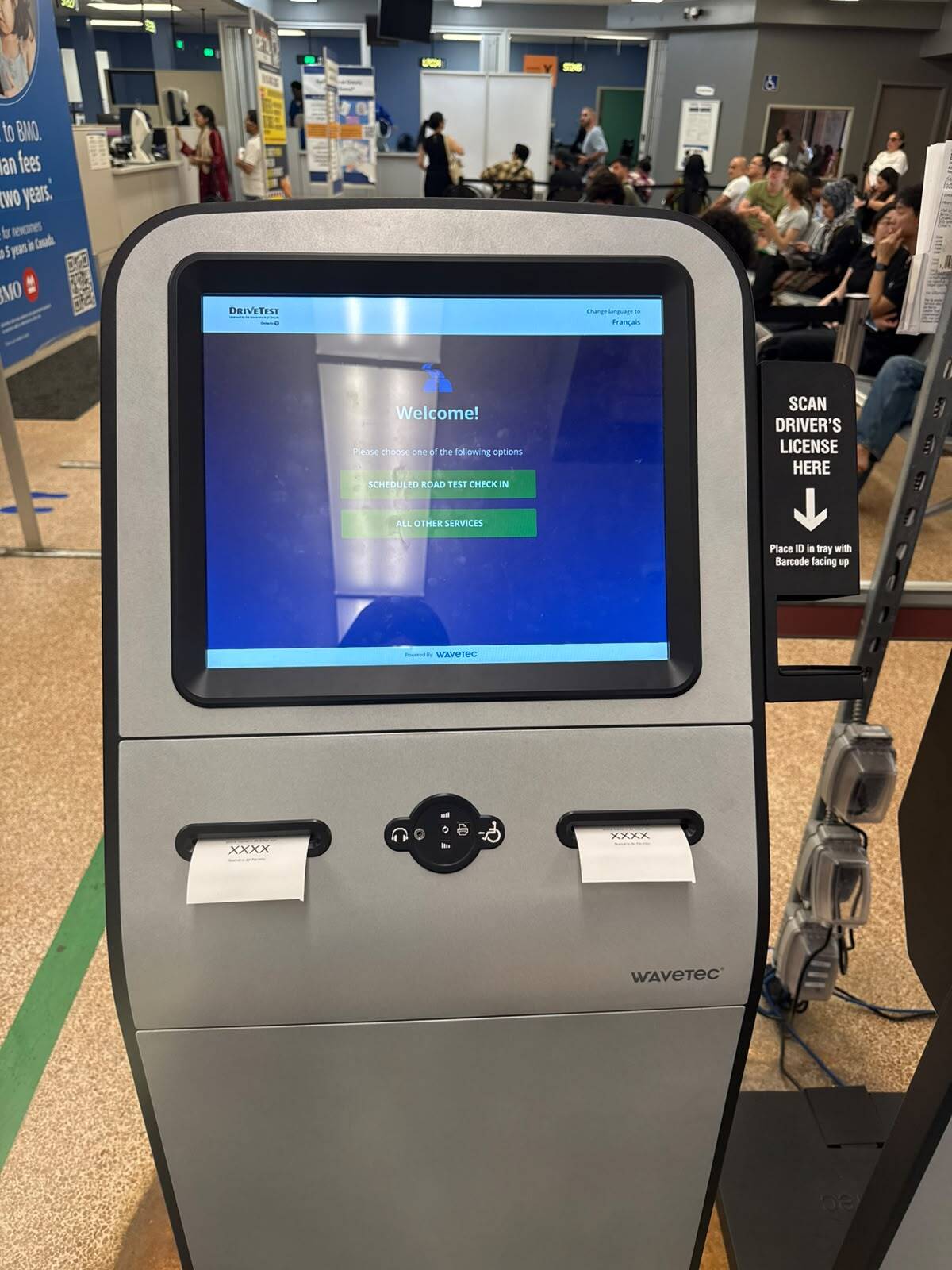
In the road-test appointment journey, customers book and pay online, then check in through the M-13 kiosk or a staff-assisted process. The kiosk scans the driver’s license, confirms the appointment, and routes the customer into the road-test workflow, with SMS, email, and onsite displays continuing to provide status updates until service begins.
Wavetec’s architecture: innovation-first, configurable, and full-stack
Wavetec treated the DriveTest program as connected service infrastructure. Spectra acts as the central rules and orchestration engine, applying service logic across appointments, walk-ins, and road-test check-in. Lobby Leader gives staff a live control layer to validate customers, manage queues, reassign customers, prioritize exceptions, and route customers to the right counter or service point. Donatello signage and LED Customer Display Units keep the customer informed visually inside the branch, while SMS and email services deliver confirmations, reminders, arrival instructions, queue progression, and call-forward messages.
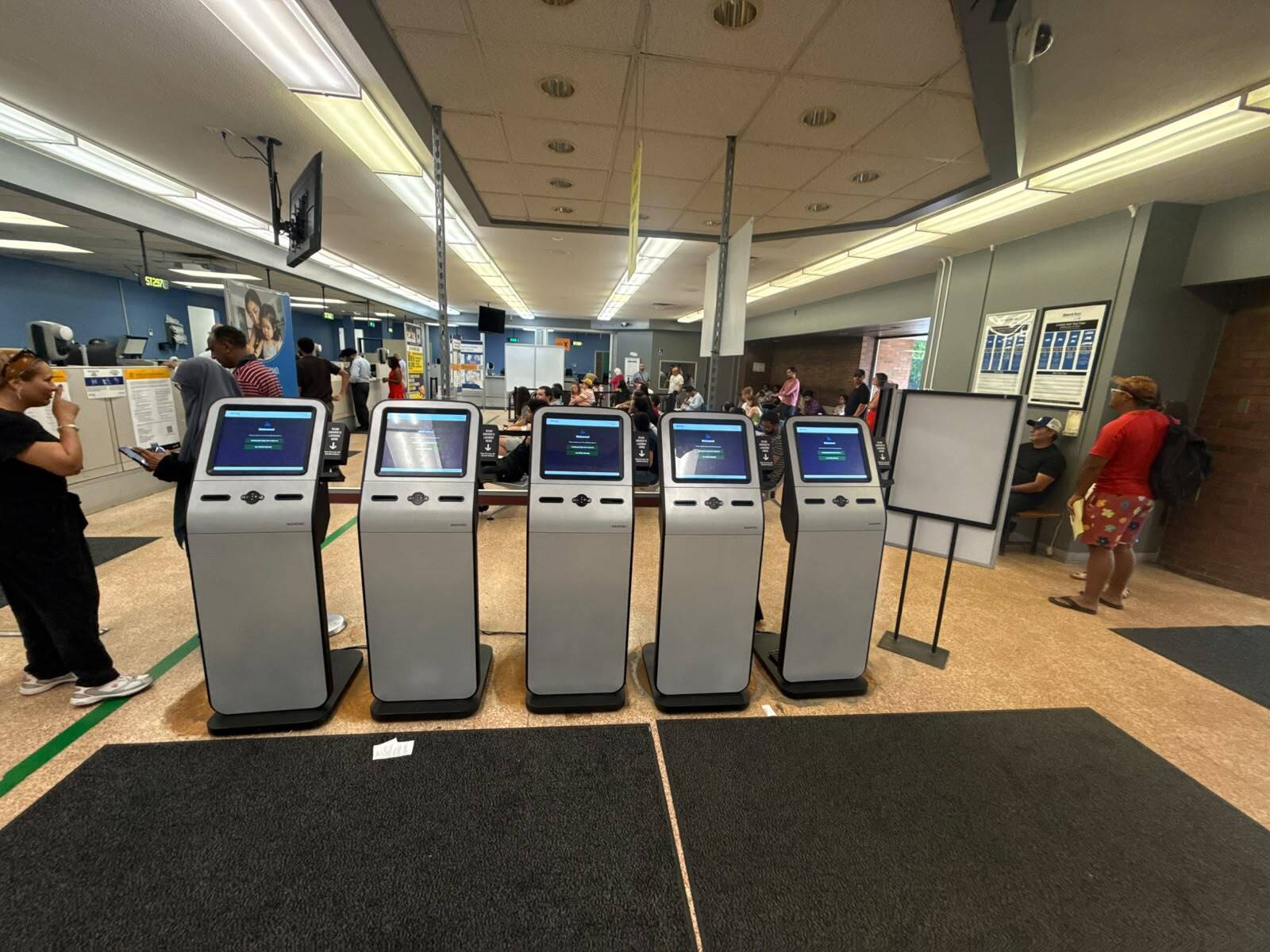
The M-13 kiosk was customized for both resilience and speed. It includes dual thermal ticket printers with automatic failover, integrated driver’s licence scanning, accessible interaction flows, remote device monitoring, and Canadian spare-parts planning. The dual-printer setup directly addresses the earlier single point of failure: if one printer becomes unavailable, the kiosk can continue operating through the backup printer rather than taking the entire check-in point offline.
ActiveHub centralizes device health monitoring and multi-location administration, while WaveSphere gives management operational dashboards, historical reporting, and performance insights. APIs and configurable interfaces exchange appointment, customer, service, transaction, and payment-status data across connected systems. Identity controls, role-based access, auditable staff activity, and controlled data exchange support the governance expectations of regulated public-service environments. These capabilities are further reinforced by Wavetec’s enterprise security and quality framework, including SOC 2 Type II certification, ISO/IEC 27001-certified information security management, and ISO 9001:2015 quality management processes, giving transportation agencies greater confidence in the platform’s security, operational governance, and service reliability.
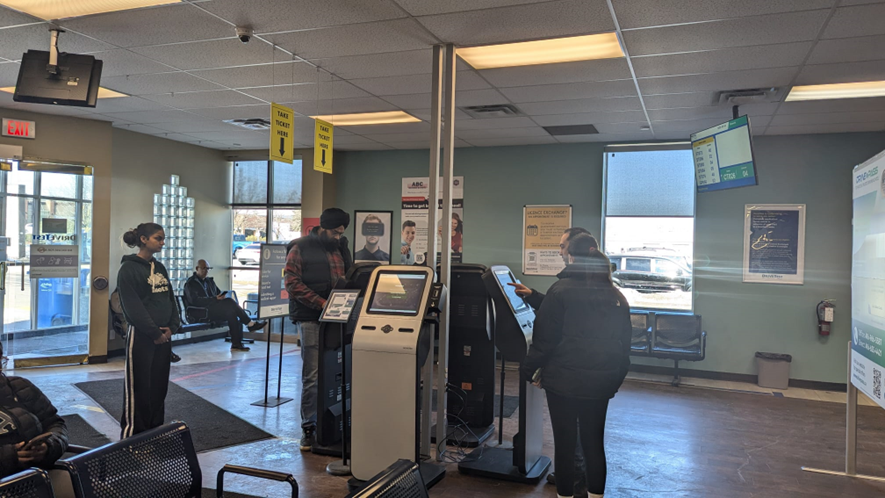
Installation photograph from the DriveTest Ontario case study showing in-branch kiosk and queue-management infrastructure.
Salman Agha, Director of Sales and Business Development at Wavetec North America says “Successful public-sector modernization isn’t about replacing legacy systems with new technology – it’s about designing a platform around the way people actually deliver and receive services. With DriveTest Ontario, we customized every layer of the solution to match operational requirements while creating a foundation for future innovation, including AI-driven operational intelligence, predictive analytics, and smarter branch management. That’s how we help agencies improve today’s customer experience while preparing for tomorrow’s demands.
Accessibility as an end-to-end journey
Accessibility was designed into the full service journey rather than added as a kiosk feature. The M-13 interface, appointment websites, web ticketing, check-in journeys, customer notifications, and staff-assisted alternatives were designed to align with AODA and applicable WCAG requirements. The solution was independently reviewed and also vetted through Canadian ministry governance processes to support ongoing compliance as workflows changed.
This is strategically important because accessibility in a DMV environment is multi-channel. Customers may book online, arrive with a QR code, check in at a kiosk, need staff assistance, rely on SMS or email updates, use assistive technologies, or require physical guidance inside the branch. A modern customer-flow platform must keep those paths connected rather than treating accessibility as a one-time hardware certification.
Platform components and roles
The following table outlines the core Wavetec platform components deployed at DriveTest Ontario and the specific functions each performs. Rather than relying on a single application, the solution brings together integrated hardware, software, communications, monitoring, and analytics components that work together as one unified customer-flow platform.
| Component | Role in the DriveTest solution |
| M-13 self-service kiosk | Onsite check-in, ticket issuance, licence scanning, accessible interaction, dual-printer redundancy |
| Spectra | Central queue, appointment, and service-rule orchestration engine |
| Lobby Leader | Staff validation, live queue control, reassignment, priority handling, and counter routing |
| Donatello digital signage | Real-time queue status, service instructions, visual announcements, and content playback |
| LED Customer Display Units | Clear ticket and workstation guidance at the point of service |
| ActiveHub | Centralized device health monitoring and multi-location administration |
| WaveSphere | Operational dashboards, historical reporting, performance insights, and management visibility |
| SMS/email services | Confirmations, reminders, arrival instructions, queue progression, and call-forward messages |
| Web ticketing and appointment portal | Remote line entry, booking, payment, language selection, and accessible digital journeys |
Performance evidence: digital adoption at province-wide scale
A dashboard snapshot captured on June 26, 2026 illustrates the platform’s ability to support high daily transaction volumes across the province. On that day, the platform processed 3,710 new appointments, 786 reschedules, and 60 cancellations, representing 4,496 booking and rescheduling transactions across all channels. Of those, 3,891 were completed through the public website, 580 through dashboard agents, and 25 through IVR, meaning approximately 86.5% of booking and rescheduling activity was completed through digital self-service while assisted channels remained available.
The same daily snapshot highlights operational variability. Rescheduling represented roughly 17.5% of booking-related activity that day. Booking activity peaked at 342 transactions between 11:00 a.m. and noon, while rescheduling peaked at 70 transactions between 10:00 and 11:00 a.m. These intra-day demand spikes demonstrate the need for an appointment platform capable of absorbing changing customer behaviour without increasing branch congestion or call-centre workload.
Across the 30-day measurement period shown in the dashboard (excluding a partial final day), the platform processed 93,783 booking, rescheduling, and cancellation transactions, averaging approximately 3,126 appointment-related transactions per day. Based on this observed 30-day operating period, the deployment represents an annualized run rate of approximately 1.14 million appointment-related transactions, assuming similar transaction volumes are maintained throughout the year. This figure is presented as a projection derived from the measured period rather than an observed annual total.
During the same 30-day window, 89.3% of transactions were completed through the public website, compared with 10.3% through agent-assisted channels and 0.4% through IVR, demonstrating strong adoption of digital self-service while preserving assisted options for customers who require them.
This performance aligns with appointment-systems research. A 2024 study on robust appointment scheduling observes that appointment design must balance cost, waiting time, and customer satisfaction, concluding that “limiting instead of minimizing customer waiting times is a win-win solution.” For DriveTest, Wavetec’s value extends beyond digitizing bookings; the platform helps shape demand before arrival, validate customers at arrival, route them during service, and measure performance after completion.
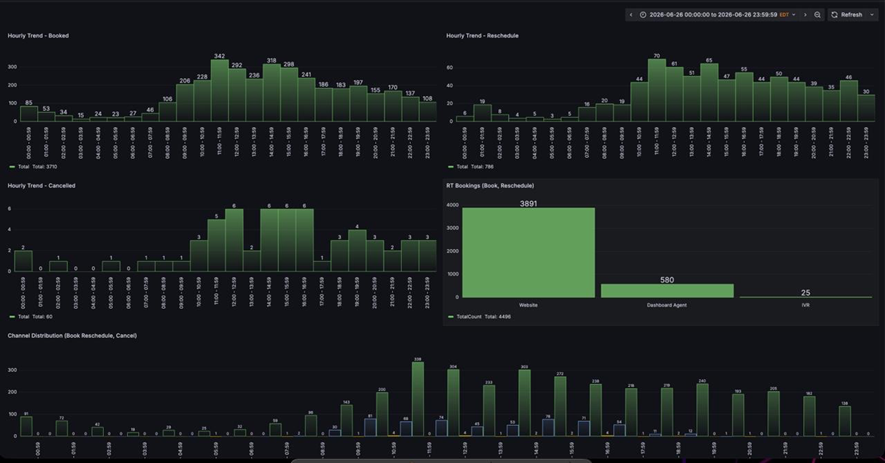
Thirty-day DriveTest booking-platform dashboard image from the source case study, showing sustained multi-channel transaction volume.
Business impact for DriveTest
For DriveTest, the business impact is the creation of a more resilient and measurable operating model. Dual-printer kiosk redundancy and remote monitoring improve continuity. Configurable rules make it faster to adapt service logic, language options, and branch workflows. A shared orchestration layer creates consistency across appointments, walk-ins, and road-test check-in. Remote queue entry, controlled arrivals, and proactive notifications reduce lobby pressure and give customers clearer next steps.
For managers, the platform provides province-wide visibility into queues, branch capacity, device health, transaction patterns, and service performance. For staff, it reduces manual lookup and gives branch teams live control through Lobby Leader. For customers, the journey becomes more predictable: book, pay, get reminders, check in, wait virtually or onsite, follow signage, and reach the correct service point.
Why the model is configurable across verticals
The DriveTest solution is not locked to driver licensing because the configuration layer is built around service rules, customer types, channels, routing logic, staff roles, notifications, integrations, and analytics. That makes it adaptable to any environment where customers must move through regulated, high-volume, multi-step service journeys.
In government and DMV settings, the same platform can support licensing, renewals, road tests, permits, tax services, identity verification, and document review. In healthcare, it can support patient registration, lab check-in, outpatient appointments, pharmacy queues, insurance validation, and multilingual communications. In banking, it can connect appointment booking, branch check-in, teller queues, advisory services, VIP routing, and branch analytics. In telecom and utilities, it can support service-centre visits, repair appointments, bill-payment assistance, equipment pickup, and escalation workflows. In universities, embassies, airports, and municipal centres, it can be configured for eligibility checks, appointment capacity, priority handling, and multilingual service delivery.
This vertical flexibility is where Wavetec’s global capability and local delivery model becomes important. The same full-stack foundation can be deployed across regions and adapted through local compliance, language, integration, and support requirements without fragmenting the core operating environment.
Related motor-vehicle deployments
DriveTest Ontario sits alongside other Wavetec motor-vehicle deployments. Schenectady County DMV in New York uses Wavetec capabilities for online appointments, reception-assisted check-in, SMS and email notifications, digital signage, feedback tools, and real-time staff workflows. St. Lucie County Tax Collector in Florida connects appointments, walk-ins, QR-code check-in, virtual queuing, SMS updates, Donatello signage, and live branch-performance dashboards across three branches. Arizona Auto Biz uses online appointments, web-based walk-in check-in, Lobby Leader, customer feedback, and Spectra analytics across six locations.
Together, these deployments show that Wavetec can support statewide networks, county offices, tax-service environments, and private motor-vehicle service providers with the same core model: appointments, walk-ins, self-service, communications, staff control, accessibility, and analytics working as one service ecosystem.
Conclusion: How Wavetec Solved a Clear Problem with a Connected, Modern Platform
Before this deployment, DriveTest Ontario’s core problem was fragmentation: appointments, walk-ins, and road-test check-in ran on separate systems, a single failed ticket printer could take an entire kiosk offline, and staff had no unified way to see or control customer flow across 90+ locations. That kind of fragmentation is what turns a busy day into a wider operational disruption – the exact pattern documented in the North Carolina DMV audit and in Ontario’s own road-test backlog reporting.
Wavetec’s answer was architectural, not cosmetic. Instead of a ticketing add-on, the platform unified three previously separate customer journeys – remote queue entry, scheduled in-center service, and road-test appointments – under one orchestration layer (Spectra), gave staff live control through Lobby Leader, and removed the kiosk’s single point of failure with dual-printer redundancy on the M-13. Accessibility was built into every channel from the start and independently verified against AODA and WCAG requirements, rather than retrofitted after launch.
The scale of adoption is the clearest evidence the approach worked. At the observed run rate, the platform supports roughly 1.14 million appointment-related transactions a year, with about 89% of that volume handled through self-service rather than staff intervention – freeing agent and IVR capacity for the customers who actually need assisted service.
For DriveTest, and for any high-volume public agency evaluating this model, the takeaway is specific: resilience comes from redundant hardware and unified orchestration, not from adding more staff or more kiosks to the same disconnected setup. Wavetec didn’t just reduce wait times – it gave DriveTest a platform that can absorb demand shocks, adapt to new service rules, and hold accessibility and continuity standards at province-wide scale.
FAQ
What is Wavetec’s role in the DriveTest Ontario deployment?
Wavetec is the technology provider behind the connected appointments, kiosk, and queue-management platform used across DriveTest Ontario’s 90+ centres.
What problem does the M-13 kiosk’s dual-printer design solve?
Earlier kiosk configurations had a single ticket printer, so one printer fault could take the entire kiosk offline. The M-13’s dual thermal printers provide automatic failover to reduce check-in disruption.
Is the DriveTest platform accessible?
Yes. The kiosk interface, appointment websites, web ticketing, check-in journeys, notifications, and staff-assisted alternatives were designed to align with AODA and applicable WCAG requirements, with independent review.
How much transaction volume does the platform support?
Across the displayed 30-day operating period, the platform processed 93,783 booking, rescheduling, and cancellation transactions, or about 3,126 per day and approximately 1.14 million annually at the observed run rate.
Can the model be used outside driver licensing?
Yes. The same appointment orchestration, kiosk check-in, signage, staff routing, monitoring, and analytics model can be configured for healthcare, banking, telecom, utilities, education, embassies, airports, and municipal service centres.
Sources referenced
Wavetec and Serco/DriveTest project information supplied for the case study, including hardware, workflow, customization, support, accessibility, and dashboard details.
Office of the Auditor General of Ontario, 2023 Annual Report, Driver Training and Examination: public context on road-test backlog after reopening.
DriveTest Ontario public booking information and service expectation: customers should not have to wait more than 42 days to secure a road-test appointment, subject to availability.
Bauerhenne, Kolisch, and Schulz, Robust Appointment Scheduling with Waiting Time Guarantees, 2024.