Multi service queue management is a system that allows a single ticket to cover multiple services or visits within a customer journey. Instead of issuing separate tickets for each step, one parent ticket tracks the entire interaction, routing customers between service points seamlessly.
Many customer visits are not simple. A person walking into a bank branch may need to open an account, apply for a credit card, and speak with a loan officer.
A patient at a hospital may need registration, a consultation, lab work, and a follow-up appointment. A citizen at a government service center may need document verification, fee payment, and permit issuance.
In traditional queue management systems, each of these steps would require a separate ticket. The customer would wait in line multiple times, repeating information to different staff members.
- Coordination between service points is poor.
- Time is wasted.
- Frustration builds.
Multi service queue management solves this problem by allowing a single ticket to manage multiple services, whether within one visit or across multiple visits.
This approach creates a unified customer journey, reduces duplicate waiting, and improves operational efficiency. Wavetec enables seamless customer journey management with multi-service queue solutions designed for complex service environments.
What Is Multi-Service Queue Management?
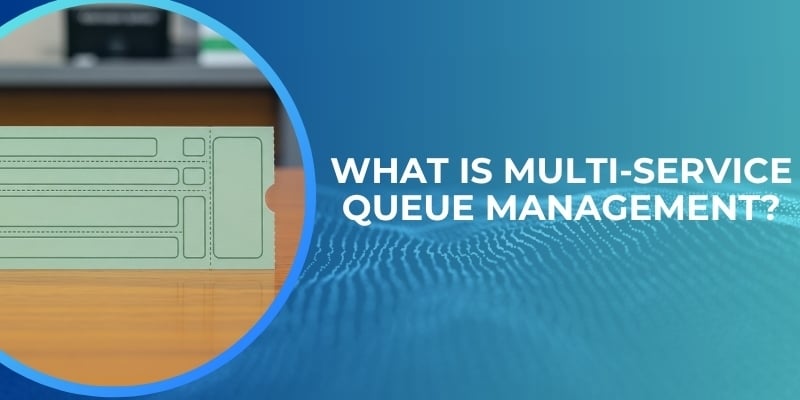
Multi service queue management is a system that handles customer journeys involving more than one service or interaction.
Unlike single-service queues where each customer receives a ticket for one specific counter, multi-service systems issue a single ticket that tracks the entire customer journey across multiple service points.
This approach is essential in complex service environments such as banking, healthcare, and government.
A customer may need to visit different counters or departments to complete their overall goal. Without a multi-service system, the customer would take a new ticket at each step, wait in separate queues, and possibly share the same information multiple times. Staff would have no visibility into what the customer had already done or what remained.
Multi-service queue management changes this. The system issues one parent ticket. As the customer moves from one service to the next, the ticket is updated.
- Staff can see the customer’s full history, including completed steps and pending actions.
- Service points are coordinated.
- Wait times are reduced because the customer is routed intelligently rather than rejoining the back of each queue.
The result is a smoother, faster, and more satisfying customer journey.
What Does “Multiple Visits Under One Ticket” Mean?
The phrase “multiple visits under one ticket” refers to the ability of a queue management system to track a customer’s entire interaction with an organization, even when that interaction spans multiple service steps or separate visits.
Instead of creating a new ticket each time, the system maintains a single parent ticket that contains all related sub-tickets or child visits.
In multi‑visit journeys, a single parent ticket with child visits or sub‑tickets prevents the same issue from spawning multiple threads.
For example, a bank customer might need to open an account today, return next week to activate a credit card, and come back a month later for a loan consultation. With traditional systems, each visit would be treated as a separate, unrelated event. The customer would wait in line each time, and staff would have no continuity.
With multiple visits under one ticket, the system links all these interactions. The customer’s history is preserved. Staff can see previous visits, notes, and outcomes. The customer does not need to re-explain their situation. Follow-up services are prioritized based on the existing relationship.
This approach is particularly valuable for long-term customer relationships where service is delivered over days or weeks, not just minutes.
How Multi-Service Queue Systems Work
Understanding the mechanics of multi-service queue systems helps appreciate their value. The process begins when a customer arrives for their first service.
- When a customer checks in, the system creates a parent ticket.
- The ticket contains basic customer identification and the reason for the visit.
- If the customer indicates they need multiple services, the system can immediately create a service path.
For example, a bank customer might select “Open checking account,” “Apply for credit card,” and “Meet with financial advisor.”
- The queue management for multiple services systems then routes the customer to the appropriate first service point.
- After completing the first service, staff update the ticket, marking that step as done.
- The system then determines the next service point based on availability, priority, and customer preferences.
- The customer may be directed to a different counter, a different department, or asked to wait briefly.
Throughout the journey, the system tracks progress in real time. Managers can see how many customers are in multi-step journeys, where bottlenecks occur, and how long each step takes.
Staff at each service point have access to the customer’s unified ticket, showing completed steps and pending actions. This visibility eliminates the need for customers to repeat information.
For visits that span multiple days, the system stores the parent ticket in a database. When the customer returns, they can check in using their original ticket number or phone number. The system retrieves the parent ticket, sees what services remain, and routes them accordingly.
This continuity transforms fragmented service into a coherent journey.
Key Features of Multi-Service Queue Management Systems
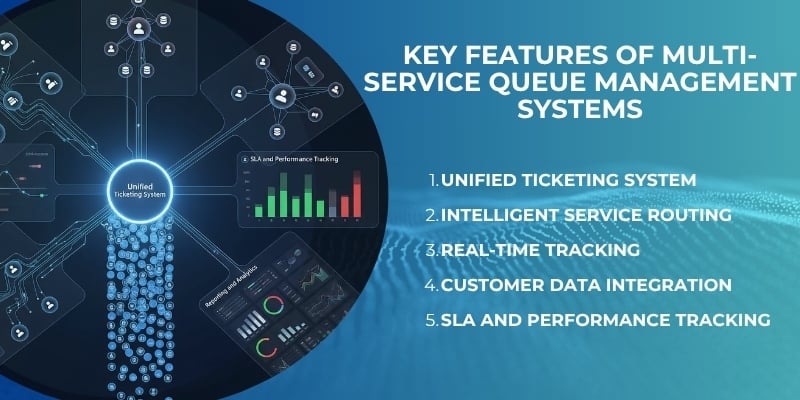
Several features make multi-service queue management effective for complex service environments.
Unified Ticketing System
A unified ticketing system manages all services under one parent ticket. Each service step may have a sub-ticket or child visit, but all are linked to the master record. Customers and staff can see the entire journey at a glance. No information is lost between steps or visits.
Intelligent Service Routing
The system routes customers to the appropriate service point based on their current step, staff availability, skill requirements, and priority. A customer who needs a loan specialist is not sent to a general teller.
A patient who needs lab work is routed to the phlebotomy station after their consultation. Routing is dynamic, adjusting to real-time conditions.
Real-Time Tracking
Managers can monitor customer journeys in real time. They see how long each customer has been in the system, which steps are complete, and where delays are occurring. This visibility allows proactive intervention before customers become frustrated.
Customer Data Integration
Customer information is centralized. Staff at any service point can access the same data, including notes from previous interactions. This prevents repetitive data entry and ensures consistent service.
Integration with customer relationship management systems can bring in additional context such as account history or loyalty status.
SLA and Performance Tracking
Service level agreements can be applied to multi-step journeys. The system tracks first-response time, time between steps, and overall resolution time.
Ticketing‑best‑practice materials note that SLA‑aware systems that track first‑response, last‑visit, and overall resolution time can improve on‑time performance by roughly 20–25%. This capability helps organizations meet service standards and identify improvement opportunities.
Benefits of Multi-Service Queue Management
Organizations that implement multi-service queue management realize significant benefits across customer experience and operations.
- Improved customer experience is the most direct benefit. Customers no longer wait in multiple lines or repeat information. They feel guided rather than abandoned. Satisfaction scores improve because the journey feels coordinated and respectful of their time.
- Reduced waiting times follow from elimination of duplicate queuing. Instead of waiting separately for each service, customers wait once for the entire journey. Intelligent routing ensures they move to the next available appropriate service point without rejoining the back of a line.
- Better service coordination results from shared visibility. Different departments can see what the customer has already done and what remains. Handoffs are smooth. Customers are not passed between staff who lack context.
- Increased operational efficiency occurs because staff spend less time on redundant data collection and more time on service. The system automates routing and tracking, reducing manual coordination. Bottlenecks are visible and can be addressed.
- Enhanced visibility into customer journeys gives managers data to optimize service design. They can see which service combinations are common, where delays happen, and how journey length affects satisfaction. This insight supports continuous improvement.
Multi-Service Queue Management in Wavetec Solutions
Wavetec provides multi-service queue management as a core capability of its queue management systems. The platform is designed for organizations that need to handle complex and modern customer journeys across multiple service points.
- Centralized queue management is the foundation. Wavetec systems issue parent tickets that link all services a customer requires. Sub-tickets for individual service steps are managed automatically. Staff at any counter can access the full customer journey, seeing completed steps and pending actions.
- Integration with smart online appointment booking and scheduling software extends multi-service capabilities to pre-visit planning. Customers can select multiple services when booking online. The system reserves time for each step and coordinates with branch queue logic. When the customer arrives, their multi-service journey is already mapped.
- Integration with customer journey management ensures that multi-service logic applies across all channels, not just in-branch. A customer who books online, checks in at a kiosk, and moves between counters experiences the same unified ticket throughout. Real-time monitoring across branches gives managers visibility into multi-service journeys at every location.
Wavetec systems also support multi-visit journeys spanning days or weeks. Parent tickets are stored and retrievable by customer identifier. When a customer returns for a follow-up service, the system recognizes their ongoing journey and routes them appropriately without creating a new, unrelated ticket.
Case Study – Managing Multi-Service Journeys in Banking
Banks increasingly serve customers whose needs extend beyond a single transaction. Opening accounts, applying for financial products, and completing follow-up services often require multiple interactions across departments.
Wavetec’s implementations demonstrate how multi-service queue management enables banks to handle these complex journeys through a unified, coordinated approach.
Nasfund – Enabling Multi-Step Member Services Through Unified Ticketing
Nasfund implemented Wavetec’s queue management system to support members requiring multiple services within a single visit or across repeated interactions.
Members often needed to complete several steps, such as account inquiries, documentation updates, and financial consultations. Wavetec’s system enabled these services to be managed under a unified ticket, allowing staff to track progress and guide members through each stage without requiring them to rejoin separate queues.
By maintaining visibility into completed and pending services, the organization improved coordination between service points and reduced overall wait times, delivering a smoother and more structured member experience.
Ministry of Commerce – Managing Multi-Department Service Journeys
The Ministry of Commerce in Saudi Arabia deployed Wavetec’s queue management solution to handle complex, multi-step customer journeys across various service departments.
Customers visiting service centers often required multiple interactions, including verification, approvals, and follow-up processing. Through a combination of linear, virtual, and mobile queuing, the system enabled a unified journey where customers could move between service points without restarting the process.
This implementation highlights how multi-service queue management can coordinate high-volume, multi-department environments while maintaining continuity and reducing customer effort.
BCI Bank – Improving Cross-Service Coordination in Branch Operations
BCI Bank implemented Wavetec’s queue management system to enhance service delivery across its branch network, where customers frequently required assistance across multiple service categories.
The system provided visibility into customer needs and service progression, enabling staff to route customers efficiently between service points such as account services, advisory desks, and transaction counters.
By reducing the need for customers to take multiple tickets and repeat information, the bank improved both service efficiency and customer satisfaction. Staff were better equipped to deliver personalized service, supported by a complete view of each customer’s journey.
Challenges in Multi-Service Queue Management
Implementing multi-service queue management is not without challenges. Organizations should anticipate and plan for these issues.
- Complexity in system design is the primary challenge. A multi-service system must handle many possible service sequences, routing rules, and exceptions. Designing the logic requires a deep understanding of customer journeys and service workflows. Simpler single-service systems are easier to implement but lack the needed capability.
- Coordination between service points requires staff buy-in and training. Different departments may have their own priorities and processes. Getting them to work together under a unified queue system can be difficult. Clear communication and demonstrated benefits help overcome resistance.
- Data synchronization issues can arise when multiple systems need to share ticket information. The queue system must integrate with appointment booking, customer relationship management, and possibly core business systems. Without proper integration, data silos persist.
- Staff training requirements are higher for multi-service systems. Staff must understand how to read parent tickets, update sub-tickets, and follow routing rules. Training should cover both technical skills and customer service expectations for multi-step journeys.
Future of Multi-Service Queue Management Systems
The future of multi-service queue management will be shaped by artificial intelligence, predictive analytics, and deeper integration with customer experience platforms.
- AI-driven service routing will move beyond simple rules-based logic. Machine learning models will predict which service sequence is most efficient for each customer based on their history, current branch conditions, and predicted wait times. Routing will become dynamic and personalized.
- Predictive customer journey management will anticipate customer needs before they arrive. A bank might predict that a customer who just opened a checking account is likely to want a credit card within 30 days. The system could proactively offer to schedule that second visit as part of the original parent ticket.
- Personalized service flows will adapt to individual customer preferences. Some customers prefer to complete all services in one long visit. Others prefer to spread services across multiple shorter visits. Multi-service systems will support both patterns seamlessly.
- Advanced queue management analytics will provide deeper insights into journey performance. Organizations will be able to analyze multi-service journeys by customer segment, service combination, branch location, and time of day. This data will drive continuous improvement in service design.
FAQs
What is multi-service queue management?
Multi-service queue management is a system that handles customer journeys involving multiple services or visits using a single parent ticket. It coordinates routing between service points, tracks progress, and preserves customer context across steps.
What does multiple visits under one ticket mean?
Multiple visits under one ticket means a single queue ticket can cover a customer’s entire interaction with an organization, even when that interaction spans multiple service steps or separate visits across different days. All related sub-tickets are linked to the parent.
How do queue systems handle multiple services?
Queue systems handle multiple services by creating a parent ticket with linked sub-tickets for each service step. The system routes customers intelligently between service points, tracks completion of each step, and maintains customer data across the entire journey.
Why is unified ticketing important?
Unified ticketing is important because it prevents duplicate waiting, eliminates repetitive data entry, improves service coordination, and gives staff full visibility into customer history. It transforms fragmented service into a seamless journey.
Which industries use multi-service queue systems?
Banking, healthcare, government services, telecommunications, and large retail operations use multi-service queue systems. Any organization where customers typically need multiple services or follow-up visits can benefit from this approach.
Conclusion
Managing multiple services under one ticket is essential for organizations that serve customers with complex needs.
Traditional single-service queue systems force customers to wait repeatedly, repeat information, and navigate fragmented processes. Multi service queue management solves these problems by creating a unified parent ticket that tracks the entire customer journey, whether across multiple counters in one visit or across multiple days.
The benefits are clear: shorter wait times, better coordination, higher customer satisfaction, and more efficient operations. Wavetec provides advanced multi service queue management solutions integrated with appointment booking and customer journey platforms.
For banks, hospitals, government offices, and retail chains, adopting multi-service queue management is a strategic step toward modern, customer-centered service delivery.
The future of queue management is not about isolated transactions but connected journeys, and multi-service systems are the foundation of that future.
BOOK A FREE DEMO