See how Wavetec’s Self-Service Telecom Kiosk platform handles KYC, SIM registration, and payments end to end.
Every telecom self-service telecom kiosk running a SIM registration or a KYC check is already making a decision, every single transaction: does this proceed on its own, or does it need a human? Right now, that decision usually lives in an ID-scan confidence score or an unwritten habit at the counter, not in a documented policy. As telecom operators push more branch traffic onto self-service, that gap matters more than it used to. Get the split wrong one way, and the kiosk escalates constantly and saves nobody any time. Get it wrong the other way, and a machine waves through an identity check that should have been flagged, real fraud exposure, not a theoretical one.
The cost of getting this wrong is not abstract. In South Africa, telecom fraud costs the industry more than R5.3 billion a year, and close to 60% of mobile banking fraud is linked directly to SIM-swap attacks, fraud that persists specifically because current registration rules do not require biometric verification at the point of registration, according to GSMA-cited industry data. That is not a hypothetical risk case. It is a documented, ongoing cost tied directly to how strictly identity gets verified at the exact moment a kiosk decides whether to proceed unattended.
Independent research backs the logic of building this decision deliberately rather than leaving it implicit. McKinsey’s Responsible AI framework for telecom operators is explicit that use cases handling customers’ personal information warrant the most advanced level of AI oversight, not the least. In other words, the more sensitive the data a self-service step touches, the more deliberate the human-oversight decision needs to be, exactly the fork this piece is about.
This piece lays out that decision as an actual framework: what belongs to the machine, what belongs to a person, and how an operations team proves, after the fact, that the line was drawn in the right place.
The Moment Nobody Documents
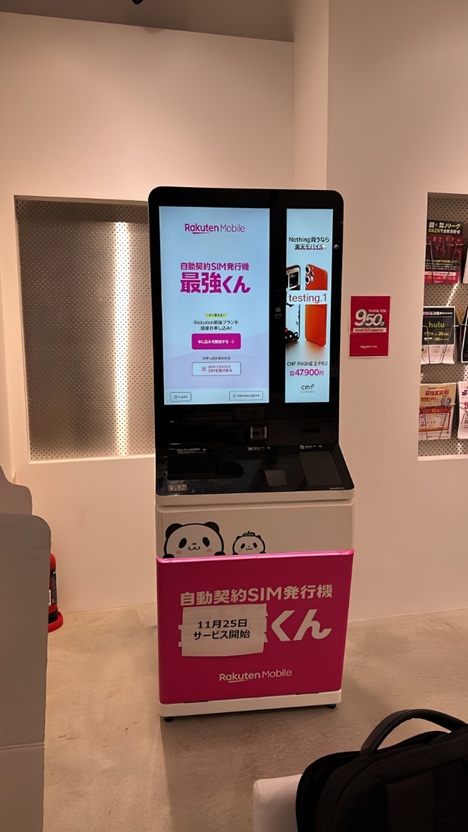
Picture a customer replacing a lost SIM at a self-service telecom kiosk. Wavetec’s deployment with Kcell in Kazakhstan runs exactly this flow: the customer selects SIM Replacement, enters their mobile number, and scans their ID. The kiosk verifies the photo against the ID in real time. If the number is registered in the customer’s name and the registration data matches what is on file, the kiosk issues the new SIM immediately, no staff member involved.
That single verification step, does the photo match, does the data match, is the actual decision moment. It usually is not described as one. Most self-service documentation talks about the customer journey (book, arrive, check in, get served) without naming the specific fork where the system has to decide whether to keep going alone or bring in a person.
What Actually Belongs to the Machine
Not every KYC step carries the same risk, and that is the actual basis for the decision, not a blanket rule like “kiosks handle simple stuff, humans handle everything else.”
| Signal | Route |
| High-confidence document + liveness match | Unattended |
| Simple top-up, no new KYC required | Unattended |
| Low-confidence face match or blurry scan | Escalate to staff |
| Suspected counterfeit or mismatched document | Escalate to staff |
| Customer is a minor | Escalate to staff |
| Registration data does not match existing records | Escalate to staff |
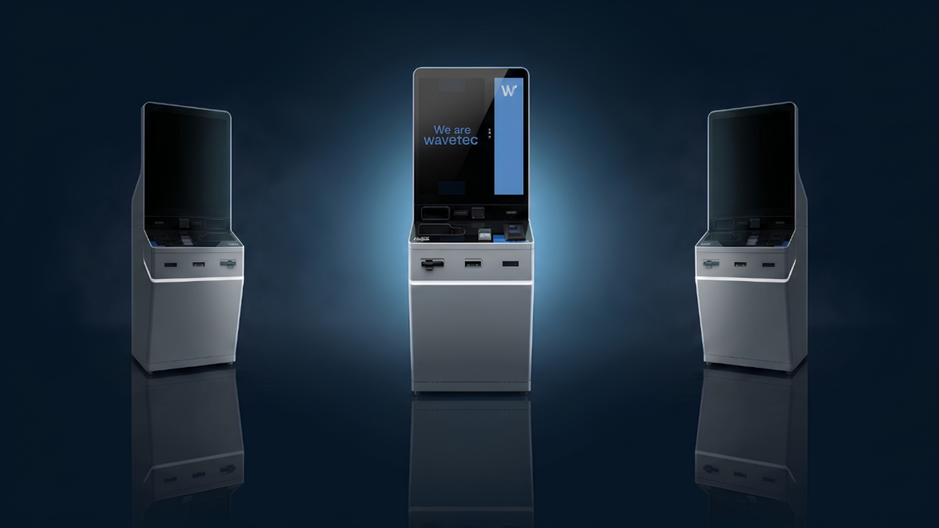
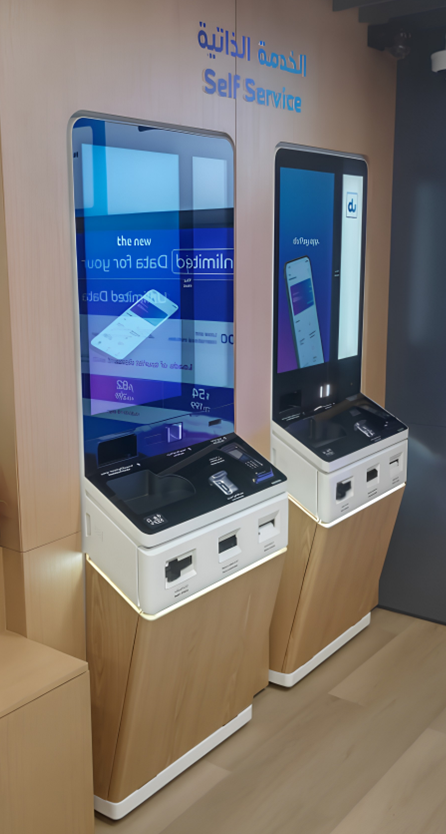
Wavetec’s self-service telecom kiosks are built with the hardware this depends on: multi-modal biometric verification (fingerprint, iris, and facial scanning), OCR-based document reading, and counterfeit or photocopy detection built into the ID scanner. Those are the actual inputs the decision runs on, a measured confidence score at each step, not a policy statement.
The Assisted-or-Unattended Framework
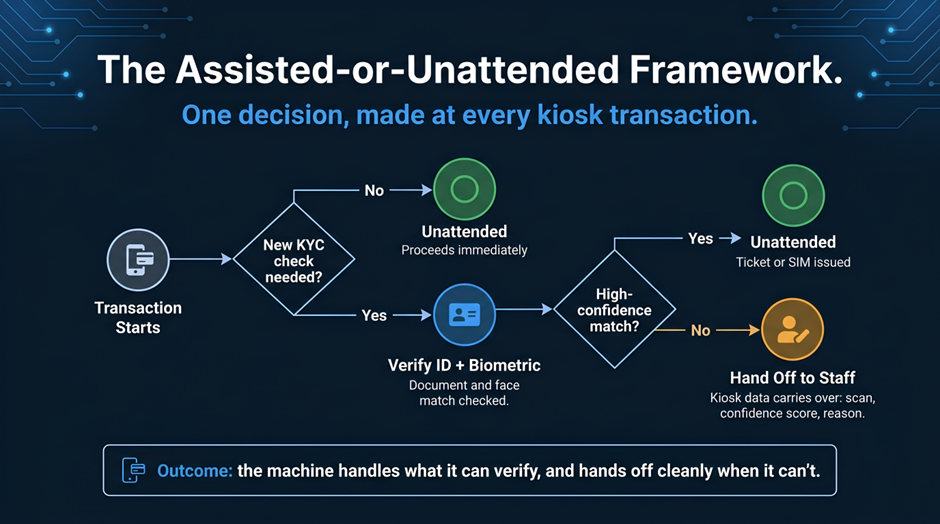
Put together, the logic is a fork, not a gradient:
- Customer starts a transaction (top-up, SIM registration, SIM replacement). 2. If no new identity check is required, it proceeds unattended immediately. 3. If a KYC check is required, the kiosk runs document and biometric verification. 4. A high-confidence match proceeds unattended, ticket or SIM issued. 5. A low-confidence match, a mismatch, or a flagged case hands off to a staff member, with the kiosk’s data (scan, confidence score, mismatch reason) already available to whoever picks it up.
That handoff is where Nexia-Q, Wavetec’s AI digital human deployed on the kiosk, does real work: it guides the customer by voice through the transaction, and when a handoff is needed, it is the one that tells the customer what is happening and where to go next, rather than the customer hitting a dead screen.
What Changes When the Split Is Right
Get this right and the throughput gain is real, not marginal. In one Wavetec deployment, roughly 80% of bill payment, top-up, and SIM replacement transactions shifted from the counter to the kiosk. Journeys that took 30 to 40 minutes at the counter were completed in 2 to 4 minutes on the kiosk, a 13x or greater reduction in transaction time.
That gain only holds if the split is actually calibrated. An operator that escalates too conservatively keeps almost everything at the counter and gets none of that time back. One that automates too aggressively risks exactly the fraud exposure the GSMA-cited data points to above.
How You Know the Split Is Holding
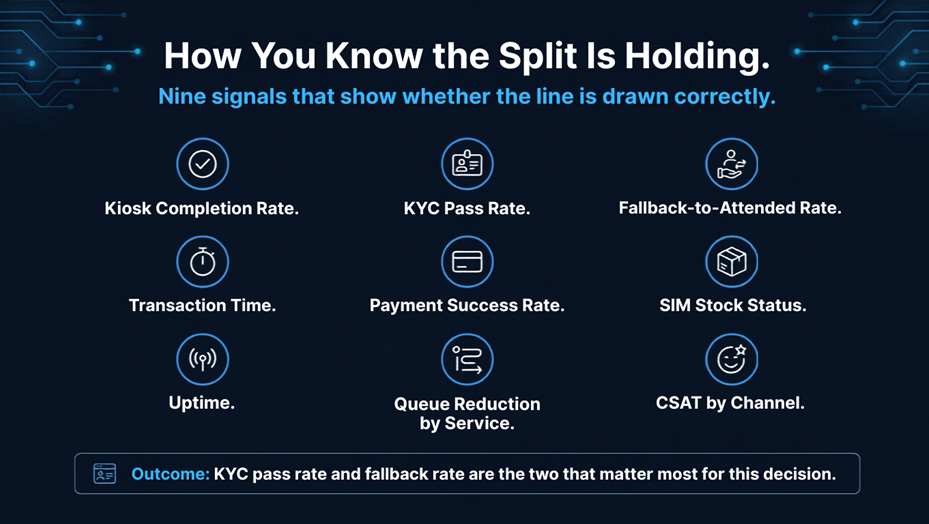
This is not a set-and-forget decision. Wavetec’s own guidance for telecom operators names the specific metrics that show whether the line is holding: kiosk completion rate, KYC pass rate, fallback-to-attended rate, transaction time, payment success rate, SIM stock status, uptime, queue reduction by service type, and CSAT by channel.
Two of those numbers matter most for this specific decision: KYC pass rate tells you how often the machine is clearing people correctly, and fallback-to-attended rate tells you how often it is punting to a human. If fallback climbs, either fraud attempts are rising or the threshold is set too conservatively, and those require two very different responses. Spectra, Wavetec’s analytics and business intelligence platform, is what surfaces these numbers on a live dashboard rather than in a monthly report.
Proving the Decision Was Right
When an auditor or regulator asks why a specific transaction was allowed to proceed unattended, “the machine was probably right” is not an answer. This is where governance stops being a checkbox and becomes the thing that makes the whole framework defensible.
Wavetec’s self-service telecom kiosk architecture is built around this: TLS-encrypted data in transit, OAuth2, mTLS, API keys, or SSO for administrative access, and role-based access control governing who can see dashboards, configuration, and inventory, documented directly on Wavetec’s own deployment architecture. Updates roll out in staged releases with rollback, and the kiosk itself runs in a locked-down mode. On top of that sits Wavetec’s broader enterprise security posture: SOC 2 Type II, ISO 27001, and GDPR-aligned data handling.
Put together, that is what lets an operator answer the actual question a regulator asks: not “is your system secure,” but “can you show me, for this specific transaction, why it was allowed to proceed.”
Proof This Works at Scale
This is not theoretical. Kcell in Kazakhstan runs exactly this KYC-verification flow on Wavetec’s Azimut platform across its self-service telecom kiosk network, in three languages. Cable & Wireless uses the same SIM dispensing platform for identity-linked self-service. And in West Africa, Orange Sierra Leone runs Wavetec’s broader queue and self-service telecom infrastructure across 8 branch locations, the same operational discipline, applied at network scale.
FAQs
What is assisted vs. unattended KYC self-service?
It is the operational decision of whether a given identity-verification step, like SIM registration or replacement, can be completed by a self-service telecom kiosk on its own, or needs a staff member to step in. The decision is based on how confidently the system can verify the customer’s identity, not a fixed rule about transaction type.
What signals should trigger escalation to a human?
Low-confidence document or face match, a suspected counterfeit or mismatched ID, a minor, a disputed identity, or registration data that does not match existing records.
What metrics show whether the assisted/unattended split is working?
KYC pass rate and fallback-to-attended rate are the two most direct signals, alongside kiosk completion rate, transaction time, and uptime.
Does unattended KYC self-service still meet SIM registration compliance requirements?
Yes, when it is built on verified biometric and document-authentication checks with a defined escalation path, and backed by audit logging and role-based access control so every decision is traceable.
The Bottom Line
The point is not to remove humans from telecom retail. It is to make sure the machine only handles what it can verify confidently, and hands off cleanly, with the data intact, when it cannot.
Explore Wavetec’s Telecom Self-Service Kiosk and SIM Dispensing solutions, or book a demo to see the assisted/unattended framework running live.
BOOK A FREE DEMO