A practical guide to how telecom operators can automate SIM registration, KYC refresh, bill payment, top-up, SIM replacement, eSIM activation, and routine subscriber journeys through connected self-service kiosks.
Introduction: Telecom Retail Needs a New Operating Model
A telecom store that requires a staff member for every routine transaction is carrying a cost structure from a different decade.
SIM registration, KYC refresh, bill payment, top-up, SIM replacement, plan upgrade, and eSIM activation are not all complex service encounters. Many are predictable, repeatable workflows that can move to a secure self-service layer, provided the system can capture identity, apply the operator’s policy rules, connect to BSS/OSS systems, and escalate exceptions without breaking the customer journey.
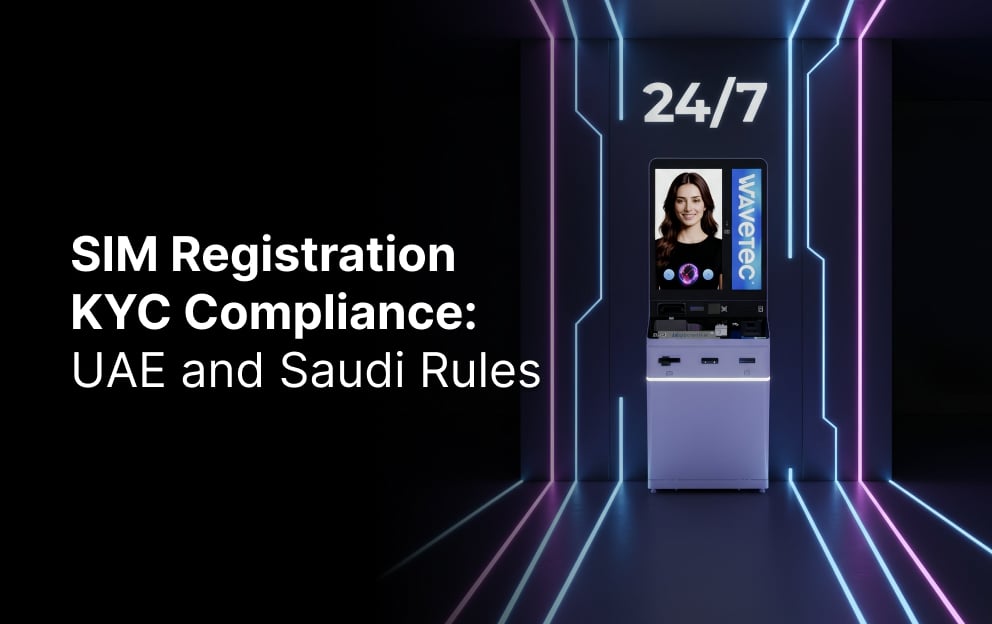
That is the point of Wavetec’s Telecom Self-Service Kiosk. It is designed to automate SIM lifecycle, bill payments, KYC journeys, prepaid top-ups, biometric security, fraud prevention, telemetry, dashboards, and operational control.
The goal is not to remove the human from telecom retail. The goal is to move staff away from repetitive data entry and toward the moments where human service actually matters: complaints, corporate accounts, complex plan selection, exceptions, accessibility support, and high-value customer retention.
Why Telecom Retail Needs a Phygital Self-Service Model
Telecom operators sit at the intersection of retail, identity, payments, and regulated digital access. That makes their physical stores operationally complex.
Customers may arrive to buy a new SIM, replace a lost SIM, activate an eSIM, register identity documents, pay a bill, top up prepaid credit, collect a device, or resolve a service complaint. Treating all of those journeys as attended-counter journeys creates unnecessary pressure on staff and avoidable waiting for customers.
A phygital telecom store is not a store with a kiosk in the corner. It is a store where the kiosk, attended counter, queue system, signage, mobile channel, and analytics layer operate as one service model.
The Three Structural Problems with Attended-Only Telecom Service Desks
1. Routine Transactions Consume Too Much Counter Time
A SIM registration or KYC refresh often becomes an attended process because the customer’s ID needs to be captured, verified, copied into another system, and attached to the subscriber record. In many cases, this is controlled data capture rather than skilled advisory work.
2. KYC Is Treated as a Human-Only Checkpoint
Regulations usually require reliable identity verification, auditability, consent, and data retention. They do not automatically require every step to be performed by an agent. Whether automation is allowed depends on the jurisdiction, but a well-designed self service kiosk can support ID capture, OCR, liveness checks, face matching, API verification, consent logging, and audit trails.
3. Self-Service and Attended Service Are Rarely Designed Together
A kiosk that cannot escalate exceptions into the live queue creates frustration. A queue system that cannot see kiosk failures misses the real workload. A branch manager who cannot see kiosk utilization, KYC pass rates, and fallback-to-attended frequency cannot manage the store as a system.
The Updated Wavetec Product Model
Telecom self-service works best when the solution is positioned as a connected Wavetec stack rather than a standalone kiosk.
| Wavetec Product Layer | Role in the Telecom Journey |
|---|---|
| Telecom Self-Service Kiosk | Automates SIM registration, KYC, SIM dispensing, bill payments, prepaid top-ups, and subscriber self-service. |
| Self-Service Kiosk Software / ViaOS | Manages kiosk workflows, device health, software updates, transactions, security, APIs, and remote monitoring. |
| Self-Service Kiosks | Provides the broader modular hardware ecosystem for telecom, banking, retail, airports, and public service environments. |
| Edge 2.0 Premium Self-Service Kiosk | Supports flagship telecom environments with SIM dispensing, eSIM activation, ID/passport scanning, liveness detection, fingerprint capture, POS, and cash acceptance. |
| Wavetec QMS | Routes kiosk exceptions, attended-counter tickets, appointments, and walk-ins into one service flow. |
| Spectra Queue Analytics | Tracks service performance, kiosk utilization, fallback rates, wait times, and branch-level KPIs. |
| Digital Signage | Guides customers to self-service, attended counters, collection points, or exception desks. |
| Integrations & Systems Architecture | Connects kiosks to BSS, OSS, CRM, identity systems, payment gateways, notification tools, and monitoring platforms. |
Wavetec’s Self-Service Kiosk Solutions automate transactions and remove service friction with modular hardware and device management software. For telecom operators, that means secure self-service for SIM lifecycle workflows, payment journeys, customer identity capture, and integration with core systems, POS, and analytics.
Transaction Taxonomy for Telecom Self-Service
A phygital telecom store should begin with a transaction taxonomy. Not every journey belongs at the kiosk, and not every journey belongs at the counter.
| Transaction Type | Recommended Channel | Why |
|---|---|---|
| New SIM Registration | Telecom kiosk with eKYC | ID capture, liveness, API checks, and audit logs can standardize the process. |
| SIM Replacement | Telecom kiosk or assisted kiosk | Customer identity can be verified before replacement is authorized. |
| eSIM Activation | Telecom kiosk, mobile, or assisted self-service | QR or remote provisioning workflows can reduce counter dependency. |
| Prepaid Top-Up | Kiosk, mobile, or WhatsApp | Low-complexity transaction with clear automation potential. |
| Bill Payment | Kiosk or mobile | Payment rails and receipt generation can be automated. |
| KYC Refresh | Kiosk with ID verification | Similar to registration, with exception routing when needed. |
| Plan Upgrade / Add-On | Kiosk, app, or attended counter | Simple plan changes can be automated; advisory cases can escalate. |
| Complaint / Escalation | Attended counter | Requires context, empathy, and resolution ownership. |
| Corporate Account Management | Attended counter | Requires authority verification and commercial discussion. |
| Accessibility Support | Assisted self-service or attended counter | Service design must preserve support for customers who need help. |
This framing is safer and more accurate than saying “kiosks replace counters.” The better message is: kiosks absorb repeatable load; counters handle complexity.
A KYC-Ready SIM Registration Journey: Step by Step
A customer enters a telecom store to register a new SIM. Instead of joining the attended queue immediately, they see live service guidance on digital signage: “SIM registration available at self-service kiosk. Typical completion time: 3–5 minutes.”
The customer selects SIM registration on the kiosk. The kiosk asks for language preference, consent, and document type. The customer scans a national ID, passport, or residency document. OCR captures the fields. Where supported, the document chip or identity API provides additional verification. The kiosk camera performs face matching and liveness detection.
Wavetec’s Telecom Self-Service Kiosk supports configurable eKYC for SIM registration using ID document capture, face matching, liveness checks, sanctions logic, and compliance-driven verification to reduce inconsistent manual checks.
If verification passes, the customer selects a plan, pays any required fee or deposit, and receives a SIM, eSIM QR code, or collection instruction. If verification fails because of expired ID, document mismatch, unreadable document, or watchlist response, the system issues an attended-service ticket with the exception reason pre-populated.
That last part is critical. A failed kiosk journey should not send the customer back to the beginning. It should escalate cleanly into Wavetec QMS, with staff already aware of what happened.
Where Edge 2.0 Fits
Wavetec’s Edge 2.0 gives telecom operators a stronger product configuration for flagship stores and high-footfall service environments.
Edge 2.0 is a premium self-service platform for flagship banking and telecom environments. It supports account opening, card dispensing, SIM dispensing, eSIM activation, strong KYC, advanced peripherals, and enterprise integration. It also includes dual cameras, facial recognition, liveness detection, fingerprint capture, ID/passport scanning, barcode workflows, POS, cash acceptance, and optional cheque or cash dispensing modules.
| Edge 2.0 Capability | Telecom Use Case |
|---|---|
| Dual cameras and liveness detection | Stronger identity assurance for SIM registration and SIM replacement. |
| Fingerprint capture | Jurisdictions where biometric verification is required or permitted. |
| ID/passport scanner with OCR, IR, and UV | Automated document capture for local and international customers. |
| SIM dispenser with QR/barcode workflow | SIM issuance, SIM replacement, and controlled inventory release. |
| eSIM activation support | QR-driven activation and digital onboarding. |
| Semi-embedded POS and cash acceptance | Fee collection, deposits, prepaid top-ups, and bill payments. |
| Large touch display and branding screen | Flagship in-store customer guidance and promotion. |
| Monitoring and analytics integration | Fleet visibility, uptime tracking, transaction monitoring, and operational control. |
KYC, Privacy, and Compliance Boundaries
KYC-ready self-service must be positioned carefully. It is not simply a faster retail workflow. It is a regulated data workflow.
| Requirement | What the System Needs to Do |
|---|---|
| Consent Capture | Present consent at the start of the transaction and timestamp the customer’s acceptance. |
| Data Minimization | Capture only the fields required for the transaction and local regulatory requirements. |
| Identity Verification | Use ID capture, OCR, chip read where available, liveness checks, face matching, and API verification. |
| Data Residency | Store and process identity records according to the operator’s jurisdictional requirements. |
| Audit Trail | Log who did what, when, through which channel, and with what result. |
| Exception Routing | Send failed or uncertain cases to attended staff without forcing the customer to restart. |
| Retention Policy | Retain identity and transaction data only for the configured statutory or operator-approved period. |
| Security Controls | Use encryption, access control, and monitoring for sensitive workflows. |
Wavetec’s Integrations & Systems Architecture supports this enterprise governance message through baseline security controls such as SSO, RBAC, TLS, audit logging, retention controls, access controls, export controls, governed deployments, and encryption at rest where applicable.
Payments, Top-Ups, and Bill Settlement
Telecom self-service is strongest when it goes beyond SIM issuance. Telecom kiosks can support bill payment and prepaid top-up transactions, including cash acceptance, card terminals, and mobile wallet QR flows.
That matters because telecom stores often become payment centers during peak billing periods. Moving these transactions to kiosks reduces attended-counter load and keeps stores open for customers who need higher-value assistance.
| Transaction | Customer Value | Operator Value |
|---|---|---|
| Bill Payment | Pay after hours or without counter wait. | Reduce payment-counter queues. |
| Prepaid Top-Up | Recharge quickly through cash, card, or QR. | Increase self-service adoption. |
| SIM Replacement | Recover access without long wait. | Standardize identity checks. |
| eSIM Activation | Activate through QR and guided instructions. | Reduce counter dependency. |
| Plan Upgrade | Compare and select eligible plans. | Shift routine plan changes to digital. |
| Device Collection | Use token, QR, or ID verification. | Reduce attended collection workload. |
| Feedback Capture | Rate the experience immediately. | Link CX feedback to service data. |
How Spectra Analytics Changes Telecom Store Operations Management
A connected telecom self-service model gives operations teams more than a queue dashboard. It gives them visibility into kiosk utilization, escalation rates, KYC pass rates, fallback-to-attended frequency, and service outcomes by transaction type.
| KPI | What It Tells the Operator |
|---|---|
| Kiosk Completion Rate | Whether customers can finish self-service journeys without staff help. |
| KYC Pass Rate | Whether document capture and verification rules match the customer population. |
| Fallback-to-Attended Rate | How much kiosk demand still becomes counter demand. |
| Average Kiosk Transaction Time | Whether the flow is fast enough to justify migration. |
| SIM Inventory Status | Whether kiosks are stocked and operational. |
| Payment Success Rate | Whether payment modules are reliable across cash, card, and wallet flows. |
| Device Uptime | Whether field support and remote monitoring are working. |
| Queue Reduction by Service Type | Whether self-service is actually reducing attended-counter load. |
| CSAT by Channel | Whether customers prefer the kiosk journey for eligible transactions. |
This turns the deployment from a hardware installation into an operations playbook.
Designing the Phygital Telecom Operating Model
A strong telecom self-service deployment should not begin with “install kiosks.” It should begin with service design.
| Design Decision | Why It Matters |
|---|---|
| Which transactions are kiosk-eligible? | Prevents forcing complex cases into a weak self-service journey. |
| Which transactions require attended review? | Protects compliance and customer experience. |
| Which documents are accepted? | Prevents high KYC failure rates. |
| Which languages are available? | Improves adoption in multilingual markets. |
| What happens when an API is down? | Avoids kiosk abandonment during verification failures. |
| What happens when SIM stock is low? | Prevents failed journeys caused by replenishment issues. |
| How does the kiosk escalate? | Keeps exception handling structured. |
| Who owns the dashboard? | Makes self-service performance manageable. |
| What is the rollout threshold? | Prevents scaling before adoption, uptime, and completion are proven. |
This is where Wavetec can differentiate: the value is not just hardware. It is the combined model of kiosk hardware, software, queue orchestration, analytics, signage, and integrations.
Deployment Architecture
For technical and enterprise buyers, the self-service model should be understood as a multi-layer architecture.
| Layer | Example Systems |
|---|---|
| Customer Interaction | Telecom kiosk, mobile app, WhatsApp, attended counter. |
| Identity and Verification | ID scanner, OCR, liveness, biometrics, national ID API, operator KYC rules. |
| Transaction Systems | BSS, OSS, CRM, billing, payment gateway, SIM inventory, eSIM provisioning. |
| Journey Orchestration | Wavetec QMS, Spectra & ViOS, exception routing, service rules. |
| Analytics and Monitoring | Spectra dashboards, kiosk telemetry, transaction logs, SLA alerts. |
| Customer Communication | SMS, WhatsApp, email, digital signage, receipt printer. |
| Governance | RBAC, audit logs, consent records, data residency, retention policy. |
Quantified Outcomes
Across Wavetec phygital telecom deployments, reported deployment benchmarks include:
| KPI | Reported Benchmark |
|---|---|
| Average Handle Time | 42% lower for KYC-eligible transactions processed at self-service kiosks versus attended counters. |
| Counter Utilization Shift | 55–65% of previously attended transactions migrate to self-service within 6 months. |
| Customer Satisfaction | Successful self-service completions average 4.3/5 versus 4.0/5 for attended counter journeys of the same type. |
| KYC Accuracy | Automated ID capture with NFC chip read produces 99.3% field accuracy versus 94.1% for manual transcription in comparable deployments. |
These should be treated as Wavetec deployment benchmarks and validated against the final case-study or anonymized benchmark methodology before publication.
Why Wavetec
Wavetec is a strong fit for telecom self-service because it connects the physical and digital parts of the service journey.
- Telecom Self-Service Kiosk: SIM lifecycle, KYC, bill payment, top-up, and retail automation.
- Self-Service Kiosk Software / ViaOS: Workflow management, kiosk monitoring, security, and integration.
- Edge 2.0: Premium flagship telecom environments requiring SIM dispensing, eSIM activation, strong KYC, POS, cash acceptance, and enterprise monitoring.
- Wavetec QMS: Attended-counter routing, virtual queuing, mobile queuing, and escalation.
- Spectra: Queue and self-service analytics.
- Digital Signage: In-store guidance, wait-time communication, and customer education.
- Integrations & Systems Architecture: Enterprise APIs, identity, monitoring, auditability, and deployment governance.
The commercial point is simple: telecom operators do not need another isolated kiosk. They need a connected subscriber journey that can shift routine work to self-service while keeping staff, compliance, and service recovery in control.
Related Wavetec Links
- Telecom Self-Service Kiosk
- Self-Service Kiosk Solutions
- Self-Service Kiosk Software / ViaOS
- Queue Management System
- Spectra Queue Analytics Software
- Integrations & Systems Architecture
- Digital Signage
- Telecom Industry Solutions
Frequently Asked Questions
What is a telecom self-service kiosk?
A telecom self-service kiosk is an interactive kiosk that lets customers complete routine telecom transactions such as SIM registration, SIM replacement, eSIM activation, bill payment, prepaid top-up, KYC refresh, and account updates without waiting for a counter agent.
Can a kiosk handle SIM registration and KYC?
Yes, where allowed by local regulation. Wavetec’s Telecom Self-Service Kiosk supports configurable eKYC journeys using ID document capture, face matching, liveness checks, sanctions logic, and audit-ready verification workflows.
Does self-service replace telecom store staff?
No. The best model is phygital. Kiosks handle repeatable transactions, while staff focus on complaints, corporate accounts, complex plan changes, accessibility support, and exceptions.
What happens if KYC verification fails?
The kiosk should issue an attended-service ticket through the queue system, with the reason code and captured context passed to the staff member. That prevents the customer from restarting the journey.
Can the kiosk support eSIM activation?
Yes. Edge 2.0 is positioned for telecom use cases including SIM dispensing and eSIM activation, with QR/barcode workflow support and strong KYC peripherals.
Which Wavetec products support this model?
The main products are Telecom Self-Service Kiosk, Self-Service Kiosk Software / ViaOS, Edge 2.0, Wavetec QMS, Spectra Queue Analytics, Digital Signage, and Integrations & Systems Architecture.
What should telecom operators measure after deployment?
Operators should measure kiosk completion rate, KYC pass rate, fallback-to-attended rate, transaction time, payment success rate, SIM stock status, uptime, queue reduction by service type, and CSAT by channel.
Telecom retail does not need to choose between digital automation and human service. It needs a better operating model for both.
With Wavetec Telecom Self-Service Kiosks, Self-Service Kiosk Software, Edge 2.0, QMS, Spectra, and enterprise integrations, operators can automate repeatable subscriber journeys, reduce counter load, improve identity capture, extend service availability, and keep exceptions under human control.
Explore Telecom Self-Service Kiosk or Self-Service Kiosk Software to see how Wavetec can help telecom operators modernize SIM registration, KYC, payments, top-ups, and in-store service journeys.
BOOK A FREE DEMO