A pillar-by-pillar breakdown of QMS architecture, AI-driven routing, branch journey design, measurable outcomes, and enterprise operations for Kuwait’s financial sector.
Introduction: Why Kuwait’s Physical Branch Still Matters
Kuwait’s banking sector is in active transformation. As financial institutions move toward customer-centric digital delivery, one critical service layer still defines customer trust: the physical branch.
For account services, complex transactions, relationship banking, and high-value customer interactions, branch visits remain essential. Yet many branches still operate with a queuing model that has not fundamentally changed in years.
This is where an enterprise Queue Management System becomes more than a ticketing tool. It becomes the operational layer that connects check-in, routing, service delivery, analytics, compliance, and customer experience across the branch network.
The Kuwaiti Bank Branch: Current State vs. QMS-Enabled State
The banking branch is one of the highest-stakes physical touchpoints for customer trust in Kuwait. Complex transactions, account services, and relationship-led banking all require a controlled, transparent, and efficient service journey.
| Touchpoint | Before: Unmanaged | After: QMS-Enabled |
|---|---|---|
| Arrival | Customer walks in without visibility into wait time. | Customer checks in through the bank app or web link before arrival. |
| Check-In | Paper ticket is issued manually or through a basic front-desk process. | Customer scans a QR code or ID at a QMS kiosk and receives an instant ticket. |
| Waiting | Customer waits in the lobby with no reliable estimate. | Customer receives SMS or WhatsApp updates and can wait comfortably nearby. |
| Service | Customer may be sent to the wrong counter and re-routed manually. | Customer is routed to the right counter the first time based on service type and availability. |
| Post-Service | No structured record of the visit is captured. | Full interaction is logged for CRM, analytics, and operational reporting. |
Kuwait-Specific Workflow Considerations
Banking operations in Kuwait require a queue management model that reflects local customer behavior, bilingual service needs, premium banking expectations, accessibility requirements, and audit visibility.
| Factor | Challenge | QMS Response |
|---|---|---|
| Prayer-Time Demand Spikes | Sudden queue surges before and after salah can disrupt counter planning and service continuity. | Pre-scheduled counter pause and resume rules help buffer queues during prayer windows. |
| Arabic / English Bilingual Service | Interfaces must support Arabic and English across digital and physical touchpoints. | Full bilingual support across kiosks, LCD displays, SMS, WhatsApp, and web booking portals. |
| VIP and Premium Banking | High-net-worth customers expect differentiated service and minimal waiting. | Customer lookup at check-in can identify premium accounts and route them to the right relationship manager or priority counter. |
| Audit Requirements | Paper ticketing creates limited visibility and weak service traceability. | Timestamped records capture check-in, wait time, counter assignment, service type, duration, and resolution. |
| Multi-Branch Networks | Regional teams often lack live visibility across branches without manual follow-up. | Centralized dashboards show live queue status, SLA compliance, and throughput across locations. |
| Accessibility | Banking environments must support inclusive access for customers with disabilities. | Accessible kiosk design, screen reader compatibility, tactile inputs, high-contrast interfaces, and voice-guided journeys improve service access. |
Inclusive Design and Accessibility Compliance
Inclusive branch design is a practical requirement for banks serving diverse customer groups. Wavetec’s kiosk and queue management hardware can support accessibility requirements through ergonomic design, multilingual interfaces, tactile inputs, screen reader compatibility, and voice-assisted journeys.
| Category | Feature | Specification |
|---|---|---|
| Physical Access | Wheelchair-accessible interaction height | Accessible touchpoint placement, adjustable screen orientation, and ergonomic enclosure design. |
| Visual Impairment | Screen reader and contrast support | Compatibility with screen reader workflows, high-contrast display modes, and configurable large-text UI. |
| Blind Users | Voice-guided journey | Voice-assisted check-in can allow customers to complete the entry journey without relying only on screen interaction. |
| Tactile Support | Physical navigation | Tactile buttons and contactless identity verification options support users with limited vision or motor impairment. |
| Audio Assistance | Voice interaction | Microphone and speaker systems can support Arabic and English audio guidance in busy lobby environments. |
| Environmental Resilience | Climate-ready hardware | Hardware options can be configured for demanding environmental conditions, depending on deployment requirements. |
What Modern QMS Is Built to Solve
Modern QMS is not just a ticket dispenser. Each core feature in Wavetec’s platform addresses a specific failure point in the branch service chain, from front-desk congestion to misrouting, long wait times, and limited management visibility.
AI-Based Queue Routing
Pain point: Customers are routed to the wrong counters, teller workloads become uneven, and complex transactions create bottlenecks at general desks.
How it works: The routing engine evaluates each incoming customer against live counter availability, service type, expected handling time, staff skill profile, and current queue depth. It then assigns the customer to the most suitable counter based on configurable branch rules.
QMS Kiosk Check-In
Pain point: A single front-desk agent manually distributing tickets creates an immediate bottleneck at peak hours.
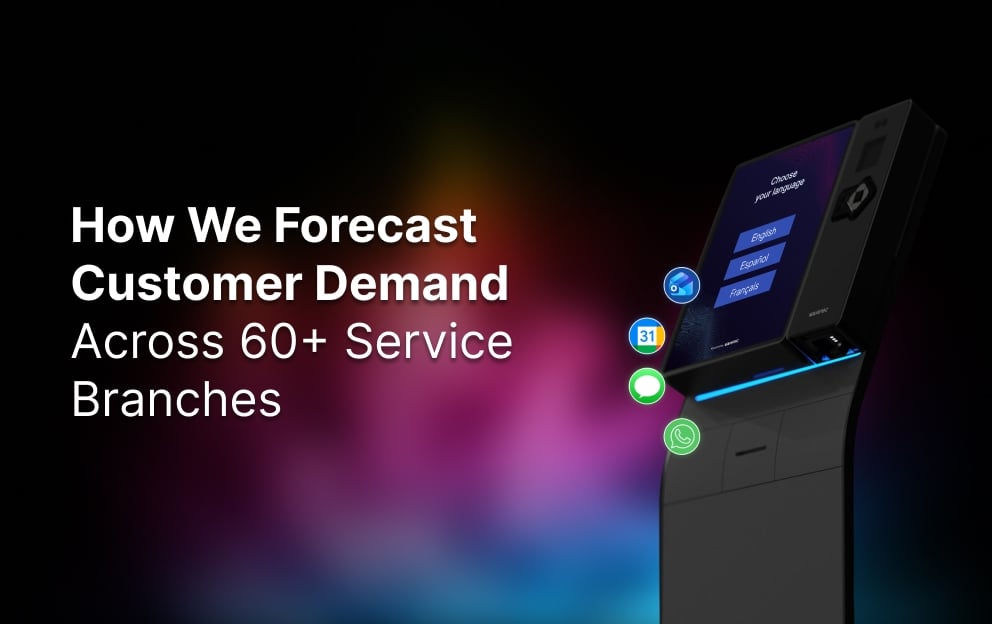
How it works: Wavetec’s ticketing and self-service check-in kiosks allow customers to select their service type on a bilingual touchscreen, verify identity through QR code or ID scan where required, and receive a ticket while being registered in the live queue.
Nexia-Q AI Digital Human Check-In
Before a customer reaches the counter, Nexia-Q can handle the entry experience through an AI digital human interface. Deployed on compatible Wavetec kiosk hardware, it can greet customers in Arabic or English, capture their intent through natural interaction, and route them into the right service journey without front-desk intervention.
- Arabic-first voice interaction: Supports Arabic and English interaction for bilingual banking environments.
- Premium client recognition: Can support premium journey identification and routing where permitted by policy and configuration.
- Document pre-check: Helps validate basic service requirements before the customer reaches the counter.
- Accessibility support: Voice-led journeys, tactile inputs, and screen reader compatibility can improve access for blind and visually impaired customers.
- Secure deployment: Can be configured for secure on-premise deployment, role-based access, audit trails, and controlled data flows.
Mobile Pre-Arrival Journey
Pain point: Customers arrive at the branch with no visibility into wait times and must physically join a queue even when they already know the service they need.
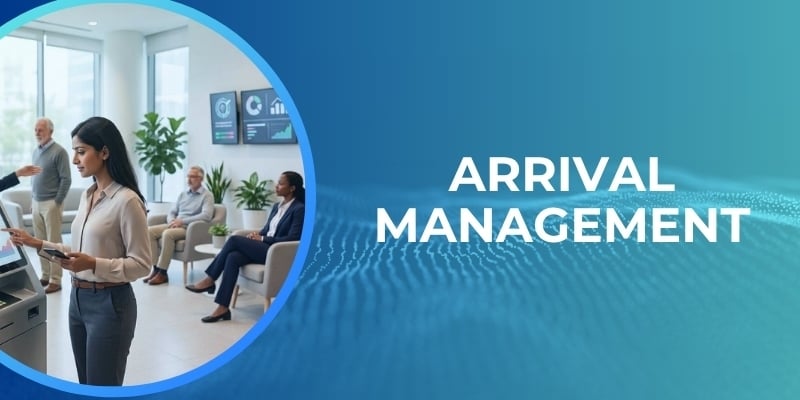
How it works: Mobile check-in allows customers to join a virtual queue through a bank app or web link before arrival. The system issues a live queue position, sends estimated wait time updates through SMS or WhatsApp, and alerts the customer when their turn is approaching.
Appointment-to-Walk-In Balancing
Pain point: Pre-booked appointments can monopolize teller availability, while walk-ins can create unpredictable pressure on branch staff.
How it works: The scheduling engine maintains separate demand pools for booked and walk-in customers, then balances them in the live queue using configurable rules. Banks can use this with smart appointment booking and scheduling to improve customer flow across planned and unplanned visits.
System Design: Architecture, Integration Patterns, and API Readiness
For technical evaluators, integration architecture is often the purchase decision. Wavetec’s QMS is designed as an open-integration platform where customer interactions emit structured events, hardware endpoints can be monitored remotely, and the core engine can exchange data with existing banking technology stacks.
High-Level System Architecture
| Customer Layer | QMS Core Engine | Bank Backend |
|---|---|---|
| Mobile app check-in | AI routing engine | Core banking system |
| QMS kiosk with QR or ID scan | Queue orchestrator | CRM platform |
| Web booking portal | Notification gateway | Analytics and reporting |
| Walk-in ticketing | Nexia-Q triage layer | Branch performance dashboards |
Deployment Models
| Model | Description | Best For |
|---|---|---|
| Cloud-Hosted | QMS core runs on managed cloud infrastructure and branch hardware connects securely. | New deployments and smaller branch networks. |
| On-Premise | Full QMS stack is deployed within the bank’s own data center. | Banks with strict data sovereignty or internal infrastructure requirements. |
| Hybrid | QMS core is deployed on-premise while selected analytics or reporting layers can be hosted separately. | Large multi-branch networks balancing compliance and scalability. |
Performance Benchmarks and Branch-Level ROI
Deploying QMS without measuring performance defeats the purpose. The strongest deployments are built around measurable improvements in wait time, throughput, abandonment, utilization, and data capture.
| Metric | Before QMS | After QMS | Business Impact |
|---|---|---|---|
| Average Wait Time | 18–25 minutes | 7–11 minutes | Approximately 35–40% reduction. |
| Customers Served per Hour | 24–30 | 38–46 | Approximately 50–55% throughput increase. |
| Queue Abandonment Rate | 12–18% | 3–5% | Lower abandonment and better customer retention. |
| Staff Utilization Rate | 52% | 76% | Improved workforce productivity. |
| Counter Reassignment Rate | 8–12% manual | Less than 1% automated | Near-zero rework from incorrect routing. |
| Data Captured per Visit | Limited or none | Full journey record | Supports audit, CRM, and analytics readiness. |
Reduced wait times by up to 35%, while operational costs per branch decreased by 30% within the first two quarters of full deployment.
How Banks Should Measure QMS Success
| Benchmark | Definition |
|---|---|
| Average Handling Time | Measured by transaction type, counter, and shift. Rising AHT can trigger branch manager alerts. |
| Net Wait Time vs. Gross Wait Time | Net wait time measures ticket issue to counter call. Gross wait time includes pre-queue steps, helping isolate where delays originate. |
| Queue Abandonment Rate | Tracks customers who enter the queue but leave before service. Time-of-day analysis helps identify peak pressure windows. |
| SLA Compliance Rate | Measures the percentage of customers served within the bank’s defined wait threshold. |
| Counter Utilization Index | Compares active service time with counter availability to support workforce planning. |
Wavetec in Kuwait: Proven Enterprise Deployments
Wavetec’s experience in Kuwait extends across government ministries, healthcare, oil and gas, aviation, education, and commercial service environments. These deployments demonstrate the company’s ability to operate in enterprise-grade, high-footfall service environments.
| # | Installation | Sector | Location |
|---|---|---|---|
| 1 | MOI Saad Al Abdullah Service Center | Ministry of Interior | Saad Al Abdullah |
| 2 | MOI Al Sadiq Service Center | Ministry of Interior | Al Sadiq |
| 3 | MOI Subhahiya Service Center | Ministry of Interior | Subhahiya |
| 4 | MOI Traffic Inspection | Ministry of Interior | Ardiya |
| 5 | MOI Jabriya Traffic Department | Ministry of Interior | Jabriya |
| 6 | MOI Police Force | Ministry of Interior | Messilah |
| 7 | MOI Dajeej Branch | Ministry of Interior | Farwaniyah |
| 8 | MOJ Jahraa Court Complex | Ministry of Justice | Jahraa |
| 9 | MOJ Farwaniyah Court Complex | Ministry of Justice | Farwaniyah |
| 10 | MOJ branches across Kuwait | Ministry of Justice | Nationwide |
| 11 | Emirates | Aviation | Kuwait City |
| 12 | Etihad | Aviation | Kuwait City |
| 13 | X-cite Alghanim Service Center | Commercial | Shuwaikh |
| 14 | Nissan Service Center | Automotive | Shuwaikh |
| 15 | Egypt Embassy | Diplomatic | Rawdah |
| 16 | KOC Samsung Security System Building | Oil & Gas / KOC | Ahmadi |
| 17 | KOC Ahmadi Hospital | Healthcare / KOC | Ahmadi |
| 18 | KOC Ahmadi Dental Clinic | Healthcare / KOC | Ahmadi |
| 19 | MOH Sabah Hospital | Ministry of Health | Shuwaikh |
| 20 | MOH Jahra Old Hospital | Ministry of Health | Jahra |
| 21 | MOH Jahra New Hospital | Ministry of Health | Jahra |
| 22 | MOH Al-Amiri Hospital | Ministry of Health | Kuwait City |
| 23 | MOH Al Rawda Clinic | Ministry of Health | Al Rawda |
| 24 | KIPIC Industrial Laboratory | Petrochemical / KIPIC | Ahmadi |
| 25 | Ministry of Electricity and Water | Government Utility | Surra |
| 26 | MOD Jaliya Camp | Ministry of Defence | Jaliya |
| 27 | MOD Service Centers | Ministry of Defence | Nationwide |
| 28 | Dasman Bilingual School | Education | Kuwait City |
Enterprise-Grade Infrastructure: Reliability, Security, and Fleet Management
For IT and operations teams, the question is not only whether a queue management system works. It is whether the system can fail gracefully, recover quickly, prove security, and scale across the branch network.
Uptime and Availability
The QMS platform is designed for high availability across enterprise banking deployments. Hardware endpoints can run watchdog processes that restart failed services and report status to a central fleet management console. If connectivity to the central server is interrupted, branch operations can continue in fallback mode with data resync after reconnection.
Security and Compliance
Banking QMS deployments require secure data transport, controlled access, and strong audit visibility. Wavetec supports role-based access control across management interfaces, encrypted data transport, and exportable audit logs for configuration changes and access events.
Kiosk Fleet Monitoring
All deployed kiosks and display units can be registered in a fleet management console. This gives banks live visibility into device status, software versions, remote restart capability, and automated alert escalation for hardware faults.
Patch Management and Rollback
QMS software updates can be deployed using a staged rollout model: test branch, pilot group, and full fleet. A validated rollback path reduces operational risk if an update introduces instability.
Frequently Asked Questions
Is Wavetec’s QMS suitable for regulated banking environments in Kuwait?
Yes. The system can support audit trail logging, role-based access control, encrypted data transport, and on-premise deployment models where customer and transactional data must remain within the bank’s own infrastructure.
How does the system handle Kuwait’s daily prayer times?
The QMS can be configured to pause ticket issuance, notify waiting customers through SMS or WhatsApp, and resume queue flow after the break. This helps branches manage prayer-time demand changes without manual queue disruption.
How long does a typical multi-branch deployment take?
Deployment timelines vary by branch count, integrations, hardware scope, and internal approval cycles. A phased rollout model is often recommended, starting with a pilot branch before full network deployment.
Can the system integrate with an existing core banking platform?
Yes. Wavetec’s QMS can connect with core banking systems, CRM platforms, and other IT infrastructure using API-based integration models.
What happens if the system goes offline at a branch?
The platform can support offline fallback workflows that maintain local queue operations independently of the central server. Once connectivity is restored, data can be synchronized automatically.
Is the kiosk hardware accessible for customers with disabilities?
Yes. Accessible configurations can include wheelchair-friendly interaction height, voice-guided navigation, screen reader support, tactile buttons, high-contrast display modes, and audio assistance for check-in workflows.
Conclusion: QMS Is a Branch Transformation Layer
For banks in Kuwait, Queue Management System investment is not just about reducing lines. It is about transforming the branch into a controlled, measurable, customer-centric service environment.
The right QMS connects arrival, check-in, routing, counter service, analytics, accessibility, and compliance into one operational layer. It allows banking leaders to reduce wait times, improve throughput, support premium journeys, and gain real-time visibility across every branch.
Wavetec has delivered enterprise queue management across banking institutions, government environments, and high-footfall service networks globally. Whether you are planning a single flagship branch or a nationwide rollout, Wavetec provides discovery, deployment, integration, and support services for scalable branch transformation.
Authors: Abdullah Faisal, Marketing Executive | Meriem Elarby, AM Sales MENA – Wavetec
BOOK A FREE DEMO