Modern customer service environments rely on queue management systems to organize customer flow, balance staff workloads, and reduce wait times.
These systems are used across bank branches, hospital registration desks, government service centers, and retail stores. They collect customer data, track service histories, and coordinate staff assignments in real time.
With multiple users accessing the same system across different locations, controlling who can see what and do what becomes a critical security challenge.
Without proper access controls, sensitive customer information can be exposed, service workflows can be disrupted, and errors can multiply.
Role based access control system technology solves these problems by assigning permissions based on job functions rather than individual identities.
This article explains RBAC and its role in securing queue management platforms, with practical insights for enterprises deploying these solutions.
What Is Role-Based Access Control (RBAC)?
Role based access control RBAC is a security model that restricts system access to authorized users based on their organizational roles.
Instead of granting permissions to individual users one by one, RBAC assigns permissions to roles, and users are assigned to those roles. A role represents a job function or responsibility within the organization.
- A branch manager role might include permissions to view all queue data, adjust staffing levels, and generate performance reports.
- A teller role might only include permissions to see their own queue and serve customers.
- A receptionist role might only include check-in functions and basic customer lookup.
The difference between users, roles, and access levels is central to understanding RBAC. Users are individual people with unique login credentials.
Roles are sets of permissions grouped together under a job function. Access levels determine what actions a user can perform, such as view, edit, create, or delete.
In a well designed RBAC model, users never receive direct permissions. They receive permissions only through the roles assigned to them. This approach simplifies administration, reduces errors, and ensures consistent security across the organization.
For SaaS and enterprise systems handling sensitive customer data, RBAC is a foundational security control.
How RBAC Works in Queue Management Systems
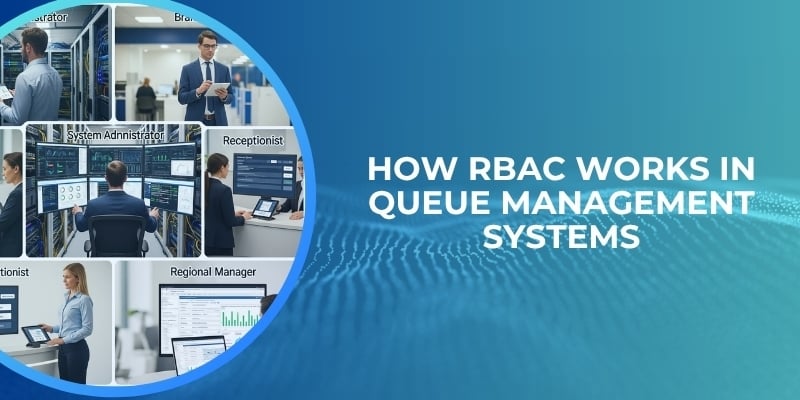
In a queue management system, access control in queue systems is implemented through carefully defined roles that match real world responsibilities.
When a new employee joins a bank branch, the system administrator simply assigns them an appropriate role. The employee immediately gains all permissions needed for their job and nothing more.
Typical roles in a queue management system include the following.
- A system administrator role has full access to all configuration settings, user accounts, and system logs. This role is limited to IT staff.
- A branch manager role can view queue analytics, generate reports, adjust service priorities, and override queue rules during peak periods. This role cannot change system wide security settings.
- A teller role can see the current queue, call the next customer, complete service transactions, and add notes to customer records. Tellers cannot view other branches’ data or access administrative functions.
- A receptionist or check-in staff role can check customers in, print tickets, and view basic queue status but cannot call customers or complete service transactions.
- A regional manager role can view aggregate data across multiple branches but cannot access individual customer details or modify daily operations at specific locations.
Permissions control specific actions such as viewing queue length, editing wait time estimates, managing appointments, accessing customer histories, exporting reports, or configuring hardware settings. Access can also be limited by branch location, service type, or time of day.
RBAC ensures that a teller at one branch cannot accidentally view or modify queue data at another branch. This isolation is essential for multi-branch organizations.
The system enforces these rules in real time, so any attempt to perform an unauthorized action is blocked immediately.
Why RBAC Is Critical for Queue Management Security
Queue management systems handle sensitive information. Customer names, service reasons, appointment details, and sometimes identification numbers or account references pass through these platforms.
In healthcare settings, queue systems may connect to electronic health records. In banking, they may link to customer account systems. Unrestricted access to this data creates serious risks.
Without RBAC, every user might have access to all data across all branches. A teller could view customer records from a branch across town. A temporary staff member could change queue rules or delete appointment logs.
These risks are not theoretical. Internal misuse, whether accidental or intentional, is a leading cause of data breaches. Employees who can access data they do not need for their jobs create unnecessary exposure.
RBAC prevents internal misuse by limiting access to only what each role requires.
- A teller does not need to see branch level analytics, so those permissions are not assigned to the teller role.
- A branch manager does not need to change system wide security settings, so those permissions are restricted to administrators.
By enforcing the principle of least privilege, RBAC dramatically reduces the attack surface and limits potential damage from compromised accounts or insider threats. Data privacy concerns are addressed systematically rather than through ad hoc approvals.
Key Features of RBAC in Queue Management Systems
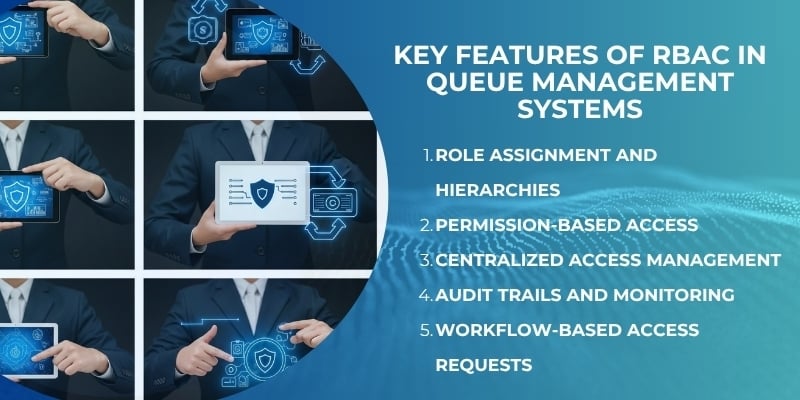
Modern RBAC implementations include several features that make access management practical and effective for large organizations.
Role Assignment and Hierarchies
Roles are structured hierarchically to reflect organizational reporting lines. A regional manager role may inherit permissions from branch manager roles while adding broader data access. A teller supervisor role may include all teller permissions plus override capabilities.
Hierarchies simplify role management because changes to parent roles automatically apply to child roles.
Permission-Based Access
Permissions are granular, controlling specific actions on specific data types.
- A user may have permission to view customer names but not edit them.
- They may have permission to call the next customer but not to skip customers in the queue.
- They may have permission to run daily reports but not to export historical data.
This granularity allows organizations to fine tune access to exactly what each role needs.
Centralized Access Management
For organizations with multiple branches, centralized access management is essential. An administrator can create roles once and apply them across all locations.
User accounts can be managed from a single dashboard, with role assignments pushed to all relevant systems. This centralization reduces administrative overhead and ensures consistent security policies across the enterprise.
Audit Trails and Monitoring
Every access attempt and action is logged. Audit trails show who accessed what data, when, and from where. Monitoring systems can detect unusual patterns such as after-hours access or repeated failed permission checks.
These logs support security investigations and compliance audits. Organizations can demonstrate that access controls are properly enforced and that unauthorized attempts are tracked.
Workflow-Based Access Requests
RBAC integrated self-service portals let users request access through workflows, reducing the need to manually ticket each access change.
When an employee needs a new role, they submit a request through the system. The request routes to the appropriate approver based on role type and organizational rules.
Once approved, access is granted automatically. This workflow reduces delays, ensures proper authorization, and creates an audit trail of access changes.
Benefits of RBAC in Queue Management Systems
Organizations that implement RBAC in their queue management systems realize multiple benefits that extend beyond security.
- Improved security is the most obvious benefit. By limiting access to only what each role requires, organizations reduce the risk of data breaches, unauthorized modifications, and internal misuse. Even if a user account is compromised, the attacker gains only the permissions of that role, not full system access.
- Reduced human error follows from role based permissions. Employees cannot accidentally perform actions outside their job scope because the system prevents those actions. A teller cannot accidentally delete queue configuration settings because those permissions are not assigned to the teller role.
- Better compliance is achieved because RBAC provides clear separation of duties and audit trails. Regulators and auditors look for evidence that access controls are properly designed and enforced. RBAC provides that evidence in a structured, auditable format.
- Operational efficiency improves because employees can do their jobs without waiting for access approvals. With role based assignment, new employees receive appropriate permissions immediately upon hiring. Temporary staff can be assigned limited roles that expire automatically.
- Scalability across branches is enabled by centralized role management. Adding a new branch requires only configuring the branch location and assigning existing roles to local staff. The same security policies apply everywhere, ensuring consistency without additional administrative burden.
RBAC in Wavetec Queue Management Solutions
Wavetec implements role based access control across its suite of customer experience solutions. The queue management system includes granular role definitions that match real world organizational structures.
System administrators define roles once, then assign users to those roles across multiple branches.
For multi-branch management, Wavetec RBAC ensures that users can only access data from branches they are authorized for.
A branch manager sees only their own branch data. A regional manager sees aggregate data across their region but cannot drill into individual customer records. A teller sees only the current queue and customer names for their assigned service point.
- Role based dashboards and reporting provide different views based on user permissions. A teller dashboard shows current queue status and customer wait times. A branch manager dashboard adds performance metrics, staff utilization, and trend analysis. A regional dashboard shows comparative performance across locations. Each user sees only what they need.
- Integration with smart online appointment booking and scheduling software extends RBAC to appointment management. Schedulers can view and modify appointments based on their role. Some users may only book appointments for themselves. Others may manage appointments for an entire department. The same role based rules apply consistently across queue and appointment systems.
- Integration with customer journey management platforms ensures that access controls follow the customer throughout their service experience. A call center agent who handles pre-visit questions may have different permissions than a branch teller who handles the actual service. RBAC ensures that each user has appropriate access to customer data at each stage of the journey.
Case Study – Improving Access Control in a Multi-Branch Bank
In multi-branch banking environments, managing user access across locations, roles, and responsibilities is critical to maintaining operational control and data security.
Wavetec’s queue management deployments illustrate how role-based access control (RBAC) enables banks to standardize access policies while supporting diverse operational needs.
BCI Bank – Standardizing Role-Based Access Across Branches
BCI Bank implemented Wavetec’s queue management and digital signage solutions across its nationwide branch network to enhance service delivery and operational consistency.
With a large workforce operating across multiple locations, the bank required a structured access control model that could be managed centrally while enforcing strict role separation at the branch level. Wavetec’s RBAC framework enabled the bank to define roles such as teller, branch manager, and regional manager, each with clearly defined permissions aligned to their responsibilities.
Tellers were limited to managing live queues and serving customers at their assigned service points. Branch managers were granted access to performance dashboards, queue configurations, and reporting tools within their respective branches. Regional managers were able to view aggregated data across multiple branches without accessing individual customer-level interactions.
This role-based structure ensured consistent access control across the network, reduced administrative complexity, and eliminated the risk of unauthorized data visibility between branches.
Maduro & Curiel Bank – Enforcing Role Segmentation and Operational Clarity
Maduro & Curiel Bank adopted Wavetec’s queue management system to improve service efficiency while introducing structured access control across its branch operations.
The implementation focused on aligning system access with real-world job functions. Frontline staff such as receptionists were restricted to customer check-in and ticket issuance, while tellers were limited to queue handling and service execution.
Managerial roles were assigned permissions to monitor performance, adjust service priorities, and generate reports.
All roles were centrally defined and consistently applied across branches, ensuring that access policies remained uniform regardless of location. The system prevented users from accessing features or data outside their roles, reducing the chance of errors and maintaining operational discipline.
By implementing RBAC, the bank achieved greater clarity in responsibilities, streamlined onboarding for new staff, and ensured that access to system capabilities remained tightly controlled.
RBAC vs Traditional Access Control Models
Traditional access control models differ significantly from RBAC. Understanding these differences helps explain why RBAC is preferred for modern SaaS systems.
- Discretionary Access Control (DAC) allows data owners to decide who can access their resources. In a queue system, a branch manager might manually grant access to individual tellers. This approach is flexible but creates inconsistency and security gaps. Managers may grant excessive permissions or forget to revoke access when employees leave. DAC does not scale well across large organizations.
- Mandatory Access Control (MAC) uses system wide rules based on data classification and user clearance levels. This model is common in government and military systems but is too rigid for most commercial environments. MAC does not accommodate the dynamic, role based needs of customer service organizations.
- RBAC combines the flexibility of DAC with the structure of MAC. Permissions are assigned to roles, not individuals. Users receive permissions based on their job functions. This approach scales efficiently, ensures consistency, and simplifies administration. For SaaS environments where organizations manage hundreds or thousands of users across multiple locations, RBAC is the standard.
- Traditional manual access control, where permissions are granted one by one through spreadsheets or help desk tickets, is slow, error prone, and insecure. It cannot keep pace with employee turnover or organizational changes. RBAC automates access management, reducing administrative overhead while improving security.
Risks of Not Using RBAC in Queue Systems
Organizations that operate queue management systems without RBAC face multiple risks that can have serious consequences.
- Unauthorized access is the most direct risk. Without role based controls, users may have access to data they should not see. A teller might view customer records from other branches. A temporary employee might change system configurations. These access gaps create opportunities for data theft, both intentional and accidental.
- Data breaches can result from unauthorized access. Customer information exposed through queue systems can lead to identity theft, financial fraud, or regulatory penalties. The cost of a data breach includes not only fines but also legal fees, customer notification costs, and long term reputational damage.
- Operational inefficiencies arise when access is not properly controlled. Employees may be unable to do their jobs because they lack necessary permissions. Or they may have excessive permissions that create confusion and risk. Manual access request processes create delays that slow down service delivery.
- Compliance risks are significant for organizations in regulated industries. Healthcare queue systems must comply with HIPAA. Banking systems must meet financial regulations. Government systems face strict data protection requirements. Without RBAC, demonstrating compliance to auditors is difficult or impossible.
Future of Access Control in Customer Experience Systems
The future of access control in customer experience platforms will be shaped by emerging technologies and evolving security models.
- AI-driven access control will use machine learning to analyze user behavior and detect anomalies. Systems will learn what normal access patterns look like for each role and flag unusual activity automatically. AI may also recommend role adjustments based on observed job functions, reducing manual role definition work.
- Adaptive security models will adjust access permissions in real time based on context. A user accessing the system from a trusted office network during business hours may receive full permissions. The same user accessing from a coffee shop at midnight may receive limited read only access. Adaptive models balance security with usability by applying stricter controls only when risk is elevated.
- Zero-trust architecture assumes that no user or device is trustworthy by default, even inside the network. Every access request is verified regardless of origin. Zero-trust aligns naturally with RBAC because both models focus on identity and permissions rather than network location.
- Automated identity management will integrate RBAC with HR systems. When an employee is hired, promoted, or terminated, the queue management system will update access automatically based on role changes. This integration eliminates manual access management and ensures that permissions are always current.
FAQs
What is RBAC in queue management systems?
RBAC in queue management systems is a security model that controls access based on user roles such as teller, manager, or administrator. Each role has specific permissions for viewing queue data, serving customers, and managing configurations, ensuring users can only access what their job requires.
Why is RBAC important for SaaS platforms?
RBAC is important for SaaS platforms because it enables secure, scalable access management across multiple customers and user groups. It prevents unauthorized data access, simplifies administration, and provides audit trails needed for compliance.
How does RBAC improve security?
RBAC improves security by enforcing the principle of least privilege, meaning users get only the permissions necessary for their job. This limits damage from compromised accounts, prevents internal misuse, and reduces human error.
What is the difference between RBAC and traditional access control?
Traditional access control often grants permissions individually or by data ownership, which is hard to manage at scale. RBAC groups permissions into roles assigned to job functions, making administration consistent, scalable, and auditable.
Can RBAC be used in multi-branch environments?
Yes, RBAC is ideal for multi-branch environments. Roles can be defined centrally and applied to users across all branches, with additional restrictions limiting data access to specific locations as needed.
Conclusion
A role based access control system is an essential security requirement for modern queue management systems. It ensures that tellers, managers, and administrators have exactly the permissions they need and nothing more.
This approach prevents unauthorized data access, reduces operational errors, supports compliance, and scales efficiently across hundreds of branches.
For organizations deploying queue management in banking, healthcare, government, or retail, RBAC is not optional. It is essential infrastructure for secure and efficient customer service operations.
Wavetec delivers enterprise ready queue management solutions with built in RBAC, centralized administration, and comprehensive audit capabilities. Organizations that prioritize access control position themselves for secure growth and lasting customer trust.
BOOK A FREE DEMO