Customer journeys today rarely stay in one channel.
A person might research a product on their phone, visit a store to see it in person, buy online, and pick it up at a branch. Another might book a bank appointment through an app, receive a reminder by text, check in at a lobby kiosk, and speak with a teller who already knows their name and purpose.
These hybrid journeys are now normal. Yet many businesses still operate with disconnected touchpoints; online systems that do not talk to physical locations, staff who cannot see digital interactions, and customers forced to repeat themselves.
This fragmentation creates frustration, wasted time, and lost opportunities.
Phygital customer experience solves this problem by weaving digital and physical channels into a single, seamless journey.
This article explains what phygital means, why it matters, and how organizations can build effective phygital strategies using modern customer experience focusing on customer journey management.
What Is Phygital Customer Experience?
Phygital customer experience is the integration of physical and digital interactions into a unified, continuous customer journey. The term combines “physical” and “digital” to describe experiences where online and offline touchpoints work together seamlessly.
In a phygital model, customers move between channels without friction.
- Data follows them.
- Context is preserved.
- Service is consistent regardless of whether the interaction happens on a mobile app, a website, a self-service kiosk, or face-to-face with a staff member.
This is different from omnichannel, which simply means having multiple channels available. Phygital goes further by ensuring those channels are connected.
- A customer who starts an application on their phone should be able to finish it at a branch without starting over.
- A patient who registers online should not need to fill out the same forms again at the clinic.
- A shopper who scans a QR code in a store should see personalized offers based on their online browsing history.
Phygital experiences are not just about having options; they are about making those options work together as one system.
Across industries, phygital matters because customers expect convenience, speed, and personalization. They do not want to choose between digital efficiency and human touch. They want both, integrated seamlessly.
Organizations that deliver true phygital experiences build stronger loyalty, higher satisfaction, and competitive advantage.
Why Phygital Experiences Are Becoming Essential
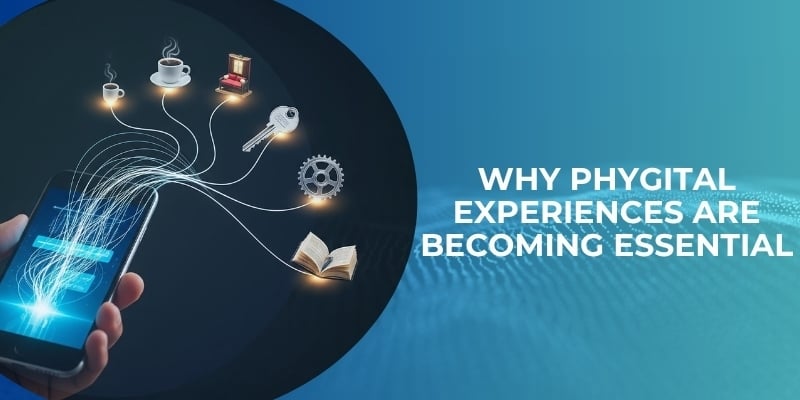
Customer behavior has shifted permanently. People research online before buying in stores. They book appointments through apps before visiting branches. They use social media to ask questions that once required phone calls.
According to research, 73% of shoppers engage across six or more touchpoints (website, app, social, in‑store, etc.) before purchasing, making omnichannel (often phygital) the baseline expectation.
This multi-touchpoint behavior is not limited to retail.
- Banking customers check rates online, then visit branches for advice.
- Patients find doctors through portals, then attend in-person consultations.
- Government service users download forms digitally, then submit them at service centers.
The need for seamless omnichannel engagement is driven by several factors.
First, convenience is no longer a luxury. Customers expect to interact on their terms, switching channels as their circumstances change.
Second, personalization requires data from both digital and physical interactions. A brand that knows what a customer browsed online can offer relevant recommendations in store. A bank that knows a customer booked an appointment can prepare the right documents in advance.
Third, competition is intense. Organizations that force customers to choose between digital and physical channels lose to those that offer both seamlessly.
Phygital experiences also address a fundamental human need: the desire for efficiency without losing connection. Digital tools provide speed and convenience. Physical interactions provide trust and relationship. Phygital combines the best of both.
Key Components of a Phygital Customer Experience
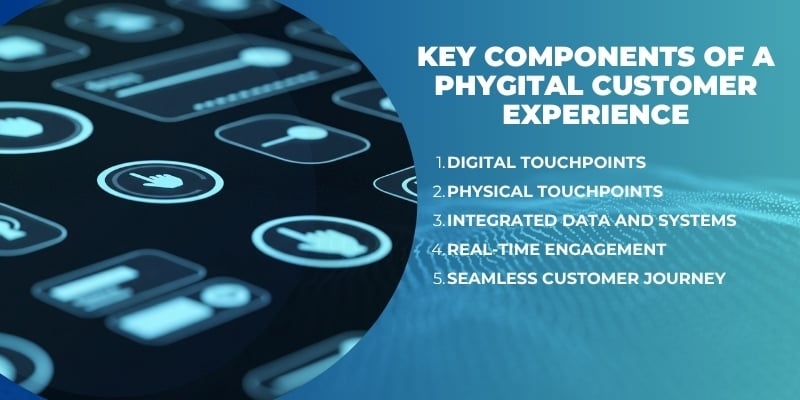
Building a phygital experience requires several interconnected components working together.
Digital Touchpoints
Digital touchpoints include websites, mobile apps, social media, email, SMS, chatbots, and self-service portals. These channels allow customers to start journeys, get information, book appointments, and complete transactions remotely.
In a phygital model, digital touchpoints are not separate from physical ones; they are the starting point or continuation of the same journey.
Physical Touchpoints
Physical touchpoints include branches, stores, service counters, kiosks, and in-person staff interactions. These channels provide the human element that digital cannot fully replace. In a phygital model, physical touchpoints are informed by digital data.
Staff know what customers have already done online, so they do not need to ask customers to repeat themselves.
Integrated Data and Systems
Integrated data and systems are the technical foundation of phygital experiences. Customer profiles, interaction histories, appointment records, and service status must be shared across all channels in real time.
A central customer journey management platform ensures that a customer who books online is recognized at the kiosk and known to the staff member who provides service.
Real-Time Engagement
Real-time engagement includes live updates, notifications, and service tracking. Customers receive confirmation when they book. They get reminders before appointments.
They see queue positions on digital displays. They receive notifications when their turn is approaching. This real-time communication keeps customers informed and reduces anxiety.
Seamless Customer Journey
A seamless customer journey means transitions between online and offline are smooth and invisible.
- A customer who starts a mortgage application on their phone should be able to continue at a branch without re-entering data.
- A patient who registers online should walk into the clinic and be called immediately.
- A shopper who scans items in an app should see those items saved when they log into a store kiosk.
This seamlessness is the defining characteristic of phygital. A queue management system integrated with digital booking ensures that customers move through service points without friction.
Examples of Phygital Customer Experience
Real-world phygital experiences are already common across multiple industries.
Banking
- A customer uses a bank’s mobile app to book an appointment for a loan consultation.
- They receive confirmation by text.
- On the day of the appointment, they check in at a branch kiosk using a QR code from the app.
- The system notifies the loan officer, who already has the customer’s application details on screen.
- The customer is seen within minutes, and the officer addresses them by name with relevant information ready.
The entire journey, from app to branch to consultation, is connected.
Retail
- A shopper browses a clothing brand’s website, saving items to a wish list.
- Later, they visit a physical store.
- At a fitting room kiosk, they scan their loyalty card, and the system shows their wish list.
- They request items to be brought to the fitting room.
- After trying on, they purchase through a mobile app and choose to pick up at the store exit.
- The brand tracks preferences across both channels, sending personalized offers based on combined online and in-store behavior.
Healthcare
- A patient schedules a telemedicine consultation through a hospital portal.
- The doctor determines an in-person follow-up is needed.
- The portal automatically books the follow-up appointment and sends check-in instructions.
- The patient arrives, checks in at a self-service kiosk, and receives a text when the doctor is ready.
- The doctor already has the telemedicine notes, so the in-person visit focuses on physical examination rather than repeating history.
Government Services
- A citizen starts a driver’s license renewal online, uploading documents and paying fees.
- The system provides a QR code and appointment time at a local service center.
- At the center, the citizen scans the code at a kiosk, takes a photo, and completes the process in under ten minutes. No paperwork is repeated. No forms are re-filled.
These examples share a common pattern: digital channels start the journey, physical channels complete it, and data flows seamlessly between them.
Benefits of Phygital Customer Experience
Organizations that implement phygital experiences realize significant benefits across customer satisfaction, operations, and revenue.
- Improved customer satisfaction is the most direct benefit. Customers appreciate not having to repeat themselves. They value the ability to switch channels without losing progress. They feel respected when staff know their history and needs. A behavioral research study on phygital consumer behavior finds that a clear majority (over 60%) of consumers have a positive attitude toward using integrated physical–digital experiences in their purchase journeys.
- Reduced wait times follow from better journey orchestration. When customers book appointments, check in digitally, and receive real-time queue updates, in-person waiting is minimized. Staff are prepared before customers arrive, so service is faster. Perceived wait times also decrease because customers are informed and engaged.
- Better engagement results from personalized, context-aware interactions. Customers receive relevant offers based on their combined digital and physical behavior. They are more likely to act on recommendations that reflect their actual interests and history.
- Increased operational efficiency comes from automation and integration. Staff spend less time on data entry and more time on service. Appointment scheduling reduces no-shows. Self-service kiosks handle routine transactions, freeing staff for complex needs.
- Higher conversion rates occur because phygital experiences remove friction from the customer journey. A customer who can easily move from research to purchase, online to in-store, is more likely to complete the transaction than one who encounters barriers at every transition.
Phygital Strategy – How Businesses Can Implement It
Building a phygital experience requires a deliberate strategy, not just isolated technology investments.
Map the Customer Journey
Start by identifying all touchpoints customers use, both digital and physical. Map how customers move between channels. Look for friction points where data is lost, repetition is required, or transitions are clumsy.
Understanding the current journey reveals where phygital integration will have the greatest impact.
Integrate Digital and Physical Channels
Connect systems so that data flows seamlessly across channels. A central customer journey platform should capture interactions from websites, apps, kiosks, and staff workstations.
Customer profiles, appointment records, queue status, and service histories must be shared in real time. Integration is the technical backbone of phygital.
Use Data for Personalization
Leverage customer data to personalize interactions across channels. A customer who browsed specific products online should see related offers in store. A patient who completed forms digitally should not be asked for the same information at the clinic.
Personalization shows customers that the organization knows them and values their time.
Implement Smart Technologies
Deploy technologies that enable phygital experiences. Self-service kiosks allow customers to check in, complete transactions, and access information without staff assistance. Queue management systems organize customer flow and provide real-time updates.
Digital signage communicates wait times and service information. Appointment booking platforms let customers schedule visits online and integrate with in-person queues.
Continuously Optimize Experience
Monitor performance metrics such as wait times, customer satisfaction, channel usage, and journey completion rates. Use data to identify bottlenecks and friction points.
Continuously refine the experience based on customer feedback and operational insights. Phygital is not a one-time project but an ongoing capability.
Phygital Customer Experience in Wavetec Solutions
Wavetec provides a comprehensive platform for enabling phygital customer journeys across banking, healthcare, retail, and government services. The solutions work together to create seamless transitions between digital and physical touchpoints.
- Queue Management Systems organize customer flow from check-in to service completion. Integrated with digital booking, the system knows who is coming, why, and when. Real-time displays and mobile notifications keep customers informed. Staff receive customer context before each interaction.
- Appointment Booking allows customers to schedule visits online, receive confirmations, and manage their appointments. The system integrates directly with branch queues, so appointment customers move to the front without disrupting walk-in traffic. Reminders reduce no-shows, and pre-appointment data collection speeds service.
- Self-Service Kiosks put check-in, registration, and routine transactions in customers’ hands. Kiosks read QR codes from mobile appointments, capture customer data, and print tickets or receipts. They reduce lobby congestion and free staff for complex service.
- Digital Signage communicates wait times, queue positions, service information, and promotions. Displays keep customers informed and engaged, reducing perceived wait times and improving satisfaction.
All these solutions are managed from a centralized platform, providing real-time monitoring and analytics.
Wavetec’s phygital architecture ensures that a customer who books online, checks in at a kiosk, waits informed by digital signage, and is served by a prepared staff member experiences one seamless journey, not four disconnected steps.
Case Study – Implementing Phygital Experience in Banking
Banks are increasingly adopting phygital strategies to bridge the gap between digital convenience and in-branch service.
Wavetec’s implementations demonstrate how financial institutions can create connected customer journeys by integrating digital touchpoints with physical service environments.
BCI Bank – Connecting Digital Engagement with In-Branch Experience
BCI Bank implemented Wavetec’s queue management and digital signage solutions across its branch network to create a more connected and engaging customer journey.
Customers entering branches experienced real-time communication through digital displays, while backend systems enabled centralized control of content and service flow.
Digital interactions such as service selection and queue updates were seamlessly linked with in-branch processes, ensuring that customers remained informed throughout their visit.
By integrating digital communication with physical service delivery, BCI Bank reduced perceived wait times and created a more transparent and engaging branch experience.
EuroAmerica – Enhancing Customer Interaction with Real-Time Digital Integration
EuroAmerica adopted Wavetec’s digital solutions to improve how customers interact with financial information and services within physical locations.
The implementation focused on delivering real-time data through digital displays while maintaining a strong in-branch advisory experience. Customers were able to access relevant financial information visually, while staff used the same data to support personalized interactions.
This integration of digital information systems with face-to-face service enabled EuroAmerica to create a more informed, consistent, and connected customer journey across touchpoints.
Diamond Trust Bank Kenya – Bridging Self-Service and Branch Banking
Diamond Trust Bank Kenya implemented Wavetec’s self-service cheque deposit machines to digitize a key in-branch process and reduce reliance on manual workflows.
Customers could initiate transactions independently through secure self-service channels, while the system remained fully integrated with the bank’s core infrastructure. This allowed digital transaction data to flow directly into branch operations without duplication or delays.
By combining self-service technology with traditional banking services, the bank created a hybrid experience where customers could choose between digital convenience and assisted service, depending on their needs.
Challenges in Implementing Phygital Experiences
Organizations face several obstacles when building phygital capabilities.
- System integration issues are the most common challenge. Legacy systems were not designed to share data in real time. Connecting appointment platforms, queue systems, kiosks, and staff workstations requires technical expertise and often custom development. Without proper integration, phygital remains a vision rather than reality.
- Data silos persist when different departments own different systems. Marketing may control the website. Operations may manage the queue system. Branch staff may use yet another platform. Breaking down these silos requires organizational alignment, not just technology.
- Staff training is essential but often overlooked. Employees must understand how phygital workflows work and why they matter. A teller who does not know how to access appointment data cannot provide the promised seamless experience. Training must cover both technical skills and customer service expectations.
- Technology costs can be significant, especially for organizations with many locations. Kiosks, digital signage, queue management software, and integration work require investment. However, the ROI from improved efficiency and customer satisfaction typically justifies the expense.
Future of Phygital Customer Experience
The future of phygital will be shaped by emerging technologies that make experiences even more seamless and personalized.
- AI-driven personalization will use machine learning to predict customer needs across channels. A system might know that a customer who browsed mortgage rates online is likely to visit a branch soon and proactively prepare relevant materials. AI will also enable real-time offer personalization based on current context, not just past behavior.
- Predictive customer journeys will anticipate what customers want before they ask. A bank might predict that a customer who just received a paycheck is likely to need a savings product and trigger a personalized offer at the next branch visit. A retailer might predict that a customer who browsed winter coats online will buy in store when temperatures drop.
- IoT-enabled service environments will use sensors and connected devices to create responsive physical spaces. Digital signage might change based on who is nearby. Kiosks might greet returning customers by name. Service counters might automatically route customers to available staff based on real-time location tracking.
- Hyper-personalized engagement will combine data from every interaction, digital and physical, to create uniquely tailored experiences. Customers will feel known at every touchpoint, not because they have been asked to identify themselves repeatedly, but because the system recognizes them seamlessly.
FAQs
What is a phygital customer experience?
Phygital customer experience blends physical and digital interactions into a unified journey where data flows seamlessly across channels. Customers can start on a mobile app, continue at a kiosk, and complete service with a staff member without losing context or repeating information.
What are examples of phygital experiences?
Examples include booking a bank appointment online and checking in at a branch kiosk, scanning a QR code in a store to access online wish lists, registering for healthcare digitally before an in-person visit, and starting a government form online before completing it at a service center.
Why is phygital important for businesses?
Phygital is important because customers expect seamless experiences across channels. Disconnected touchpoints create frustration, wasted time, and lost sales. Organizations that deliver integrated physical-digital journeys build stronger loyalty, higher satisfaction, and competitive advantage.
How can companies implement phygital strategies?
Companies can implement phygital by mapping customer journeys, integrating digital and physical systems, using data for personalization, deploying smart technologies like kiosks and queue management, and continuously optimizing based on performance metrics.
What industries use phygital solutions?
Banking, retail, healthcare, government services, hospitality, transportation, and entertainment all use phygital solutions. Any industry where customers interact through both digital and physical channels can benefit from seamless integration.
Conclusion
Phygital customer experience is not a trend. It is the new standard for service delivery.
Customers expect to move seamlessly between digital and physical channels, and they judge organizations by how well they deliver that experience.
The organizations that succeed will be those that break down silos between online and offline, integrate their systems, and design journeys around customer needs rather than internal convenience.
Wavetec provides the technology platform to enable this transformation, connecting queue management, appointment booking, self-service kiosks, and digital signage into a unified phygital ecosystem.
For businesses ready to meet modern customer expectations, the path forward is clear: build seamless, connected, and personalized journeys that work wherever the customer happens to be.
BOOK A FREE DEMO