An SLA management system is software that tracks, monitors, and enforces Service Level Agreements in customer support. It measures response times, resolution times, and other performance metrics, automatically alerts teams about potential breaches, and provides dashboards for continuous improvement.
Timely customer support is the foundation of any service organization. Whether a bank, a healthcare provider, a retail chain, or a government office, customers expect their issues to be resolved quickly and professionally.
When response times lag or resolution drags on, satisfaction drops, reputations suffer, and customers leave.
In fact, studies show that a majority of customers will switch to a competitor after just one or two bad support experiences. Yet managing response and resolution times across hundreds or thousands of tickets is not easy.
Support teams face high volumes, competing priorities, and limited visibility into performance. Without a structured way to track commitments, delays become normal, backlogs grow, and customers feel ignored.
Managers are left guessing which agents are overloaded, which tickets are aging, and where bottlenecks occur. This lack of visibility leads to inconsistent service, missed targets, and frustrated staff.
An SLA Management System solves this problem by automating the tracking of Service Level Agreements. These systems define expectations, monitor performance in real time, alert teams when breaches are likely, and provide data to improve workflows. They transform support operations from reactive firefighting to proactive, data-driven management.
This article explains how SLA management works, its key features, benefits, and how it integrates with queue systems to boost support efficiency.
Wavetec incorporates SLA management into its customer journey management solutions, helping organizations deliver consistent, timely service across all channels.
What Is an SLA Management System?
An SLA Management System is software designed to define, track, monitor, and enforce Service Level Agreements. To understand this, we first need to understand what a Service Level Agreement (SLA) is.
An SLA is a formal commitment between a service provider and a customer that specifies expected performance levels.
In customer support, SLAs typically include metrics such as first response time (how quickly an agent replies to a new ticket), average resolution time (how long to fully resolve the issue), and uptime guarantees for digital services.
The purpose of an SLA management system is to take these commitments out of static documents and make them operational. Instead of printing SLAs in a contract that sits on a shelf, the system embeds them into daily workflows.
When a new support ticket arrives, the system automatically assigns SLA targets based on factors such as customer tier (premium vs standard), issue severity (critical vs low), or service type (technical support vs billing inquiry).
It then tracks every action against those targets, measuring how long from ticket creation to first response, from first response to resolution, and other milestones such as update frequency or customer follow-up.
The system continuously compares actual performance against targets. It calculates how much time remains before an SLA breach would occur. When a ticket is at risk of missing its SLA, the system sends automated alerts to agents or managers.
- Escalation rules can move overdue tickets to higher priority queues, reassign them to senior agents, or notify supervisors.
- Real-time dashboards show performance against SLA goals, highlighting areas where the team is excelling or struggling.
- Historical reports reveal trends, common bottlenecks, and opportunities for process improvement.
SLA management systems are essential in customer support and service environments where consistency and timeliness are critical. They replace guesswork with data, accountability with automation, and reactive firefighting with proactive management.
Without such a system, even well-intentioned teams will miss SLAs because they lack visibility into what is due when. With a system, organizations can scale support operations without sacrificing quality.
How SLA Management Works in Support and Queue Systems
SLA management integrates directly with support ticketing systems and queue management platforms to create a seamless workflow.
Understanding this integration helps organizations see how SLA tracking drives efficiency at every stage of the customer interaction.
- When a new customer request arrives, whether through email, web form, phone call, live chat, or in-person check-in at a branch, the system creates a ticket.
- Immediately, the system assigns SLA targets based on predefined rules configured by managers.
For example, a premium customer’s urgent technical issue might have a first response target of 15 minutes. A routine billing inquiry from a standard customer might have a 4 hour target. A simple informational request might have a 24 hour target. The system records the creation timestamp and starts the clock.
As the ticket moves through the workflow, the system tracks key milestones.
- The first milestone is the first response, when an agent acknowledges the ticket, often with an automated or template reply.
- The second milestone is assignment, when the ticket is allocated to a specific agent or team.
- The third milestone is update frequency, ensuring that customers receive regular communication on long-running issues.
- The final milestone is resolution, when the issue is closed to the customer’s satisfaction. Each milestone can have its own SLA target. For instance, a contract might promise first response within 1 hour but resolution within 48 hours.
In support ticket SLA management, prioritization is automatic. Tickets with shorter remaining SLA time or higher severity are pushed to the top of agent queues.
Agents see at a glance which tickets need immediate attention. This prevents important issues from languishing while less urgent tickets are handled. Without this automation, agents might work on the easiest tickets first, leaving complex or time-sensitive issues to age and eventually breach.
Integration with queue systems is natural. In a physical service environment such as a bank branch, clinic, or government service center, SLAs can apply to customer wait times.
A customer checking in for a scheduled appointment might have a target wait time of 5 minutes. The queue management system tracks how long they wait and alerts managers if the target is at risk. A walk-in customer might have a different SLA, say 15 minutes. The system balances both queues, ensuring that appointment customers are seen on time while walk-ins are not neglected.
In digital support queues, the same logic applies to chat, email, and phone requests. A customer waiting in a chat queue has an SLA on how long before an agent joins.
The system tracks wait time and can automatically offer a callback option if the wait exceeds the SLA. For email tickets, the system monitors time since creation and escalates if no response has been sent.
The system also handles escalations automatically. If a ticket is approaching its SLA limit without resolution, the system can reassign it to a more experienced agent, notify a supervisor, or move it to an expedited queue.
These automated workflows ensure that no ticket falls through the cracks. Supervisors can set rules such as “if a critical ticket is unresolved after 80% of SLA time, escalate to team lead.” This proactive approach prevents breaches rather than just reporting them after the fact.
Why SLA Management Is Critical for Support Efficiency
Delayed responses and slow resolutions damage customer relationships. Research consistently shows that wait time is a top driver of dissatisfaction. When customers feel ignored, they leave. In competitive industries, a single bad support experience can cost a customer for life.
For support teams, the absence of SLA tracking leads to chaos. Agents work on whichever ticket seems most urgent to them personally, not necessarily the one that matters most to the business or the customer. Some agents might cherry-pick easy tickets. Others might let complex tickets sit because they are hard. The result is inconsistent service and missed commitments.
SLA management brings structure to this chaos. By defining clear targets, teams know what is expected. By tracking performance automatically, managers know where problems exist. By automating prioritization, the system ensures that the most critical tickets get attention first.
This structure is not about micromanagement; it is about enabling agents to work efficiently by removing the guesswork of what to do next.
Structured workflows enabled by SLA management reduce average ticket backlog because issues move faster through queues.
When agents see SLA timers counting down on their dashboard, they focus on completing tickets rather than letting them sit idle. The visibility into aging tickets prevents the accumulation of stale, unresolved issues that customers have to chase. A ticket that would have sat for days is now resolved in hours.
SLA management also improves team performance through accountability.
When agents can see their individual SLA adherence rates, they are motivated to improve. Healthy competition can be encouraged through team leaderboards. When managers can see team-level trends, they can provide targeted coaching.
For example, if one agent consistently misses first response SLAs but resolves tickets quickly, the issue might be notification setup rather than agent effort. If an entire team misses SLAs on certain days, staffing levels might be inadequate.
Consistency across shifts and agents becomes achievable. Night shift agents and day shift agents can be held to the same standards. New hires can be onboarded with clear performance expectations. Tenured agents can be recognized for consistent SLA adherence.
This consistency builds customer trust because they receive the same quality of service regardless of when they contact support.
Finally, SLA management supports continuous improvement. Historical data shows where SLAs are routinely missed. Perhaps first response times are good but resolution times lag. This points to a bottleneck in later stages of the workflow, such as a lack of specialized agents for certain issue types. Perhaps weekend tickets have higher breach rates, indicating a need for better weekend staffing.
With data, organizations can diagnose root causes and implement fixes, not just guess. Over time, SLA adherence improves, and customer satisfaction rises.
Gorgias’ SLA‑best‑practice article notes that meeting SLA commitments reduces average ticket backlog because issues move faster through queues. This operational benefit compounds over time, creating a virtuous cycle of faster service, happier customers, and less stressed agents.
When agents are not constantly dealing with angry customers upset about delays, their job satisfaction improves, reducing turnover and training costs.
Key Features of an SLA Management System
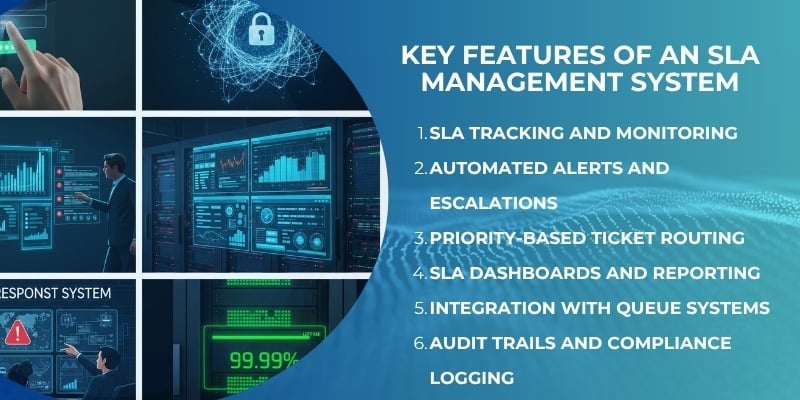
Modern SLA management systems include several features that work together to improve support efficiency.
Each feature addresses a specific aspect of the SLA lifecycle: definition, tracking, alerting, reporting, and integration.
SLA Tracking and Monitoring
The system continuously tracks response times, resolution times, and other SLA metrics for every ticket. It records every event: ticket creation, assignment, first reply, subsequent updates, and closure.
Timestamps are compared against SLA targets in real time. Managers can see at a glance which tickets are on track and which are at risk.
This tracking down to the second and can be filtered by agent, team, queue, customer tier, or issue type. Historical tracking allows trend analysis over days, weeks, or months.
Automated Alerts and Escalations
When a ticket approaches its SLA limit, the system sends alerts. Notifications can go to the assigned agent, their supervisor, a team channel, or even a mobile device. Alerts can be configured at different thresholds, such as a warning at 80% of SLA time and a critical alert at 95%.
Escalation rules can automatically reassign tickets, increase priority, or trigger other workflows such as sending a proactive apology message to the customer. This automation prevents SLA breaches before they happen, turning potential failures into managed exceptions.
Priority-Based Ticket Routing
The system assigns priority levels based on SLA targets and other factors. Tickets with shorter deadlines are routed to the front of queues. Agents see high-priority tickets first. This ensures that urgent issues are never buried under routine requests.
Priority can also consider customer value, issue type, or contract terms. For example, a ticket from a VIP customer might be routed to a dedicated premium support queue regardless of its nominal severity. Priority-based routing can be dynamic, adjusting as SLA time decreases.
SLA Dashboards and Reporting
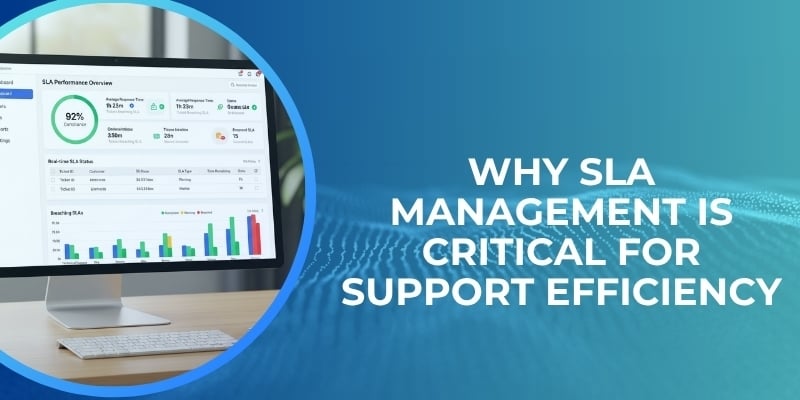
Real-time dashboards show SLA performance across teams, agents, queues, and time periods. Managers can see adherence rates, average response times, and trends.
A guide on SLA‑measurement in managed services highlights that SLA‑dashboards reveal 20–25% more visibility into recurring issues, slow‑lane queues, and team‑level lag. This visibility drives targeted improvements.
Dashboards can be customized for different roles: agents see their own performance, team leads see their team, and executives see high-level trends. Reporting can be scheduled and exported for compliance audits or board presentations.
Integration with Queue Systems
SLA management integrates with queue management systems to apply SLA logic to physical service environments.
A customer waiting in a branch queue has an SLA on their wait time. The system tracks how long they have waited, predicts remaining time, and alerts staff when targets are at risk.
This connection between digital SLAs and physical queues is essential for omnichannel service organizations that serve customers both online and in person.
Integration also extends to appointment booking systems, ensuring that scheduled customers are seen within their promised window.
Audit Trails and Compliance Logging
For regulated industries, SLA management systems provide comprehensive audit trails. Every SLA assignment, breach, alert, and escalation is logged with timestamps and user identifiers. This logging supports internal audits and regulatory inspections.
Organizations can prove that they met their service commitments or, if breaches occurred, that they followed proper escalation procedures. Audit trails also support dispute resolution when customers claim they did not receive timely service.
Benefits of SLA Management Systems
Organizations that implement SLA management systems realize benefits across multiple dimensions of support operations. These benefits are both quantitative (measurable metrics) and qualitative (improved culture and customer relationships).
- Improved response and resolution times are the most direct benefit. With automated tracking and prioritization, tickets move faster. First response times drop from hours to minutes. Resolution cycles shorten from days to hours. Customers receive answers sooner, reducing follow-up contacts. In the case study earlier, first response time for premium customers dropped from 45 minutes to 8 minutes, a reduction of over 80%.
- Better workload management results from visibility. Managers can see which agents have the most tickets, which queues are longest, and where bottlenecks form. This data supports intelligent workload distribution, such as reassigning tickets from overloaded agents to those with capacity. It also supports capacity planning, showing when additional staff are needed.
- Increased customer satisfaction follows from faster, more consistent service. When customers know what to expect and receive timely updates, their trust grows. Meeting SLA commitments directly correlates with higher satisfaction scores. In the case study, customer satisfaction improved by 28 points. Repeat contact rates decrease because issues are resolved correctly the first time.
- Enhanced operational efficiency comes from automation. Manual tracking of SLAs is impossible at scale. Automated systems eliminate spreadsheets, manual reminders, and guesswork. Agents spend less time managing their queues and more time resolving issues. The system’s automated alerts and escalations reduce the need for supervisors to manually check on aging tickets.
- Data-driven decision making replaces intuition. Leaders can see which SLA targets are realistic, where training is needed, and which process changes have the greatest impact. Continuous improvement becomes a data exercise, not a guessing game. For example, if data shows that tickets related to a specific product have the highest breach rates, training can be focused on that product.
- Reduced agent turnover is an indirect but important benefit. When agents are not constantly dealing with angry customers upset about delays, their job satisfaction improves. Clear SLAs also reduce ambiguity about performance expectations, which lowers stress. In the case study, agent turnover dropped by 15% after implementation.
- Competitive advantage emerges from superior service. In industries where competitors have similar products, support quality becomes a differentiator. Organizations that consistently meet SLAs can use that fact in marketing and sales conversations. Enterprise customers, in particular, demand SLA guarantees from their vendors.
SLA Management in Wavetec Solutions
Wavetec integrates SLA management directly into its queue management, customer journey, and appointment booking solutions. This integration ensures that service level commitments are tracked consistently across digital and physical channels.
For organizations that serve customers both online and in person, this unified approach is essential.
- In Wavetec queue management systems, SLA tracking applies to customer wait times. When a customer checks in at a self-service kiosk or via a mobile app, the system records the time and calculates an estimated wait based on current queue conditions. The system compares actual wait against target SLAs, which can be configured differently for appointment customers, VIP customers, and walk-ins. If wait times exceed thresholds, managers receive real-time alerts and can open additional service points or redirect customers to other counters.
- Real-time monitoring of service performance is central to Wavetec’s approach. Dashboards show SLA adherence by branch, by service type, by time of day, and by staff member. A branch manager can see at a glance whether today’s wait time SLAs are being met. Historical reports reveal trends, such as which days of the week have the worst breaches, allowing proactive staffing adjustments.
- Integration with customer journey management extends SLA logic beyond individual interactions. A customer on a multi-step journey, such as applying for a loan, may have SLA targets for each step: check-in, initial consultation, document submission, underwriting, and final approval. The system tracks progress against each target, ensuring that the entire journey meets service standards. If any step is delayed, the system alerts managers and can trigger customer notifications.
- Integration with appointment booking allows SLAs to be set for scheduled services. An appointment customer expects to be seen within a certain window of their booked time, often 5 minutes. The queue system respects appointment SLAs while also managing walk-ins, balancing both flows intelligently. If an appointment customer arrives and the queue is long, the system can prioritize them without completely blocking walk-in customers.
- Centralized dashboards give managers visibility across all channels and locations. A regional director can see which branches are meeting wait time SLAs and which are struggling. A support center manager can see ticket response times by agent. This unified view supports consistent service delivery across the enterprise. Wavetec’s SLA management also integrates with common CRM and ticketing platforms, allowing organizations to leverage existing investments.
- Wavetec’s smart online appointment booking and scheduling software includes SLA tracking for appointment-based services. Customers receive confirmation and reminder messages. If the service provider is running late, the system can automatically notify customers and update expected wait times. This proactive communication reduces customer frustration and manages expectations.
Case Study – Improving Support Efficiency with SLA Management
A large service organization managing customer requests across multiple service points was handling a high volume of daily tickets. These requests ranged from walk-in customer queries to appointment-based services and follow-up interactions.
The organization relied on a queue management system to manage in-person flow, but lacked structured control over service timelines and resolution commitments. As customer expectations increased, the need for a more accountable and time-bound service model became critical.
Challenges
Without defined service level agreements (SLAs), the organization faced several operational issues.
- Service requests were handled on a first-come, first-served basis without prioritization based on urgency or complexity. This led to delays in resolving critical requests while less important ones consumed available resources.
- Backlogs began to build as there was no mechanism to track response or resolution times. Managers lacked visibility into how long tickets remained open or where bottlenecks were occurring.
- Additionally, there was no standardized way to measure staff performance. Without tracking timelines, it was difficult to identify inefficiencies, enforce accountability, or ensure consistent service quality across branches. These gaps ultimately impacted customer satisfaction and increased frustration.
Solution
The organization implemented an SLA management framework integrated with its queue management system.
- Each service type was assigned defined response and resolution timelines, ensuring that every ticket followed a structured lifecycle. The system automatically tracked key metrics such as first response time, service duration, and overall resolution time for each customer interaction.
- Integration with the queue system allowed tickets to be prioritized dynamically. High-priority requests were routed faster, while time-sensitive services were flagged to ensure compliance with SLA commitments.
- Real-time dashboards provided managers with visibility into active tickets, SLA performance, and potential breaches. Alerts were generated when service timelines were at risk, enabling proactive intervention.
This approach aligns with modern queue-based workflows enabled through solutions such as ticketing kiosk, where structured ticketing and centralized tracking form the foundation for service control. It also reflects patterns seen in multi-branch retail deployments, where performance tracking enables structured service management.
Results
The implementation of SLA management delivered measurable improvements across operations.
- Response times improved significantly as staff prioritized tickets based on defined service levels rather than handling them sequentially.
- Backlogs were reduced as the system identified delays early and enabled timely intervention. Tickets were resolved faster, and fewer requests remained unattended.
- Team performance improved through clear accountability. Managers could track individual and branch-level performance, identify gaps, and optimize resource allocation.
Most importantly, customer satisfaction increased. Customers experienced faster service, more predictable outcomes, and greater transparency throughout their journey. These improvements align closely with key performance indicators outlined in our guide “Customer Satisfaction Metrics”, reinforcing the impact of structured SLA management on overall service quality.
Common Challenges in SLA Management
Implementing SLA management is not without obstacles. Organizations should anticipate these challenges and plan accordingly.
- Setting realistic SLA targets is harder than it seems. Targets that are too aggressive lead to constant breaches and frustrated teams. Targets that are too lenient provide no improvement. The right balance requires understanding current performance, industry benchmarks, and customer expectations. A common mistake is to copy SLAs from competitors without analyzing internal capacity. The solution is to start with current performance data, set incremental improvement targets, and adjust over time.
- Managing high ticket volumes can overwhelm even automated systems. During spikes, such as after a product launch or during a service outage, SLA breaches may be unavoidable. The system must handle peak loads without crashing and provide accurate tracking even under stress. Scalable cloud infrastructure and load testing are essential. The system should also support temporary SLA overrides during known high-volume periods.
- Ensuring team compliance requires buy-in. Agents may resist SLA tracking if they perceive it as micromanagement. Clear communication about how SLA data is used for improvement, not punishment, helps. Involving teams in target setting builds ownership. Regular feedback sessions where agents see how SLA data helps them work smarter can turn skeptics into advocates.
- Integrating with existing systems can be technically complex. The SLA management system must connect with ticketing platforms, CRM, queue systems, and possibly other tools. APIs and pre-built integrations reduce this challenge. Organizations should prioritize vendors with proven integration capabilities and allocate sufficient time for testing.
- Data quality issues can undermine SLA tracking. If tickets are not categorized correctly, SLA targets may be wrong. If timestamps are inaccurate, tracking is meaningless. Organizations must enforce consistent data entry practices and periodically audit ticket data.
Future of SLA Management Systems
The evolution of SLA management will be driven by artificial intelligence, predictive analytics, and deeper automation. These advances will make SLA management more proactive and less reactive.
- AI-driven SLA monitoring will move beyond simple threshold alerts. Machine learning models will predict which tickets are likely to breach SLAs based on patterns in ticket content, agent workload, and historical data. For example, the system might learn that tickets containing certain keywords (like “urgent” or “server down”) tend to require longer resolution times and should be prioritized earlier. Proactive interventions, such as automatically escalating predicted breaches, will prevent failures before they happen.
- Predictive issue resolution will use AI to suggest solutions to agents or even automatically resolve common issues. When a new ticket arrives, the system will analyze its content against a knowledge base of past resolved tickets. If a match is found with high confidence, the system can suggest a resolution or apply it automatically. This will reduce resolution times dramatically, making SLA targets easier to meet.
- Automated workflow optimization will dynamically adjust routing rules, escalation paths, and agent assignments based on real-time SLA risk. The system will learn which adjustments are most effective and apply them automatically. For instance, if the system detects that a particular agent resolves tickets faster than others, it might route more tickets to that agent during SLA-critical periods.
- Advanced analytics and reporting will provide deeper insights into root causes of SLA misses. Natural language processing will analyze ticket content to identify which issue types cause the longest delays. Integration with workforce management will link SLA performance to staffing levels, showing exactly how many agents are needed at each hour to meet targets.
- Integration with customer sentiment analysis will add another dimension. The system will analyze customer language in tickets and surveys to gauge sentiment. Even if an SLA is met, if the customer is unhappy, the system will flag the interaction for review. This ensures that SLA compliance is not pursued at the expense of customer satisfaction.
FAQs
What is an SLA in customer support?
An SLA (Service Level Agreement) in customer support is a formal commitment that defines expected performance levels, such as first response time and resolution time.
It sets clear expectations for customers and accountability for support teams. SLAs are often included in customer contracts.
How does an SLA management system work?
An SLA management system automatically tracks response and resolution times for every support ticket.
It compares actual performance against SLA targets, sends alerts when tickets are at risk of breach, escalates overdue tickets, and provides dashboards for performance monitoring. It integrates with ticketing and queue systems.
Why is SLA important for support teams?
SLA is important because it creates structure, accountability, and consistency. Teams know what is expected. Managers can identify problems.
Customers receive timely service. Without SLAs, support becomes chaotic and unpredictable, leading to customer churn and agent burnout.
What metrics are used in SLA tracking?
Common SLA metrics include first response time (time from ticket creation to first agent reply), resolution time (total time to close the ticket), update frequency (regular communication during long-running issues), customer satisfaction score, and backlog size. Some SLAs also track escalation time and reassignment counts.
How does SLA improve queue management?
SLA improves queue management by automatically prioritizing tickets based on remaining SLA time. Urgent tickets move to the front of queues.
Agents always work on the most time-sensitive issues first, reducing breaches and improving overall efficiency. In physical queues, SLA tracking ensures that wait times stay within promised limits.
Conclusion
An SLA Management System transforms customer support from reactive chaos into proactive, data-driven efficiency.
By defining clear targets, tracking performance automatically, prioritizing work intelligently, and providing visibility into results, these systems help organizations deliver faster, more consistent service.
The benefits extend beyond metrics: happier customers, less stressed agents, lower operational costs, and reduced turnover.
For organizations that manage queues, whether digital tickets or physical waiting lines, SLA management is a foundational capability. Without it, teams operate in the dark, missing commitments and frustrating customers. With it, they gain the visibility and automation needed to meet and exceed expectations consistently.
Wavetec provides advanced SLA management integrated with queue systems, customer journey platforms, and appointment booking solutions.
As customer expectations continue to rise, the ability to track, meet, and exceed service commitments will separate market leaders from the rest. Investing in an SLA management system is investing in the future of customer support.
The evidence from real-world implementations, such as the telecommunications case study, shows that significant improvements are achievable within months.
Organizations that delay risk falling behind competitors who have already made the investment. The time to act is now.
BOOK A FREE DEMO