A Cash Deposit Machine, cash recycler and ATM may appear to serve similar purposes, but each one addresses a different cash-flow problem.
A commercial branch receiving large daily deposits has different requirements from an off-site location dominated by withdrawals. A flagship branch with balanced cash inflows and outflows may need another model entirely.
The decision should therefore not be based only on which machine offers the most features. Banks must determine which cash-handling model best matches the location’s transaction mix, denomination patterns, operating hours, security requirements, integration environment and service strategy.
The three principal options are:
- A Cash Deposit Machine (CDM) for deposit-intensive environments
- A cash recycler for locations with balanced deposits and withdrawals
- An Automated Teller Machine (ATM) for withdrawal-led and general self-service banking
For most large banks, the right answer is not one machine across the entire network. It is a strategically designed fleet in which different technologies serve different location profiles.
Talk to Wavetec about developing a data-led cash automation strategy for your banking network.
CDM vs Cash Recycler vs ATM: The Short Answer
Choose a CDM when the principal requirement is accepting large or frequent cash deposits quickly and securely.
Choose a cash recycler when the same location processes substantial deposits and withdrawals in compatible denominations, allowing validated deposited notes to be reused for subsequent withdrawals.
Choose an ATM when cash withdrawals, balance inquiries and conventional self-service transactions dominate, and high-capacity deposit handling is not the primary requirement.
| Decision factor | Cash Deposit Machine | Cash Recycler | ATM |
| Primary function | Accept cash deposits | Accept and dispense cash | Primarily dispense cash and provide general banking services |
| Cash-flow pattern | Deposit-heavy | Relatively balanced | Withdrawal-heavy |
| Best-fit location | Commercial branches, cash-intensive locations and collection points | High-volume branches with two-way cash movement | Retail areas, transport hubs and off-site locations |
| Deposit capacity | Generally high | Determined by recycling cassette configuration | Usually limited or unavailable |
| Cash reuse | No | Yes | No |
| Main operational objective | Automate and accelerate cash intake | Reduce cash replenishment and collection requirements | Extend convenient withdrawal access |
| Operational complexity | Moderate | High | Low to moderate |
| Wavetec offering | WT CQuick24 CDM | Integration within a wider cash ecosystem | ATM deployment and integration ecosystem |
Why Cash-Channel Strategy Still Matters
Digital banking has reduced certain types of routine branch traffic, but it has not eliminated the need for physical banking infrastructure.
Accenture’s 2025 Global Banking Consumer Study—based on responses from 49,300 banking customers across 39 countries—found that:
- Bank branch numbers declined by 40% in Europe and 24% in the United States over the previous decade.
- Despite those closures, 64% of customers still rely on branches to resolve problems they cannot address online.
- 65% of customers regard a local branch presence as a sign of stability and availability.
- ATMs average approximately 52 customer interactions per year, with 57% of respondents using an ATM at least once per month.
- Mobile banking applications average 152 customer interactions annually, reinforcing the need to connect physical and digital banking channels.
These statistics do not suggest that banks should simply deploy more physical machines. They show why banks need to make each physical channel more purposeful.
A deposit-intensive branch may need a high-capacity CDM. A withdrawal-led off-site location may only require an ATM. A branch with balanced cash activity could produce a stronger business case for recycling.
The objective is to deploy the right technology where it creates the greatest operational and customer value. Accenture Global Banking Consumer Study 2025
The CDM vs Recycler vs ATM Decision Tree
Question 1: Is cash withdrawal the location’s primary requirement?
Yes → Choose an ATM.
An ATM remains the most direct choice when most transactions involve withdrawals, balance inquiries, transfers, PIN services or other routine banking functions.
This is particularly suitable for:
- Shopping centres
- Transport hubs
- University campuses
- Fuel stations
- Remote or off-site locations
- Branches where deposits are handled through another channel
If deposit traffic is limited, investing in high-capacity deposit or recycling hardware may add cost and complexity without creating sufficient value.
No → Continue to Question 2.
Question 2: Are deposits significantly higher than withdrawals?
Yes → Choose a CDM.
A Cash Deposit Machine is designed to move deposit transactions away from teller counters while providing secure note acceptance, validation, transaction processing and receipt generation.
CDMs are particularly effective where customers or businesses regularly deposit:
- Daily retail takings
- Distributor and agent collections
- School or institutional fees
- Utility payments
- Business cash receipts
- Bulk deposits involving large quantities of banknotes
A deposit-led environment does not necessarily benefit from cash recycling. If relatively little cash is withdrawn from the same machine, deposited banknotes will accumulate faster than they can be reused.
In this scenario, a high-capacity CDM may offer a more appropriate balance of throughput, storage and operational simplicity.
No → Continue to Question 3.
Question 3: Does the location have substantial deposits and withdrawals in compatible denominations?
Yes → Consider a cash recycler.
A cash recycler validates deposited notes, stores eligible denominations in recycling cassettes and makes those notes available for subsequent withdrawal transactions.
This closed-loop movement can reduce the frequency of cash loading and removal. However, the business case depends on more than total deposit and withdrawal volume. The denominations entering and leaving the machine must also be reasonably aligned.
For example, a branch may receive large quantities of low-denomination notes but dispense mainly high-denomination notes. Although the location has both deposits and withdrawals, the denomination mismatch limits the value of recycling.
A recycler is most effective when:
- Deposit and withdrawal volumes are both substantial
- Cash inflows and outflows are relatively balanced
- Deposited notes match commonly requested denominations
- Cash-in-transit activity is expensive or difficult
- The bank can support more complex reconciliation and servicing requirements
No → Continue to Question 4.
Question 4: Do cash-flow patterns differ across the network?
Yes → Build a hybrid fleet.
A bank does not have to choose one machine category for every location. A stronger strategy may include:
- ATMs at withdrawal-led off-site locations
- WT CQuick24 CDMs at deposit-intensive branches
- Cash recyclers at locations with balanced two-way cash activity
- Teller-assisted cash handling for exceptions and complex transactions
This approach treats cash infrastructure as a portfolio. Each device is assigned according to the role of the location rather than applying a uniform hardware standard across the entire branch network.
What Is a Cash Deposit Machine?
A Cash Deposit Machine accepts, validates and processes banknotes without requiring a teller to complete the transaction.
Depending on the banking workflow and integration, funds may be credited to the beneficiary account in real time or after defined verification checks.
Unlike a cash recycler, a CDM does not normally dispense the banknotes it receives. Its hardware, cash-storage architecture and software are optimized around secure and efficient cash intake.
A CDM is therefore particularly suitable for banks serving:
- Cash-intensive businesses
- Retail merchants
- Distributors and agents
- Educational institutions
- Government payment collections
- Customers making frequent or high-volume deposits
Inside Wavetec’s WT CQuick24 CDM
The WT CQuick24 Cash Deposit Machine is engineered for demanding, high-volume cash environments.
Cash-processing capacity
The WT CQuick24 provides:
- Bulk acceptance of up to 200 notes per transaction
- Processing speeds of up to 700 notes per minute
- A 200-note escrow capacity
- A 100-note reject-bin capacity
- Storage for up to 20,000 notes
- Optional capacity expansion to 30,000 notes
- Multi-currency support
These specifications are particularly relevant to banks serving business and commercial customers who may need to deposit large quantities of cash within a short period.
Customer interface
The WT CQuick24 includes:
- A 19-inch PCAP touchscreen
- Multi-touch capability
- A resolution of 1280 × 1024
- An optional 10-inch operator display for rear-access configurations
- An 80 mm thermal receipt printer
- Dual speakers and a microphone
The interface can be configured around the bank’s deposit journey, account-validation requirements, transaction rules and branding.
Physical and transaction security
Security features include:
- A 40 mm concrete-filled vault
- Dormakaba digital locking
- A three-wheel combination safe lock
- Dedicated locks for machine doors
- Door-status sensors
- A shutter-protected acceptor hopper
- Hardware-status LEDs
- An optional 500 DPI optical fingerprint sensor
- A 2 MP camera supporting 1280 × 720 image capture
These controls help banks protect deposited cash, monitor physical access and support transaction verification requirements.
Computing and connectivity
The machine’s computing platform includes:
- A 13th-generation Intel Core i3 processor
- 8 GB DDR4 RAM
- A 256 GB SSD
- Ethernet connectivity
- Wi-Fi and Bluetooth support
- Windows 10 and Windows 11 compatibility
Front-access and rear-access configurations allow banks to select the service model most appropriate for a branch lobby, through-wall environment or secure back-office area.
Enterprise integration
The WT CQuick24 can integrate with core banking and supporting enterprise systems to enable:
- Account validation
- Real-time transaction processing
- Beneficiary-account credit
- Biometric verification
- Receipt generation
- Electronic transaction journals
- Cash reconciliation
- Device-status monitoring
- Exception management
- Centralized operational reporting
Wavetec combines in-house hardware, software, deployment services and operational support. This full-stack approach allows the CDM to operate as part of a managed banking channel rather than as an isolated device.
What Is a Cash Recycler?
A cash recycler combines deposit acceptance and cash dispensing in one device.
Once banknotes are deposited, the recycler authenticates and sorts eligible notes into recycling cassettes. Those notes can then be used to fulfil later withdrawal requests.
The potential benefit is a reduction in external cash replenishment and collection requirements. However, a recycler is operationally more complex than a deposit-only machine.
Banks evaluating a recycler should assess:
- The balance between deposits and withdrawals
- Denomination compatibility
- Recycling-cassette capacity
- Banknote quality and rejection rates
- Forecast demand by denomination
- Cash-in-transit costs
- Reconciliation procedures
- First- and second-line maintenance capabilities
- Device-availability requirements
- Service-level agreements
A recycler deployed in the wrong location can become an expensive deposit machine or an underutilized ATM. The bank should establish the use case through transaction data before selecting the device and cassette configuration.
What Is an ATM?
An ATM is primarily designed to extend access to cash withdrawals and routine banking services beyond teller counters and conventional branch hours.
Depending on the configuration and integration, an ATM may support:
- Cash withdrawals
- Balance inquiries
- Mini statements
- Account transfers
- PIN services
- Bill payments
- Cardless transactions
- Limited envelope or intelligent deposits
An ATM is generally the better fit when convenient withdrawal access is more important than bulk deposit handling or local cash recirculation.
The continued relevance of ATMs is supported by Accenture’s findings that 57% of respondents use ATMs at least monthly, while physical branch presence continues to signal availability and stability to 65% of customers. Accenture Global Banking Consumer Study 2025
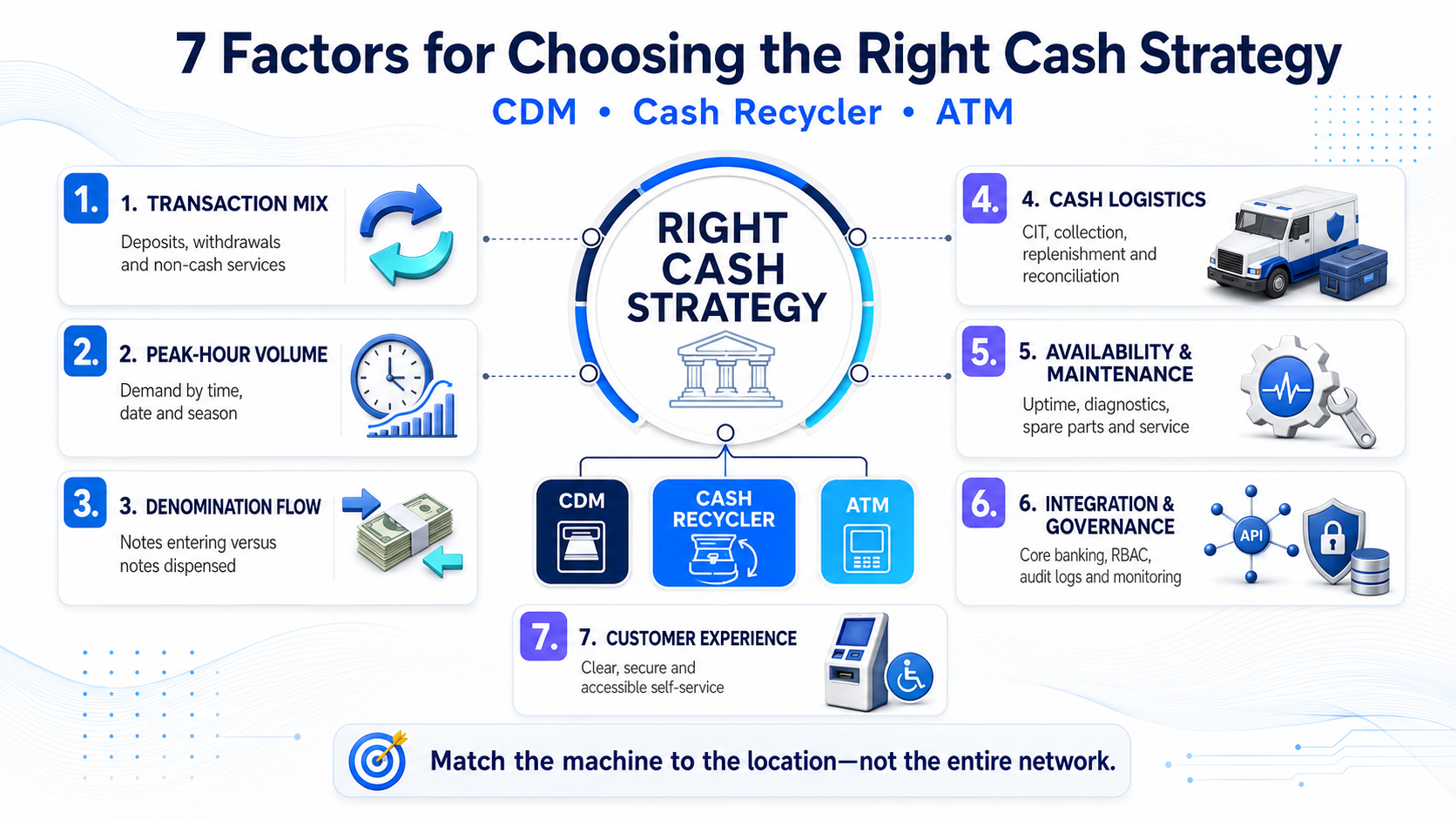
Seven Factors Banks Should Evaluate Before Choosing
1. Transaction mix
Start with the percentage of deposit, withdrawal and non-cash transactions at each location.
Network-wide averages can conceal major differences. A commercial branch may be heavily deposit-led, while an off-site machine nearby may process almost exclusively withdrawals.
Banks should analyze:
- Deposit-to-withdrawal ratios
- Average deposit size
- Banknotes per transaction
- Transaction frequency
- Customer type
- Assisted versus self-service volumes
2. Peak-hour volume
Daily totals are not enough. Banks should determine how transactions cluster around:
- Salary dates
- Weekends
- Public holidays
- Business closing hours
- Tax and fee deadlines
- Seasonal retail periods
- Local events
A high-throughput CDM may create more value at a location with concentrated deposit peaks than a more complex machine with lower bulk-processing capacity.
3. Denomination flow
Denomination matching is particularly important for cash recyclers.
Banks must understand which denominations enter a location and which denominations customers request. A recycler creates the greatest value when deposited denominations can satisfy subsequent withdrawal demand.
Where denomination patterns do not align, the bank may still need frequent cash collection and replenishment, reducing the recycler’s expected benefit.
4. Cash logistics
The total cost of cash operations includes more than the machine purchase price.
Banks should evaluate:
- Cash-in-transit frequency
- Secure collection and replenishment
- Insurance
- Cassette exchange
- Vault capacity
- Cash counting and reconciliation
- Route planning
- Branch staff involvement
- Downtime caused by full or empty cassettes
The correct comparison is therefore based on total cost of ownership rather than initial hardware cost.
5. Availability and maintenance
More complex hardware generally requires more specialized maintenance.
Banks should compare:
- Device uptime requirements
- Field-service coverage
- Local spare-parts availability
- Remote diagnostic capabilities
- Mean time to repair
- Preventive maintenance requirements
- Software-update procedures
- Cash-module maintenance
The right machine is not necessarily the one with the longest feature list. It is the one the bank can operate reliably across its intended environment.
6. Integration and governance
A self-service cash device must connect securely to banking and operational systems.
The architecture may include:
- Core banking integration
- Transaction switching
- Account and beneficiary validation
- Biometric or identity verification
- Receipt and notification services
- Device monitoring
- Electronic journals
- Cash reconciliation
- Role-based access control
- Audit logs
- Exception and dispute workflows
Wavetec’s enterprise platform provides centralized visibility into device status, cash operations and transaction performance. Role-based access, operational logs and multi-site dashboards help banks govern distributed self-service fleets.
7. Customer experience
Customers should not need to understand the bank’s internal channel architecture.
The journey should provide:
- Clear service instructions
- Account or beneficiary confirmation
- Banknote-count visibility
- Rejected-note guidance
- Transaction-status updates
- Error and exception handling
- A reliable printed or digital receipt
- Accessibility and multilingual options where required
Accenture found that 72% of customers say personalization influences their choice of bank, but only 3% use the personalization tools provided by their primary bank.
The same research found that banks in the top 20% for customer advocacy grew revenue 1.7 times faster than banks with the lowest advocacy scores. Customer advocates also hold an average of 17% more products with their primary bank.
These findings demonstrate that self-service efficiency should not come at the cost of experience. A fast, clear and reliable cash journey can contribute to trust and customer advocacy. Accenture Global Banking Consumer Study 2025
How AI Improves Cash-Channel Decisions
AI should not be added to a cash strategy as a decorative feature. Its most credible role is helping banks make stronger operational decisions using transaction, device and service data.
Cash-demand forecasting
Machine-learning models can analyze historical withdrawals and deposits alongside:
- Salary cycles
- Weekends and holidays
- Seasonal activity
- Branch operating schedules
- Local events
- Customer segments
- Denomination demand
Forecasts can help determine how much cash each location is likely to receive or dispense.
Device and location selection
AI-assisted analysis can group locations according to cash-flow behaviour.
Deposit-heavy locations can be prioritized for CDMs, balanced locations for cash recyclers and withdrawal-heavy locations for ATMs. This reduces the risk of purchasing functionally advanced but operationally unnecessary hardware.
Predictive collection and replenishment
Forecasting can help cash teams schedule collections and replenishments based on projected capacity and demand rather than fixed calendars.
This can reduce unnecessary visits while helping prevent machines from becoming full or running out of required denominations.
Anomaly detection
Analytics can identify:
- Sudden changes in transaction volume
- Unexpected denomination patterns
- Increasing note-rejection rates
- Capacity risks
- Repeated transaction failures
- Unusual device behaviour
These signals can be escalated for operational or security review.
AI analytics assistance
Wavetec’s enterprise analytics layer can consolidate device, transaction and cash-operation data into centralized dashboards.
An embedded AI analytics assistant can help authorized users explore performance, identify patterns and retrieve operational summaries through natural-language questions. Recommendations should remain governed by role-based access, approved business rules and human oversight.
What the Banking AI Statistics Show
The banking industry is increasing its investment in AI, but data readiness and legacy infrastructure remain significant challenges.
Deloitte’s 2025 Banking Industry Outlook reports that:
- Only 25% of banking respondents considered their data-management platforms highly or very highly prepared for generative AI.
- More than 75% of banks planned to increase investment in data management and cloud consumption to advance enterprise generative AI.
- Nearly 60% of banking leaders identified legacy infrastructure as the leading obstacle to organizational growth.
- One banking AI application referenced by Deloitte increased abandoned-application completion rates by 10% to 20%.
- AI could help increase global banking industry profits to approximately US$2 trillion by 2028, representing an estimated 9% increase over five years, according to the Citigroup projection cited by Deloitte.
These figures reinforce the need for cash devices that generate structured operational data and integrate with modern enterprise platforms.
Cash forecasting and anomaly detection will only be reliable when transaction, device and cash-capacity data can be collected consistently, governed securely and analyzed centrally. Deloitte 2025 Banking Industry Outlook
From AI Pilots to Operational Cash Intelligence
McKinsey’s 2025 banking analysis reviewed more than 600 AI initiatives across approximately 30 banking innovation categories.
The underlying McKinsey Panorama database covers:
- More than 10 million data points
- Approximately 10,000 banks and fintechs
- Around 300,000 financial products and services
- Approximately 4,000 innovation clusters
McKinsey found that fintechs represented approximately 40% of the organizations in its dataset but nearly 70% of the AI initiatives.
It also found that approximately 600 AI-focused launches represented only 3% of all financial-product and service launches captured between late 2022 and mid-2025.
For banks, the lesson is that AI must progress from isolated experiments to operational applications. In cash management, that means using predictive models to forecast cash demand, recommend collections or replenishments, detect unusual machine behaviour and determine whether a location needs a CDM, recycler or ATM. McKinsey: How Banks Can Catch Up to Fintechs on AI
A Practical Location-Segmentation Model
| Location profile | Recommended strategy | Reason |
| Commercial branch receiving frequent bulk deposits | WT CQuick24 CDM | High-speed intake and large storage capacity |
| Branch with comparable deposits and withdrawals | Cash recycler | Reuses eligible deposited notes |
| Off-site retail or transport location | ATM | Customer demand is primarily withdrawal-led |
| Branch with high deposits but limited withdrawals | WT CQuick24 CDM | Recycling would provide limited value |
| Location with incompatible deposit and withdrawal denominations | CDM plus ATM | Separates high-capacity intake from dispensing |
| Flagship branch serving several customer segments | Hybrid deployment | Matches different machines to different journeys |
| Low-volume location | ATM or alternative channel | Avoids investment in unnecessary capacity |
Wavetec’s Cash Automation Experience
Wavetec’s cash automation strategy is supported by banking deployments where self-service hardware, software integration and centralized operations work as one system.
Bank AL Habib
Bank AL Habib deployed 173 Wavetec WT CQuick24 Cash Deposit Machines across 173 locations.
The project combined:
- Bulk cash acceptance
- Core banking integration
- Real-time transaction processing
- Centralized device monitoring
- Enterprise operational visibility
- Secure cash management
Each WT CQuick24 can accept up to 200 notes per transaction, process up to 700 notes per minute and store up to 20,000 notes, with an optional extension to 30,000 notes.
The rollout demonstrates how a high-capacity CDM can be standardized across a large banking network while remaining connected to banking systems and centralized operational controls.
Read the Bank AL Habib cash deposit machine case study.
Meezan Bank
Meezan Bank deployed Wavetec CQuick24 CDMs across 20 locations.
In 2025, the deployment:
- Processed more than 425 transactions per day
- Handled average daily deposits exceeding PKR 49 million
- Reduced dependency on teller-assisted deposits
- Extended access to deposit services without requiring longer teller operating hours
The project demonstrates how deposit-specific automation can support high-value cash movement while reducing pressure on branch counters.
Read the Meezan Bank cash deposit machine case study.
These deployments show why machine selection should follow the operational problem. Where the principal challenge is high-volume cash intake, a purpose-built CDM can be more appropriate than adding recycling or withdrawal capabilities that the location does not require.
Final Recommendation
The CDM-versus-recycler-versus-ATM decision should be made at the location level, not only at the network level.
Choose an ATM when convenient withdrawal access is the principal objective.
Choose a cash recycler when a location has substantial, balanced and denomination-compatible cash inflows and outflows—and when the resulting reduction in cash handling justifies the additional complexity.
Choose a WT CQuick24 CDM when the bank needs high-speed, high-capacity and secure deposit automation, particularly at cash-intensive branches and locations serving commercial customers.
For a diverse banking network, use all three strategically. Segment locations, analyze transaction and denomination patterns, calculate total operating costs and manage the resulting fleet through a centralized enterprise platform.
Contact Wavetec to evaluate your transaction mix and design the appropriate cash automation strategy for each location.
Frequently Asked Questions
What is the main difference between a CDM and a cash recycler?
A CDM accepts and securely stores cash deposits but does not normally reuse those notes for withdrawals. A cash recycler accepts, validates and sorts deposited notes before making eligible notes available for subsequent withdrawal transactions.
Is a cash recycler always more efficient than a CDM?
No. A recycler is most efficient when deposit and withdrawal volumes are both substantial and the denominations entering and leaving the machine are compatible. In a deposit-heavy location, a high-capacity CDM may be more appropriate and less operationally complex.
Can an ATM accept deposits?
Some intelligent ATMs support cash deposits, but their deposit capacity and processing capabilities vary. A purpose-built CDM is generally more suitable for high-volume bulk deposits, while a conventional ATM is primarily optimized for withdrawals and routine banking transactions.
When should a bank deploy the WT CQuick24?
The WT CQuick24 is suitable for high-volume, security-sensitive deposit environments. It accepts up to 200 notes per transaction, processes up to 700 notes per minute and stores up to 20,000 notes, with an optional extension to 30,000.
Should every branch use the same cash machine?
Not necessarily. Branches and off-site locations can have significantly different transaction patterns. A segmented strategy can assign CDMs, recyclers and ATMs according to each location’s deposits, withdrawals, denominations, customer segments and operating costs.
How can AI support cash automation?
AI can support cash-demand forecasting, location segmentation, predictive collection and replenishment, denomination planning, anomaly detection and operational analysis. Final cash decisions should remain governed by approved rules, reliable data, appropriate access controls and human oversight.
BOOK A FREE DEMO