Hospital appointment scheduling software is a digital platform that automates patient booking, sends multi-channel reminders, and manages multi-department capacity across a healthcare facility. In 2026, AI-enhanced systems predict no-show risk and dynamically reallocate slots, reducing revenue loss and improving patient access to care.
Every empty chair in a hospital waiting room tells a story of missed care and lost revenue.
A patient fails to show up for an appointment that another patient desperately needed.
A consultant’s time is wasted.
A surgical suite sits idle.
The scale of this problem is staggering.
The global average hospital no-show rate sits at 23.5%, with each missed appointment carrying an average cost of $200 or more. In outpatient care specifically, the chance of a patient missing an appointment ranges between 23% and 33%; a direct and measurable drain on clinical capacity and revenue.
Add to this the growing pressure on hospital access teams: phone lines overwhelmed, wait times stretching across departments, and patients frustrated by the complexity of booking and managing their care.
Legacy scheduling systems were never designed to solve these problems. They were built to record appointments, not to predict behaviour, orchestrate patient flow, or integrate across multiple hospital departments.
In 2026, a new generation of hospital appointment scheduling software is transforming patient access. These intelligent platforms use artificial intelligence to forecast no-show risk, automate personalised reminders across multiple channels, and dynamically reallocate cancelled slots to waiting list patients in real time.
They integrate with electronic health records, queue management systems, and digital signage, creating a unified patient journey from online booking to in-person service.
For hospital administrators, the ROI is clear: fewer missed appointments, shorter waiting lists, higher provider utilisation, and better patient satisfaction scores.
Wavetec’s queue management platform is purpose-built for this new era of intelligent healthcare scheduling.
The No-Show Crisis in Hospital Outpatient Services
The scale of the no-show crisis demands attention. Across the U.S. healthcare system, missed appointments cost an estimated $150 billion annually.
For an individual practice, the financial impact is equally severe. Industry analyses estimate that no-shows and last-minute cancellations can consume roughly 14% of a medical group’s revenue on a given day, with revenue losses around $150,000 annually per physician in some models.
A single no-show costs a practice approximately $200 in lost revenue; a figure that multiplies rapidly across a busy outpatient department.
The problem varies significantly by care setting. Research indicates that general healthcare no-show rates average 27%, while primary care sees rates between 19% and 23%. Specialist referrals face even higher attrition at 30–35%, and mental health and behavioral health appointments experience rates of 30–40%. Community health clinics, serving some of the most vulnerable populations, face no-show rates as high as 35%.
The hidden costs extend beyond immediate revenue loss.
- Empty appointment slots mean fixed costs (staff salaries, facility overhead, equipment leases) remain constant while income drops.
- Scheduling backlogs worsen, pushing wait times longer for patients who do show up.
- Clinician burnout accelerates when schedules are unpredictable.
- Delayed care can lead to deteriorating health outcomes for the very patients who miss appointments.
A January 2025 MGMA Stat poll of 622 medical group leaders found that more than one-third (37%) had seen an increase in patient no-shows, and 42% of practices now charge no-show fees; a direct indicator of how significantly missed appointments are affecting practice revenue and scheduling efficiency.
The message is clear: no-shows are not a minor inconvenience. They are a core operational crisis requiring a systematic, technology-led response.
What Is Hospital Appointment Scheduling Software?
Hospital appointment scheduling software is a digital platform that automates the entire patient booking lifecycle, from initial appointment request through to post-visit follow-up.
It replaces fragmented manual processes (phone calls, spreadsheets, disparate calendars) with a unified, intelligent system that manages capacity across multiple departments, providers, and facilities.
Core components of modern hospital scheduling software include:
- Online booking portal and self-scheduling: Patients can view real-time availability and book, reschedule, or cancel appointments 24/7 without phone calls. This reduces administrative burden and meets patient expectations for digital convenience.
- Multi-department routing: The platform understands the relationships between services (a cardiology referral that requires prior lab work, a pre-surgical consultation that must precede an operating room booking) and manages dependencies automatically.
- Automated multi-channel reminders: Personalised reminder sequences are sent via SMS, WhatsApp, email, and voice calls at configurable intervals (typically 72 hours, 24 hours, and 2 hours before the appointment). Two-way interaction allows patients to confirm, reschedule, or cancel with a single reply.
- Waitlist management: When an appointment is cancelled, the system automatically identifies the most appropriate patient from the waiting list based on clinical priority, geography, and booking history, and offers the freed slot.
- EHR/EMR integration: Scheduling systems connect directly with electronic health records to pre-populate patient information, flag clinical priorities, and update appointment statuses without duplicate data entry.
In 2026, these core capabilities are being supercharged by artificial intelligence, moving hospital scheduling from reactive record-keeping to proactive, predictive optimisation.
Key Features of Modern Hospital Scheduling Software in 2026
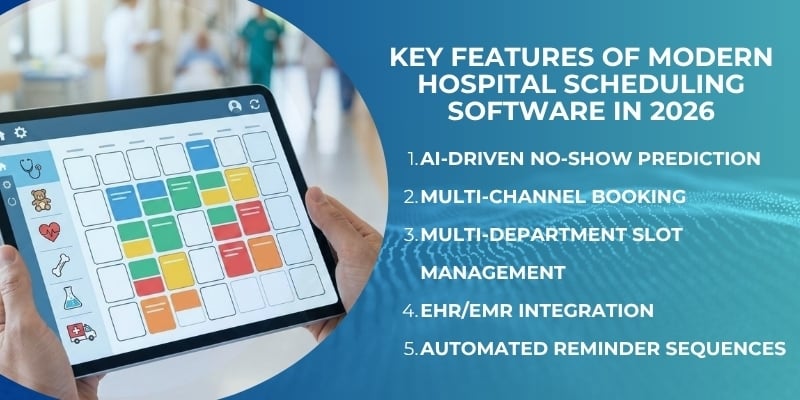
Here are the main features of modern hospital scheduling software:
AI-Driven No-Show Prediction
Machine learning models are now capable of forecasting appointment no-show risk with remarkable accuracy. These systems analyse hundreds of variables: historical attendance patterns, appointment type, lead time between booking and appointment, time of day, day of week, patient demographics, travel distance, and even weather conditions.
Academic research has demonstrated the effectiveness of this approach. A 2026 study published in a major healthcare technology platform showed that a Gradient Boosting machine learning model (XGBoost) can predict appointment no-shows with 87.4% accuracy. The same study found that AI-powered scheduling reduced no-shows by 24.3%, increased provider utilisation by 15.6%, and decreased patient waiting time by 19.8%.
In practice, when a high-risk appointment is identified, the system can trigger additional reminders, flag the booking for live outreach from a care coordinator, or enable strategic overbooking to protect schedule utilisation.
Multi-Channel Booking
Modern patients expect to interact with healthcare systems on their own terms. In 2026, hospital scheduling software supports booking via web portal, mobile app, SMS, WhatsApp, self-service kiosk inside the facility, and even AI-powered voice assistants.
Critically, appointments booked online have been shown to have substantially lower no-show rates, in one study, online bookings recorded a 1.8% no-show rate compared to 5.9% for offline bookings. When patients can book at their convenience, they are more committed to attending.
Multi-Department Slot Management
A patient journey rarely involves a single appointment. A hospital visit might include registration, consultation, lab work, imaging, and a follow-up appointment.
Modern scheduling software manages slot availability across all relevant departments simultaneously, ensuring that a patient can book a complete care pathway without returning to a separate system for each step.
EHR/EMR Integration
Seamless integration with electronic health records is non-negotiable. The scheduling system must write appointment data directly into the patient record and read clinical flags that affect scheduling priority.
For example, a patient flagged for urgent follow-up can be automatically offered the earliest available slot rather than being subject to standard booking rules.
Automated Reminder Sequences
Multi-channel, multi-stage reminders are now standard. A typical sequence might include a confirmation immediately after booking, a reminder 72 hours before, a second reminder 24 hours before, and a final “on your way” notification 2 hours before. The system adapts channel preferences based on patient history and response patterns.
How Scheduling Software Reduces Patient Wait Times
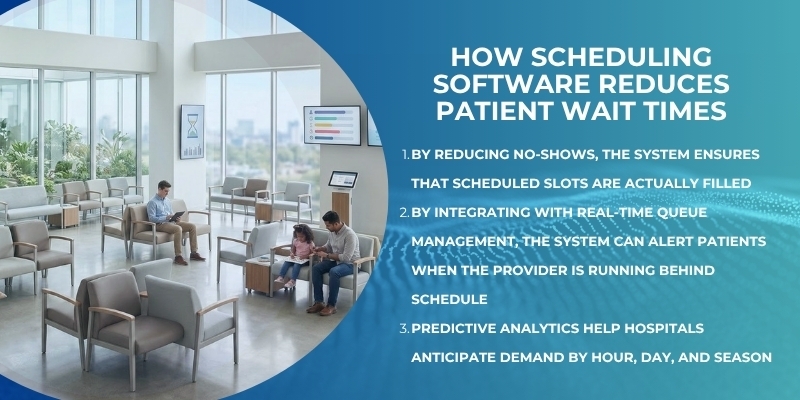
Reducing wait times requires more than simply speeding up service. It requires managing patient flow so that demand matches capacity. Hospital appointment scheduling software accomplishes this through several mechanisms.
- First, by reducing no-shows, the system ensures that scheduled slots are actually filled. Fewer empty appointments mean fewer patients waiting longer for the next available slot.
- Second, by integrating with real-time queue management, the system can alert patients when the provider is running behind schedule, allowing them to adjust their arrival time and reducing lobby congestion.
- Third, predictive analytics help hospitals anticipate demand by hour, day, and season, enabling proactive staffing rather than reactive scrambling.
The results are measurable. Practices using AI scheduling have reported zero-second wait time for inbound scheduling calls and an 89% drop in call abandonment for patient access. Urgent care online queuing has been shown to shorten waiting room times without having to reduce patient volume.
By smoothing the flow of patients across the day, scheduling software prevents the common “hurry up and wait” scenario where waiting rooms are overflowing one hour and empty the next.
Integrating Appointment Scheduling with Hospital Queue Management
The full patient journey (from pre-booking through arrival to service completion) requires integration between scheduling software and queue management systems. These two platforms must operate in tandem to deliver a seamless experience.
Consider a typical journey:
- A patient books an appointment online through the scheduling portal.
- The system reserves a time slot and sends a confirmation with check-in instructions.
- On the day of the visit, the patient arrives and checks in at a self-service kiosk.
- The kiosk, integrated with both the scheduling system and the queue management platform, retrieves the patient’s appointment record and adds them to the appropriate service queue.
- Digital signage in the waiting area displays the patient’s ticket number and estimated wait time.
- When the provider is ready, the queue system calls the patient.
- After service, the scheduling system closes the loop, updating the appointment status and potentially triggering a follow-up booking.
Without integration, this journey fractures.
- The patient might check in at the kiosk but find that their appointment is not recognised.
- They might wait in a general queue alongside walk-ins, losing their appointment priority.
- They might receive conflicting information from digital signage and SMS notifications.
Integration ensures that the patient’s experience is unified, not fragmented.
Wavetec’s customer journey management bridges appointment scheduling and queue management, creating a single, orchestrated patient flow across all touchpoints.
Hospital Digital Signage and Patient Flow Management
Digital signage is an often-overlooked but essential component of hospital flow management. Screens placed in waiting areas, corridors, and at departmental entrances serve multiple functions that support scheduling and reduce patient anxiety.
- First, appointment status boards show patients which service counter is currently being served, reducing the need for them to approach staff with “how much longer?” queries.
- Second, directional signage guides patients to the correct department or service zone, reducing confusion and missed connections.
- Third, waiting area displays can show estimated wait times by department, allowing patients to make informed decisions about whether to wait or reschedule.
When integrated with the scheduling system, digital signage can display personalised messages. A patient who checks in at a kiosk may see their name and appointment type on a nearby screen, confirming that they are in the right place.
When combined with self-service kiosks and queue management, digital signage creates a friction-free arrival and waiting experience.
Wavetec’s digital signage solutions are designed to integrate seamlessly with appointment scheduling and queue management platforms, providing real-time, accurate information to waiting patients.
Case Study – Hospital Reduces No-Shows with Smart Scheduling
Healthcare organizations struggle with missed appointments, delayed patient arrivals, and inefficient coordination between registration, triage, and consultation stages.
Traditional scheduling systems typically provide appointment confirmation but offer little visibility once the patient journey begins, increasing the risk of missed visits and operational bottlenecks.
Modern healthcare scheduling works best when appointment management, patient communication, and queue orchestration operate as a single system.
Real-time reminders, digital check-in, and automated workflow routing help patients stay informed and engaged throughout their visit, significantly reducing the likelihood of missed appointments.
Nahdi Care Clinics Improves Attendance Through Intelligent Patient Communication
Nahdi Care Clinics partnered with Wavetec to modernize patient flow and improve appointment adherence across its healthcare facilities. The organization needed a solution that could reduce waiting times, streamline patient movement between departments, and create a more connected patient experience.
Wavetec integrated its Spectra platform with Nahdi’s Hospital Information System (HIS), enabling a workflow-driven patient journey supported by WhatsApp notifications and real-time queue updates. Patients received automated messages throughout their visit, from registration and check-in through triage and doctor consultations.
Rather than relying on a single appointment reminder, the system continuously engaged patients with real-time updates about their queue position, upcoming service stage, and room assignment. This reduced uncertainty and helped patients remain connected to the care process from arrival to completion.
The workflow-based ticketing model automatically transferred patients between triage and physician consultations, ensuring that each stage of care remained coordinated without manual intervention.
Patients were guided throughout the journey and received confirmation messages once their visit was completed.
The results included reduced waiting times, improved operational efficiency, and a more organized patient experience.
By combining appointment workflows, digital communication, and real-time queue management, Nahdi Care Clinics created a healthcare environment that helped patients stay informed, arrive prepared, and complete their scheduled care journeys more reliably.
FAQs
What is hospital appointment scheduling software?
Hospital appointment scheduling software is a digital platform that automates patient booking, manages multi-department capacity, and integrates with electronic health records and queue systems. In 2026, it includes AI-powered no-show prediction, automated multi-channel reminders, and waitlist management.
How does scheduling software reduce hospital no-show rates?
By using AI to predict which appointments are at risk, triggering personalised reminders via SMS, WhatsApp, and voice, and automating waitlist fills when cancellations occur. Studies show AI-driven scheduling can reduce no-shows and recover significant lost revenue.
Can hospital scheduling software integrate with existing EHR systems?
Yes. Modern scheduling platforms are designed with APIs that allow seamless integration with major EHR systems. This ensures that appointment data flows directly into the patient record, and clinical flags can inform scheduling priority.
What reminder channels are most effective for hospital appointments?
Multi-channel reminders combining SMS, WhatsApp, email, and automated voice calls are most effective. Online booking portals and self-service kiosks also contribute to lower no-show rates. Patients who book online have been shown to miss appointments less often.
How does AI improve hospital appointment scheduling in 2026?
AI analyses historical attendance patterns, appointment type, lead time, and patient behaviour to predict no-show risk with over 87% accuracy. It then triggers targeted interventions, enables dynamic slot optimisation, and fills cancellations automatically from a prioritised waitlist.
Author Bio: This article was written by the healthcare solutions team at Wavetec, a global provider of appointment scheduling, queue management, and digital signage platforms. Wavetec has helped hospitals and healthcare systems worldwide reduce no-shows, optimise patient flow, and improve access to care.
Conclusion
In 2026, hospital appointment scheduling software has evolved far beyond simple calendar management. It is now an intelligent platform for patient access, no-show prevention, and flow optimization.
By applying machine learning to predict no-show risk, automating personalised reminders across multiple channels, and integrating seamlessly with queue management and digital signage, these systems address the core operational challenges that have plagued healthcare access for decades.
The financial impact is significant: reduced revenue loss from missed appointments, higher provider utilisation, and shorter waiting lists. But the patient impact is even greater: faster access to care, better communication, and a smoother, less stressful experience.
Wavetec’s appointment and queue management platform is purpose-built for this new era of intelligent healthcare scheduling.
BOOK A FREE DEMO