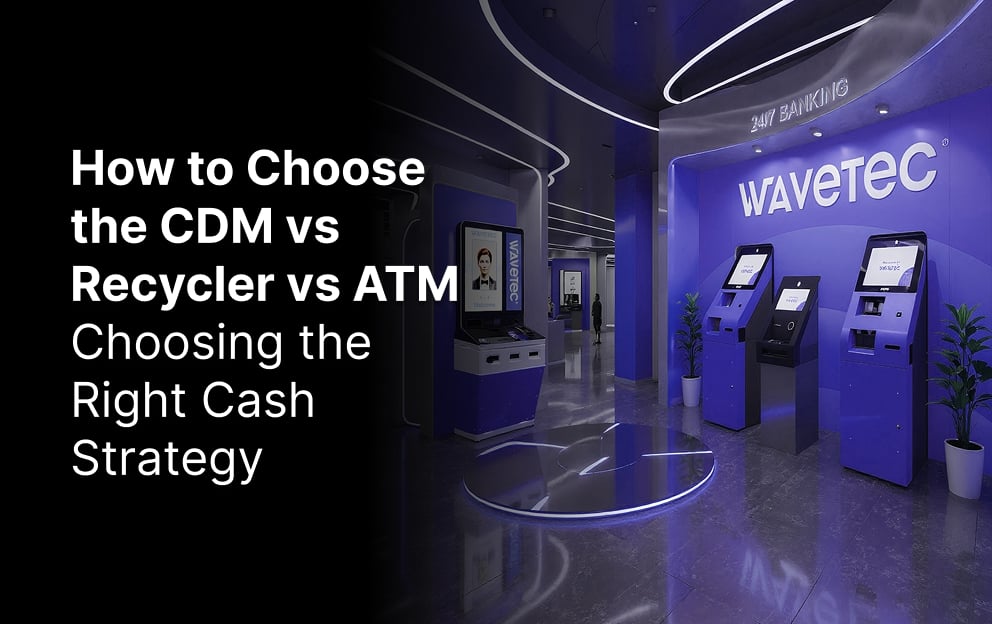
Cash Deposit Machines (CDMs) have evolved from simple cash-acceptance terminals into mission-critical branch automation infrastructure. For banks in Pakistan and across emerging markets in Africa and Asia, the decision has shifted: it is no longer about which machine accepts cash, but about which platform delivers security, uptime, regulatory compliance, and fleet-scale operational control across hundreds of branches.
Enterprise banking leaders are increasingly prioritising end-to-end reliability over upfront cost. This guide walks through every dimension you need to evaluate before signing a CDM contract, from physical peripherals to software architecture, fleet management, offline resilience, and compliance depth.
For banks evaluating self-service infrastructure, Wavetec’s CQuick Cash Deposit Machine and broader self-service kiosk solutions provide a useful reference point for how hardware, software, and operations come together in a scalable CDM ecosystem.
1. Security Hardening: The First Line of Trust
Security in a cash deposit machine must extend well beyond a physical lock and a basic login screen. For regulated environments like Pakistan, SBP certification is a baseline requirement, not a differentiator. The real benchmark is how deeply security is embedded across both hardware and software architecture.
Key Evaluation Areas
- Encrypted cash transaction flows from end to end
- Tamper detection and alerts
- Secure OS hardening and restricted access layers
- Role-based access control (RBAC) for operations teams
- Audit logs for every transaction event
For regulated environments like Pakistan, SBP compliance is a baseline requirement, not a differentiator. The real benchmark is how deeply security is embedded into both hardware and software architecture, not just certification checkboxes.
2. Peripherals: The Hidden Driver of Failure or Scale
Most cash deposit machine failures in the field are not core system failures; they are peripheral failures. The cash acceptor jams. The printer ribbon expires. A sensor drifts out of calibration. These issues account for a disproportionate share of branch downtime, yet they receive the least scrutiny during procurement.
Key Components to Evaluate
- Cash acceptor reliability and multi-denomination handling
- Note quality detection accuracy
- Printer durability and thermal consistency
- Sensor calibration stability over time
A strong CDM ecosystem ensures peripherals are:
- Modular, so they can be replaced without extended downtime
- Locally serviceable
- Standardized across the fleet for operational consistency
3. Maintainability: The Real Cost of Ownership
Upfront machine cost is a misleading metric. The real cost driver is maintenance downtime and dependency on on-site field intervention. A CDM that requires a vendor technician for every minor issue, and where that technician takes 48 hours to arrive, can destroy branch productivity faster than any technology inefficiency.
Banks should evaluate:
- Mean time to repair (MTTR)
- Spare part availability in-country
- Remote diagnostic capability
- Predictive maintenance alerts
In Pakistan, a recurring industry challenge is slow vendor support response times, which directly impacts branch productivity and customer satisfaction.
A modern CDM platform should minimize on-site dependency through:
- Remote diagnostics
- Software-based issue resolution
- Standardized maintenance workflows
For banks already working to reduce teller workload through self-service banking, CDM downtime directly undermines that strategy.
4. Fleet Management: Controlling 10 or 1000 Machines from One Layer
At scale, a cash deposit machine is no longer a device; it is a node in a distributed fleet system. This is the single dimension that most separates hardware vendors from platform providers, and it is where the operational ROI of CDM investment is realised or lost.
A strong fleet management layer should provide:
- Central configuration control, so machines can be updated remotely
- Real-time uptime monitoring
- Transaction analytics dashboards
- Remote software updates and rollback capability
- Branch-level performance benchmarking
This is where banks differentiate between hardware vendors and platform providers. A CDM fleet should connect into a central control plane that gives operations, IT, and business teams the visibility needed to manage uptime, transactions, service events, and software performance across the network.
5. Offline Mode: Business Continuity During Network Failure
In markets like Pakistan, network instability remains a practical reality in many branch locations. A cash deposit machine that simply goes offline during a connectivity drop is not branch-ready; it creates customer friction and reconciliation risk when connectivity resumes.
A CDM must support:
- Secure offline cash acceptance workflows
- Buffered transaction storage
- Automatic sync once connectivity resumes
- Fraud-safe reconciliation logic
Offline capability is not a feature; it is a business continuity requirement for branch banking resilience.
6. Certifications: Beyond Compliance, Toward Assurance
Certification is commonly treated as a procurement checkbox. The more useful question is: how does compliance translate into live operational governance? A machine can hold a certification and still lack the operational controls that make that certification meaningful in practice.
- SBP certification, mandatory in Pakistan
- ISO 27001 for information security
- SOC 2 alignment for data governance readiness
- Internal audit traceability standards
However, certification alone does not guarantee operational performance. The real question is how compliance translates into live operational governance.
7. Acceptance Tests: The Final Gate Before Deployment
Before any cash deposit machine goes live in a branch environment, it must pass structured acceptance validation. This is your final gate, and it is far more valuable to catch issues in a controlled environment than at a customer-facing branch.
- Cash acceptance accuracy under load
- Multi-user concurrency testing
- Peripheral stress testing for printers, sensors, and acceptors
- Failover and recovery scenarios
- Security penetration validation
A robust acceptance framework ensures deployment readiness is proven, not assumed.
Comparison Snapshot: What to Look For vs What Matters in Practice
Use this table as a quick reference during vendor evaluation or RFP scoring:
| Evaluation Area | Basic Expectation | Enterprise Benchmark Standard |
|---|---|---|
| Security | Encryption + login control | Full RBAC + audit + hardening |
| Fleet Management | Device monitoring | Central control + analytics + remote updates |
| Maintenance | Reactive support | Predictive + remote diagnostics |
| Offline Mode | Limited cash capture | Full secure offline + sync logic |
| Certifications | Listed compliance | Operational governance alignment |
Expert Insight
“At scale, CDM performance is not defined by the machine itself, but by how intelligently it is managed, monitored, and maintained across its lifecycle.”
— Head of Product, Cash Automation, Wavetec
Frequently Asked Questions
What is a Cash Deposit Machine (CDM), and how does it differ from an ATM?
A Cash Deposit Machine (CDM) is a self-service banking terminal purpose-built to accept and process cash deposits without teller involvement. Unlike a standard ATM, which is primarily designed for cash dispensing and account enquiries, a CDM is optimised for cash intake, real-time crediting, receipt printing, and audit trail generation. Many CDMs also support cardless deposits, multi-denomination handling, and integration with core banking systems.
What certifications should a CDM have for deployment in Pakistan?
For deployment in Pakistan, a CDM must hold SBP certification as a baseline requirement. Beyond this, enterprise buyers should look for ISO 27001 alignment for information security, SOC 2 readiness for data governance, and evidence of internal audit traceability that supports regulatory reporting.
What is offline mode in a CDM, and why does it matter?
Offline mode is the capability of a cash deposit machine to continue accepting and securely storing cash transactions when network connectivity is unavailable. Transactions are buffered in an encrypted local store and automatically synchronised with fraud-safe reconciliation logic once connectivity resumes. In markets with unreliable network infrastructure, offline mode is a critical business continuity requirement, not an optional feature.
How should banks evaluate CDM fleet management capabilities?
Banks should look for a centralised control plane that enables remote configuration, real-time uptime monitoring, over-the-air software updates, and branch-level transaction analytics from a single dashboard. The ability to push updates and roll back software remotely without site visits is the key differentiator between a hardware vendor and a true platform provider.
What is the true cost of ownership for a CDM fleet?
The true cost of CDM ownership extends well beyond the upfront hardware price. The primary cost drivers are unplanned downtime, field intervention frequency, spare parts availability, and software update management. Vendors should be assessed on Mean Time to Repair (MTTR), remote resolution rates, and in-country service infrastructure.
Conclusion: CDM Evaluation Is a Branch Transformation Decision
For banking leaders in Pakistan and across emerging markets, selecting a cash deposit machine is no longer a procurement exercise; it is a branch transformation decision. The platforms that deliver long-term operational value are those that combine:
- Secure, compliant hardware architecture
- An intelligent, remotely manageable software layer
- Fleet-scale operational control and analytics
- Resilient offline capability built in from the ground up
- Responsive local service infrastructure with low MTTR
Wavetec’s CQuick CDM platform is built specifically for high-volume branch banking environments in markets like Pakistan, with SBP certification, end-to-end encryption, fleet management dashboards, and cardless deposit support.
If you are evaluating CDM platforms for your branch network or planning a large-scale rollout, speak to our experts to understand deployment architecture, operational benchmarks, and lifecycle performance in real banking environments.
Author: Clinton John, Asistant Brand Manager – Wavetec
BOOK A FREE DEMO