When an ESG audit begins, it usually starts with confidence. Policies are documented, sustainability goals are defined, and commitments are clearly stated.
The challenge arises when auditors request evidence demonstrating how environmental care, service fairness, and governance controls operate within daily workflows. At that point, many organizations discover gaps between what is promised and what can be proven.
This pressure is increasing. Global ESG regulations are becoming more detailed, investor scrutiny is intensifying, and stakeholders expect transparency grounded in day-to-day operations.
Yet ESG reporting often depends on fragmented systems, manual inputs, and historical data that cannot keep pace with real operational activity.
Queue data introduces a different approach. Generated from customer flows, service interactions, and digital engagement pathways, it records operational activity in real time.
This article explores how queue data enhances ESG audits by improving compliance reporting, increasing transparency, advancing social impact metrics, and supporting sustainability goals.
What Are ESG Audits and Why Accurate Data Matters
ESG audits are formal reviews that assess whether an organization’s environmental, social, and governance disclosures align with regulatory requirements, investor expectations, and recognized reporting frameworks.
As ESG oversight expands across regions and industries, organizations must submit disclosures traceable to consistent, well-documented data sources.
The outcome of an ESG audit is closely tied to how data is collected and maintained over time. Auditors assess the consistency of metrics across reporting periods, the level of operational detail available, and the clarity of documentation used to support disclosures.
Recent industry research shows that 76% of executives identify data quality as a leading challenge in ESG reporting, while fragmented systems and manual workflows continue to slow audit readiness and increase compliance risk exposure.
Operational queue data for ESG audits addresses many of these limitations by introducing structured records directly tied to service activity.
Rather than relying only on periodic summaries or disconnected datasets, organizations can reference continuous operational data that connects daily service behavior with ESG reporting and compliance requirements.
What is Queue Data?
Queue data refers to information generated as people move through a service environment. It includes customer interactions, footfall patterns, service wait times, digital queueing journeys, appointment flows, and workflow movement across service touchpoints.
Together, these data points describe how demand enters a service system, how it progresses, and how operational capacity is used over time.
Because this information is continuously generated by live service activity, it provides a reliable, real-time view of behavioral and operational patterns.
Collected through queue management systems, kiosks, appointment platforms, sensors, and ticketing systems, queue data is used in ESG audits to link day-to-day service activity with environmental, social, and governance reporting.
It allows organizations to connect operational behavior to areas such as resource use, service accessibility, and oversight without relying on manual reporting or periodic snapshots.
How Queue Data Supports ESG Audits and Compliance Reporting?
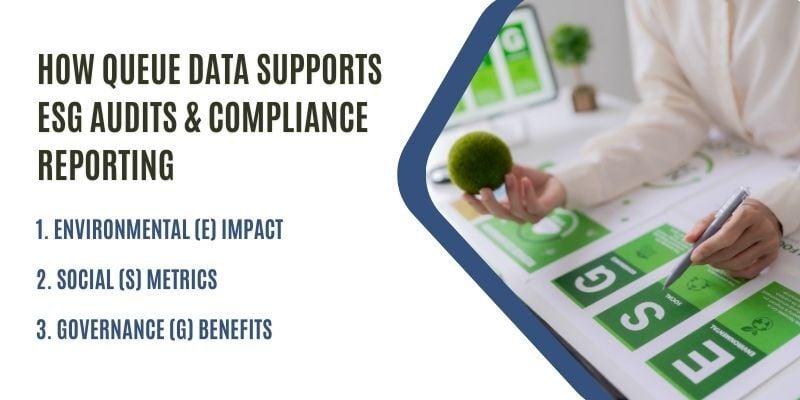
Queue data connects service operations to environmental efficiency, social responsibility, and governance controls in a way that traditional ESG datasets often struggle to achieve.
Rather than relying on periodic summaries or indirect indicators, organizations can reference operational records generated through everyday service delivery.
This grounds ESG reporting in observable service activity across all three pillars.
1. Environmental (E) Impact
Queue data helps organizations understand how service demand influences energy use and resource allocation throughout the day.
Footfall trends and service volumes show peak and low-activity periods, making it easier to identify operational bottlenecks connected to wasted energy and inefficient space utilization.
These patterns inform adjustments to HVAC systems, lighting schedules, and staffing levels based on actual demand.
This focus is especially relevant given that, according to the International Energy Agency, building operations account for around 30% of global final energy consumption and 26% of energy-related emissions.
In addition, digital queueing reduces reliance on paper tickets and printed materials, reinforcing waste-reduction efforts and providing queue data insights for sustainability reporting.
2. Social (S) Metrics
Queue data provides visibility into the social conditions created by service delivery. Indicators such as wait times, congestion levels, and service distribution show how fairly services are delivered across different groups.
Accessibility patterns can indicate whether certain populations experience longer delays or limited access, while employee-facing data shows how workloads shift during high-demand periods.
Real-time visibility supports safer service environments, more balanced workloads, and more equitable service delivery without depending solely on surveys or subjective feedback.
3. Governance (G) Benefits
Queue data reinforces governance practices by producing objective, time-stamped records of service activity.
Automated service logs document when interactions occur, how long they last, and how demand is handled across channels. This reduces dependence on manual reporting and lowers the likelihood of inconsistencies during audits.
Governance frameworks are strengthened when organizations rely on automated, tamper-resistant data sources that support oversight, accountability, and consistent compliance reporting.
Key Technologies That Make Queue Data Usable for ESG
Several technologies make queue data suitable for ESG audits by converting day-to-day service activity into structured, reviewable records. Queue management systems (QMS) record arrivals, wait times, service durations, and channel usage in a consistent format.
IoT sensors and footfall analytics add location-based counts and movement patterns, allowing organizations to track demand across spaces and time periods.
Digital kiosks and self-service platforms generate interaction data from check-ins, ticketing, and guided workflows while reducing reliance on paper-based processes.
On the analytics side, AI and machine learning models analyze large volumes of queue data to identify irregular patterns such as unexpected congestion, service delays, or deviations from normal operating ranges.
Cloud-based data warehousing brings these data streams together across locations, preserves historical records, and maintains version control for audit review.
When connected with ESG audit platforms, these technologies support continuous data flow into reporting processes, allowing organizations to maintain oversight, traceability, and audit readiness without manual consolidation.
Practical Ways Queue Data Improves ESG Compliance
Queue data is most valuable when applied directly to compliance workflows. Organizations can begin by measuring people flow and service distribution in real time across locations, creating a consistent view of how services operate during peak and low-demand periods.
This helps teams identify congestion risks, service imbalances, and operational pressure points before they affect compliance outcomes.
Another practical step is tracking ESG-related KPIs tied to service delivery, such as accessibility performance, service fairness, and customer wait times.
When monitored continuously, queue data metrics for ESG performance reduce reliance on periodic surveys or manual records and create a direct link between service behavior and reported outcomes.
Queue data also informs resource allocation decisions. Footfall and demand patterns guide adjustments to staffing, space usage, and energy consumption, helping organizations reduce waste while maintaining service standards.
During audits, automated logs and real-time dashboards provide time-stamped evidence of how controls operate in practice.
Many organizations rely on integrated queue management and analytics platforms from providers such as Wavetec to centralize service metrics across locations and maintain audit-ready visibility for ESG reporting.
6 Best Practices for Using Queue Data in ESG Reporting
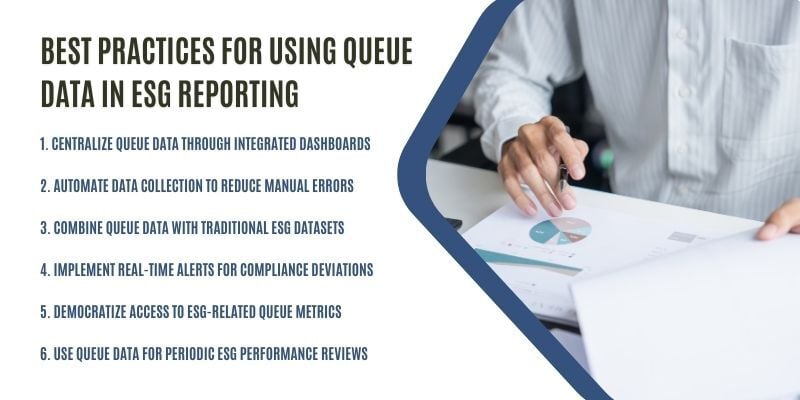
To use queue data effectively in ESG disclosures, organizations need disciplined operational practices rather than ad hoc reporting approaches.
The following best practices focus on how queue data should be structured, governed, and reviewed to maintain consistency, audit readiness, and long-term reporting integrity.
Each practice addresses a specific point where ESG reporting commonly breaks down during implementation.
1. Centralize Queue Data through Integrated Dashboards
Effective ESG reporting depends on consistent access to operational activity across locations. Organizations should centralize queue data within an integrated analytics dashboard to reduce fragmentation between departments and reporting cycles.
Centralization ensures that ESG disclosures can be traced back to the same operational records during audits and internal reviews.
2. Automate Data Collection to Reduce Manual Errors
Manual data handling introduces inconsistencies and increases audit risk. Automating the collection of queue data helps ensure consistent processes for generating, storing, and reviewing records over time.
Automated capture also ensures that time-stamped data remains complete across reporting periods.
3. Combine Queue Data with Traditional ESG Datasets
Queue data should be used alongside existing environmental, workforce, and governance datasets rather than in isolation.
Integrating these data sources allows organizations to place service activity alongside established ESG indicators, resulting in disclosures that reflect both operational behavior and formal reporting requirements.
4. Implement Real-Time Alerts for Compliance Deviations
Real-time alerts help organizations respond when operational conditions approach compliance thresholds. Alerts linked to congestion levels, extended wait times, or service imbalances allow teams to intervene early, reducing the likelihood of audit findings tied to service disruptions or access issues.
5. Democratize Access to ESG-Related Queue Metrics
ESG-related queue data should not be limited to compliance teams. Providing operational leaders, facilities teams, and service managers with access to relevant metrics promotes shared accountability and integrates ESG considerations into daily operational decisions.
6. Use Queue Data for Periodic ESG Performance Reviews
Regular reviews of queue data help organizations identify trends in service delivery, accessibility, and resource use over time.
These reviews allow teams to evaluate progress against ESG objectives using observed operational patterns rather than relying on retrospective summaries.
5 Challenges in Leveraging Queue Data for ESG Compliance
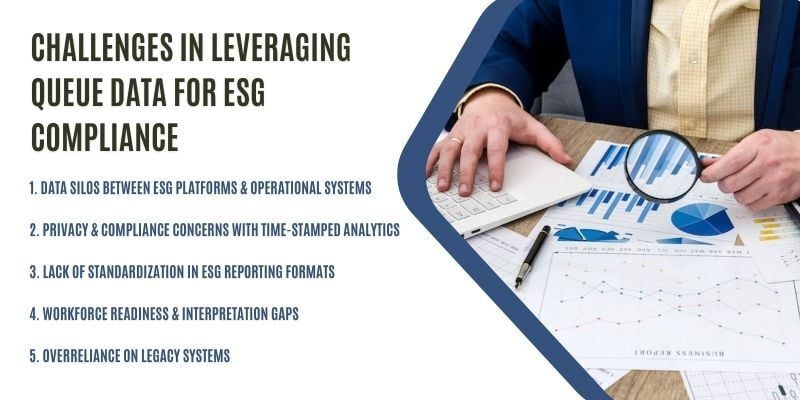
Despite the value that queue data can bring to ESG compliance, organizations often encounter structural and organizational barriers when integrating operational data into formal reporting frameworks.
Audit preparedness remains limited across many industries. A KPMG survey found that only 29% of companies feel ready for independent ESG data assurance, pointing to gaps in how ESG data is collected, validated, and maintained for audit review.
These challenges typically arise during implementation rather than at the strategy level:
1. Data Silos between ESG Platforms and Operational Systems
Data silos remain a persistent barrier when integrating queue data into ESG reporting workflows. When operational systems and ESG platforms operate independently, organizations face reconciliation challenges that complicate audit preparation and increase reporting risk.
Differences in data ownership, reporting cycles, and system architectures often make it difficult to maintain consistent ESG disclosures.
Without integrated data flows, queue-based metrics require additional validation and manual intervention before they can be used confidently in compliance reporting.
2. Privacy and Compliance Concerns With Time-Stamped Analytics
Queue data often includes time-stamped and location-based information, which introduces privacy and regulatory considerations. Organizations must ensure that queue analytics comply with applicable data protection laws and internal governance standards.
Without clear policies around anonymization, retention, and access controls, privacy concerns can limit how queue data is used in ESG disclosures.
3. Lack of Standardization in ESG Reporting Formats
The absence of uniform ESG reporting standards presents another challenge. Organizations frequently report against multiple frameworks, each with distinct data definitions and disclosure expectations.
Mapping queue data to these varying formats requires additional interpretation and alignment, increasing reporting complexity and manual effort.
4. Workforce Readiness and Interpretation Gaps
Queue-based ESG metrics introduce operational indicators that many sustainability and compliance teams are not trained to interpret.
Without sufficient guidance, teams may struggle to understand demand patterns, service variability, or congestion data in an ESG context.
Workforce readiness becomes essential to ensure consistent interpretation and responsible use of queue data in reporting.
5. Overreliance on Legacy Systems
Legacy systems can limit an organization’s ability to integrate queue data into ESG workflows. Older infrastructure often lacks support for real-time data ingestion, automated analytics, or system interoperability.
This reliance can slow modernization efforts and restrict how effectively queue data is incorporated into compliance processes.
The Future of Queue Data in ESG and Sustainability
ESG reporting is moving toward continuous oversight as regulators and stakeholders place greater emphasis on timely evidence of operational performance. This direction favors data that originates directly from daily service activity rather than periodic summaries.
Queue data meets this requirement by showing how people move through services, how demand fluctuates, and where operational pressure builds, providing organizations with a consistent operational reference point between formal disclosure cycles.
As analytical methods mature, queue data is also used to anticipate operational conditions rather than only describe them after the fact.
Patterns in service demand, congestion, and wait times inform predictive models that help organizations prepare for resource strain, service imbalance, or access issues before they affect compliance outcomes.
When queue management systems already track customer flow across physical and digital environments, this operational data becomes a practical input into forward-looking ESG planning.
Physical infrastructure is increasingly integrated with ESG oversight through smart building strategies and digital twins.
By combining queue data with energy, occupancy, and environmental sensors, digital twins create a live operational representation of service environments.
A practical example is Wavetec’s implementation for the Emirates Identity Authority (EIDA) in the UAE. Serving over nine million residents across 70+ service centers, EIDA used Wavetec’s queue management system to monitor footfall, wait times, and service distribution in real time.
This data allowed the authority to anticipate peak periods, optimize staffing, reduce congestion, and ensure equitable service delivery, generating operational evidence that can directly support ESG and compliance reporting.
Organizations that manage customer flow and service demand through queue management systems maintain detailed operational visibility.
This same data can be applied to ESG and sustainability reporting, connecting service behavior with environmental efficiency, accessibility, and governance oversight.
Frequently Asked Questions (FAQs)
How does queue data improve ESG reporting accuracy?
Queue data is generated automatically during service activity, reducing reliance on manual inputs and retrospective estimates. This creates consistent, time-stamped records that auditors can trace back to actual operations.
What types of ESG metrics can queue data support?
Queue data supports metrics related to service access, wait times, congestion levels, space utilization, and demand patterns. These indicators map naturally to environmental efficiency, social fairness, and governance oversight.
Can queue data help with real-time compliance monitoring?
Yes. Because queue data is recorded continuously, it allows organizations to observe operational conditions as they occur and identify potential compliance issues before formal reporting cycles.
How does queue data contribute to better social impact reporting?
Queue data shows how services are delivered across different groups by revealing delays, crowding, and access patterns. This helps organizations assess service equity using observed behavior rather than survey-based assumptions.
Which industries benefit most from queue data for ESG audits?
Industries with high customer flow and regulated service environments benefit most, including healthcare, government services, transportation, banking, retail, and large public facilities. These sectors already rely on queue analytics for ESG reporting to connect service delivery with compliance requirements.
Conclusion
Queue data strengthens ESG audits and compliance reporting by grounding disclosures in everyday service activity rather than fragmented records or retrospective summaries.
By referencing operational data generated during service delivery, organizations gain direct evidence of how environmental efficiency, service equity, and governance controls function in practice.
This method delivers value across Environmental, Social, and Governance pillars while helping organizations maintain visibility between reporting cycles.
As ESG expectations continue to rise, integrating real-time operational data into ESG and sustainability frameworks helps maintain audit readiness, transparency, and long-term compliance resilience.
Organizations using queue management systems, such as those offered by Wavetec, can turn everyday operational insights into structured, audit-ready evidence, making ESG reporting more accurate, timely, and actionable.
BOOK A FREE DEMO