In a world defined by instant access and on-demand services, patience has become one of the most limited customer resources. A delayed order, an unanswered service call, or a long queue is no longer treated as a small inconvenience.
Instead, it is often taken as an indication that a business is falling short of customer expectations. This reality has brought customer patience in business into sharper focus as a factor that directly influences competitive performance.
Today’s customers expect speed, transparency, and low-friction experiences at every touchpoint. At the same time, delays remain unavoidable across industries such as retail, healthcare, banking, hospitality, and telecom, where operational complexity and fluctuating demand are constant challenges.
The difference between brands that frustrate customers and those that retain them lies in how effectively these waiting moments are managed.
Businesses that design more thoughtful and responsive experiences are better positioned to maintain trust, reduce frustration, and outperform competitors in loyalty, satisfaction, and lifetime value.
This blog explores the psychology of wait times, the connection between patience and loyalty, industry-specific examples, and practical strategies organizations can use to turn wait-time management into a lasting competitive advantage.
What is Customer Patience in Modern Customer Experience?
Customer patience in modern customer experience refers to the level of tolerance customers have for delays, waiting periods, or slower service during an interaction. It is influenced less by the length of the wait and more by how manageable the experience feels while time passes.
Unlike satisfaction, which is assessed after an interaction, or loyalty, which develops over time, patience operates in the moment.
Experiences designed around customer effort and frustration reduction make it easier for customers to remain engaged even when resolution is not immediate.
As on-demand access and instant fulfillment increasingly influence consumer behavior, expectations around time continue to tighten.
Customers are more aware of inefficiencies and less accepting of unclear processes, particularly when progress is not visible. This makes perceived waiting more influential than the actual duration.
When customers understand what is happening and feel their time is being respected, tolerance increases. When uncertainty dominates, even brief waits can feel excessive.
Why Customer Experience is the New Competitive Advantage
As products, pricing, and service models become easier to replicate, customer experience has become the primary space where brands differentiate themselves.
In this context, patience is a key advantage because it determines whether customers remain engaged when interactions take longer or require additional effort. This matters more than ever as expectations rise and tolerance for friction narrows.
High levels of customer patience are closely connected to stronger Net Promoter Scores, lower churn, and emotionally grounded loyalty.
Research shows that over 50 percent of customers will switch to a competitor after a single negative experience, leaving brands with little room to recover once frustration sets in.
When patience is preserved, customers are more likely to remain open, cooperative, and receptive during problem resolution, even when outcomes are not immediate.
Experience is where loyalty is decided long before an issue is fully resolved. Customers increasingly judge brands by how they are treated while waiting, not just by the final outcome.
Companies that maintain patience gain valuable time to resolve issues effectively, deliver consistent quality, and reduce frustration. Those that fail to do so often lose customers before recovery is possible.
The Psychology Behind Customer Patience and Wait-Time Tolerance
Customer patience is strongly influenced by how the brain interprets time and control during a service interaction. One of the most significant factors is the gap between perceived and actual wait times.
When customers feel uncertain or uninformed, even short delays can feel much longer. Clearly communicated average wait times give customers a reference point that helps them understand the delay and stay calmer throughout the experience.
Expectation management also affects tolerance, as unexpected delays tend to trigger stronger negative reactions than delays customers are prepared for.
Uncertainty increases frustration thresholds by adding mental strain. When customers are forced to guess what will happen next or repeatedly seek updates, emotional pressure rises quickly.
Emotional states such as stress, anxiety, or urgency reduce patience, while predictability and structure help lower cognitive load. Experiences designed with transparency and clear progress signals make waiting feel more controlled and less overwhelming.
These psychological responses influence the behavioral drivers of customer loyalty. Customers who feel emotionally supported during waiting moments are more likely to remember the experience positively.
Those memories affect future decisions, including whether customers return, remain engaged, or recommend the brand to others.
How Customer Patience Influences Trust, Loyalty, and Brand Perception?
Customer patience influences how trust and satisfaction develop during service interactions. When experiences feel predictable and transparent, customers are more likely to view a brand as reliable and considerate.
Clear communication, visible progress, and acknowledgment during waiting moments help customers feel valued rather than ignored.
This matters because experience increasingly guides decision-making: 73% of customers say customer experience is a key factor in their purchasing decisions. When waiting moments are handled well, they strengthen confidence rather than weaken it.
In industries where long waits are common, such as healthcare, travel, and banking, patience has an even greater influence on loyalty and brand perception.
Appointment delays, service disruptions, and verification processes are often unavoidable, but how they are handled shapes long-term customer perceptions.
Brands that manage waiting well reduce frustration and create positive service impressions that support retention. When patience breaks down, customers often disengage before the service outcome has a chance to matter.
Industries Where Customer Patience Creates a Clear Competitive Edge
Customer patience is especially influential in industries where waiting is a regular part of service delivery. While delays cannot always be avoided, how they are handled often sets preferred brands apart from the rest.
- Healthcare: Appointment overruns and emergency room delays are common, but patient confidence depends on how clearly those delays are explained. Providers who offer updates, guidance, and reassurance help patients stay calm and informed during extended waits.
- Retail: Checkout lines and online order fulfillment delays frequently test tolerance, particularly during high-demand periods. Retailers that communicate timing clearly and provide order visibility help prevent frustration and purchase abandonment.
- Hospitality: Check-in delays and dining waits influence early impressions. Hotels and restaurants that manage these moments thoughtfully create a sense of organization and care, even when service takes longer than expected.
- Telecom: Service calls and troubleshooting processes often involve extended interactions. Providers that structure these journeys clearly and keep customers informed reduce uncertainty during complex resolutions.
- Banking: Branch queues and identity verification steps are unavoidable in many situations. Financial institutions that handle these interactions with clarity and pacing stand out by reducing wait-related dissatisfaction during sensitive moments.
Across these industries, competitive advantage comes from managing delays better than competitors do, not from eliminating them entirely. Brands that respect customers’ time and maintain consistency throughout the waiting experience earn greater preference and trust.
7 Strategies Businesses Can Use to Increase Customer Patience
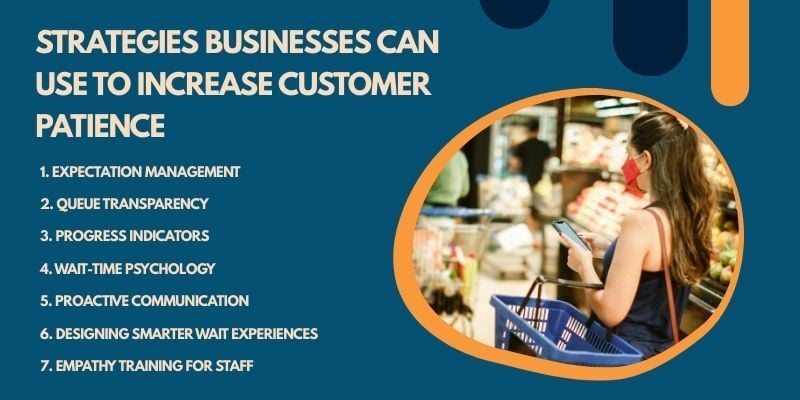
Businesses can actively improve customer patience by designing waiting experiences that feel structured, informed, and intentional. The most effective approaches focus on removing confusion and guiding customers through delays in a way that feels controlled and respectful.
1. Expectation Management
Setting clear expectations upfront gives customers a reference point for what lies ahead. When customers know how long a process may take, they are less likely to feel caught off guard or misled.
Clear timelines also reduce the emotional impact of delays by aligning perception with reality. Even when waits are longer than ideal, predictability helps customers stay engaged rather than frustrated.
2. Queue Transparency
Visibility into the queue reassures customers that the system is functioning fairly. Real-time updates via SMS, digital displays, or apps reduce anxiety by showing progress.
Transparency also minimizes repeated inquiries, allowing customers to focus on waiting rather than chasing information. When customers can see where they stand, uncertainty decreases significantly.
3. Progress Indicators
Progress indicators give customers a sense of movement, even when advancement is slow. Position-in-line updates or estimated time remaining help customers feel that their wait has purpose.
These signals reduce the mental strain of wondering when service will begin. Clear indicators also prevent time from feeling wasted or unaccounted for.
4. Wait-Time Psychology
Idle waiting often feels longer than purposeful waiting. Simple engagement, such as guided steps, short tasks, or contextual information, makes time feel more productive.
When customers are mentally occupied, attention shifts away from the clock. This subtle shift can significantly improve tolerance without changing actual service speed.
5. Proactive Communication
Silence during delays often leads customers to assume the worst. Brief updates, acknowledgments, or apologies signal that the situation is being actively managed.
Proactive communication also demonstrates accountability and care. When customers feel acknowledged, frustration is less likely to escalate into dissatisfaction.
6. Designing Smarter Wait Experiences
Well-designed waiting environments support patience by offering customers choices. Self-service options, digital check-ins, and light diversions help customers use their time more productively.
These experiences reduce perceived effort and create a sense of agency. When customers feel in control, waiting becomes easier to tolerate.
7. Empathy Training for Staff
Frontline interactions significantly affect emotional responses during delays. Staff trained to listen, acknowledge concerns, and respond calmly can quickly ease tension.
A composed tone and genuine understanding often matter more than speed. Human connection remains one of the most effective tools for maintaining patience.
Together, these strategies turn waiting into a managed part of the experience rather than a point of friction. When applied consistently, they support calmer interactions, smoother operations, and stronger customer relationships, even when immediate service is not possible.
The Role of Technology in Extending Customer Patience
Technology helps organizations manage waiting moments with greater consistency and clarity. When designed around visibility and guidance, digital capabilities make delays easier for customers to tolerate by reducing guesswork and keeping interactions structured.
The objective is not to make every service instant, but to ensure customers always understand what is happening and what to expect next.
Queue management systems bring order and fairness to service flows by organizing demand and clarifying service progression. Self-service kiosks allow customers to check in, complete simple tasks, or access information independently, lowering perceived effort during waits.
Automated updates delivered through SMS, email, or mobile apps keep customers informed without requiring repeated follow-ups. Real-time service dashboards enhance transparency by providing staff and managers with a clear view of queues, wait times, and service status.
Together, these capabilities reduce friction by replacing uncertainty with structure and reassurance. Offerings from Wavetec bring together queue management, self-service kiosks, automated customer communications, and real-time visibility into a cohesive service experience.
When applied thoughtfully, technology helps organizations maintain customer patience across physical and digital touchpoints, even when delays cannot be avoided.
Customer Patience vs. Customer Speed
Many organizations still pursue a speed-first approach, assuming that faster service automatically leads to better customer outcomes. While speed remains important, it does not consistently determine how customers feel about an interaction.
Research from Forrester shows that brands that strengthen both customer experience and brand experience together achieve up to 3.5 times higher revenue growth, reinforcing that emotional experience and consistency matter as much as operational performance.
When expectations are unclear or communication breaks down, even quick service can feel rushed, impersonal, or confusing.
A patience-first approach places greater emphasis on clarity, acknowledgment, and guidance during the interaction, which often results in more positive experiences even when service takes longer than expected.
Effective brands recognize that satisfaction is influenced by how customers experience time, not only by how quickly tasks are completed. Clear explanations, timely updates, and visible progress help customers feel respected and informed throughout the interaction.
This is where emotional intelligence in customer service becomes essential, as teams that recognize emotional cues and respond with empathy create interactions that feel human rather than purely transactional.
Achieving the right balance between speed and patience requires aligning operational efficiency with emotional experience. Efficiency keeps processes moving, but patience-focused design keeps customers comfortable when delays occur.
Brands that manage this balance well focus on the full customer journey, understanding that service quality is defined not just by resolution time, but by how customers are treated at every stage of the experience.
How Leading Brands Turn Patience into a Competitive Weapon?
Leading organizations have found ways to use waiting moments as opportunities to improve customer satisfaction and build loyalty, turning what could be a source of frustration into a differentiator in competitive markets.
Theme Parks and Entertainment Experiences
In the theme park industry, companies like Disney Parks have long used virtual queueing systems to improve the guest experience.
By allowing visitors to join a queue electronically and enjoy other attractions or amenities while they wait, parks reduce the time guests spend standing in lines and increase overall enjoyment of the visit.
These systems help visitors feel in control of their day and less focused on wait times, thereby enhancing satisfaction and encouraging repeat visits.
Healthcare and High-Volume Public Services
During periods of heavy demand, healthcare providers rely on structure and communication to keep patients informed.
At the AlMoosa Covid-19 Vaccination Centre in Saudi Arabia, structured queue flows, digital ticketing, and clear service progression helped manage high visitor volumes while maintaining calm and order.
Solutions delivered by Wavetec organized patient movement and provided visibility at each stage, making long waits more predictable and easier to tolerate.
Retail and In-Store Shopping Journeys
Retailers also use queue design to improve the in-store experience. In Spain, a large supermarket chain, Consum, implemented digital queue management at fresh food counters, allowing shoppers to take a ticket and continue browsing while waiting.
Real-time queue displays and self-service entry reduced perceived waiting and walkaways. This approach, implemented using Wavetec’s queue management and customer communication capabilities, helped customers feel in control of their time while keeping service areas orderly.
Airlines and Travel Operations
Airlines regularly face disruptions such as weather delays or air traffic control constraints, making clear communication essential.
Many leading carriers rely on mobile notifications and real-time updates for gate changes, boarding, and delays to keep passengers informed throughout their journey.
For example, Alaska Airlines reports that more than two-thirds of its active app users opt in for day-of-travel notifications, including check-in reminders and flight status alerts, helping travelers stay updated throughout their journey and reducing anxiety caused by uncertainty.
6 Challenges Businesses Face When Managing Customer Patience
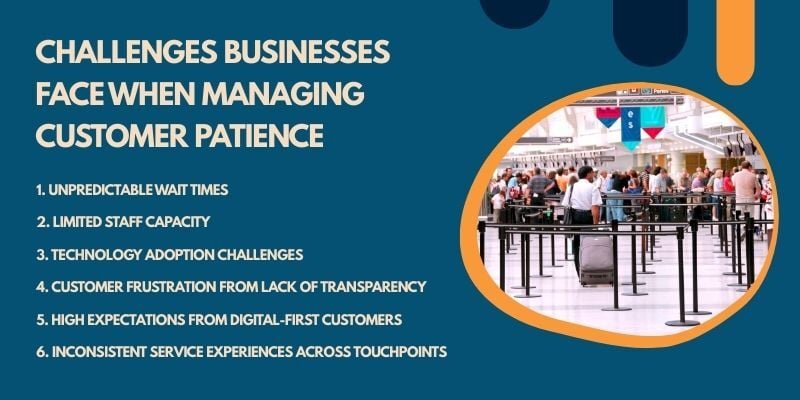
Here are a few challenges businesses commonly face when managing customer patience during wait times:
- Unpredictable wait times: Fluctuating demand, service interruptions, or external factors often make it difficult to provide accurate time estimates. When actual wait times change unexpectedly, customers may feel misled, even when delays are unavoidable.
- Limited staff capacity: During peak periods or staffing shortages, teams are often stretched thin. This can limit their ability to communicate clearly with customers while managing service delivery, increasing frustration during longer waits.
- Technology adoption challenges: Introducing new systems can be complex, especially when tools are not fully integrated or when staff are not adequately trained. Partial adoption may result in inconsistent information rather than improved visibility.
- Customer frustration from lack of transparency: When customers cannot see where they stand or understand why delays are happening, uncertainty quickly builds. Without clear updates, waiting feels longer and more stressful.
- High expectations from digital-first customers: Many customers are accustomed to real-time updates and seamless experiences in other areas of their lives. When service interactions fall short of these expectations, tolerance for delays decreases.
- Inconsistent service experiences across touchpoints: Differences between online, in-person, and mobile interactions can create confusion. Conflicting information across channels often undermines trust and makes waiting harder to accept.
These challenges highlight why managing customer patience requires coordination across operations, communication, and experience design, rather than isolated improvements.
7 Best Practices for Building a Patience-Optimized Customer Journey
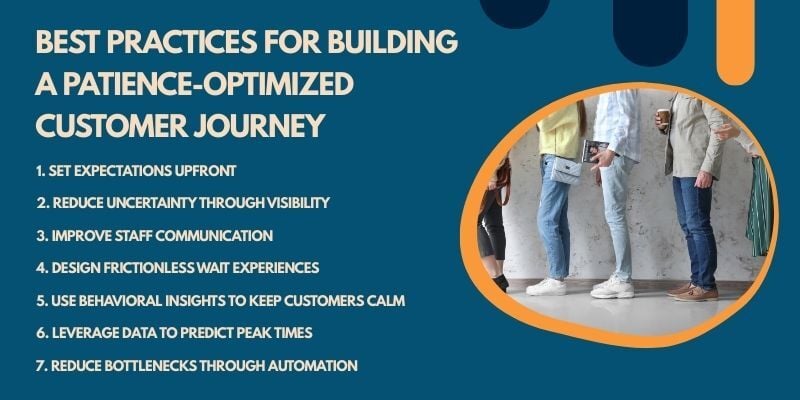
Building a patience-optimized customer journey requires treating waiting as a designed experience rather than an operational side effect. The following best practices focus on consistency, foresight, and coordination across the entire service lifecycle.
- Set expectations upfront: Customers respond better when they know what lies ahead before delays occur. Clearly outlining steps, timelines, and potential wait points at the start of the journey establishes trust and prevents negative reactions later.
- Reduce uncertainty through visibility: Visibility into status, position, or progress helps customers feel oriented and informed. When people understand where they are in a process, waiting feels intentional rather than arbitrary.
- Improve staff communication: Clear, confident communication from frontline teams reinforces calm during delays. Training staff to explain situations simply and consistently helps align customer understanding with operational reality.
- Design frictionless wait experiences: Waiting should fit naturally into the overall journey. Removing unnecessary steps, simplifying interactions, and offering choice during idle moments make waiting less intrusive and easier to accept.
- Use behavioral insights to keep customers calm: Understanding how customers perceive time, fairness, and control allows organizations to design experiences that reduce stress. Small cues, structure, and reassurance can significantly improve emotional responses.
- Leverage data to predict peak times: Historical patterns and real-time data help organizations anticipate demand surges. Planning around these insights allows teams to prepare communication, staffing, and service flow before pressure builds.
- Reduce bottlenecks through automation: Automating repetitive or administrative steps frees up staff for customer-facing interactions. Streamlined processes reduce congestion and help maintain steady service progression during busy periods.
When applied together, these practices create a journey where waiting feels managed, transparent, and respectful. The result is a more consistent experience that protects customer patience and supports long-term loyalty, even when delays are unavoidable.
Frequently Asked Questions (FAQs)
Why is customer patience so important today?
Customer patience has become more limited as expectations for immediacy and convenience continue to rise. When patience breaks down, customers are more likely to disengage quickly, making it a key factor in experience quality and retention.
How does wait-time transparency improve customer patience?
Transparency reduces uncertainty by helping customers understand what is happening and what comes next. When people have clear context around delays, they are more likely to remain calm and cooperative throughout the interaction.
Which industries benefit most from improving customer patience?
Industries with complex services or frequent delays, such as healthcare, retail, banking, hospitality, and travel, see the greatest impact. In these settings, effective wait management directly influences trust and repeat engagement.
What tools help businesses reduce perceived wait times?
Queue visibility, automated notifications, self-service options, and real-time status updates all help reduce perceived waiting. These tools shift attention away from waiting time and create a more structured experience.
How does customer patience impact loyalty and lifetime value?
When customers feel respected during delays, they are more likely to maintain a positive impression of the brand. Over time, this supports stronger loyalty, repeat interactions, and higher lifetime value.
Conclusion
Customer patience has become a competitive advantage as service expectations continue to rise across digital and physical channels. When waiting is handled with care, it shapes how customers judge reliability, fairness, and overall experience.
Organizations succeed by reducing friction, managing expectations, and designing wait experiences that feel intentional rather than focusing only on speed. Behavioral insight, proactive communication, and technology each help make delays easier to accept.
Businesses that commit to building patience across the customer journey can strengthen loyalty, support retention, and sustain long-term growth.
BOOK A FREE DEMO