McDonald’s self ordering kiosks have reshaped how customers place orders in fast-food restaurants by offering faster service, improved accuracy, and greater convenience. As demand grows for restaurant self-service technology and digital-first ordering experiences, McDonald’s has implemented self-service kiosks technology to streamline in-store operations and improve order accuracy.
This article explores how McDonald’s self-ordering kiosks support operational efficiency, enhance the customer experience, and what other fast-food brands can learn when adopting self-service ordering technology at scale.
- In this blog, we are going to cover the top user-friendly features offered by McDonald’s self-service kiosks and how they enhance the overall customer experience;
Why McDonald’s Invested in Self-Service Technologies
McDonald’s invested in self-service technologies to address growing challenges in fast-food operations, including rising labor costs, increasing order volumes, and customer expectations for faster, more personalized service. By adopting self-service kiosks, McDonald’s reduced pressure on front-counter staff while improving order accuracy and speed during peak hours.
These technologies play a key role in customer experience solutions for QSR restaurants, allowing customers to customise orders, navigate digital menus easily, and complete transactions with minimal friction. Self-service systems also support restaurant automation by integrating with point-of-sale and kitchen workflows, enabling smoother order processing. For McDonald’s, scalable customer self-service technology became a strategic way to enhance efficiency while delivering a consistent, modern in-store experience.
Key Features of McDonald’s Self Ordering Kiosks
McDonald’s self ordering kiosks are built to support high-volume fast-food operations while delivering a fast, intuitive, and consistent digital ordering experience. Designed for ease of use, these kiosks help reduce front-counter congestion, improve order accuracy, and streamline the customer journey across McDonald’s locations.
The most important features of McDonald’s self ordering kiosks include:
-
Intuitive touchscreen interface that enables quick menu navigation and minimizes the learning curve for first-time users
-
Guided ordering flow with clear on-screen instructions, helping customers select items, customize meals, and complete transactions confidently
-
High-quality visual menus that display food images and options clearly, supporting better decision-making and upselling
-
Advanced customization capabilities, allowing customers to personalize orders without slowing down service
-
Flexible payment options, including cards and digital wallets, to support faster and more convenient checkout
-
Multilingual and accessibility support, ensuring inclusivity for diverse customer demographics
-
Order review and confirmation screens that reduce errors before submission and improve overall order accuracy
Together, these features position McDonald’s self ordering kiosks as effective customer experience solutions for QSR restaurants, helping improve speed of service, consistency, and operational efficiency at scale.
How Self-Ordering Kiosks Benefit McDonald’s Business, Customers, and Employees
Self-order kiosks offer numerous benefits to McDonald’s business, customers, and employees. Here’s how:
1. Revolutionizing Fast Food with Self-Ordering Kiosks
The average fast food consumer is extremely impatient; they expect food fast! Beyond fast, they also seek convenience and an easy ordering process.
According to an NRF report, 97% of consumers will back out of their purchase decision if they face inconvenience in making that purchase. Fast food customers are not a fan of long queues; studies show that 75% of customers will simply leave if there are even seven people in line in front of them.
On the other hand, 90% of customers said they would seek an alternative if there were ten people queueing in front of them.
Supermarkets managed to alleviate queues and reduce time spent per customer significantly by using touch screen device that enabled customers to scan their items, pay, and checkout themselves.
Let’s take a look at how McDonald’s leveraged self ordering technologies to its advantage.
2. McDonald’s Self-Ordering Kiosks: A Case Study
Maccas pioneered the restaurant self-service revolution in kiosks for fast food and went all in on self-ordering McDonald’s technology when they learned how successful it had been in the retail industry.
According to Business Insider, McDonald’s leads with 130,000+ kiosks as of 2024-2025 reports, part of 345,000+ in QSR globally by 2023. Expansions include cash-accepting models amid labor costs.
Almost instantly after deploying these self-service kiosks, McDonald’s saw an incremental bump in sales, a 6% growth in sales in the first year after deploying self-service.
50% Reduction in Operational Cost
Ready to experience the convenience firsthand? Book a free demo now and discover why our self-service kiosk is loved by 95% of our customers!
BOOK A FREE DEMOSo, how do these kiosks work?
Well, McDonald’s implementation of the self-order kiosks is quite simple. It is a freestanding kiosk with a large touch display, a payment unit that accepts cards, and a receipt printer.
One freestanding structure often has a kiosk mounted front and back to house as many kiosks as possible while maintaining a comfortable distance between the freestanding structures.
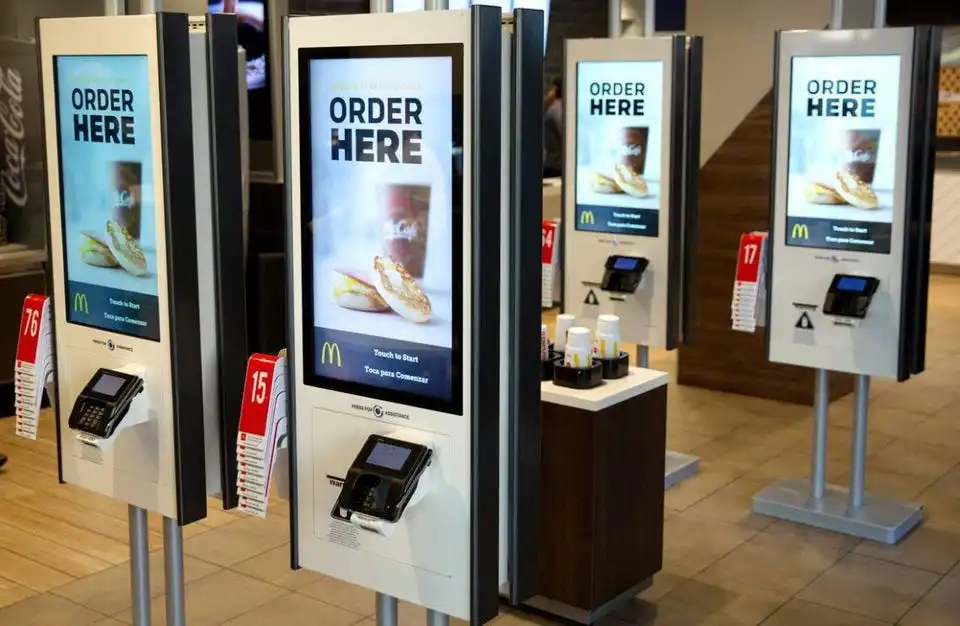
Picture Courtesy Wall Street Journal
The ordering application has a well-designed UI with large clear images and text, so visibility is not an issue. The touch capability makes the application easy to navigate, touch, and swipe through just like a smartphone or tablet.
The McDonald’s self-checkout kiosk has virtually eliminated human error while ordering because there are no communication gaps as there may be with the manual ordering process. Ordering through the kiosk is generally a lot quicker as well because you don’t have to repeat your order or deal with any cash.
3. Empowering Staff Through Self-Service Technology
You may think that McDonald’s self-order kiosk may have replaced all the restaurant staff with kiosks since it’s so convenient, but no, McDonald’s retained all the employees working in franchises behind the counters and those working the floors as well.
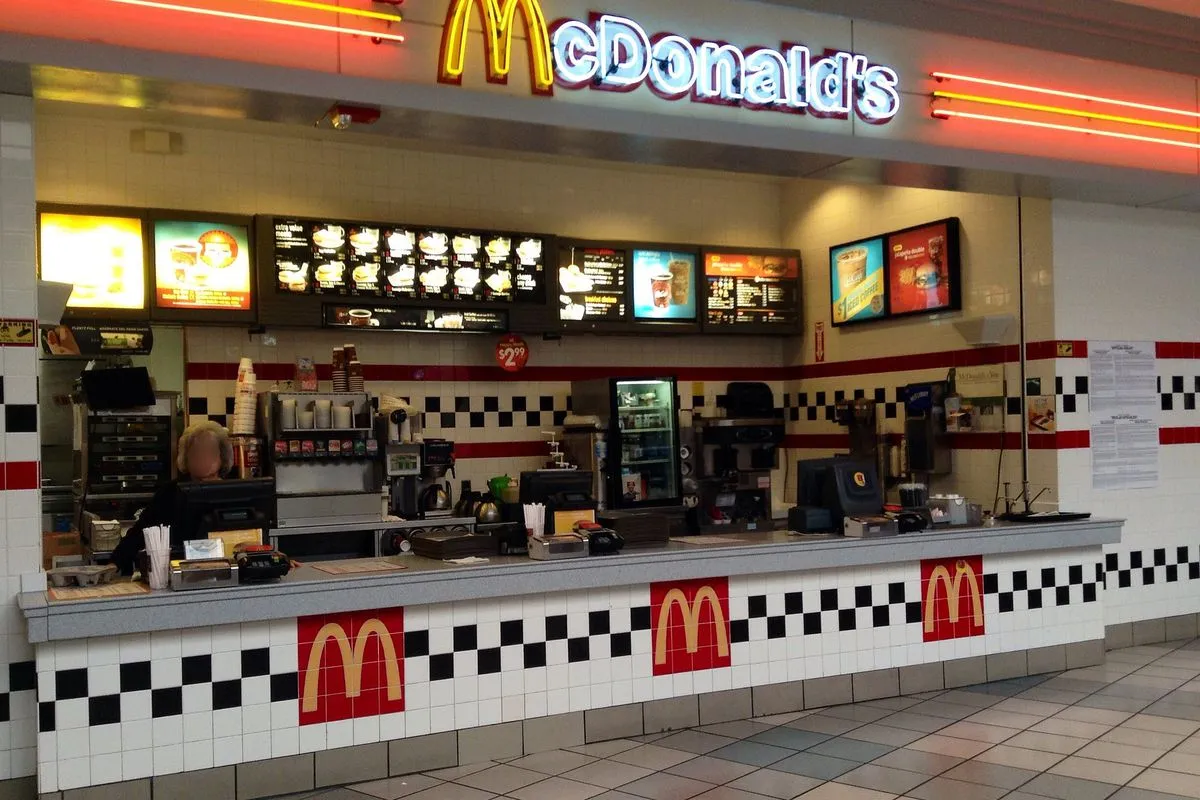
Incorporating self-service kiosks marked significant transformation phases in our operational strategy. The kiosk improved efficiency and order accuracy while dividing foot traffic between the kiosks and order counters. Plus, employees are always required to assist first-time users of the kiosks or older individuals.
4. Improving Consumer Behavior and Ordering Confidence
For specific individuals, going up to a counter and ordering can be very anxiety-inducing; “what am I going to order? What if they don’t have what I want? Will they customize my order? How many people are there behind me?” are among some of the questions that might go through their heads as they wait in line for their turn, getting more and more anxious as they get closer to the counter.

There was an interesting shift in consumer behavior when presented with the option of ordering via a self-service kiosk. The average order size increased by 20%, and the average order value rose by 30%. Self-service has dramatically changed how people act when ordering.
This increase in order value and size was credited to the kiosk’s ability to upsell; customers who wouldn’t usually buy drinks or dessert were now ordering these add-ons when the kiosk would offer them.
A cashier may forget their script and leave out the ‘Would you like fries with that?’; however, a McDonald’s order machine will never forget.
5. Digital Ordering Trends in the QSR Industry
Delivery trends are also shifting. When presented with the option to order via an app or via phone call, most customers will choose apps without hesitation.
When using apps, users tend to order more and use more features in general; they’ll order more calories and more difficult-to-pronounce items, make more customizations, and give more special instructions. When presented with options, customers will use them.
Read more: Enter the arts of the ‘New Normal’, freshly digitized with self-service
6. Improved Order Accuracy with Self-Ordering Kiosks
Order accuracy is crucial in ensuring customer satisfaction. Traditional ordering methods often involve miscommunications and errors.
However, self-service kiosks provide a clear visualization of menu items and options, minimizing the chances of misunderstandings.
Customers can easily modify their orders and view real-time updates, ensuring accuracy before finalizing their choices. Additionally, integrating payment methods and automatic calculations eliminates any payment discrepancies, further improving order accuracy.
7. Personalization and Upselling Opportunities
McDonald’s self-service kiosks have opened up new avenues for personalization and upselling. By analyzing customer preferences, these kiosks can offer customized recommendations based on previous orders and dining habits.
Furthermore, they can display promotions, special offers, and menu combinations that may appeal to individual customers.
Additionally, self-service kiosks seamlessly integrate with loyalty programs and rewards, encouraging customers to engage with the brand and enhancing their overall experience.
8. Promoting a Cashless and Contactless Experience
In an era where digital transactions reign supreme, McDonald’s self-service kiosks cater to the growing preference for cashless payments.
Customers can conveniently complete transactions using various electronic methods, fostering a secure and entirely contactless payment environment that aligns with the evolving expectations of modern consumers.
9. Enhanced Accessibility for All Customers
Diversity and inclusion are integral components of McDonald’s commitment to creating an accessible and enjoyable dining experience for all. The user-friendly interface of self-service kiosks and the ability to customize orders make the entire ordering process more accessible for individuals with diverse needs.
This includes those with dietary restrictions, language preferences, or varying levels of comfort with traditional order-taking methods.
10. Reduced Queues and Increased Ordering Capacity
By dispersing the order-taking process through self-service kiosks, McDonald’s successfully mitigates the challenges posed by traditional queues at the counter. This improves the overall flow of customers within the restaurant and allows McDonald’s to serve a larger number of patrons simultaneously.
The result is an enhanced restaurant capacity, particularly beneficial during peak hours when efficiency is paramount.
23% Increase in Customer Satisfaction
Ready to see it in action? Book a free demo today and revolutionize your customer experience
BOOK A FREE DEMOHow McDonald’s Self-Ordering Kiosks Improve QSR Operations
McDonald’s self-ordering kiosks play a critical role in improving day-to-day operations across high-volume fast-food locations. By allowing customers to place orders independently, McDonald’s reduces congestion at the front counter and manages peak-hour demand more efficiently. This shift helps maintain the speed of service even during busy periods without increasing staffing pressure.
These kiosks are tightly integrated with McDonald’s point-of-sale and kitchen systems, ensuring orders are transmitted directly to food preparation teams. This reduces manual entry errors, improves order accuracy, and shortens fulfilment times. From an operational standpoint, McDonald’s self-ordering kiosks also support better labour optimization by enabling staff to focus on food preparation, order assembly, and customer assistance rather than manual order taking.
According to Datos Insights, McDonald’s leads globally with over 130,000 self-ordering kiosks installed worldwide as of mid-2023, contributing to nearly 350,000 total restaurant kiosks amid 43% growth in two years.
For a global QSR brand like McDonald’s, operational consistency is essential. Self-ordering kiosks help standardize the ordering process across locations, delivering a reliable experience while supporting scalable restaurant automation and long-term efficiency.
What Other Industries Can Learn from McDonald’s Self-Service Strategy
The rapid rollout of McDonald’s self-ordering kiosks shows how a well-executed omnichannel approach can transform high-volume customer interactions. By integrating in-store kiosks with digital ordering and POS systems, McDonald’s scaled self-service across more than 14,000 U.S. locations in just a few years, driving measurable improvements in sales performance and average order value (AOV).
According to 247 Wallst, Kiosks raised McDonald’s average order value by 30%, through targeted upselling visuals that prompt add-ons like fries or drinks, a tactic retail stores can replicate at checkouts.
This success influenced other QSR brands like Starbucks and Subway and positioned self-service as one of the most effective customer experience solutions for QSR restaurants. Importantly, McDonald’s demonstrated that kiosks do not replace employees but work alongside them to reduce queues, improve order flow, and create a smoother in-store experience.
Lessons for Banking and Telecommunications from QSR Self-Service
Industries such as banking and telecommunications could also benefit from self-service kiosks; however, their implementation of SIM dispensing kiosks and other automated service points has progressed more slowly despite clear customer demand. McDonald’s success highlights how self-service technology can harmonize customer flow rather than eliminate human support, especially in service-intensive environments.
In banking, adoption has largely been limited to traditional ATMs, with slower expansion into advanced machines like CDMS, cash recyclers, and multi function self-service terminals. While these technologies improve efficiency and service availability, their deployment remains smaller in scale compared to QSR and retail environments.
Key takeaways from McDonald’s self-service strategy that apply across industries include:
- Faster customer on boarding and reduced wait times
- 24/7 service availability through automated touch points
- Integration with mobile apps and digital wallets
- Expanded service offerings via guided self-service workflows
The slower adoption in banking and telecom is often driven by complex integrations, security requirements, and regulatory compliance. However, modern self-service platforms now support secure workflows, encryption, and scalable deployment – making large-scale implementation more achievable than ever.
Check out similar blogs:
Frequently Asked Questions – McDonald’s Self-Service Kiosks
How do self-service kiosks contribute to a faster dining experience?
Self-service kiosks streamline the ordering process by allowing customers to browse the menu, customize orders, and complete transactions at their own pace. This reduces wait times, especially during peak hours, resulting in a faster and more efficient dining experience.
Can customers provide feedback about their experience using the kiosk machine?
McDonald’s highly values customer feedback. If you would like to provide feedback or share your experience using the self-service kiosks, you can do so through their customer feedback channels, which may include online surveys or speaking with a manager at the restaurant.
Are kiosks accessible for customers with disabilities?
McDonald’s self-service kiosks are designed to be accessible and inclusive. They offer language selection, text-to-speech functionality, and audio cues to accommodate customers with disabilities. Additionally, McDonald’s staff members are available to provide any necessary assistance.
Final Words
McDonald’s self-service kiosks have emerged as a game-changer in the fast-food industry, significantly enhancing the customer experience. These innovative kiosks have revolutionized how customers interact with the brand, providing greater convenience, customization, and control over their dining journey.
By streamlining the ordering process with a queue management solution, McDonald’s self-service kiosks have eliminated long queues and reduced waiting times, allowing customers to enjoy their meals more quickly. The improved order accuracy and real-time updates ensure that customers receive precisely what they desire, minimizing errors and misunderstandings.
Furthermore, self-service kiosks equipped with a queue management solution have opened up a world of personalization and upselling opportunities. With tailored recommendations, promotions, and integration with loyalty programs, McDonald’s can create a more engaging and rewarding experience for its customers.
This queue management solution optimizes the flow of customers, ensuring efficient and organized service while also providing valuable insights and analytics to enhance operational efficiency and customer satisfaction.
BOOK A FREE DEMO