Across the world, healthcare systems have made progress in treatment and technology, yet many people still struggle to receive timely and reliable care.
Some communities navigate fragmented services, inconsistent follow-ups, or limited coordination between providers. Others face challenges such as long appointment backlogs or restricted access to specialists, even when facilities are located nearby.
These gaps often stem from how services are structured, organized, and distributed. As they accumulate, they widen differences in health outcomes and create inconsistencies in the way care is delivered across regions and populations.
This shows that improving access requires more than expanding clinics or adding staff. It requires a clear view of how the system functions in practice.
To close these gaps, many organizations now use data analytics in health inequities to pinpoint where the system breaks down and to deliver care more reliably across diverse communities.
This blog explores how analytics supports decision-making, the technologies involved, and how data-driven approaches strengthen access for underserved populations.
What is Health Inequity in Healthcare?
Health inequity refers to avoidable, unfair, and unnecessary differences in health outcomes. These differences appear in patterns such as higher rates of chronic illness, shorter life expectancy, and uneven access to preventive services across populations.
These inequities emerge from long-standing social and economic conditions, including income levels, education opportunities, neighborhood environments, and historical disadvantages that influence daily living conditions and exposure to risks.
They are not the result of individual choices alone but come from circumstances that affect how communities experience health over time.
One example of this gap can be seen in maternal health. In 2023, the maternal mortality rate for non-Hispanic Black women in the United States reached 50.3 deaths per 100,000 live births, compared with 14.5 for non-Hispanic White women and 12.4 for Hispanic women.
Rural communities also face higher rates of preventable disease and delayed diagnoses because of geographic isolation and limited local services.
These inequities place pressure on families and healthcare systems and show the need for focused strategies that address the conditions producing unequal outcomes instead of treating the symptoms alone.
The Role of Data and Analytics in Addressing Health Inequities
Data-driven solutions for health equity help organizations examine how care is delivered across different populations.
Rather than focusing solely on outcomes, analytics highlight where processes slow down, where communication gaps occur, and where access varies across communities. These insights guide teams in improving service delivery and promoting more consistent care.
Predictive analytics and advanced modeling help organizations prepare for shifts in demand and changes in patient flow patterns. By anticipating where pressure may build, providers can adjust resources, reduce avoidable delays, and improve the overall patient experience.
CX analytics add valuable visibility into how patients move through steps such as scheduling, check-in, and follow-up. These metrics help identify service bottlenecks and points where engagement drops, allowing teams to create more responsive and equitable experiences.
Healthcare providers draw on information from electronic health records, health surveys, community-level sources, and operational systems.
By using data to close health gaps, organizations can analyze care delivery patterns, assess which interventions work, and direct resources to where they have the greatest impact.
4 Key Technologies Driving Data Solutions in Healthcare
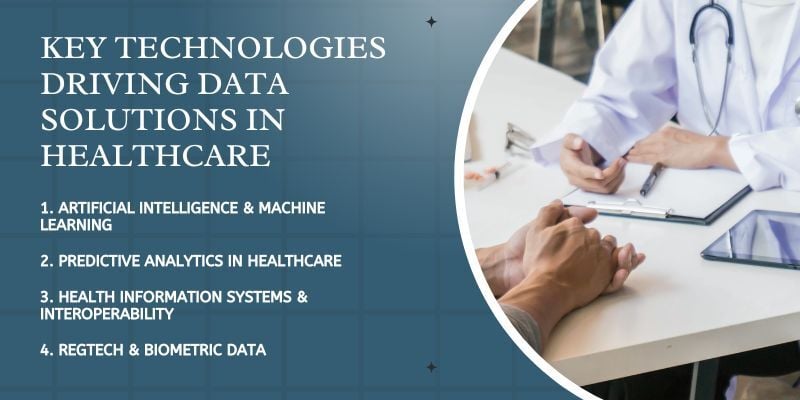
Several technologies help organizations advance their work in addressing healthcare disparities with data. These technologies strengthen coordination, improve visibility into service delivery, and help teams act on insights with greater consistency.
1. Artificial Intelligence and Machine Learning
AI and ML examine large datasets to find patterns that routine review may miss. These systems detect shifts in service use, changes in patient flow, and trends that may require attention.
They also assist with triage accuracy, scheduling efficiency, and timely follow-ups, helping organizations maintain more reliable care across facilities.
2. Predictive Analytics in Healthcare
Predictive analytics focuses on anticipating system-level pressures. By studying appointment trends, seasonal fluctuations, and transitions within the care process, organizations can prepare staffing plans, allocate resources, and reduce scheduling disruptions. This approach helps maintain steadier movement through the system.
As of 2024, 71% of hospitals reported using predictive AI integrated with EHR systems, up from 66% in 2023.
3. Health Information Systems and Interoperability
Health Information Systems connect data across clinics and hospitals, giving teams the ability to map the patient journey from referral to follow-up without gaps in communication.
Interoperability reduces duplicate testing, shortens administrative delays, and enhances continuity of care. It also provides population-level insights by combining information from multiple sites.
4. RegTech and Biometric Data
RegTech and biometric data streamline identification, improve verification accuracy, and reduce administrative barriers. These technologies shorten registration times, reduce mismatched records, and enhance access for patients who rely on telehealth or mobile clinics.
They also help organizations maintain compliance requirements while keeping processes efficient for underserved communities.
How Data and Analytics Close the Gaps in Healthcare
Data analysis helps organizations see how patients interact with services across different locations. By examining patterns in appointment activity, follow-up completion, and service availability, teams can identify areas where access is inconsistent and where operational changes may be needed to reduce disparities.
A useful example comes from New York City Health + Hospitals, which connected its electronic medical record system to more than 7,000 community programs. In 2023, over 250,000 primary care patients were screened for non-clinical needs.
Automated, location-based recommendations helped connect individuals to food assistance, transportation resources, and housing programs, reducing everyday obstacles that often delay or interrupt care.
Insights from healthcare data for equity also help organizations create a more personalized experience for communities with limited options.
When patterns such as transportation challenges, long travel distances, or inconsistent clinic availability appear in the data, organizations can respond with mobile units, telehealth access, expanded clinic hours, or other outreach efforts customized to local needs.
Queue analytics platforms such as Wavetec’s Spectra extend this work by monitoring real-time wait times, no-show rates, and congestion across service points.
These metrics reveal where patients encounter delays, which areas experience recurring pressure, and how demand changes throughout the day. Acting on these insights reduces operational barriers and gives patients in high-need areas a more predictable path to care.
4 Best Practices for Leveraging Data to Improve Healthcare Access
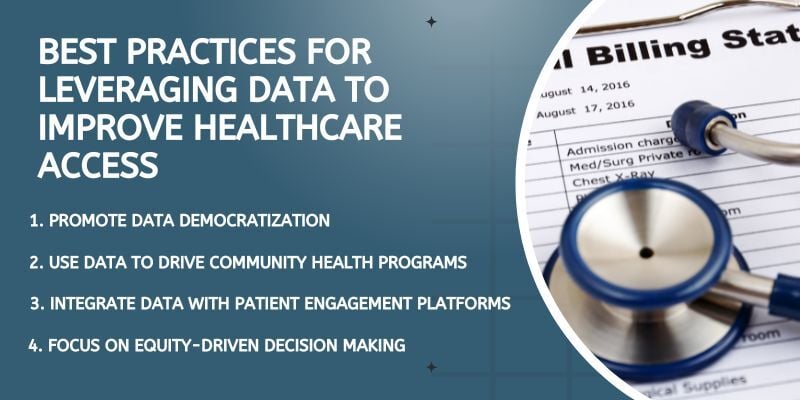
Organizations aiming for healthcare access improvement with analytics benefit from structured approaches that connect insights with everyday operations.
These practices help teams respond to local needs, manage rising demand, and provide more reliable care to underserved communities.
1. Promote Data Democratization
Data is most useful when the right people can act on it. Making key information available to clinicians, care coordinators, and operational teams helps align decisions across departments.
When staff can examine local visit patterns, follow-up trends, or service delays, they can adjust workflows without waiting for system-wide directives. This creates faster responses to issues that affect access and patient satisfaction, especially in facilities with varied populations.
2. Use Data to Drive Community Health Programs
Community health programs gain precision when decisions are grounded in local trends instead of system averages. Analytics can show which neighborhoods experience long travel distances, limited appointment availability, or inconsistent usage of preventive services.
With this insight, organizations can position outreach activities, such as weekend clinics, transportation assistance points, or rotating care teams, in places where they have the strongest impact.
3. Integrate Data with Patient Engagement Platforms
Facilities that manage high patient volume often struggle to keep pace with follow-ups, reminders, and ongoing communication. Integrating data with engagement platforms gives staff a single source for patient updates, message history, and upcoming appointments.
It reduces manual coordination and helps ensure that instructions, reminders, and check-in details reach patients on time. These systems also help detect patterns such as repeated missed visits, allowing teams to intervene early and reduce disruptions in care.
4. Focus on Equity-Driven Decision Making
Analytics can be incorporated into routine decision-making rather than kept as a separate reporting exercise.
When demographic insights, access indicators, and local demand forecasts influence scheduling, staffing, and outreach planning, organizations consistently move toward more equitable service models.
This creates a predictable method for addressing gaps and ensures that adjustments benefit communities that historically face uneven access.
6 Challenges of Implementing Data Solutions for Health Equity
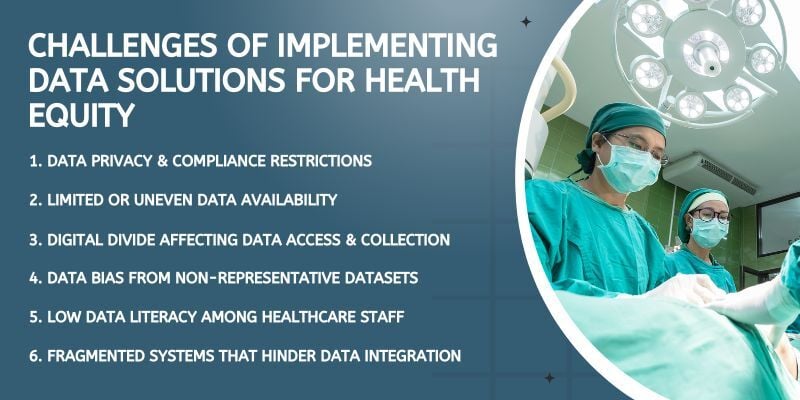
Using data to address health inequities comes with several challenges. Data privacy concerns, limited data availability, and the digital divide can restrict access to information, making it difficult for organizations to interpret local conditions and respond effectively to community needs.
Regulatory and compliance requirements, including HIPAA in the U.S. and GDPR in Europe, also influence how information is collected, shared, and stored.
Navigating these rules while maintaining useful data flows requires careful coordination across clinical, administrative, and technical teams.
Data bias is another issue. When datasets do not represent diverse populations or overlook key context, such as social determinants of health, analytics can produce incomplete or misleading insights.
Using social determinants of health and data analytics responsibly helps organizations identify genuine healthcare needs and direct interventions where they can make a meaningful difference.
Data literacy adds an additional layer of complexity. Many healthcare professionals work with high workloads and limited time for technical training.
Interpreting analytical reports, understanding visual summaries, and drawing accurate conclusions can be difficult, especially when information is scattered across different systems.
In these situations, practical visibility into daily operations becomes essential. Platforms such as Wavetec’s Spectra provide real-time operational metrics that frontline teams can act on without relying on complex analysis.
By showing where delays occur, where demand rises, and how patients move through facilities, Spectra helps teams make timely decisions that reduce bottlenecks and improve access in high-need areas.
Data and Health Equity: The Future Outlook
Emerging technologies such as AI, blockchain, and big data will help reduce health inequities. By analyzing large datasets and supporting secure, transparent sharing of health information, these technologies can improve decision-making and direct interventions to where they are needed most.
Future trends in data transparency will give patients more control over their health information and strengthen trust in care. Integrating patient-generated data with clinical records and social determinants of health can help providers design more relevant care plans.
With more than 4.5 billion people worldwide still lacking full access to essential health services, approaches to improving healthcare access are becoming increasingly important.
These include mapping service deserts, prioritizing outreach to underserved communities, and monitoring service uptake to measure progress. Policymakers and providers can use these insights to allocate resources effectively and track movement toward universal health coverage.
Ongoing investment in analytics initiatives ensures technologies expand their reach and enhance healthcare results globally.
Frequently Asked Questions (FAQs)
How does data analytics help in reducing health disparities?
Data analytics uncovers patterns in healthcare access, treatment outcomes, and social factors, allowing providers to identify underserved populations and target interventions that improve care delivery.
What technologies are used in addressing healthcare inequities?
Technologies such as AI, machine learning, predictive analytics, health information systems, and queue analytics platforms help organizations analyze data, anticipate risks, and streamline service delivery to high-need populations.
How can predictive analytics improve healthcare for underserved communities?
Predictive analytics forecasts potential health risks and identifies populations at higher risk, enabling proactive interventions like preventive screenings, outreach programs, and early treatment before conditions worsen.
What are the key barriers to using data to address health inequities?
Barriers include limited data availability, privacy regulations, dataset bias, the digital divide, and a lack of data literacy among healthcare staff, all of which can hinder the generation of accurate insights and equitable decision-making.
How do social determinants of health impact healthcare access?
Social determinants like income, transportation, education, and living conditions directly affect an individual’s ability to access care and adhere to treatment, influencing health outcomes across communities.
Conclusion
Data and analytics give healthcare organizations the ability to see where access breaks down, which communities face the biggest delays, and how services can be adjusted to reduce inequities.
These insights help teams plan resources, anticipate demand, and develop outreach efforts that match real conditions rather than assumptions.
Operational visibility strengthens this work. Platforms such as Wavetec’s Spectra offer real-time metrics that help staff respond quickly to congestion, long waits, and changing demand.
As data becomes more integrated into everyday care, organizations that use these insights will be better equipped to close gaps and deliver more consistent access for underserved populations.
BOOK A FREE DEMO