Bank branches remain essential to how customers interact with their financial institutions. Despite the rise of mobile banking, customers still visit branches for complex transactions, financial advice, and relationship building.
Yet many branches struggle with persistent challenges:
- Long wait times
- Uneven teller workloads
- Frustrated customers who watch others arrive after them but get served first
These inefficiencies do more than annoy customers. They drive away business, lower staff morale, and limit a branch’s capacity to generate revenue.
This article explores how a bank queue management system transforms branch operations, turning chaotic lobbies into streamlined service environments that benefit both customers and staff.
Retailers, including bank branches, report 20% sales increases after implementing queue management software, driven by shorter lines and better upselling opportunities.
For banks committed to improving bank branch efficiency, queue management is not a luxury but a foundation of modern operations.
What Is a Bank Queue Management System?
A bank queue management system is a digital platform that organizes, monitors, and optimizes the flow of customers through a bank branch. It replaces manual paper tickets and chaotic first-come-first-served lines with structured, technology-driven service routing.
When customers enter a branch, they check in through a self-service kiosk, a staff-assisted tablet, or even their mobile device before arriving. The system captures their identity and the reason for their visit, then places them in a virtual queue.
Based on service type, customer value, and staff availability, the system routes each customer to the most appropriate teller or specialist.
Real-time displays keep customers informed about their position and expected wait time.
Staff receive notifications when customers are assigned to them, along with relevant information to personalize the interaction.
This queue management software for banks creates order from chaos, ensuring that customers are served fairly, efficiently, and in alignment with their needs.
Why Traditional Bank Queues Hurt Branch Efficiency
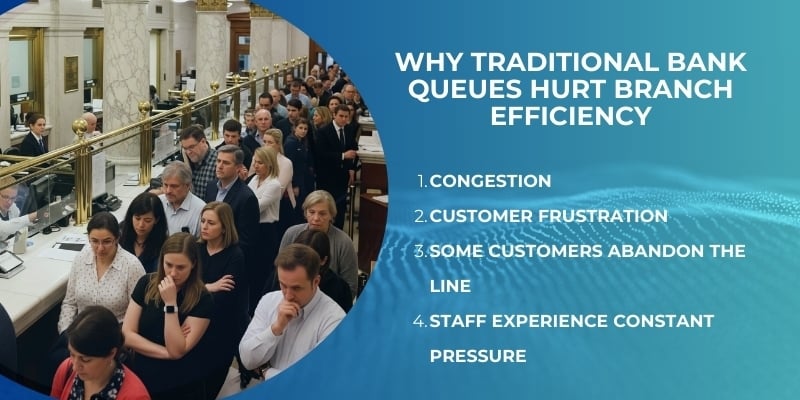
The old way of managing branch traffic creates problems that ripple through every aspect of operations.
Manual queues typically operate on a simple first-come-first-served basis, with customers standing in physical lines waiting for the next available teller. This approach ignores the reality that not all transactions are equal.
A customer needing a simple balance inquiry takes the same path as someone applying for a mortgage. Specialists who could handle complex needs remain idle while general tellers are overwhelmed.
Congestion builds at peak hours as customers cluster around counters without clear direction.
Customer frustration escalates when lines move unevenly or when someone with a simple transaction waits behind multiple customers with complex needs.
Some customers abandon the line entirely, leaving without service and taking their business elsewhere.
Staff experience constant pressure, unable to predict workflow or manage their time effectively.
The academic literature on queuing theory confirms that unstructured wait times create negative customer experiences and operational inefficiencies that digital systems are designed to solve.
Manual processes also raise privacy concerns when customer details are written on paper logs visible to others.
How Banks Use Queue Management Software to Improve Branch Efficiency
Banks deploy queue management software across their branch networks to transform chaotic lobbies into efficient, customer-centric environments. The software works by digitizing the entire customer journey from arrival to departure.
- When a customer enters, they check in through a kiosk, tablet, or mobile app.
- The system captures essential information: their identity, the purpose of their visit, and whether they have an appointment.
- Based on this data, the software assigns them to the appropriate service queue and provides an estimated wait time.
Behind the scenes, the system continuously monitors branch conditions.
- It tracks which tellers are available, what skills they have, and how long each customer has been waiting.
- It dynamically adjusts assignments to balance workloads and minimize delays.
Managers see real-time dashboards showing queue lengths, wait times, and service completion rates across all counters. This visibility allows them to open additional stations when queues build or reassign staff to meet demand.
Reducing Customer Wait Times in Bank Branches
Wait time is the single most important factor in customer satisfaction with branch visits. Long waits frustrate customers, create negative perceptions of the bank, and increase the chance that customers will leave without service. Queue management software attacks this problem from multiple angles.
Digital ticketing replaces physical lines, allowing customers to wait comfortably anywhere in the branch rather than standing in a queue. They can sit in waiting areas, check their phones, or even step out briefly while monitoring their position.
Real-time displays and mobile notifications keep them informed, transforming the psychology of waiting. When customers know how long they will wait and can see progress, the perceived wait time shrinks even when the actual wait remains unchanged.
Appointment-based flow integrates with walk-in traffic to create predictable service patterns. Customers with appointments move through quickly, while walk-ins are smoothly integrated without disrupting scheduled service.
Virtual queuing allows customers to join the queue remotely before arriving, reducing their in-branch wait time to nearly zero.
The banking customer experience improves dramatically when wait times are managed effectively. Customers feel respected when their time is valued, and they are more receptive to additional service offers when not stressed by long delays.
Balancing Teller Workloads with Real-Time Routing
Queue management systems balance teller workloads in real time, saving 20–25% of processing time by auto-routing customers to optimal counters. This statistic reveals one of the most powerful capabilities of modern queue software: intelligent customer assignment based on multiple factors.
In a manual system, customers choose which line to join based on guesswork. They may pick the wrong line, watch others move faster, and feel frustrated by the perceived unfairness.
Staff face uneven workloads as some lines build while others remain empty. Skilled specialists may be underutilized while general tellers are overwhelmed.
Queue management software solves this by taking routing decisions out of customers’ hands and optimizing based on data.
When a customer checks in, the system considers which staff members are available, what skills they have, and how long each customer has been waiting. It may route a simple transaction to any available teller but direct a loan inquiry specifically to a loan officer.
High-value customers can be prioritized for faster service without alienating others, because the system applies rules consistently.
This teller optimization benefits everyone. Customers get faster, more appropriate service. Staff work at their skill level rather than handling random transactions.
Managers gain visibility into workload patterns, allowing them to adjust scheduling and training. The result is a branch that operates smoothly even during peak periods.
Improving Branch Productivity and Throughput
Productivity gains from queue management extend far beyond faster customer service. When wait times decrease and workloads balance, branches process more transactions with the same staff. This increased throughput directly impacts the bottom line.
Consider a branch that handles 500 customer visits daily. If average service time drops by 10%, as achieved by the major U.S. bank cited earlier, the branch gains capacity equivalent to 50 additional transactions without adding staff.
Over a month, this extra capacity represents a significant revenue opportunity. Staff can use the freed time for proactive selling, relationship building, or handling more complex customer needs that generate higher value.
Analytics from queue systems provide insights that drive further productivity gains. Managers can identify which times of day experience highest demand and adjust staffing accordingly. They can see which transaction types take longest and explore process improvements.
They can compare performance across branches and share best practices. This data-driven approach to operational efficiency transforms branch management from reactive to proactive.
Enhancing Customer Experience in Bank Branches
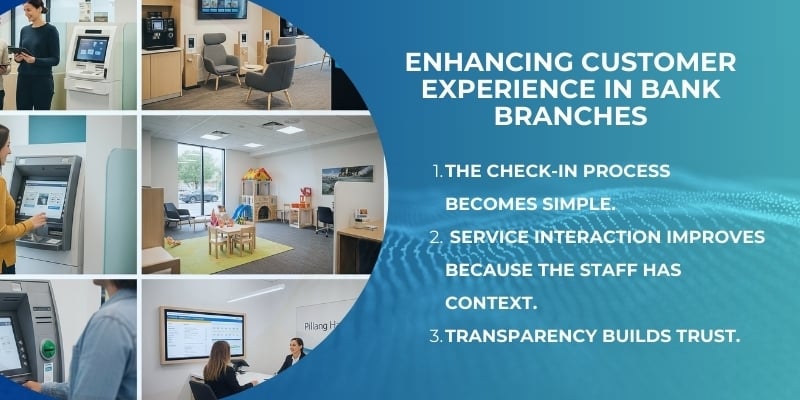
Customer experience in banking is shaped by every interaction, from the moment a customer walks through the door to their final farewell. Queue management software enhances this experience at multiple touchpoints.
- The check-in process itself becomes simple and intuitive. Customers approach a kiosk, select their service, and receive a ticket. They are not forced to stand in a line wondering if they are in the right place. While waiting, they see their position on digital displays and receive updates, reducing anxiety. When their turn approaches, they are guided to the correct counter without confusion.
- The service interaction improves because staff have context. The system tells them why the customer is there before they even meet. A teller who knows a customer wants to discuss a mortgage can prepare appropriate materials. A relationship manager who sees a customer’s recent transaction history can personalize the conversation. This preparation makes interactions more efficient and more meaningful.
- Transparency builds trust. Customers see that the system is fair, that wait times are communicated honestly, and that their time is respected. Old Mutual, a leading African financial services group, made branch queues nine times shorter and saw a 15% increase in Net Promoter Score after implementing process automation that included queue management. This direct link between wait time reduction and customer loyalty demonstrates why queue management software is essential for customer experience strategy.
Integrating Appointments with Queue Management
One of the most powerful capabilities of modern queue management systems is their ability to integrate scheduled appointments with walk-in traffic seamlessly.
Customers increasingly expect to book appointments for complex services, just as they do for restaurants and healthcare. When appointment scheduling connects directly to queue management, the entire branch flow becomes predictable and efficient.
Consider a customer who books a mortgage consultation online for Tuesday at 10 AM.
- When they arrive, they check in at a kiosk or simply notify a greeter.
- The queue system immediately recognizes their appointment and places them at the top of the appropriate service queue.
- The mortgage officer receives a notification that their customer has arrived.
- The customer waits minutes rather than hours.
Meanwhile, walk-in customers continue to be served efficiently alongside appointments. The system balances both flows, ensuring that appointment customers are not delayed excessively while also protecting service for those who prefer to walk in.
This integration creates what industry experts call a hybrid banking experience, where digital and physical channels work together seamlessly.
Mobile integration takes this further. Customers can book appointments through websites, mobile apps, or even messaging platforms like WhatsApp. They can receive reminders, confirmations, and instructions automatically. When they arrive, their information is already in the system, reducing check-in time to seconds.
This WhatsApp appointment management capability turns the branch visit from a chore into a smooth, predictable experience.
Role of Self-Service in Reducing Branch Congestion
Not every banking transaction requires a teller. Balance inquiries, statement printing, check deposits, and even some loan payments can be handled through self-service channels.
When customers can serve themselves for routine tasks, queue pressure on staff decreases dramatically.
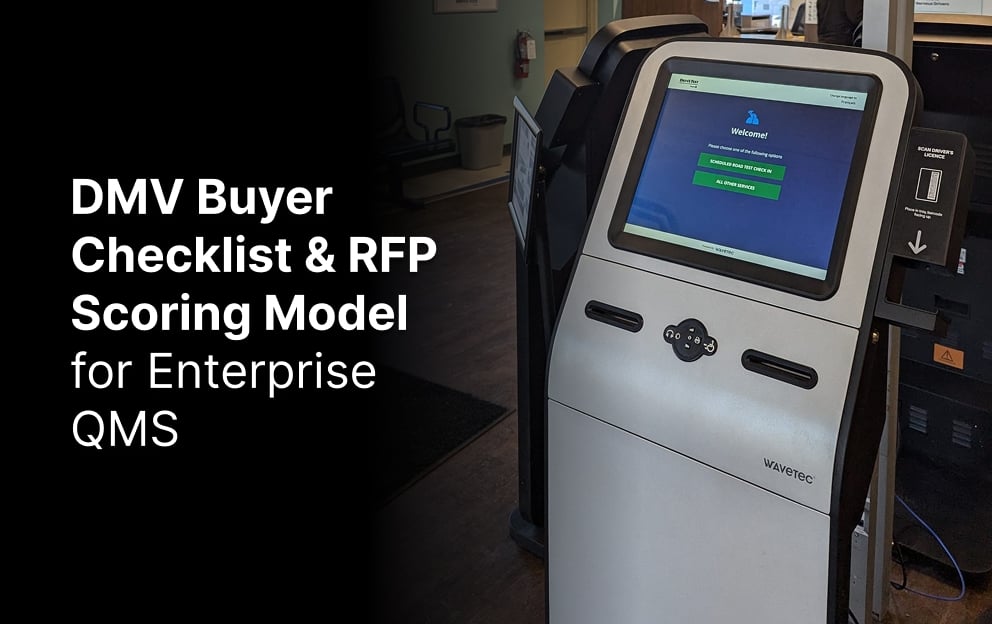
Self-service kiosks placed in branch lobbies allow customers to check in for service, but they also handle many transactions directly.
A customer who only needs a printed statement can complete the task at the kiosk without ever waiting for a teller. This frees staff to focus on complex needs that truly require human expertise.
The impact on congestion is substantial. When routine transactions move to self-service, queue lengths shrink and wait times drop for everyone.
Staff experience less pressure and can devote more attention to each customer interaction. The branch becomes a place for advice and relationship building rather than simple transactions.
Wavetec’s self-service kiosks are designed specifically for this purpose, offering intuitive interfaces that guide customers through common transactions quickly and accurately.
When integrated with queue management, these kiosks become part of a unified system that optimizes the entire branch experience.
Using Queue Data and Analytics to Optimize Branch Performance
The data generated by queue management systems is a goldmine of insights for branch optimization. Every customer check-in, every wait time, every service interaction creates data points that reveal patterns and opportunities.
Queue analytics show managers which hours experience the heaviest traffic, allowing them to schedule staff accordingly. They reveal which transaction types take longest, highlighting opportunities for process improvement or self-service migration.
They track individual staff performance, identifying training needs and recognizing excellence.
Over time, this data supports strategic decisions about branch operations. A bank might discover that certain branches need additional loan officers during lunch hours while others need more general tellers on Saturday mornings.
- They might find that wait time increases correlate with lower satisfaction scores, justifying investment in additional resources.
- They might identify branches where self-service adoption remains low and target those locations for customer education.
Queue management systems provide real-time reporting on transactions and digital interactions, keeping customers informed while generating insights that empower staff to deliver quality services. For banks committed to continuous improvement, this data is invaluable.
Queue Management Software in Digital Branch Transformation
Bank branches are not disappearing, but they are transforming. The branch of the future is smaller, more technology-enabled, and focused on advice rather than transactions. Queue management software is central to this transformation.
In a digitally transformed branch, customers move seamlessly between self-service and staff-assisted banking channels based on their needs.
- They check in through mobile devices before arriving.
- They receive personalized offers based on their profile and history.
- They connect with specialists via video when those experts are not physically present.
All of this coordination depends on intelligent queuing that understands each customer’s context and routes them appropriately.
For banks pursuing digital branch transformation, queue management is not an isolated tool but a foundational component that connects all other systems. It ensures that technology enhances rather than fragments the customer experience.
Common Challenges Banks Face with Queue Management
Alt-text: Common Challenges Banks Face with Queue Management
Implementing queue management software is not without obstacles. Banks often encounter challenges that must be addressed for successful deployment.
- Legacy processes embedded in branch operations can resist change. Staff accustomed to manual methods may be skeptical of new technology. Training and change management are essential to overcome this inertia.
- Staff adoption varies widely. Some employees embrace digital tools enthusiastically while others resist. Clear communication about benefits, combined with hands-on training and visible leadership support, helps drive adoption.
- Integration with appointments requires careful design. When appointment systems and queue management operate separately, customers experience confusion and delays. Unified platforms that handle both seamlessly are essential.
- Inconsistent service rules across branches create customer confusion. A customer who experiences one process at their home branch may be frustrated when a different branch operates differently. Standardizing service rules while allowing local flexibility is a delicate balance.
Technology integration with core banking systems can be complex. Queue management must connect with customer databases, appointment systems, and sometimes multiple legacy platforms. Choosing solutions with robust APIs and proven integration capabilities reduces this complexity.
Best Practices for Implementing a Bank Queue Management System
Successful implementation follows proven practices that maximize value and minimize disruption. These implementation best practices guide banks through the process.
- Define service rules clearly before selecting software. Understand what types of service your branch offers, how you want to prioritize different customers, and what data you need to capture. Clear requirements simplify vendor selection and configuration.
- Train staff thoroughly before launch and provide ongoing support. Staff who understand how the system helps them will embrace it enthusiastically. Include them in planning to build ownership and gather valuable frontline insights.
- Integrate appointments from the start. A queue system that handles walk-ins but not appointments creates its own problems. Ensure your chosen solution manages both seamlessly.
- Monitor performance continuously after implementation. Track wait times, service completion rates, customer satisfaction, and staff utilization. Use this data to refine processes and identify additional opportunities.
- Optimize continuously based on data and feedback. Queue management is not a set-it-and-forget-it solution. Regular review and adjustment ensure it continues to meet evolving needs.
Future of Queue Management in Bank Branches
The future of banking branches will be shaped by technologies that make queue management even more intelligent and predictive. Several trends point toward increasingly sophisticated systems.
- AI-based routing will use machine learning to assign customers to staff based not only on availability and skills but also on personality matching, past interaction history, and predicted needs. The system will learn which staff members build the strongest relationships with which customer segments.
- Predictive staffing will forecast demand days or weeks in advance, allowing branches to schedule exactly the right number and mix of staff for each hour. Machine learning models will incorporate weather, local events, and historical patterns to make increasingly accurate predictions.
- Mobile queues will become the norm, with customers joining virtual queues from anywhere and receiving turn notifications on their phones. They may never need to step into a branch until their specialist is ready.
- Deeper integration with digital channels will create seamless experiences where customers move between mobile, web, and branch without friction. A loan application started online will be waiting for the customer when they check in at the branch, with all data already entered.
These advances will further amplify the bank queue management system benefits that banks already enjoy, making branches more efficient, customers more satisfied, and staff more effective.
FAQs
What is a bank queue management system?
A bank queue management system is digital software that organizes customer flow in branches through self-service check-in, virtual queuing, intelligent routing to appropriate staff, and real-time wait time displays. It replaces manual paper tickets and chaotic physical lines.
How does queue management software improve branch efficiency?
It improves efficiency by reducing customer wait times, balancing teller workloads through intelligent routing, increasing transaction throughput, providing data for better staffing decisions, and freeing staff to focus on complex, high-value interactions rather than managing lines.
Can queue management reduce customer wait times in banks?
Yes, absolutely. Queue management is specifically designed to reduce customer wait times, and when implemented correctly in a bank, it can have a dramatic impact on both the actual time spent waiting and the customer’s perception of that wait.
How does QMS balance teller workloads?
The system auto-routes customers to optimal counters based on staff availability, skills, and customer needs. This balanced distribution saves 20–25% of processing time and ensures no single teller is overwhelmed while others are idle.
Is queue management software suitable for all bank branches?
Yes, queue management benefits branches of all sizes. Small branches gain organization and efficiency, while large branches gain capacity to handle high volumes without chaos. Cloud-based solutions make implementation feasible even for branches with limited IT resources.
Conclusion
A bank queue management system transforms branch operations from chaotic and frustrating to smooth and satisfying.
By replacing manual queues with intelligent digital routing, banks reduce wait times dramatically, balance teller workloads, increase transaction capacity, and create experiences that keep customers loyal.
As branches continue to evolve toward advice-driven, relationship-focused models, queue management becomes even more essential.
It is the foundation upon which modern bank branch efficiency is built, enabling staff to focus on what matters most: serving customers and building relationships that last.
BOOK A FREE DEMO