Patients today expect to communicate with their healthcare providers the same way they interact with their bank, their favorite retailer, and their workplace.
They want options. Some prefer a quick phone call. Others want to text or use a mobile app.
Many now expect to handle routine tasks through self-service portals without any human interaction at all.
Yet many healthcare organizations still rely primarily on single-channel communication, often an overloaded phone line, leaving patients frustrated by long hold times and delayed responses.
This mismatch between patient expectations and provider capabilities leads to missed appointments, delayed care, and destroyed trust.
This article explores the benefits of multi-channel communication in healthcare services, showing how providers can improve access, efficiency, and patient experience by meeting patients where they are.
Omnichannel tools reduce customer wait times by 39% and service costs by up to 35%. For healthcare organizations focused on delivering modern patient-centered care, adopting a multi-channel approach has become a requirement.
What Is Multi-Channel Communication in Healthcare?
Multi-channel communication in healthcare refers to the use of multiple, integrated communication channels to interact with patients, caregivers, and the public.
These channels include traditional options such as phone and in-person conversations, as well as digital channels such as email, SMS text messaging, mobile apps, patient portals, social media, and self-service kiosks.
The key distinction from single-channel communication is that patients can choose the channel that works best for them at a given moment, and they can switch between channels as needed.
For example, a patient might receive an appointment reminder by SMS, confirm through a patient portal, and later use a self-service kiosk at the clinic to check in. When these channels are integrated, the patient experiences a seamless interaction.
When they are siloed, the patient experiences frustration and repetition. Patient communication channels that work together create a unified experience that benefits both patients and providers.
Why Healthcare Needs Multi-Channel Communication
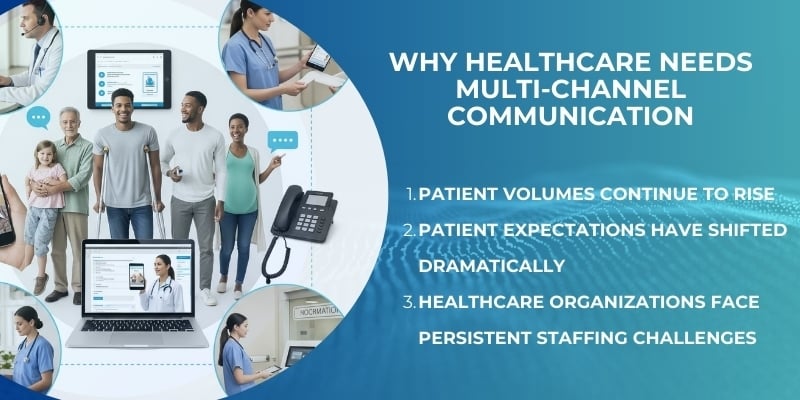
Several factors make multi-channel communication essential for modern healthcare.
- First, patient volumes continue to rise as populations age and chronic disease prevalence increases. More patients mean more calls, more questions, and more demand for access.
- Second, patient expectations have shifted dramatically. People accustomed to instant responses from other industries expect the same from healthcare. They want to book appointments online, receive reminders by text, and get test results through secure portals.
- Third, healthcare organizations face persistent staffing challenges. There are not enough people to answer every phone call manually, and relying solely on voice channels leads to burnout among staff.
Multi-channel communication addresses all these pressures. By offering digital options for routine tasks, organizations reduce the volume of phone calls that require live agents. Patients get faster answers. Staff get manageable workloads.
The healthcare engagement strategies that succeed in this environment are those that recognize communication as a two-way street, not a broadcast.
Patients want to initiate contact, ask questions, and manage their care on their own schedules. Multi-channel communication makes this possible.
Benefits of Multi-Channel Communication for Patient Access
The most immediate benefits of multi-channel communication are improved access and convenience for patients. When patients can reach their provider through their preferred channel, they are more likely to engage with their care.
- A working parent may prefer to schedule appointments through a portal after hours rather than taking time during the workday to call.
- A younger patient may prefer texting over phone calls.
- An older adult may still value voice communication but appreciate automated reminders so they do not miss appointments.
Access also means responsiveness. With multi-channel communication, patients receive faster answers to routine questions.
Appointment availability, referral status, and medication refill requests can be handled through digital channels without phone tag. This responsiveness builds trust and satisfaction.
Patients who can easily reach their provider are more likely to follow through with recommended care and less likely to seek care elsewhere. Patient engagement improves when communication barriers are removed.
Reducing Patient Wait Times Through Multi-Channel Communication
Long wait times are a common source of patient frustration and operational inefficiency. When every patient must call the same phone number for every need, queues build quickly.
Patients seeking simple information, such as office hours or directions, wait alongside those with complex clinical questions. This creates unnecessary congestion and delays for everyone.
Omnichannel healthcare communication reduces wait times by routing patients to the most appropriate channel for their needs.
- Routine requests such as appointment scheduling, prescription refills, and insurance questions can be handled through self-service portals or automated phone systems.
- Simple inquiries can be answered through SMS or chat.
- Only complex issues requiring clinical judgment need to reach a live agent.
This channel routing dramatically reduces the volume of calls that require live handling, shortening queues for those who truly need human assistance. Patients get faster service. Staff experience less pressure.
A well-designed queue management system integrated with multi-channel communication ensures that patients move efficiently through their interactions, whether digital or in person. The result is a healthcare experience defined by responsiveness rather than waiting.
Digital Self-Service as a Key Channel in Healthcare
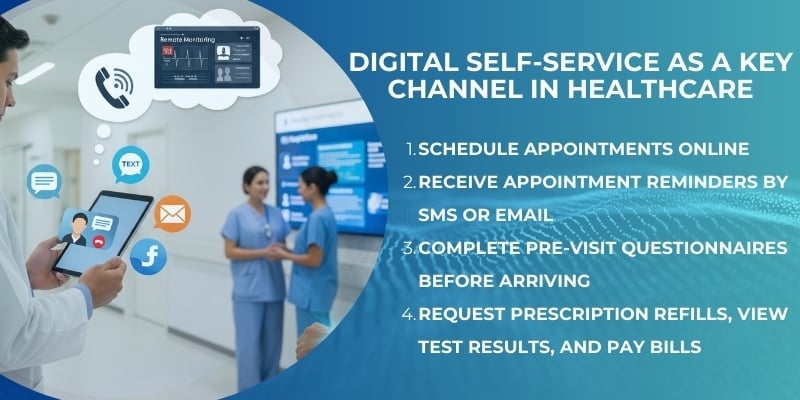
Digital self-service has emerged as one of the most important channels in healthcare communication. 71% of patients are likely to use digital self-service options over calling, driving efficiency and retention. This statistic reflects a fundamental shift in patient preferences.
People want to handle routine tasks themselves, on their own schedules, without waiting on hold or playing phone tag.
Digital self-service includes a range of capabilities.
- Patients can schedule appointments online, choosing times that work for them without back-and-forth communication.
- They can receive appointment reminders by SMS or email, reducing no-shows.
- They can complete pre-visit questionnaires and intake forms before arriving, shortening in-person wait times.
- They can request prescription refills, view test results, and pay bills through secure portals.
Messaging-based self-service such as WhatsApp appointment management, is particularly effective. Patients can ask simple questions and receive automated responses immediately.
If the question requires human attention, the conversation can be escalated seamlessly. This hybrid approach combines the efficiency of automation with the reassurance of human backup when needed. Patient engagement deepens when patients have control over their interactions.
Improving Contact Center Efficiency with Multi-Channel Communication
Healthcare contact centers are often overwhelmed by call volume, leading to long hold times, abandoned calls, and stressed agents. Multi-channel communication directly addresses this challenge by distributing interactions across channels, reducing the load on any single point of contact.
When patients can get answers through a portal, a text message, or an automated phone system, they do not need to speak to an agent. This deflection of routine inquiries frees agents to focus on complex issues that truly require their expertise.
Response times improve across all channels because the overall volume is better balanced.
Healthcare contact centers that adopt multi-channel strategies also benefit from better data. They can see which channels patients prefer, which questions are most common, and where bottlenecks occur. This insight allows continuous improvement of both technology and workflows.
Agents spend less time on repetitive tasks and more time on meaningful patient interactions, which improves job satisfaction and reduces turnover.
Customer journey management across channels creates a smoother experience for patients and a more sustainable work environment for staff.
Role of Automation in Multi-Channel Healthcare Communication
Automation is the engine that makes multi-channel communication scalable and consistent. Automated notifications, reminders, and updates reduce manual effort while ensuring that patients receive timely, accurate information.
Appointment reminders are a classic example.
Instead of staff manually calling each patient, automated systems send reminders by phone, SMS, or email based on patient preference. These reminders reduce no-show rates, improve clinic efficiency, and free staff for other tasks.
Similarly, automated notifications can alert patients when test results are available, when referrals are approved, or when prescriptions are ready for pickup.
Communication automation extends beyond simple notifications. Automated workflows can handle patient intake, collect pre-visit information, and even triage symptoms through structured questionnaires.
Patients appreciate the speed and convenience. Providers appreciate the consistency and reduced administrative burden.
When automation is thoughtfully implemented, it enhances rather than replaces human interaction, handling routine tasks so humans can focus on complex care.
Enhancing Patient Experience Through Consistent Messaging
One of the hidden dangers of multi-channel communication is inconsistency. If patients receive different information from different channels, confusion and frustration follow.
A portal that shows one appointment time while a reminder text shows another erodes trust. A phone agent who cannot see the message a patient sent through the portal forces the patient to repeat themselves.
When channels are properly integrated, patients receive consistent messaging across every touchpoint.
- The appointment time confirmed through the portal is the same time mentioned in the SMS reminder.
- The phone agent can see that the patient already updated their insurance information online.
- The kiosk at check-in knows that the patient completed their pre-visit questionnaire at home.
This consistency builds trust and reduces cognitive load for patients. They do not need to track what they are told or wonder which information is correct. They experience the healthcare organization as a unified entity rather than a collection of disconnected departments.
Patient experience improves dramatically when patients feel known and understood rather than passed from one silo to another.
Supporting Staff and Reducing Operational Strain
The benefits of multi-channel communication extend beyond patients to the staff who serve them.
Healthcare workers, particularly those in patient-facing and contact center roles, face enormous pressure. High call volumes, repetitive questions, and frustrated patients contribute to burnout and turnover.
Multi-channel communication reduces this strain by deflecting routine queries away from live staff. When patients can find answers through self-service kiosks or receive updates automatically, agents handle fewer total interactions.
The interactions they do handle tend to be more complex and meaningful, requiring genuine skill and judgment. This shift from volume to value makes work more satisfying.
Staff also benefit from better tools. Integrated communication platforms give agents a complete view of patient interactions across channels, so they do not need to ask patients to repeat information.
Workflow automation handles routine tasks such as sending confirmations and updating records. The result is a work environment where staff can focus on the human aspects of care rather than fighting administrative fires.
Healthcare operations become more sustainable when staff are supported by effective communication systems.
Multi-Channel Communication Across Care Settings
Different healthcare settings have different communication needs, and multi-channel approaches must adapt accordingly.
In primary care clinics, appointment scheduling and reminders are essential. Patients need to book visits easily, receive confirmations, and know what to expect before arrival. Self-service kiosks for check-in reduce lobby congestion and administrative work.
In hospitals, communication needs are more complex. Patients and families need updates on care plans, discharge instructions, and coordination with follow-up providers.
Secure messaging through patient portals allows families to ask questions without waiting for rounds. Automated notifications can alert patients when test results are available or when discharge is imminent.
In remote and virtual care settings, communication is the primary mode of interaction. Patients need easy ways to connect for video visits, receive device setup instructions, and share data from home monitoring equipment.
Multi-channel communication ensures that telehealth is accessible rather than intimidating. Across all settings, the principle is the same: meet patients where they are with the information they need, when they need it.
Common Challenges in Multi-Channel Healthcare Communication
Implementing multi-channel communication is not without obstacles. Organizations often face healthcare communication challenges that must be addressed for success.
- Channel silos are perhaps the most common problem. Different channels operate independently, with no integration between them. Patients who send a message through a portal may later call and find that the agent has no record of the message. This fragmentation creates frustration and inefficiency.
- Inconsistent messaging occurs when different channels present conflicting information. An appointment reminder sent by SMS may show a different time than the one displayed in the portal. These discrepancies undermine trust and lead to missed appointments.
- Staff training gaps leave employees unprepared to handle multi-channel interactions. Agents trained only for phone work may struggle with chat or messaging, where tone and pacing are different. Policies for response times, escalation, and documentation may not exist or may vary by channel.
- System integration issues are technical but consequential. Patient data must flow seamlessly between electronic health records, scheduling systems, and communication platforms. When integration is incomplete, information gets stuck in silos and patients experience friction.
Addressing these challenges requires deliberate planning, investment in integrated platforms, and ongoing attention to workflows and training. The rewards, however, justify the effort.
Best Practices for Implementing Multi-Channel Communication
Successful implementation of multi-channel communication follows several best practices that organizations can adapt to their specific contexts.
- Channel prioritization means understanding which channels matter most to your patient population. Survey patients about their preferences and monitor usage data to see which channels are most popular. Invest accordingly, but maintain enough variety to accommodate different needs.
- Clear workflows define how interactions move between channels. When should a chat conversation escalate to a phone call? How are portal messages triaged to the right staff? What happens to after-hours inquiries? Documented workflows ensure consistency and prevent patients from falling through cracks.
- Patient education helps patients use channels effectively. Many patients are unaware of available options or uncertain how to access them. Simple instructions during visits, on the website, and in automated messages can dramatically increase adoption.
- Performance monitoring tracks how well the system is working. Metrics such as response times, resolution rates, channel usage, and patient satisfaction provide feedback for continuous improvement. Regular review of these metrics helps identify bottlenecks and opportunities.
Future of Multi-Channel Communication in Healthcare Services
The future of healthcare communication will be shaped by emerging technologies and evolving patient expectations. Several trends point toward even more sophisticated multi-channel communication capabilities.
- AI-assisted routing will use machine learning to direct patient inquiries to the most appropriate channel and resource. Instead of simple rules-based routing, AI will understand intent, urgency, and context to make smart decisions about where each interaction should go.
- Proactive messaging will move beyond reminders to anticipatory communication. Systems might notify patients when they are due for preventive screenings, when new research affects their condition, or when community health resources become available. This proactive approach keeps patients engaged between visits.
- Expanded self-service will handle increasingly complex tasks. Patients may use conversational AI to schedule appointments, request referrals, or get answers to clinical questions. Natural language processing will make these interactions feel more human and less transactional.
- Integrated digital journeys will connect communication with care delivery. Scheduling, pre-visit intake, virtual visits, follow-up, and billing will flow seamlessly across channels, creating a unified experience. Patients will not need to understand organizational boundaries; they will simply experience coordinated care.
These advances will further amplify the benefits of multi-channel communication, making healthcare more accessible, efficient, and patient-centered than ever before.
FAQs
What are the benefits of multi-channel communication in healthcare?
Multi-channel communication improves patient access, reduces wait times, lowers service costs, enhances patient experience, and reduces staff strain by distributing interactions across channels and automating routine tasks.
It meets patients where they are and allows them to choose their preferred method of communication.
How does multi-channel communication reduce patient wait times?
By routing routine inquiries to self-service and automated channels, multi-channel communication reduces the volume of calls requiring live agents.
This shortens queues for those who genuinely need human assistance, resulting in faster response times and less time spent waiting.
Why do patients prefer digital self-service options?
Patients prefer digital self-service because it offers convenience, speed, and control. They can handle tasks on their own schedules without waiting on hold, and they appreciate the ability to manage appointments, requests, and information independently.
How does multi-channel communication improve staff efficiency?
Multi-channel communication deflects routine queries away from live staff, freeing them to focus on complex issues.
Integrated platforms give agents complete patient histories across channels, eliminating repetition. Automated workflows handle routine tasks, reducing administrative burden.
Which channels should healthcare providers prioritize?
Channel prioritization should be guided by patient preferences and organizational capabilities. Core channels typically include phone, patient portal, SMS text messaging, and email.
Emerging channels such as chat and messaging apps are increasingly important. The key is offering enough variety to meet diverse needs while ensuring channels are integrated.
Conclusion
The benefits of multi-channel communication in healthcare services are clear and compelling. Patients gain easier access, faster responses, and greater control over their interactions.
Providers reduce wait times, lower service costs, and improve operational efficiency. Staff experience less strain and more meaningful work.
As patient expectations continue to rise and healthcare organizations face persistent capacity challenges, multi-channel communication is not a luxury but a necessity.
The organizations that succeed in implementing integrated, patient-centered communication strategies will be those best positioned to deliver efficient, responsive, and compassionate care.
Investing in multi-channel communication in healthcare is investing in the future of patient engagement and the sustainability of healthcare delivery.
BOOK A FREE DEMO