Cash deposits remain an essential branch service for retail customers, merchants and businesses. However, processing every deposit at a teller counter increases operational costs and places repetitive cash-handling demands on branch employees employees.
A teller teller-assisted deposit involves more than receiving cash. Employees must verify account information, count and authenticate notes, enter the transaction, issue confirmation, balance their drawers and support reconciliation.
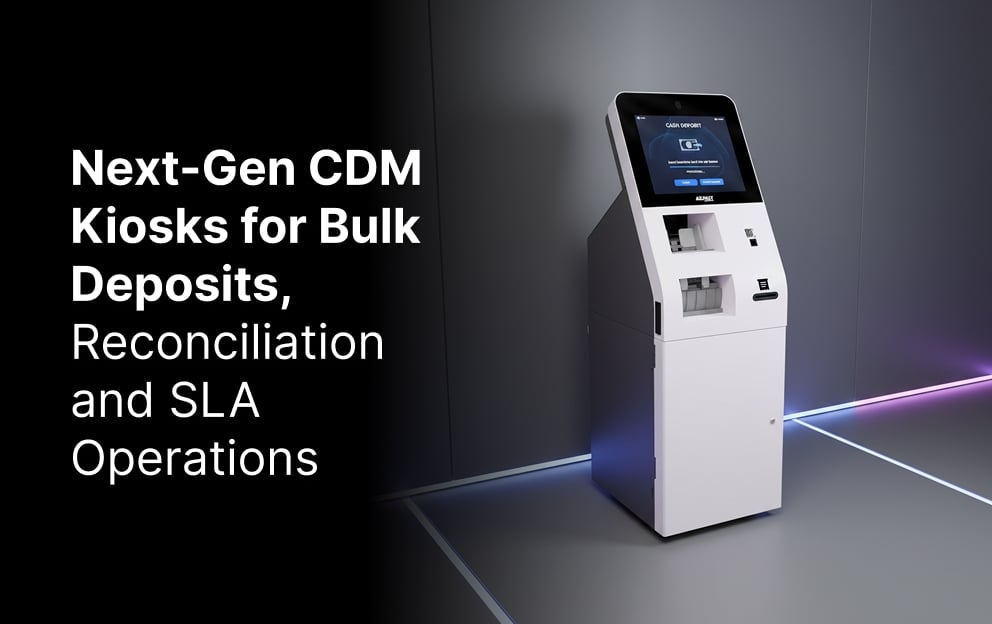
A Cash Deposit Machine, or CDM, automates much of this process. Customers deposit cash independently while the machine counts and validates the notes, connects with the bank’s transaction systems, secures the cash and generates a transaction receipt.
The financial case for a CDM should not rely on broad automation claims. Banks must assess their transaction volumes, labour costs, customer adoption, cash logistics, integration requirements and machine availability.
This article presents a practical model for evaluating that return.
Why Teller Load Matters
Routine deposits consume branch capacity that could otherwise support customer onboarding, complaint resolution, product guidance and advisory services.
A conventional deposit can involve:
- Customer and account verification
- Manual cash counting
- Note authentication
- Transaction entry
- Receipt generation
- Teller-drawer balancing
- Cash consolidation
- Reconciliation
- Exception management
When these activities are repeated across numerous transactions and locations, their cumulative cost becomes significant.
McKinsey’s retail banking research explains that branches remain important for customer acquisition and complex advice, while most everyday banking activities can move to self-service channels.
CDMs support this model by separating routine deposits from services that genuinely require teller assistance.
How a CDM Changes the Deposit Process
In a traditional deposit journey, the customer waits for a teller, provides the account information and hands over the cash. The teller counts the notes, validates the transaction, processes the deposit and issues a receipt.
With a CDM, the customer initiates the transaction through a card, account number, mobile application, QR code, biometric verification or another configured method.
The machine counts and validates the notes before displaying the accepted amount. Once confirmed, the cash is securely stored, the transaction is sent to the bank’s host system and a receipt is generated.
This automation reduces manual teller involvement while creating a consistent and traceable transaction process.
It does not necessarily eliminate teller positions. Instead, it releases capacity that can be redirected toward more valuable customer interactions or used to accommodate future growth without proportional staffing increases.
A Practical CDM ROI Model
The basic ROI calculation compares the total financial benefit generated by the CDM with its complete cost over the evaluation period:
[{ROI} ={Total Benefits} – {Total Costs}} {Total Costs}}x100]
The benefits may include:
- Reduced teller-processing effort
- Lower reconciliation workload
- Avoided overtime or future recruitment
- Greater transaction capacity
- Extended service availability
- Improved allocation of branch employees
The costs should include:
- Hardware
- Installation
- Integration
- Software
- Maintenance
- Connectivity
- Cash collection
- Consumables
- Support
- Exception handling
Illustrative ROI Assumptions
The following example represents one CDM deployed at a busy branch. The figures are assumptions and should be replaced with the bank’s actual operational data.
| Input | Assumption |
| Teller-assisted cash deposits per day | 120 |
| Deposits migrated to the CDM | 70% |
| Teller time per deposit | 4 minutes |
| Total manual processing cost per deposit | $0.85 |
| Estimated CDM processing cost per deposit | $0.17 |
| Initial deployment cost | $32,000 |
| Annual operating and support cost | $3,600 |
Under these assumptions, the CDM processes approximately 25,000 deposits annually that would otherwise have required teller involvement.
This migration releases around 1,680 teller hours per year, equivalent to approximately 0.8 of a full-time role. The capacity should only be treated as a direct saving if it reduces overtime, avoids additional hiring or produces measurable value through staff redeployment.
After accounting for the assumed transaction savings and annual operating costs, the model produces:
- Annual net benefit: Approximately $13,500
- Estimated payback: Approximately 28 months
- Three-year ROI: Approximately 27%
These results are illustrative. A change in customer adoption, labour cost, machine availability or cash-collection frequency can materially alter the outcome.
Customer Migration Determines the Return
A CDM does not create value simply because it has been installed. It must absorb transactions that would otherwise be processed by tellers.
The business case becomes stronger when:
- The machine is deployed at a high-volume location
- Eligible customers understand how to use it
- The transaction journey is simple
- The CDM is visible and easily accessible
- Machine availability remains high
- Cash is collected before storage reaches capacity
- Branch employees actively guide customers toward self-service
Low utilization extends the payback period because the bank continues to carry the machine’s fixed costs without shifting enough teller transactions.
Banks should therefore use pilot data to estimate migration instead of assuming every eligible deposit will immediately move to self-service.
What Costs Should Banks Include?
A credible assessment must evaluate the complete deployment rather than the hardware price alone.
Initial costs
Initial investment may include the CDM, cash acceptor, secure storage, freight, site preparation, installation, application configuration, core banking integration, security testing and employee training.
Recurring costs
Recurring expenditure can include software licensing, connectivity, preventive maintenance, cash collection, insurance, receipt paper, power consumption and remote support.
Exception-related costs
Banks should also account for rejected notes, deposit disputes, cash jams, communication failures, reversals, reconciliation exceptions and machine-full events.
Ignoring these activities can produce an unrealistic ROI projection.
Wavetec’s Integrated CDM Ecosystem
Wavetec’s CDM offering combines cash-processing hardware, enterprise software, banking integration, centralized monitoring and assisted-service capabilities.
The ecosystem consists of three primary layers:
- CQuick Cash Deposit Machine: Customer-facing hardware for accepting, validating and securely storing cash.
- ViaOS: An enterprise platform for developing, deploying and managing self-service applications.
- Smart Connect Middleware: A centralized integration and monitoring layer connecting machines with banking and operational systems.
Together, these components help banks automate deposits while maintaining visibility into transactions, devices, cash levels and service availability.
CQuick Cash Deposit Machine
Wavetec’s CQuick Cash Deposit Machine is designed for high-volume self-service environments, including branches, agent networks and extended-hours banking zones.
Its bulk-escrow cash acceptor can process up to 500 notes in a transaction, while total storage can be configured for up to 10,000 notes, depending on the selected configuration and denominations.
Bulk acceptance makes the machine suitable for:
- Retail cash deposits
- Business and merchant deposits
- Bill-payment collections
- Agent banking transactions
- High-traffic branch environments
Customers can submit larger deposits without inserting notes in repeated small batches, helping reduce transaction time and improve machine throughput.
Automated Note Processing
During a transaction, the CQuick cash acceptor counts and validates the inserted notes. Depending on the selected configuration and currency requirements, the machine can identify unsupported, suspicious or unacceptable notes and return them to the customer.
A typical transaction follows this journey:
- The customer identifies the account.
- Cash is inserted into the bulk-note acceptor.
- The machine counts and validates the notes.
- Accepted and rejected notes are displayed.
- The customer confirms the accepted amount.
- The transaction is sent to the bank’s host system.
- Cash is transferred into secure storage.
- A printed or digital receipt is issued.
The escrow mechanism temporarily holds the notes while the customer reviews the transaction. This supports controlled handling of cancellations, communication failures, timeouts and partial note rejections.
Secure Storage and Transaction Traceability
Accepted notes are transferred into a secured internal cash container or vault. Access is restricted to authorized personnel and governed by the bank’s cash-management procedures.
The deployment can support:
- Electronic transaction journals
- Deposit audit trails
- Controlled service service access
- Cash-level monitoring
- Device alerts
- Operational event reporting
- Secure system communication
These controls help connect the customer transaction, accepted notes, host response, receipt and reconciliation record.
Core Banking Integration
A cash-acceptance machine becomes a complete banking channel when it is securely integrated with the bank’s transaction-processing environment.
Wavetec’s integration framework can support:
- Customer and account validation
- Deposit-limit checks
- Transaction authorization
- Real-time or near-real-time posting
- Receipt confirmation
- Reversal workflows
- Transaction-status enquiries
- Reconciliation reporting
Rather than storing deposit information for later manual entry, the CDM can communicate directly with the bank’s host system and process the transaction according to predefined business rules.
This integration reduces manual intervention and supports a faster, more consistent deposit journey.
ViaOS for Self-Service Management
Wavetec’s ViaOS platform enables banks to develop, deploy and manage self-service applications across a network of machines.
Banks can configure:
- Branded user interfaces
- Multilingual journeys
- Authentication methods
- Deposit rules
- Transaction limits
- Receipt formats
- Bill-payment workflows
- Customer notifications
- Accessibility features
Centralized application management helps banks maintain a consistent experience across branches, self-service zones and agent locations.
ViaOS also supports integration with mobile channels. Customers can prepare a transaction through the bank’s application and generate a QR code. Scanning the code at the CDM retrieves the transaction information, reducing touchscreen interaction and account-entry errors.
Open APIs and SDK
Wavetec provides open APIs and an SDK to support integration with existing banking technology.
The CDM ecosystem can connect with:
- Core banking platforms
- Mobile applications
- Digital wallets
- Identity-management systems
- Bill-payment aggregators
- Cash-management applications
- Fraud-management platforms
- Customer notification services
- Enterprise reporting tools
This extensibility allows banks to introduce additional services after the initial deployment and improve machine utilization over time.
Cardless Transactions and Biometrics
The CQuick journey can be configured around the bank’s authentication strategy.
Customers may identify themselves using:
- Banking cards
- Account numbers
- Mobile applications
- QR codes
- PIN verification
- Fingerprint authentication
- Facial recognition
Cardless transactions can support mobile-first deposits, third-party payments and customers without a physical card.
Biometrics can provide an additional identity-verification layer for suitable transactions. Any biometric implementation must follow the bank’s consent, security, privacy and regulatory requirements.
Live Video Assistance
CQuick can include live video assistance for customers who need support while completing a self-service transaction.
A remote representative can help with:
- Transaction initiation
- Account selection
- Note rejection
- Deposit limits
- Navigation
- Receipt issues
- Interrupted transactions
This capability allows a centralized team to assist multiple locations without placing a dedicated employee beside every machine.
Multi-Service Capabilities
Depending on the bank’s integration and regulatory requirements, CQuick can also support:
- Bill payments
- Utility payments
- Mobile-wallet transactions
- Merchant collections
- Government payments
- Fee collection
Offering multiple services through the same platform can increase machine utilization and distribute the fixed deployment cost across a broader transaction base.
Smart Connect Middleware
Wavetec’s Smart Connect Middleware provides centralized operational visibility across the CDM network.
It can support:
- Machine-health monitoring
- Cash-level visibility
- Device alerts
- Transaction reporting
- Remote operational management
- Inventory management
- Collection planning
- Performance dashboards
- SMS and email notifications
This layer is important because machine availability directly affects ROI. A CDM that is offline, full or repeatedly rejecting notes cannot migrate deposits away from teller counters.
Central monitoring allows operational teams to identify issues and coordinate maintenance or cash collection before availability is significantly affected.
How Wavetec’s Capabilities Support ROI
| Capability | Business Impact |
| Bulk note acceptance | Supports larger deposits and shorter journeys |
| High storage capacity | Helps reduce machine-full events |
| Core banking integration | Reduces manual posting and processing |
| ViaOS | Centralizes self-service application management |
| Smart Connect | Supports uptime and operational visibility |
| QR prestaging | Reduces interaction time and account-entry errors |
| Biometrics | Supports secure identity-sensitive transactions |
| Video assistance | Extends human support across multiple locations |
| Open APIs and SDK | Simplify integration and future expansion |
| Multi-service support | Improves machine utilization |
These capabilities should only be entered into the ROI model when the bank can connect them with a measurable operational result.
How AI Can Improve CDM Operations
AI can strengthen the business case by analysing transaction, cash-level and machine-performance data.
Predictive cash collection
Historical deposit patterns can help forecast when a machine is likely to approach storage capacity. Collection schedules can then be aligned with expected expected demand instead of relying entirely on fixed routes.
Predictive maintenance
Machine telemetry can help identify unusual behaviour in cash acceptors, printers and sensors. Maintenance teams can investigate deteriorating performance before it causes extended downtime.
Transaction anomaly detection
AI-supported monitoring can identify unusual deposit patterns, transaction frequencies or note-rejection behaviour for investigation.
These alerts should support—not replace—the bank’s established fraud, AML and compliance controls.
Branch demand forecasting
Banks can combine CDM, teller and queue data to determine where additional machines, greater storage capacity, customer education or staffing adjustments may be required.
The value of AI should be measured through outcomes such as improved availability, fewer emergency visits, lower cash-logistics costs and higher successful-transaction rates.
Wavetec CDM Deployments
Wavetec’s banking deployments demonstrate how CDMs can distribute deposit demand away from teller counters.
Meezan Bank
Wavetec deployed CQuick 24 Cash Deposit Machines across selected Meezan Bank locations. The machines support bulk cash acceptance, real-time account credit, secure verification and printed receipts.
According to the Meezan Bank case study, the network processed more than 425 daily transactions in 2025, with average daily deposits exceeding PKR 49 million.
Bank AL Habib
The Bank AL Habib deployment introduced a nationwide Wavetec CDM network incorporating automated cash validation, real-time transaction processing, core banking integration and centralized monitoring.
The deployment was designed to reduce dependence on teller counters and expand access to self-service deposits.
Bank Alfalah
Wavetec also supported Bank Alfalah’s self-service transformation through its CQuick kiosks. The deployment expanded transaction availability and encouraged greater adoption of automated banking services.
These projects should not be treated as universal ROI benchmarks. Results depend on transaction volumes, customer adoption, labour structures, integration requirements and cash-management processes.
Building a Bank-Specific Business Case
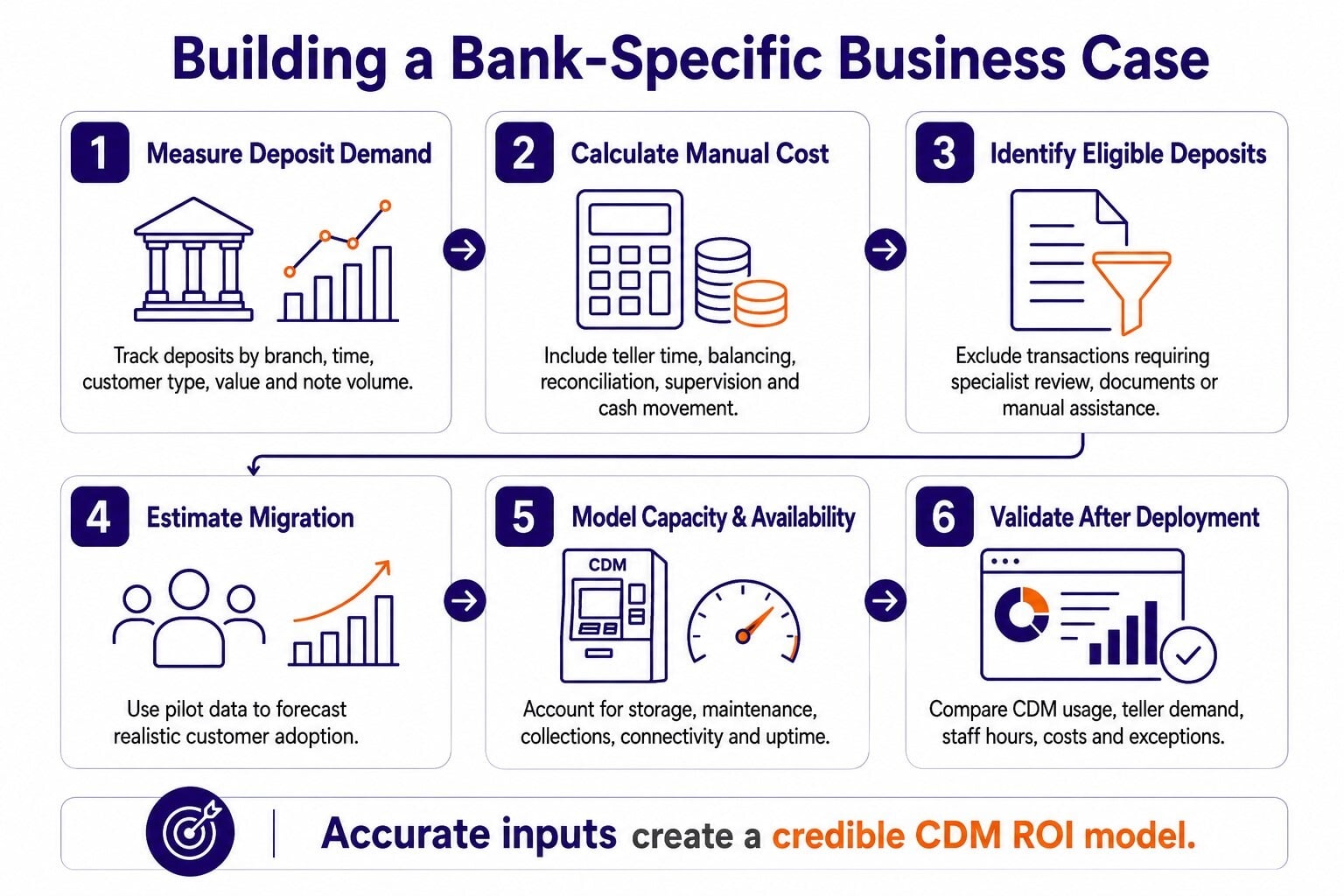
Banks can build a more reliable CDM assessment through six steps:
1. Measure deposit demand
Record deposit activity by branch, time, customer type, transaction value and note volume.
2. Calculate manual processing costs
Include teller time, balancing, reconciliation, supervision, cash movement and exception management.
3. Identify eligible transactions
Exclude deposits requiring specialist review, supporting documentation or manual intervention.
4. Estimate realistic migration
Use pilot data to determine how many eligible customers will adopt self-service.
5. Model capacity and availability
Account for storage, maintenance, cash collection, connectivity and expected uptime.
6. Validate performance after deployment
Compare actual CDM usage, teller demand, staff hours, costs and exceptions against the original branch baseline.
Metrics to Track
The most important performance indicators include:
- CDM utilization
- Deposit migration rate
- Successful transaction rate
- Machine availability
- Teller hours released
- Cost per transaction
- Cash-storage utilization
- Reconciliation exceptions
- Customer waiting time
- Customer satisfaction
The number of installed machines alone does not demonstrate ROI. Utilization, availability and cost per successful transaction provide a more accurate picture.
Common ROI Modelling Mistakes
Treating released time as an immediate saving
Released teller capacity only becomes a direct financial benefit when it reduces overtime, delays hiring or enables measurable value elsewhere.
Assuming complete customer migration
Some customers will continue to require teller assistance. Adoption barriers and exception cases must be included in the model.
Ignoring downtime
An unavailable machine cannot absorb teller demand. Uptime must be included in the projected migration rate.
Excluding cash logistics
Collection frequency, insurance, storage capacity and service requirements affect the total cost of ownership.
Applying one model to every branch
Transaction patterns vary between locations. Banks should prioritize branches where deposit demand and staffing pressure create the strongest potential return.
Final Takeaway
A Cash Deposit Machine creates value by moving repetitive cash deposits from teller counters to a secure and integrated self-service channel.
In the illustrative model, one CDM releases approximately 1,680 teller hours annually, reaches payback in around 28 months and produces a three-year ROI of approximately 27%.
The actual return will depend on transaction volumes, labour costs, customer migration, machine availability, integration requirements and cash logistics.
Wavetec’s CQuick hardware, ViaOS platform and Smart Connect Middleware provide an integrated foundation for cash deposit automation. Bulk acceptance, secure storage, real-time processing, mobile prestaging, biometrics, video assistance, open APIs and centralized monitoring can help banks improve transaction efficiency and deploy self-service at scale.
The strongest results occur when the technology is supported by accurate site selection, customer onboarding, reliable integration and continuous performance measurement.
BOOK A FREE DEMO