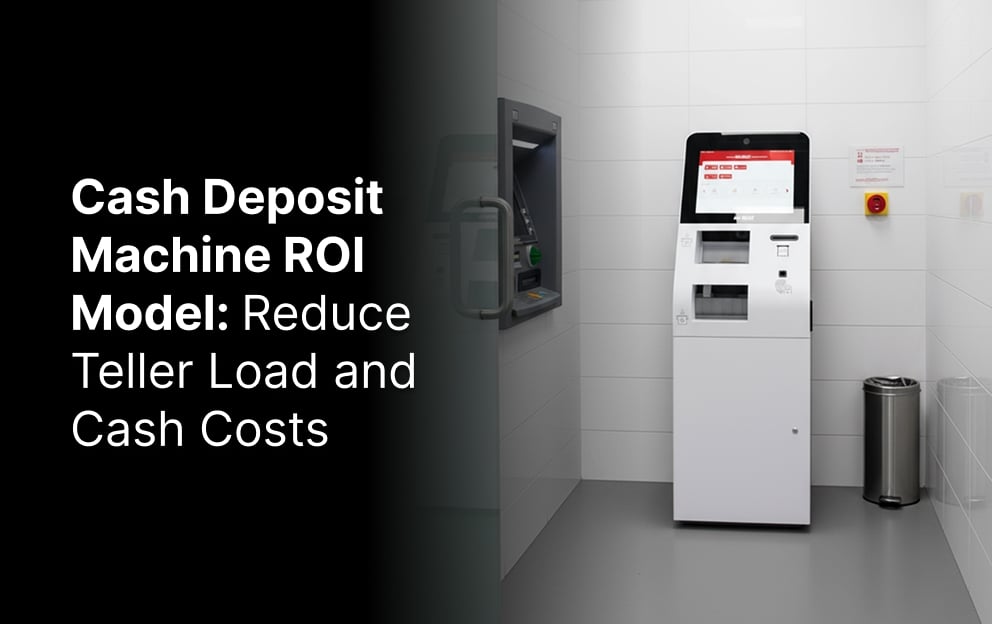
Wavetec’s next-generation Cash Deposit Machine kiosks are designed to help banks automate high-volume cash deposits while maintaining control over reconciliation, device performance and service availability.
Modern Cash Deposit Machine deployments are no longer limited to placing a cash-acceptance machine inside a branch. Banks require an integrated platform that can validate cash, connect with core banking systems, maintain transaction records, monitor machine health and support service teams across an entire device network.
Wavetec’s CDM ecosystem combines the WT CQuick 24 Cash Deposit Machine, ViaOS, enterprise middleware, centralized monitoring and operational support. Together, these components enable banks to build a scalable and operationally controlled self-service cash infrastructure.
Cash Remains Important in a Digitizing Banking Market
Digital banking adoption continues to accelerate, but cash deposits remain an important requirement for consumers, merchants, businesses and agent networks.
The State Bank of Pakistan’s Annual Payment Systems Review reported that digital channels represented more than 88% of retail payment transactions in FY2025, rising from 78% in FY2023. This growth demonstrates the rapid migration toward digital banking but does not eliminate the need for cash to enter the formal banking system.
Pakistan still had more than 19,000 bank branches and an extensive branchless banking agent network providing over-the-counter services such as cash deposits, withdrawals and bill payments, according to the SBP Payment Systems Review.
The challenge for banks is therefore not simply replacing cash. It is digitizing how cash is accepted, processed, reconciled and monitored.
This is where next-generation Cash Deposit Machines become essential.
Why Banks Need a New Cash Deposit Machine Operating Model
When cash deposits are handled exclusively at teller counters, they increase queues and consume employee time that could be redirected toward customer onboarding, advisory services and complex support.
McKinsey’s analysis of retail banking explains that branches remain important for customer acquisition and complex advice, while most routine banking activities can increasingly move to self-service channels.
CDMs enable this transition for cash deposits. However, a large deployment introduces operational questions that go beyond the customer transaction:
- Has the deposited cash been validated?
- Has the amount been credited to the correct account?
- Does the physical cash match the transaction records?
- Are offline and interrupted transactions reconciled?
- Is the machine approaching its storage limit?
- Is every machine available and operating correctly?
- Have support teams responded within their defined SLAs?
A next-generation Cash Deposit Machine platform must address these questions through one connected operating model.
Introducing Wavetec’s Next-Generation CDM Ecosystem
Wavetec’s CDM solution combines customer-facing hardware with software, integration and operational capabilities designed for enterprise banking environments.
The ecosystem includes:
- WT CQuick 24: High-volume cash deposit hardware
- ViaOS: Self-service application development and management
- Enterprise middleware: Integration with core banking and related systems
- Centralized monitoring: Visibility into devices, transactions and cash levels
- Analytics and reporting: Operational and business-performance insights
- Service management: Incident tracking, escalation and SLA reporting
This architecture allows banks to manage the Cash Deposit Machine as part of their wider banking infrastructure rather than as an isolated branch device.
WT CQuick 24 Cash Deposit Machine for Bulk Deposits
The WT CQuick 24 is designed for high-volume, security-sensitive banking environments where speed, reliability and operational control are essential.
Customers can insert a bulk stack of notes into the cash acceptor. The machine counts the notes, validates their denomination and authenticity, separates rejected notes and displays the accepted value for confirmation.
The typical deposit journey follows these steps:
- The customer identifies the receiving account.
- The bank validates the customer or account information.
- Cash is inserted into the bulk-note acceptor.
- The machine counts and validates the notes.
- Accepted and rejected notes are displayed separately.
- The customer confirms the deposit.
- The transaction is sent to the bank’s host system.
- Cash is transferred into secure storage.
- A receipt or digital confirmation is generated.
The WT CQuick 24 configuration deployed by Bank AL Habib supports deposits of up to 200 notes per transaction and high-speed note processing. Exact capacity and performance depend on the selected configuration, currency, note quality and banking workflow.
Bulk acceptance is particularly useful for:
- High-traffic retail branches
- Merchant and business deposits
- Agent banking locations
- Bill and fee collection
- Extended-hours self-service zones
- Branches operating in cash-intensive markets
By reducing repeated note insertion and teller involvement, the system creates a faster and more predictable deposit journey.
Secure Escrow and Cash Handling
The escrow mechanism temporarily holds inserted notes while the deposit is being validated and confirmed.
If the customer cancels the transaction or the system cannot complete the required authorization, the machine follows the bank’s configured recovery workflow. Notes are transferred into secure storage only after the transaction reaches the appropriate status.
This approach supports controlled handling of:
- Customer cancellations
- Partially rejected deposits
- Host communication failures
- Transaction timeouts
- Connectivity interruptions
- Reversal scenarios
- Unconfirmed deposits
The WT CQuick 24 can incorporate a concrete-filled vault, electronic locking, door sensors, a protected cash-intake hopper, hardware-status indicators and biometric authentication options.
These physical security controls are supported by application-level audit logs, operator permissions and transaction records.
Automated Reconciliation from Kiosk to Core
Accepting cash is only the first part of a CDM transaction. The bank must also confirm that the physical cash, device journal, middleware record and account posting correspond.
Wavetec’s CDM integration architecture connects the kiosk with the bank’s transaction, identity, reporting and monitoring layers.
This integration helps reduce reconciliation delays, improve deposit visibility and limit manual exception handling.
What the System Records
For every deposit, the system can capture:
- Transaction reference
- Date and time
- Device and branch identifier
- Customer or account reference
- Accepted denominations
- Accepted note count
- Rejected notes
- Deposited value
- Host-system response
- Transaction status
- Receipt reference
- Reversal or exception status
This information creates a traceable record from the customer interface to the bank’s processing environment.
Core Banking Integration
Wavetec’s enterprise integration layer can support:
- Account validation
- Customer verification
- Deposit-limit checks
- Transaction authorization
- Real-time or near-real-time account credit
- Reversal processing
- Transaction-status enquiries
- Customer notifications
- Reconciliation records
- End-of-day reporting
In Pakistan, the regulatory direction makes this integration particularly important. The State Bank of Pakistan’s CDM circular requires participating banks to provide instant credit to the beneficiary account for cash deposited through CDMs.
The same directive requires banks to expand Cash Deposit or Cash Recycling Machine coverage to at least 25% of their branch networks by the end of 2028.
This moves CDMs from an optional branch convenience toward a strategic element of banking infrastructure.
How Automated Reconciliation Works
A typical reconciliation process compares three records:
- Device record: What the CDM counted and accepted
- Transaction record: What the integration layer processed
- Core banking record: What was posted to the account
If the records match, the transaction can be marked as reconciled.
If they do not match, the transaction enters an exception workflow. Operations teams can investigate it using the device journal, host response, transaction logs and physical cash records.
Common exceptions include:
- Cash accepted but account credit not confirmed
- Host authorization received but the transaction timed out
- Reversal requested but not completed
- Device and host totals not matching
- Offline transactions awaiting synchronization
- Duplicate or delayed messages
- Customer deposit disputes
- Physical cash differing from electronic records
Automating this matching process allows employees to focus on actual exceptions instead of manually reviewing every successful deposit.
Offline and Interrupted Transactions
Network connectivity can vary across branches and agent locations. A resilient CDM architecture must therefore define how interrupted transactions will be controlled and reconciled.
Depending on the bank’s policies, the system may:
- Pause new deposits
- Complete only approved transactions
- Securely buffer transaction information
- Store cash in a controlled state
- Synchronize records when connectivity returns
- Route the transaction for review
- Notify operational teams
Offline functionality is not simply a connectivity feature. It requires defined authorization rules, encryption, synchronization, fraud controls and reconciliation logic.
ViaOS: Managing the Self-Service Journey
Wavetec’s ViaOS provides the application layer for developing and managing customer journeys across the CDM network.
Banks can use ViaOS to configure:
- Branded user interfaces
- Multilingual support
- Account-entry workflows
- Customer authentication
- Deposit limits
- Transaction rules
- Receipt formats
- Customer notifications
- Bill-payment services
- Accessibility features
Centralized application management helps the bank maintain a consistent journey across branches, self-service zones and agent locations.
Mobile-Prestaged Deposits
ViaOS can integrate with a bank’s mobile application to support prestaged deposits.
The customer enters the transaction information in the mobile application and receives a QR code. At the CDM, the customer scans the code to retrieve the prepared transaction before inserting the cash.
This journey can:
- Reduce information entered at the kiosk
- Minimize account-number errors
- Shorten interaction time
- Support cardless deposits
- Connect mobile and physical banking channels
Seamless channel integration is increasingly important. A Capgemini global banking study found that 75% of surveyed customers were attracted to FinTech providers because of their cost-effective and seamless services, demonstrating the experience standard traditional banks must now meet.
Biometric Authentication
The WT CQuick 24 can be configured with fingerprint or facial-recognition capabilities.
Biometrics may support:
- Customer authentication
- Cardless deposits
- Identity-sensitive transactions
- Higher-risk transaction controls
- KYC-related workflows
Biometric functionality must follow the bank’s privacy, consent, security and data-retention requirements. It should form part of layered authentication rather than operating as the only control.
Live Video Assistance
Customers who require assistance can connect with a remote representative through live video support.
The representative can help with:
- Account selection
- Note rejection
- Deposit limits
- Transaction navigation
- Interrupted deposits
- Receipt issues
- General service enquiries
Remote assistance allows a centralized team to support multiple locations without assigning an employee beside every machine.
Centralized CDM Fleet Operations
As the network grows, managing each CDM individually becomes inefficient.
A centralized operational platform gives business, IT, cash-management and service teams a common view of the network.
The platform can monitor:
- Device availability
- Cash-acceptor status
- Printer and sensor status
- Network connectivity
- Application health
- Cash-container levels
- Successful and failed deposits
- Reconciliation exceptions
- Open service incidents
- Software versions
- Branch-level performance
This makes it possible to distinguish between a customer-facing failure, connectivity issue, peripheral problem and backend transaction error.
Alerts and Operational Response
Monitoring rules can generate alerts when:
- A machine becomes unavailable
- Cash storage approaches capacity
- Note rejection increases unexpectedly
- A printer requires attention
- Connectivity is interrupted
- Transactions repeatedly fail
- Reconciliation exceptions remain unresolved
- A service incident approaches its SLA limit
Alerts can be routed to the relevant operations, IT, cash-management or maintenance team according to the incident category.
This reduces dependence on branch employees manually discovering and reporting every technical problem.
SLA-Driven CDM Operations
Service Level Agreements define how quickly incidents should be acknowledged, assigned, escalated and resolved.
For a CDM network, SLA management should extend beyond technician response time. It should connect real-time device monitoring with customer availability and operational accountability.
Important SLA Metrics
Banks should monitor:
- Device availability
- Successful transaction rate
- Incident response time
- Mean Time to Repair
- First-time resolution
- Remote resolution
- Cash-collection response
- Reconciliation-exception ageing
- Preventive maintenance
- Recurring machine faults
Different incidents require different priorities.
A complete outage at a high-volume branch may require immediate escalation. A receipt-paper warning may initially have a lower priority but should still be addressed before it affects service availability.
Automated Incident Escalation
An SLA-driven workflow can:
- Detect the incident
- Create a service record
- Assign a severity level
- Route it to the appropriate team
- Start the response timer
- Notify responsible personnel
- Escalate missed thresholds
- Record the resolution
- Add the event to SLA reporting
This creates accountability throughout the machine’s operational lifecycle.
Moving from Reactive to Predictive Operations
Traditional maintenance begins after a customer or employee reports a failure. Centralized monitoring enables banks to identify warning signs before the CDM becomes unavailable.
IBM defines predictive maintenance as using operational data and real-time condition monitoring to predict when an asset is likely to fail. AI and machine learning can help identify changes in performance that indicate developing problems.
For Cash Deposit Machine operations, predictive analysis can assess:
- Cash-acceptor errors
- Note-rejection patterns
- Printer performance
- Sensor events
- Transaction failures
- Connectivity patterns
- Previous maintenance incidents
This enables service teams to investigate deteriorating performance before it causes an extended outage.
Predictive Cash Collection
Historical deposits, cash levels, branch traffic, salary cycles and holidays can be analysed to estimate when a machine will approach capacity.
Cash-collection teams can then plan visits around expected demand instead of applying the same schedule to every location.
This can help reduce:
- Machine-full incidents
- Unnecessary collection visits
- Emergency cash removal
- Prolonged service interruptions
Transaction Anomaly Detection
AI models can identify unusual changes in:
- Deposit frequency
- Transaction value
- Note rejection
- Failed authentication
- Device behaviour
- Reconciliation exceptions
These alerts can support fraud, AML and operational-risk teams. They should not replace established investigation or compliance processes.
Intelligent Network Planning
Banks can combine Cash Deposit Machine, teller and queue data to determine where self-service capacity is being used effectively.
These insights can support decisions about:
- Future CDM locations
- Storage-capacity requirements
- Customer onboarding
- Branch staffing
- Cash-collection routes
- Maintenance coverage
AI creates value when it is connected with real operational workflows. McKinsey estimates that banks account for approximately $650 billion of annual global IT spending, but its research also emphasizes that technology investments must be directly connected with measurable business outcomes to generate value. Read the technology-value analysis.
Security and Governance by Design
A next-generation Cash Deposit Machine must protect physical cash, customer information and transaction data.
Banks should evaluate security across multiple layers.
Physical Security
Physical controls may include:
- Reinforced cash vaults
- Electronic locks
- Door and tamper sensors
- Protected cash-intake mechanisms
- Controlled maintenance access
- Surveillance integration
Application Security
Application controls can include:
- Role-based access
- Operator authentication
- Secure configuration
- Audit logging
- Session controls
- Restricted operating-system access
- Approved software deployment
Communication Security
Transaction data should be protected through:
- Encrypted communication
- Firewalls
- Secured gateways
- Certificate management
- Controlled API access
- Network segmentation
- Security monitoring
Operational Governance
Banks should also define:
- Who can access each system
- Who can open the cash vault
- How software updates are approved
- How incidents are investigated
- How customer disputes are handled
- How reconciliation exceptions are closed
- How SLA performance is audited
Security is not a single hardware feature. It combines physical protection, application controls, integration architecture and operational procedures.
Wavetec’s Experience in Cash Automation
Wavetec’s deployments demonstrate how next-generation Cash Deposit Machine operations can scale across different banking environments.
Bank AL Habib
Bank AL Habib deployed 173 WT CQuick 24 Cash Deposit Machines across its nationwide network.
The Bank AL Habib deployment combines:
- Bulk cash acceptance
- Core banking integration
- Centralized monitoring
- Secure cash handling
- Operational analytics
- Enterprise visibility
The project shows how Wavetec combines machine hardware with the monitoring and operational framework required for a multi-location network.
Meezan Bank
Meezan Bank introduced Wavetec’s CQuick 24 CDMs to support teller-independent deposits, real-time account credit and secure verification.
According to the Meezan Bank case study, the deployment processed more than 425 CDM transactions daily, with average daily deposits exceeding PKR 49 million in 2025.
Bank Alfalah
Bank Alfalah has continued expanding its CQuick CDM network as part of its self-service banking strategy.
The latest Bank Alfalah CDM expansion reflects the importance of integrated hardware, intelligent software and local operational support when deploying cash automation at scale.
MCB Bank
MCB Bank has also partnered with Wavetec to introduce CQuick Cash Deposit Machines across its branch network.
The MCB Bank deployment is designed to provide faster and more accessible deposits while reducing dependence on conventional branch queues.
Measuring CDM Performance
A Cash Deposit Machine release should be evaluated through operational performance—not only the number of installed machines.
Banks should monitor:
- Transactions per machine
- Successful deposit rate
- Customer adoption
- Device availability
- Average transaction duration
- Cash-storage utilization
- Note-rejection rate
- Reconciliation exceptions
- Incident response time
- Mean Time to Repair
- Teller deposits migrated
- Cost per successful transaction
- SLA compliance
These indicators help determine whether the CDM network is creating genuine operational value.
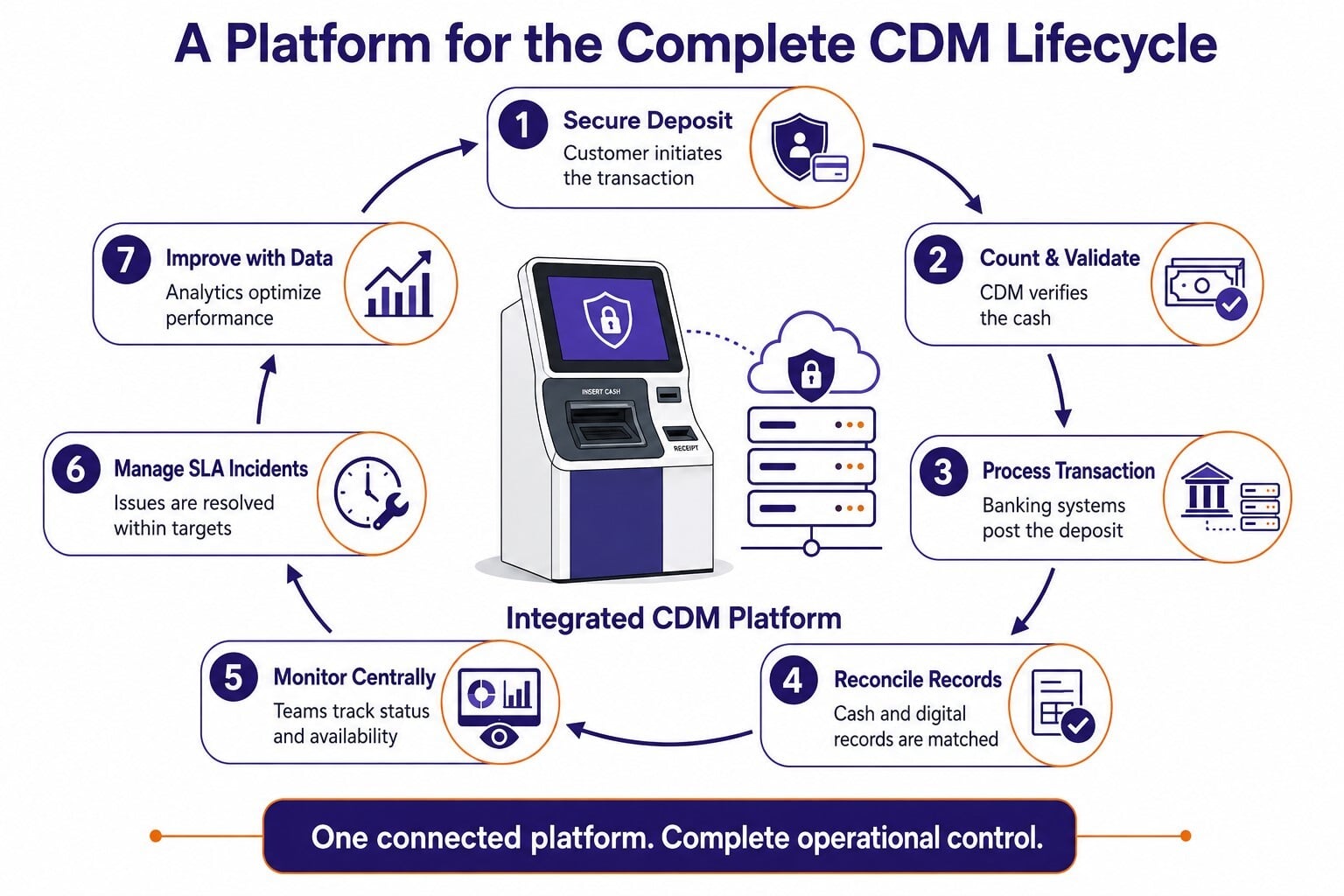
A Platform for the Complete CDM Lifecycle
The next generation of cash automation is not defined by cash acceptance alone.
Banks require a platform that manages the complete transaction and operational lifecycle:
- The customer initiates a secure deposit.
- The Cash Deposit Machine counts and validates the cash.
- The transaction is processed through banking systems.
- Physical cash and electronic records are reconciled.
- The machine is monitored centrally.
- Incidents are managed against defined SLAs.
- Operational data supports continuous improvement.
Wavetec’s WT CQuick 24, ViaOS and enterprise operational platform bring these capabilities together within one CDM ecosystem.
Final Takeaway
Next-generation CDM kiosks allow banks to move beyond basic cash acceptance toward integrated cash automation.
Bulk processing improves the deposit journey. Core banking integration enables instant or near-real-time posting. Automated reconciliation reduces manual review, while centralized monitoring gives operations teams visibility across the device network.
SLA-driven service workflows establish accountability for availability, incident response and maintenance. AI-supported forecasting and predictive monitoring can further improve capacity planning and identify technical issues before they affect customers.
As regulators promote broader CDM availability and customers expect seamless self-service, banks need more than reliable hardware. They need an operating platform capable of connecting deposits, reconciliation, monitoring, security and service management.
Wavetec’s WT CQuick 24, ViaOS and enterprise integration capabilities provide this foundation—helping banks deploy cash automation as a scalable component of branch transformation.
BOOK A FREE DEMO