Digital signage for hospitals uses networked display screens across clinical environments to provide patients with real-time queue status, appointment information, wayfinding directions, health education content, and emergency alerts. It reduces patient anxiety, minimises staff interruptions, and creates a more organised, communicative hospital environment.
Hospitals are inherently stressful places. Patients arrive worried about their health, going around unfamiliar buildings, and uncertain about what comes next. The anxiety starts before they even walk through the door.
This anxiety only grows as patients sit in waiting rooms without clear information on their status.
The problem is compounded by the sheer complexity of modern hospitals. Large campuses, multiple buildings, and countless departments create a navigation nightmare.
Patients arrive late because they cannot find the right entrance. They miss appointments because they took a wrong turn. Staff spend hours each day giving directions instead of providing care.
Static signs and outdated paper notices cannot keep up with changing layouts and service adjustments.
Digital signage for hospitals is transforming this experience.
Networked screens across clinical environments provide real-time queue status, appointment information, wayfinding directions, health education content, and emergency alerts.
They reduce patient anxiety, minimise staff interruptions, and create a more organised, communicative hospital environment.
Wavetec’s digital signage solutions are purpose-built for healthcare settings.
Why Hospital Communication Is a Patient Experience Crisis
Hospital communication failures have real consequences for patients and staff. When patients cannot find their way, they arrive late or miss appointments entirely. When waiting rooms offer no information about delays, anxiety compounds. When staff are constantly interrupted for directions, clinical care suffers.
The lack of information about what is happening, how long the wait will be, and what comes next increases the stress. Patients feel powerless and forgotten.
The burden on staff is equally significant. In large hospital environments, staff are frequently stopped for directions, pulling them away from clinical and operational responsibilities. Over time, these interruptions add up, reducing efficiency and increasing costs.
A single nurse or receptionist may answer dozens of “where is this department?” questions per shift. That is time not spent on patient care.
Outdated static signage fails to solve these problems. Printed signs cannot be updated when departments move. They do not show real-time wait times. They cannot communicate emergency alerts or display health education content. The solution requires something more dynamic.
What Is Digital Signage for Hospitals?
Digital signage for hospitals is a network of electronic display screens placed throughout clinical environments to communicate information to patients, visitors, and staff. These screens are centrally managed through a content management system that allows real-time updates across single displays or entire facilities.
The types of screens vary by location and purpose.
- Wayfinding screens at entrances, lifts, and corridor junctions help patients navigate complex campuses.
- Queue status displays in waiting rooms show real-time appointment status, ticket numbers, and estimated wait times.
- Waiting room content screens deliver health education and appointment preparation guidance.
- Department directory boards list services and locations.
- Emergency alert systems can override all screens to display critical instructions instantly.
- Staff communication displays in break rooms and nursing stations show shift information and operational announcements.
The global healthcare digital signage market was valued at $7.5 billion in 2024 and is projected to grow to nearly $19.7 billion by 2033, reflecting the expanding role of digital displays across care environments. This growth is being driven by the tangible, day-to-day value digital signage delivers inside healthcare facilities.
Key Applications of Hospital Digital Signage
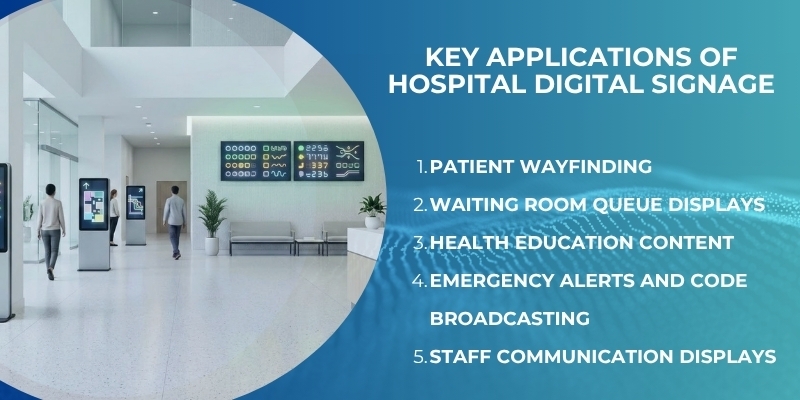
Digital signage serves multiple functions across the hospital environment. Each application addresses a specific patient or operational need.
Patient Wayfinding
Hospitals are large, busy environments that can be intimidating to navigate, especially when patients are trying to arrive at appointments on time.
Digital wayfinding signage gives visitors clear, self-guided directions. Interactive displays allow patients to search destinations, view step-by-step directions, and interact with content directly on responsive touchscreens.
Large-format displays in lobbies and high-traffic corridors provide a wide, seamless viewing experience that can be seen clearly from multiple angles. Together, these displays act as intuitive visual anchors for patients, visitors, and staff.
Waiting Room Queue Displays
Waiting rooms are where patient anxiety peaks. Digital queue displays show real-time appointment status, ticket numbers, and estimated wait times.
Patients can see their position in the queue without approaching the reception desk. This transparency reduces the “how much longer?” interruptions that plague staff and gives patients a sense of control.
Studies have found that displaying estimated wait times and surgical status updates can reduce patient anxiety and decrease perceived wait times by as much as 35%.
Health Education Content
Waiting room downtime is an opportunity for patient education. Digital signage in waiting rooms can display specialty-specific health information, giving patients a better grasp on their conditions and helping them communicate their symptoms effectively to doctors.
The more information patients have that they can easily understand, the less anxious they will feel about their doctors’ visits.
Emergency Alerts and Code Broadcasting
In emergencies, every second counts. Digital signage systems can override all screens to display emergency instructions instantly.
Evacuation routes, lockdown alerts, and safety information can be broadcast across the entire facility with a single command. This capability is critical for patient and staff safety.
Staff Communication Displays
Digital signage is not just for patients. Staff areas benefit from screens displaying shift information, key performance indicators, and operational announcements. These displays keep staff informed without requiring additional meetings or paper notices.
How Digital Signage Integrates with Hospital Queue Management
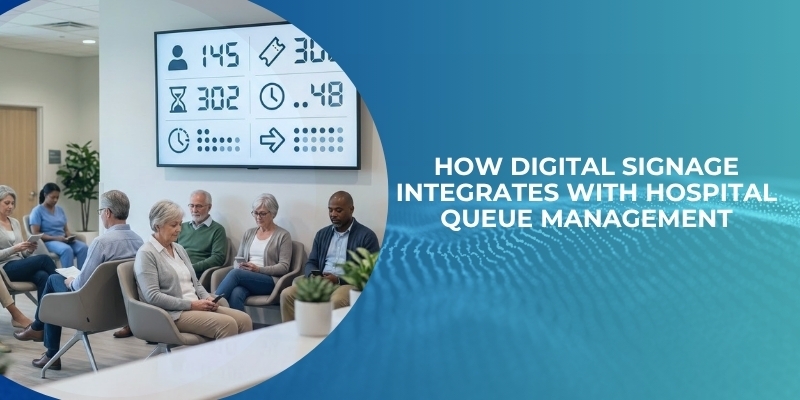
Digital signage is most powerful when it connects to the hospital’s appointment and queue management systems. This integration ensures that what patients see on screens matches what staff see on their terminals.
When a patient checks in at a self-service kiosk, the queue management system records their arrival and updates their appointment status. The digital signage system pulls this data and displays it on waiting room screens in real time.
Patients see their position in the queue and estimated wait time. Staff see the same information on their dashboards.
When an appointment is delayed, the system updates the estimated wait time automatically. Patients receive accurate information without staff intervention. When a patient is called, the screen updates instantly. This closed-loop system eliminates the information gaps that create anxiety.
Wavetec’s queue management system integrates seamlessly with digital signage, creating a unified patient flow experience from check-in to service completion.
Wayfinding Digital Signage: Solving Hospital Navigation at Scale
Large hospital complexes present unique wayfinding challenges. Multiple buildings, multiple entrances, and hundreds of departments create a maze that confuses even frequent visitors.
Digital wayfinding signage solves this through a zone-based approach.
- Screens at main entrances show an overview of the campus.
- Screens at lift lobbies show floor-by-floor directions.
- Screens at corridor junctions guide patients to specific departments.
- Department entrance screens confirm that patients have arrived at the correct location.
Multilingual wayfinding support is essential for diverse patient populations. Screens can display directions in multiple languages, rotating automatically. This ensures that all patients can navigate independently, regardless of language preference.
Interactive wayfinding kiosks allow patients to search for a department by name or specialty. The system provides step-by-step directions, including walking time and landmarks. Patients can even send directions to their phone via SMS or QR code.
Wavetec’s self-service kiosks include wayfinding capabilities that integrate with digital signage networks, providing a complete navigation solution.
Content Management for Hospital Digital Signage
Managing content across dozens or hundreds of hospital screens requires a centralized platform. A cloud-based content management system allows administrators to update content across all displays from a single dashboard.
- Scheduling by time of day is essential. Morning screens might show appointment preparation information. Afternoon screens might display health education content. Evening screens might show visitor information and visiting hours.
- Instant emergency message updates are critical. When a code is called, the system can override all screens immediately. This capability is non-negotiable for patient and staff safety.
- Multi-building campus management allows a single content team to manage screens across an entire health system. A central administrator can push content to all locations or target specific buildings, departments, or zones.
- Content should be refreshed regularly to maintain patient engagement. Stale content becomes background noise. Fresh content captures attention and delivers value.
Case Study – Villa Betania Clinic Improves Patient Navigation with Digital Signage
Hospital digital signage works best when it supports the full patient journey, from check-in to waiting, navigation, and service completion. In healthcare environments, patients often move between reception, diagnostics, laboratories, and consultation areas. Without clear visual guidance, they can become confused, anxious, or repeatedly ask staff for directions.
Villa Betania Clinic Uses Digital Signage to Simplify Patient Flow
Villa Betania Clinic in Rome implemented Wavetec’s queue management and digital signage solution to improve patient navigation across a complex healthcare environment.
The clinic served both inpatients and outpatients across multiple reception areas, blood lab services, diagnostics, and specialized procedures. With 13 service categories and a large elderly patient base, Villa Betania needed a system that was simple, visible, and easy to follow.
Wavetec deployed Donatello Digital Signage across 13 monitors, with customized screen layouts for different clinic areas. Reception screens displayed only reception-related queue calls, while other displays were grouped by department to show relevant ticket information.
This helped patients understand where to wait, when they were called, and which area they needed to visit next.
The system also supported multimedia content, RSS feeds, and multilingual WhatsApp queuing in Italian, English, and Spanish. This improved communication for diverse patient groups while reducing uncertainty in waiting areas.
As a result, Villa Betania improved patient navigation, reduced confusion across departments, enhanced waiting room communication, and created a more organized healthcare journey. This directly supports the role of hospital digital signage in reducing patient anxiety and minimizing staff interruptions.
FAQs
What is digital signage for hospitals?
Digital signage for hospitals is a network of electronic display screens placed throughout clinical environments to communicate real-time information to patients, visitors, and staff.
It includes wayfinding directions, queue status, health education, and emergency alerts, all managed from a central platform.
How does hospital digital signage reduce patient anxiety?
Digital signage reduces anxiety by providing transparency. Patients see their queue position and estimated wait time, eliminating the fear of being forgotten.
Educational content keeps them engaged and informed. Wayfinding screens remove the stress of getting lost. Together, these reduce perceived wait time by up to 35%.
Can digital signage integrate with hospital appointment systems?
Yes. Digital signage integrates with appointment scheduling and queue management systems through APIs.
When a patient checks in, the system updates waiting room displays automatically. When an appointment is delayed, the estimated wait time adjusts in real time.
What content should be shown on hospital waiting room screens?
Waiting room screens should display queue status, estimated wait times, and appointment information. They should also show health education content relevant to the patients being seen.
Custom practice messages encouraging patients to talk to their doctor and ask about their symptoms are also effective.
How is hospital digital signage content managed and updated?
Content is managed through a cloud-based platform that allows administrators to update all screens from a single dashboard. Updates can be scheduled by time of day, targeted to specific buildings or zones, and overridden instantly for emergency alerts.
Author Bio: This article was written by the healthcare solutions team at Wavetec, a global provider of digital signage, queue management, and patient journey platforms. Wavetec has helped hospitals and health systems worldwide improve patient communication, reduce anxiety, and optimize operational flow.
Conclusion
Digital signage for hospitals is transforming patient communication, reducing anxiety, and improving operational flow.
By providing real-time queue status, clear wayfinding directions, engaging health education, and instant emergency alerts, smart screens address the communication failures that have long plagued healthcare environments. Patients feel more informed and less anxious. Staff spend less time answering repetitive questions and more time on clinical care.
The market is growing rapidly, reflecting the tangible value hospitals are realising. Wavetec’s healthcare digital signage solutions are designed to integrate with queue management and patient journey platforms, creating a unified communication ecosystem.
BOOK A FREE DEMO