Double booking scheduling is the practice of intentionally or accidentally assigning two or more appointments to the same time slot. When used strategically with buffer policies and no-show data, it maximizes service capacity; when unmanaged, it creates scheduling conflicts, customer frustration, and operational chaos.
Few things frustrate a customer more than arriving for a scheduled appointment only to be told there is a conflict. They took time off work. They arranged childcare. They arrived on time. And now they must wait or reschedule.
From the customer perspective, double booking is a failure. From the business perspective, the situation is more complex. Empty appointment slots cost money. No-shows are unpredictable. And in many service industries, turning away a customer who is physically present while a reserved slot remains empty feels inefficient.
This tension between capacity utilization and customer experience creates a difficult balance.
Double booking scheduling sits at the center of that tension. When accidental, it is a sign of poor systems. When intentional and strategic, it is a revenue optimization technique used by airlines, hotels, and medical clinics. The difference lies in data, policies, and technology.
This article explores when double booking is a mistake, when it is a strategy, and how intelligent scheduling software helps businesses maximize capacity without damaging customer trust.
Wavetec’s queue management system and appointment scheduling solutions are designed to handle this complexity.
What Is Double Booking Scheduling?
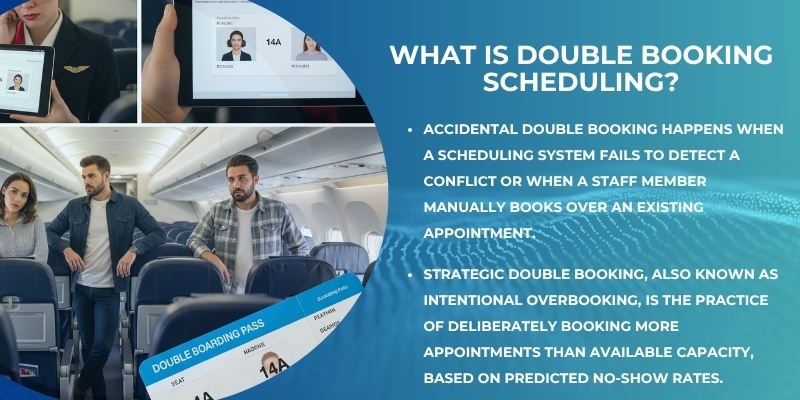
Double booking scheduling occurs when two or more customers are assigned the same appointment time slot. There are two very different types.
- Accidental double booking happens when a scheduling system fails to detect a conflict or when a staff member manually books over an existing appointment. This is an error. It creates customer frustration, staff stress, and operational chaos. It often results from using spreadsheets, paper calendars, or outdated scheduling software without real-time conflict detection.
- Strategic double booking, also known as intentional overbooking, is the practice of deliberately booking more appointments than available capacity, based on predicted no-show rates. For example, a dental clinic might book 11 patients for 10 chairs during a time slot when historical data shows that one patient typically does not show up. This strategy maximizes utilization and reduces revenue loss from empty slots.
The key difference is intent and data. Accidental double booking has no justification. Strategic double booking is calculated, monitored, and adjusted based on real performance metrics.
When Double Booking Is a Strategy, Not a Mistake
Service businesses lose significant revenue to no-shows and last-minute cancellations. A healthcare practice with a 20% no-show rate leaves exam rooms empty for one out of every five appointments. A salon with the same rate loses thousands in potential revenue each month. The instinct is to overbook.
The airline industry pioneered strategic overbooking. Carriers typically overbook flights by 5–15% based on historical no-show data, a practice that has influenced appointment-based businesses in healthcare, hospitality, and professional services. Airlines know that a certain percentage of passengers will not show up. By selling more tickets than seats, they ensure the plane flies full.
Similar logic applies to many service businesses. A medical clinic with reliable no-show data can overbook by a calculated percentage. If 10% of morning appointments are no-shows, the clinic can book 11 patients for 10 slots. The risk is that on a day when everyone shows up, there is a conflict. But the data says that day is rare.
The industries where strategic double booking works best share certain characteristics.
- No-show rates are predictable rather than random.
- Service times are relatively consistent.
- The cost of a conflict (customer wait or reschedule) is lower than the revenue lost from an empty slot.
The Risks of Unmanaged Double Booking
Strategic double booking requires careful management. Without it, the risks outweigh the benefits.
- Customer experience damage is the most immediate risk. A customer who arrives for a scheduled appointment and is told there is a conflict feels disrespected. They may leave a negative review, complain to friends, or never return. In competitive service industries, that customer is lost.
- Conflict escalation occurs when two customers arrive for the same appointment and both demand immediate service. Staff must manage an awkward situation, often by asking one customer to wait or reschedule. This damages trust with both parties.
- Staff stress increases when double bookings become routine. Receptionists dread calling customers to reschedule. Service providers feel pressure to rush through appointments to catch up. Morale suffers.
In some industries, there are legal or regulatory implications. Medical practices have duty of care obligations. Overbooking that leads to delayed treatment could have serious consequences.
For these reasons, double booking must be managed, not just allowed. Any business that intentionally overbooks needs clear policies, communication protocols, and the technology to handle exceptions.
How to Implement Strategic Double Booking Responsibly
Responsible double booking follows a methodology based on data and contingency planning.
Calculating No-Show Rates
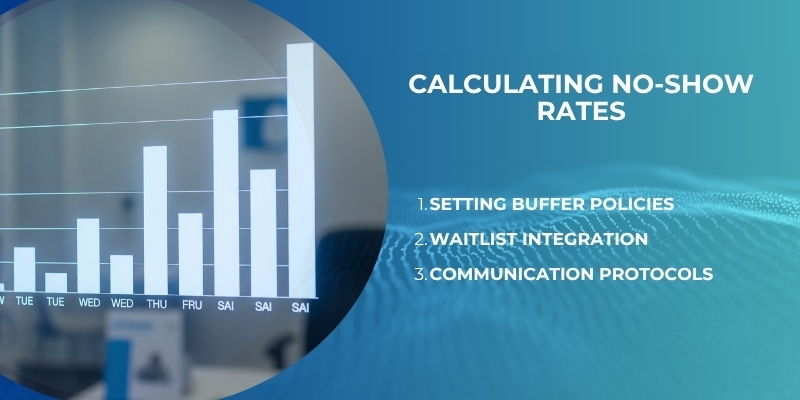
The first step is analyzing historical appointment data. What percentage of appointments are no-shows? How does this vary by day of week, time of day, and appointment type?
A clinic might find that Monday mornings have 5% no-shows but Friday afternoons have 20%. Overbooking should be adjusted accordingly.
Setting Buffer Policies
Based on no-show data, the business sets a maximum overbooking percentage or number per time slot. A conservative approach might overbook by only half the no-show rate, accepting some empty slots to avoid conflicts.
An aggressive approach might overbook at the full no-show rate, accepting that occasional conflicts will require management.
Waitlist Integration
A waitlist is essential for managing the rare occasion when more customers show up than capacity allows.
When a conflict occurs, the business can call the last-booked customer and ask if they are willing to reschedule, perhaps with a small incentive. Alternatively, a waitlist customer can be called if a slot opens.
Communication Protocols
Clear policies should be documented for handling conflicts. Which customer gets priority? The one who booked first? The one with a longer travel distance? The one whose appointment is more urgent? Staff need training to handle these situations professionally, with apologies and compensation when appropriate.
How Scheduling Software Prevents Accidental Double Bookings
Most accidental double bookings happen because of human error or inadequate technology. A staff member books an appointment from a phone call while another staff member books the same slot online. A paper calendar is not updated. A spreadsheet has conflicting versions.
Modern scheduling software eliminates these errors through several mechanisms.
- Real-time conflict detection prevents any user from booking an appointment into an already occupied slot.
- Calendar sync ensures that changes made on one device or by one user are instantly visible to all.
- Multi-staff and multi-resource scheduling allows the system to check availability of rooms, equipment, and staff simultaneously.
Healthcare practices that use intelligent double booking algorithms tied to no-show probability scores see 18% higher appointment slot utilization without a corresponding increase in patient wait times. This improvement comes from technology that understands which slots are likely to be no-shows and which are not.
Wavetec’s customer journey management platform includes appointment scheduling with real-time conflict detection and calendar synchronization.
AI-Powered Scheduling and Double Booking Prevention
Artificial intelligence takes double booking management to the next level. AI Appointment Scheduling systems analyze far more data than simple no-show rates.
They consider patient history, appointment type, lead time, weather, and even traffic patterns.
A patient who has missed three appointments in the past year gets a higher no-show probability score than a patient who has never missed. The system can then decide whether to overbook that slot.
AI can also provide dynamic recommendations. Instead of a fixed overbooking percentage, the system might recommend overbooking by 2% on Tuesday mornings and 15% on Friday afternoons based on real-time conditions. This precision reduces conflicts while maximizing utilization.
When a cancellation occurs, AI can automatically offer the slot to the most appropriate waitlist customer based on their probability of showing up, location proximity, and appointment urgency.
Double Booking in Healthcare: Special Considerations
Healthcare has unique constraints around double booking. Patient safety is essential. A physician rushed because of an overbooked schedule may miss a critical symptom. A patient who needs timely care should not be delayed repeatedly.
Regulatory compliance adds another layer. Some healthcare systems have contractual obligations about appointment wait times. Overbooking that leads to regular delays could violate these agreements.
Responsible healthcare overbooking uses narrow margins. A clinic might overbook by only 5% based on extremely reliable no-show data. It might limit overbooking to certain appointment types, such as routine checkups, while never overbooking urgent care slots. It might also build in buffer time between appointments to absorb unexpected overlaps.
Case Study – Dental Clinic Increases Utilization with Smart Double Booking
Dental clinics frequently struggle with appointment no-shows, late arrivals, and uneven chair utilization. Empty treatment slots reduce revenue, while unmanaged overbooking creates delays and patient frustration.
Wavetec’s healthcare scheduling and queue management deployments demonstrate how intelligent appointment coordination, digital notifications, and workflow-based queue systems help clinics maximize utilization without compromising patient experience.
Nahdi Care Clinics – Workflow-Based Scheduling Improves Patient Flow
Nahdi Care Clinics implemented Wavetec’s queue management and appointment workflow solution to improve patient coordination across triage and doctor consultations. The deployment integrated Wavetec’s Spectra API with the clinic’s Hospital Information System, enabling real-time appointment visibility and workflow-based patient routing.
Patients received WhatsApp notifications throughout their journey, including queue updates, room guidance, and post-visit communication. The workflow-based ticketing logic automatically transferred patients from triage to the assigned doctor once the previous stage was completed.
This structured scheduling and queue coordination model helped reduce idle consultation capacity while maintaining a smoother patient experience. Similar scheduling intelligence can support strategic double booking practices by ensuring that cancellations, delays, and patient flow adjustments are managed dynamically rather than manually.
Strategic double booking only works when supported by intelligent scheduling and real-time queue coordination. Healthcare organizations need visibility into patient flow, appointment attendance patterns, and service capacity before they can safely optimize utilization.
FAQs
What is double booking scheduling?
Double booking scheduling is the practice of assigning two or more appointments to the same time slot. It can be accidental (a system error or human mistake) or strategic (intentional overbooking to compensate for predictable no-shows and maximize capacity utilization).
Is double booking scheduling legal?
Yes, in most service industries. Airlines, hotels, and medical clinics legally overbook as long as they have clear policies for managing conflicts. Some regulated industries (certain healthcare settings) have specific constraints, but double booking itself is not illegal.
How does strategic double booking differ from overbooking?
They are often used interchangeably. Strategic double booking is a specific form of overbooking where appointments are double-booked based on data rather than guesswork. Overbooking is the broader practice of accepting more reservations than available capacity.
How can scheduling software prevent accidental double bookings?
Scheduling software uses real-time conflict detection to prevent any user from booking an appointment into an occupied slot. Calendar sync ensures all devices show the same availability. Multi-resource checking verifies staff, room, and equipment availability simultaneously.
Which industries use double booking scheduling most?
Airlines, hotels, medical and dental clinics, salons and spas, professional services (law firms, consultancies), and fitness studios use strategic double booking. Any service business with predictable no-show rates can benefit.
Author Bio: This article was written by the appointment scheduling team at Wavetec, a global provider of queue management and intelligent scheduling solutions. Wavetec helps businesses reduce no-shows, optimize capacity, and prevent scheduling conflicts through AI-powered software.
Conclusion
Double booking scheduling is neither inherently good nor bad. It is a tool.
- When used accidentally or without data, it damages customer relationships and creates chaos.
- When used strategically with no-show analytics, buffer policies, and waitlist management, it recovers lost revenue and improves capacity utilization.
The key is intention, data, and technology. Intelligent scheduling software prevents the mistakes that give double booking a bad name, while enabling the strategic overbooking that airlines, clinics, and service businesses use to stay profitable.
Wavetec’s appointment scheduling and queue management solutions include AI-powered no-show prediction, real-time conflict detection, and dynamic waitlist management.
BOOK A FREE DEMO