A customer checks their account balance on a mobile banking app. They see a certain amount. Minutes later, they walk into a branch, use a self-service kiosk, and the balance shown is different.
A payment they made online is reflected in one channel but not another. This inconsistency erodes trust instantly.
In modern banking, customers interact across mobile apps, websites, branches, kiosks, and call centers, often within the same hour. They expect real-time, accurate information everywhere, every time. Yet behind the scenes, many banks still operate with disconnected systems.
Core banking platforms, customer relationship management databases, digital channels, and analytics engines often run on separate, siloed infrastructures. This fragmentation leads to outdated balances, duplicate customer records, service delays, compliance gaps, and frustrated customers.
The solution to this problem is Data Synchronization. It is the foundational mechanism that keeps banking systems aligned, accurate, and responsive in real time. Without it, banks cannot deliver the seamless, trustworthy experiences that customers now demand.
According to McKinsey, banks modernizing their data architectures increasingly prioritize real-time data synchronization in banking to improve agility, accuracy, and customer experience.
This shift from batch-oriented, overnight processing to continuous, real-time data alignment is transforming how financial institutions operate and compete.
What Is Data Synchronization?
Data synchronization is the process of keeping data consistent, accurate, and up to date across multiple systems, applications, databases, and channels automatically and continuously.
When data is created, updated, or deleted in one place, synchronization ensures that the same change is reflected everywhere else that data exists. This involves data replication, where copies of data are distributed across systems, and data consistency checks to verify that all copies match.
In banking, synchronization applies to customer profiles, account balances, transaction histories, loan statuses, and compliance records. It ensures that a customer viewing their information on a mobile app sees the same data as a teller at a branch counter and a fraud monitoring system running in the background.
Without synchronization, each system becomes a hub of information, and the customer experience becomes fragmented and unreliable.
How Data Synchronization Works in Banking Systems
In a typical bank, data originates in multiple places. Core banking systems hold account master data. Customer relationship management platforms store interaction history. Digital channels generate transaction requests. Fraud detection systems consume transaction data in real time.
Banking data integration is the technical discipline that connects these disparate systems and enables them to share information. Real-time data synchronization is achieved through several mechanisms.
APIs, or Application Programming Interfaces, are the most common modern method. When a transaction occurs in a mobile app, an API call instantly updates the core banking system, which in turn triggers notifications to other dependent systems.
Banking middleware acts as a central hub, receiving data events from one system and broadcasting them to all others that need to know.
Event-driven architectures use message queues and publish-subscribe patterns to propagate changes as they happen.
For example, when a customer updates their address in a branch, an event is published. Every subscribed system, from loan servicing to marketing analytics, receives that event and updates its local copy of the customer record.
This approach ensures that all channels remain synchronized without requiring direct point-to-point connections between every pair of systems.
This integration layer is fundamental to delivering a unified customer journey management experience across all banking touchpoints.
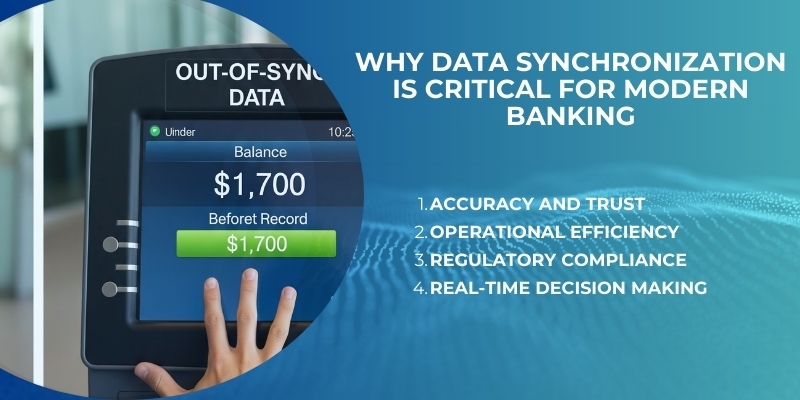
Why Data Synchronization Is Critical for Modern Banking
Accenture reports that inconsistent or delayed data remains a major barrier to delivering real-time banking experiences and operational efficiency.
Understanding the criticality of data synchronization in banking is essential. It directly impacts four core dimensions of banking performance.
- First, accuracy and trust. Customers trust banks with their money. Any discrepancy in displayed balances, transaction histories, or account statuses undermines that trust instantly.
- Second, operational efficiency. When data is synchronized, employees do not waste time manually reconciling records or asking customers to repeat information across channels.
- Third, regulatory compliance. Banking regulators require accurate, auditable records of customer data, transactions, and risk exposures. Inconsistent data creates compliance gaps and audit failures.
- Fourth, real-time decision making. Fraud detection, credit approvals, and personalized offers all depend on having the most current data available.
Delayed or inconsistent data leads to bad decisions, missed opportunities, and increased risk. Data consistency in banking is not just a technical requirement.
Impact of Poor Data Synchronization (Risks & Consequences)
When data synchronization fails or is not implemented, the consequences ripple across every part of the banking operation.
The most visible impact is on customers.
- Incorrect balances lead to declined transactions, overdraft fees, and angry calls to contact centers.
- Duplicate customer records mean that a loyal customer with a long history may be treated as a new applicant, losing access to relationship-based benefits and offers.
- Failed transactions occur when systems have conflicting information about account status or available funds. These failures destroy customer confidence.
Beyond customer experience, poor synchronization creates serious operational risks. Compliance and audit gaps emerge when different systems report different versions of the same transaction or customer profile.
Regulators require a single, reliable source of truth. When that does not exist, banks face fines, sanctions, and reputational damage.
Internally, employees spend countless hours manually reconciling data across spreadsheets, investigating discrepancies, and correcting errors. This operational drag increases costs and slows response times.
The cumulative effect of poor data accuracy is a bank that appears unreliable to customers, inefficient to shareholders, and risky to regulators.
Data Synchronization and Omnichannel Banking Experiences
Modern banking is defined by the expectation of omnichannel experiences. A customer might research loan options on a mobile app, complete an application on a laptop, visit a branch to finalize documents, and later check the loan status through a call center.
At every step, they expect the same information, the same status, and the same recognition. This is impossible without synchronized banking systems.
When data is synchronized, a loan application started on mobile is instantly visible to the branch staff when the customer walks in. The customer does not need to repeat information. The branch knows what has been completed and what remains.
When a payment is made at a self-service kiosk, the updated balance is immediately reflected in the mobile app. The customer does not wonder if the transaction was actually posted.
When a customer updates their contact information through a call center, every future interaction across all channels uses the new data. This seamlessness is what customers now expect from their primary financial institution.
It is delivered not by any single channel, but by the invisible synchronization layer that connects them all. A modern banking customer experience strategy is fundamentally a data synchronization strategy.
Real-Time Data Synchronization in Branches and Self-Service
Bank branches and self-service channels present unique challenges for real-time data synchronization. Unlike digital channels that are inherently connected, branch systems have historically operated with varying degrees of connectivity.
Teller platforms, kiosks, and queue management systems must all reflect the same real-time information as online banking.
Consider a customer who checks in at a branch using a queue management system. The system needs to know why they are visiting, which may have been pre-scheduled through an online appointment. It needs to pull their current profile and recent activity to route them to the right specialist.
After the visit, any changes made, such as an address update or a transaction, must be synchronized back to the core systems and reflected across all channels instantly.
Similarly, a self-service kiosk that allows customers to print statements, order cards, or make payments must operate with the same data as the mobile app.
If a payment is made at a kiosk, the customer should see that payment reflected online immediately. This requires bidirectional, real-time synchronization between the kiosk platform and the core banking systems.
This integration is a key component of successful bank branch transformation, turning physical locations from isolated service points into fully connected extensions of the digital bank.
Role of APIs in Data Synchronization
APIs are the primary technical mechanism for achieving API-based data sync in modern banking. They provide a standardized, secure way for different systems to request and exchange data.
When a banking application needs customer information, it calls an API exposed by the core system. When a transaction occurs, an API call notifies all interested systems.
This approach enables system interoperability without requiring all systems to be built on the same platform or even located in the same data center.
APIs abstract the underlying complexity. The mobile app does not need to know how the core banking system stores data. It only needs to know how to request it via API.
APIs also enable event-driven synchronization. When a significant event occurs, such as a high-value transaction or a profile change, the system can publish an event via API to a message bus.
Any other system that has subscribed to that event type receives the data and updates itself accordingly.
This pattern is scalable, resilient, and well suited to the distributed nature of modern banking architectures. A robust digital banking platform is built on this API-first approach to data synchronization.
Data Synchronization, Security, and Compliance
Synchronizing data across multiple systems introduces legitimate security and compliance concerns.
Every copy of data is a potential target. Every data transmission is a potential interception point. However, a well-architected synchronization strategy actually improves security and compliance posture compared to fragmented, ad-hoc data sharing.
Secure data synchronization relies on encryption for data in transit and at rest. All API communications use TLS encryption. Sensitive data elements, such as personally identifiable information, are encrypted before storage in secondary systems.
Access controls ensure that only authorized systems and users can request or receive synchronized data. Comprehensive audit logs track every data access and change, creating a complete chain of custody for compliance purposes.
Data governance is the discipline that oversees all of this. It defines who owns each data element, which systems are authorized to store copies, how long data should be retained, and what synchronization rules apply. Regulators increasingly focus on data governance as a critical risk management capability.
The Bank for International Settlements emphasizes that consistent and well-governed data aggregation is critical for banking supervision and risk management. A mature data synchronization strategy is inseparable from a strong data governance framework.
Architecture Approaches to Data Synchronization in Banking
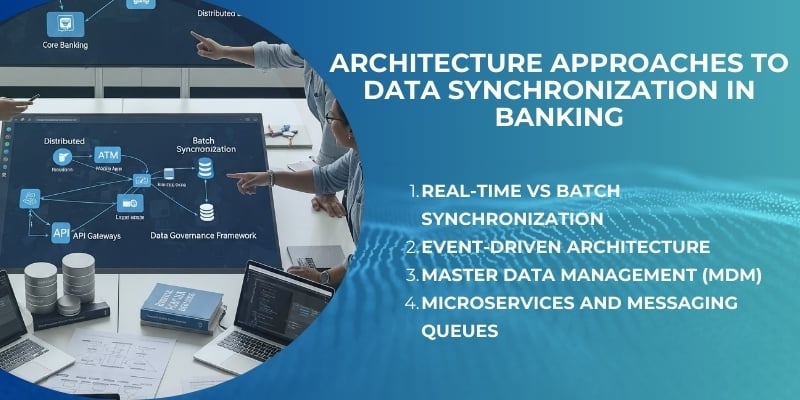
Banks have several architectural options for implementing data synchronization, each with trade-offs in speed, complexity, and consistency. The choice depends on the specific use case and data requirements.
- Real-time vs batch synchronization is the most fundamental distinction. Batch synchronization processes updates in scheduled intervals, such as hourly or nightly. It is simpler to implement but introduces latency. Real-time synchronization processes updates as they happen, ensuring immediate consistency across systems. Modern banking increasingly demands real-time approaches.
- Event-driven architecture is the dominant pattern for real-time synchronization. In this model, systems emit events whenever data changes. Other systems subscribe to relevant event types and react immediately. This decouples the systems while maintaining synchronization. Research published via IEEE Xplore highlights how real-time data synchronization in distributed financial systems reduces latency and improves consistency under high transaction loads.
- Master data management (MDM) is a complementary discipline. MDM establishes a single, authoritative source for critical data entities like customer, product, and account. All other systems synchronize to this master source, ensuring consistency across the enterprise.
- Microservices and messaging queues provide the technical infrastructure for event-driven synchronization. Each microservice owns its data but publishes events when changes occur. Messaging queues ensure reliable delivery of these events even under high load.
Data Synchronization and Open Banking
Open banking fundamentally depends on data synchronization. Open banking frameworks require banks to share customer data securely with authorized third-party providers through standardized APIs.
This data must be accurate, current, and consistent with what the customer sees in their own banking channels.
When a customer uses a budgeting app to see their account balances across multiple banks, that app relies on APIs that return synchronized data directly from each bank’s core systems. If the data returned is outdated or inconsistent with the bank’s own app, the customer loses trust in both the app and the bank.
The regulatory requirements for open banking, such as those defined by Open Banking UK, mandate that data provided through APIs must be as accurate and timely as data provided through the bank’s own channels. This places data synchronization at the heart of open banking compliance and customer experience.
For banks participating in open ecosystems, synchronization is not optional. It is the foundation of every third-party integration. This is increasingly central to the banking industry’s evolution toward platform-based models.
Common Challenges in Data Synchronization (And Solutions)
Implementing enterprise data synchronization across a large, complex banking organization is not without obstacles. Understanding these challenges and their solutions is essential for success.
- Legacy system silos are the most pervasive challenge. Core banking systems built decades ago were never designed for real-time API access.
The solution is to wrap these systems with modern API layers and event adapters that translate between old protocols and new standards. This allows synchronization without requiring core replacement.
- Latency and data conflicts arise when multiple systems update the same data simultaneously. A customer might update their address through mobile and branch at nearly the same time.
Conflict resolution strategies, such as timestamp-based prioritization or human review queues, are needed to maintain consistency.
- Scaling across channels becomes difficult as transaction volumes grow.
Event-driven architectures and distributed messaging systems are designed to scale horizontally, handling millions of events per day without degradation.
- Governance complexity increases as more systems participate in synchronization.
Centralized monitoring tools provide visibility into data flows, latency, and error rates. Clear data ownership policies define who is responsible for each data element’s accuracy.
Future of Data Synchronization in Banking
The future of banking is real-time, intelligent, and embedded. Data synchronization will be the invisible infrastructure that makes this future possible. Several trends are shaping this evolution.
- Real-time, event-driven banking will become the default architecture. Batch processing will be reserved for non-critical reporting and analytics. Every customer interaction, every transaction, every profile change will be an event that synchronizes instantly across the enterprise.
- AI-driven data validation will automate the detection and correction of data inconsistencies. Machine learning models trained on historical data patterns will identify anomalies that indicate synchronization failures and trigger automated remediation.
- Embedded finance will extend synchronization requirements beyond the bank’s own systems. As banking services are embedded into non-banking platforms, such as e-commerce sites or accounting software, synchronization must extend to these external environments, ensuring consistent data across the entire customer ecosystem.
- Cloud-native data platforms will provide the scalability and resilience needed for real-time synchronization at global scale. These platforms are designed from the ground up for distributed, event-driven architectures.
The World Bank notes that interoperable and synchronized financial data infrastructures are key to scalable, inclusive digital financial systems. This vision of a connected, real-time financial ecosystem depends entirely on robust, reliable real-time banking data synchronization.
FAQs
What is data synchronization in banking?
Data synchronization in banking is the process of keeping customer, account, and transaction data consistent and up to date across all banking systems and channels automatically. It ensures that information displayed on mobile apps matches what is in core systems and what branch staff see.
Why is data synchronization important for customer experience?
It ensures customers see accurate, consistent information whether they are using mobile banking, visiting a branch, or using a self-service kiosk. This consistency builds trust, reduces frustration, and creates a seamless omnichannel experience.
How does real-time data synchronization work?
Real-time synchronization uses APIs, event streams, and message queues to propagate data changes instantly across systems. When data updates in one place, an event is published, and all subscribed systems receive and apply that update immediately.
What role do APIs play in data synchronization?
APIs provide standardized, secure interfaces that allow different banking systems to request and exchange data. They enable real-time queries and event notifications, forming the technical foundation of modern synchronization architectures.
What happens if banking data is not synchronized?
Unsynchronized data leads to incorrect balances, duplicate customer records, failed transactions, compliance gaps, and poor customer experiences. It increases operational costs as employees manually reconcile discrepancies and exposes the bank to regulatory risk.
Conclusion
Data synchronization is the foundational capability that enables modern banking to function as a unified, reliable, and responsive system.
It ensures that customer information, account balances, and transaction histories are consistent and accurate across every channel, from mobile apps to branch kiosks.
It eliminates the friction of disconnected systems, the risk of outdated information, and the cost of manual reconciliation.
As banks expand their digital channels, integrate with fintech partners through open banking, and move toward real-time, event-driven architectures, the importance of synchronization only grows.
It is not a technical nice-to-have or an infrastructure detail. It is the mechanism that turns fragmented systems into a cohesive enterprise, enabling the accuracy, trust, and real-time experiences that define modern banking.
For banks committed to competing in an increasingly digital and customer-centric environment, investing in banking data integration and synchronization capabilities is a strategic necessity.
BOOK A FREE DEMO