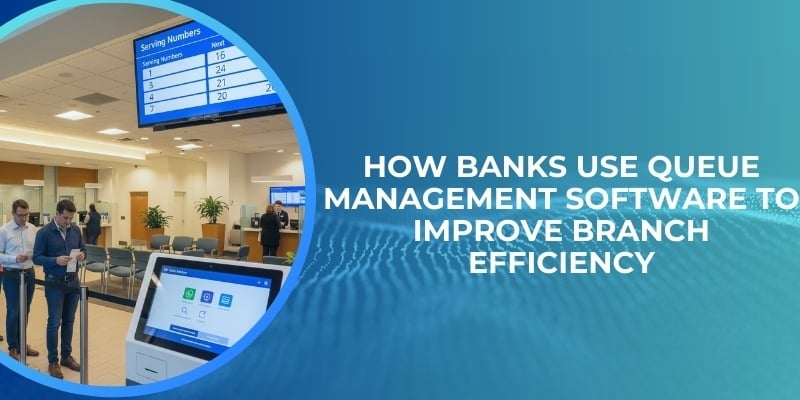
In today’s fast-paced service environment, businesses manage increasing customer traffic across branches, service centers, kiosks, and digital channels.
Traditional queue systems often rely on local servers and manual processes, making them difficult to scale and manage across multiple locations.
As customer expectations for seamless service continue to rise, organizations are discovering that legacy approaches to queue management simply cannot keep pace.
Cloud-based queue management systems have emerged as modern platforms that allow organizations to manage queues centrally, monitor service performance remotely, and optimize customer flow in real time.
From banking and healthcare to retail, telecommunications, and government services, industries across the board are adopting cloud queue management systems to transform their service delivery.
As of late 2024, approximately 58% of institutions have migrated from traditional on-premise systems to cloud-hosted queue management platforms to achieve greater scalability and centralized service control.
This shift represents a fundamental change in how businesses approach customer flow management, enabling them to leverage cloud infrastructure for greater agility and insight.
A cloud-based queue management system is a digital platform that manages customer queues, appointments, and service workflows using cloud infrastructure.
It enables organizations to monitor queues remotely, scale services across multiple locations, and improve customer experiences through centralized data and real-time service management.
What Is a Cloud-Based Queue Management System?
A cloud-based queue management system is a digital solution that uses cloud servers, centralized dashboards, and internet-based infrastructure to manage customer queues across multiple locations.
Unlike traditional on-premise systems that require local servers and dedicated IT resources at each branch, cloud-based platforms operate on infrastructure hosted by providers like AWS, Google Cloud, or Azure.
With a cloud queue management software solution, businesses can monitor queues, appointments, and service performance remotely from any location with internet access.
Service data is stored securely in the cloud, enabling real-time visibility into operations across an entire network of branches. Managers can view dashboards showing wait times, service volumes, and staff performance without ever setting foot in a physical location.
This centralized approach represents a paradigm shift in queue management. Instead of each branch operating as a silo with its own data and processes, cloud systems create a unified view of customer flow across the entire organization.
This visibility enables better decision-making, more consistent service standards, and the ability to identify and replicate best practices across locations.
How Cloud Queue Management Systems Work
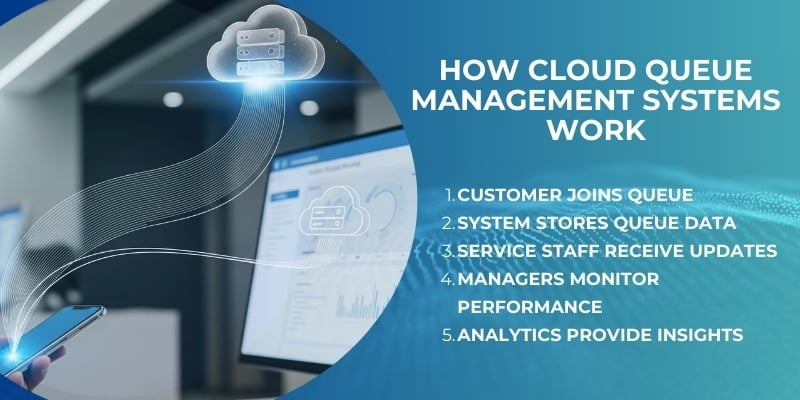
The operational flow of a cloud queue management system is designed for seamless customer flow automation:
- Customer joins queue: Customers can join virtually through a mobile app or website, or on-site via self-service kiosks or QR code check-in
- System stores queue data: All queue information is stored in secure cloud infrastructure
- Service staff receive updates: Employee dashboards and consoles display real-time queue status
- Managers monitor performance: Centralized dashboards provide visibility across all locations
- Analytics provide insights: Historical data helps optimize staffing and service delivery
The key advantage of this workflow is real-time synchronization across locations. When a customer joins a queue remotely, that information is instantly available to staff at the branch.
When service times fluctuate, managers can see the impact immediately and adjust resources accordingly. This level of coordination is simply impossible with traditional on-premise systems that lack centralized data sharing.
Why Businesses Are Switching to Cloud-Based Queue Management
Organizations are increasingly choosing cloud deployment for their queue management needs due to several compelling advantages:
- Centralized management across branches is perhaps the most significant benefit. With a cloud platform, businesses can configure settings, deploy updates, and monitor performance for all locations from a single interface. This eliminates the need to visit each branch individually for system maintenance or configuration changes.
- Lower infrastructure costs make cloud solutions attractive for organizations of all sizes. Instead of purchasing servers and hardware for each location, businesses pay predictable subscription fees. This shifts spending from capital expenditure (CAPEX) to operational expenditure (OPEX), which many financial departments prefer.
- Easier scalability means organizations can add new locations or increase capacity during peak periods within minutes. Whether opening a new branch or preparing for seasonal demand spikes, cloud systems can scale instantly without hardware procurement delays.
- Remote monitoring capabilities give managers and executives unprecedented visibility into operations. From corporate headquarters or while traveling, leadership can check real-time performance metrics and identify issues before they impact customer satisfaction.
- Faster updates and integration ensure that cloud systems remain current with the latest features and security protocols. Providers handle maintenance automatically, so businesses always run the most up-to-date version without IT intervention.
Key Features of Cloud-Based Queue Management Systems
Here are the main features of cloud-based queue management system:
Centralized Queue Control
Manage queues across multiple branches from a single dashboard. Configure service rules, staff assignments, and customer flow parameters for all locations without on-site visits.
Real-Time Monitoring and Analytics
Track service times, queue lengths, and customer wait times as they happen. Comprehensive analytics reveal patterns and opportunities for improvement.
Appointment Scheduling Integration
Allow customers to book visits in advance and seamlessly integrate scheduled appointments with walk-in traffic. This hybrid approach optimizes service delivery and reduces peak-time congestion.
Remote System Access
Managers can monitor queues, adjust settings, and view performance reports from any internet-connected device, enabling responsive management regardless of location.
Omnichannel Customer Entry
Customers can join queues through multiple channels including self-service kiosks, mobile apps, websites, and QR codes, providing flexibility and convenience. This integration with a customer journey management platform ensures a seamless experience from first touchpoint to service completion.
Cloud vs On-Premise Queue Management Systems
| Feature | Cloud-Based QMS | On-Premise QMS |
| Deployment | Hosted in cloud, accessed via internet | Installed locally on customer servers |
| Scalability | High – add locations instantly | Limited – requires hardware for expansion |
| Maintenance | Managed remotely by provider | Requires local IT team management |
| Multi-branch management | Easy – centralized dashboard | Complex – site-by-site configuration |
| System updates | Automatic and seamless | Manual, scheduled by IT team |
| Initial cost | Lower, subscription-based | High capital investment |
| Internet dependency | Requires stable connection | Operates during outages |
| Data control | Provider-managed infrastructure | Complete internal control |
Cloud systems offer significantly greater operational flexibility compared to traditional on-premise solutions.
For organizations with multiple locations, the ability to manage everything centrally eliminates the logistical challenges of coordinating hardware installations and software updates across dozens or hundreds of sites.
Benefits of Cloud-Based Queue Management Systems
The advantages of cloud deployment extend across every aspect of queue management:
- Improved scalability allows organizations to grow without infrastructure constraints. Opening new branches becomes a matter of software configuration rather than hardware procurement.
- Reduced infrastructure costs eliminate the need for servers, networking equipment, and dedicated IT staff at each location. Subscription pricing makes costs predictable and manageable.
- Centralized control ensures consistent service standards across all locations. Policies, configurations, and service rules can be applied universally from a single interface.
- Better service visibility gives managers real-time insight into operations. When issues arise, they can be identified and addressed immediately rather than discovered through end-of-day reports.
- Faster deployment across locations means organizations can roll out new capabilities quickly. Whether adding a new service type or implementing appointment booking, changes take effect immediately across all branches.
Cloud-based queue management platforms are expected to grow at a compound annual growth rate (CAGR) of 11.05% through 2031, significantly outpacing on-premises queue solutions.
Industries Using Cloud-Based Queue Management Systems
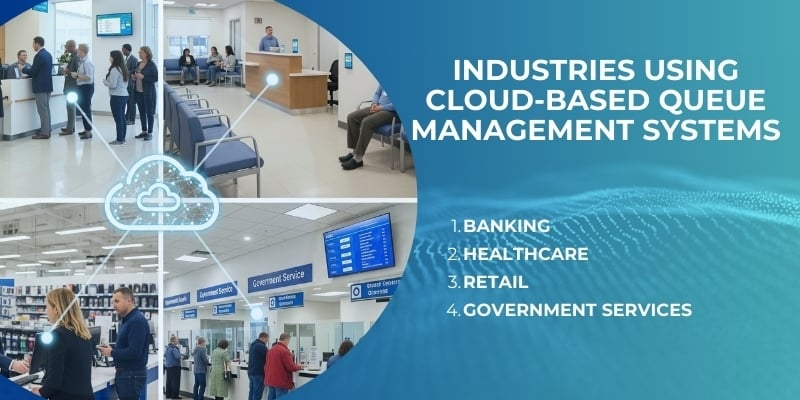
Banking
Financial institutions use cloud queue systems to manage branch queues and appointments across their entire network.
Centralized visibility helps optimize staffing and reduce customer wait times while maintaining compliance with security regulations. For more on this, explore our banking solutions.
Healthcare
Hospitals and clinics leverage cloud platforms for patient appointment scheduling and waiting room management. The ability to coordinate care across multiple facilities improves patient flow and satisfaction.
Retail
Retailers manage service desks, consultation areas, and checkout queues with cloud systems. During peak seasons, they can scale capacity without permanent infrastructure investments.
Government Services
Citizen service centers use cloud queue management to improve service flow across departments. Centralized data helps agencies optimize resources and reduce wait times for public services.
Integrating Cloud Queue Systems With Digital Service Platforms
The true power of cloud queue management emerges through integration with other digital systems. Modern platforms connect seamlessly with:
- Appointment scheduling platforms: enabling customers to book visits before arrival
- Self-service kiosks: providing on-site check-in options
- Mobile applications: allowing remote queue joining and status updates
- CRM systems: delivering customer history and preferences to service staff
- Digital signage: displaying queue status and service information in waiting areas
These integrations enable complete customer journey orchestration, from the moment a customer books online to the instant they complete their service.
By connecting previously siloed systems, businesses create seamless experiences that reduce friction and improve satisfaction.
Our self-service kiosks and digital signage solutions integrate directly with cloud queue platforms to deliver this unified experience.
Real-World Use Cases of Cloud Queue Management
Bank branch queue orchestration allows financial institutions to balance customer flow across locations. If one branch experiences a wait, customers can be directed to nearby branches with shorter queues.
Hospital patient flow management coordinates appointments, check-in, and service delivery across departments. Patients move smoothly from registration to consultation without unnecessary waiting.
Telecom service center queues enable customers to join virtually before arriving. They receive updates on wait times and can time their arrival to minimize lobby time.
Government service booking systems replace chaotic first-come, first-served models with organized appointment scheduling. Citizens receive dedicated service times, reducing frustration and improving outcomes.
Retail customer service desks manage returns, inquiries, and consultations efficiently. Staff see real-time queue status and can call the next customer without shouting across the store.
Challenges Businesses Face With On-Premise Queue Systems
Traditional on-premise systems present numerous challenges that drive organizations toward cloud alternatives:
- Limited scalability means growth requires significant capital investment. Adding a new branch involves purchasing and installing servers, often taking weeks or months.
- Expensive infrastructure includes not just initial hardware costs but ongoing maintenance, electricity, cooling, and IT staff time. These costs add up significantly across multiple locations.
- Complex maintenance requires dedicated IT resources at each site or frequent travel for central IT teams. Updates must be scheduled, tested, and implemented manually, often causing downtime.
- Lack of centralized monitoring leaves managers blind to operations at other locations. Each branch operates as an island, making it impossible to compare performance or identify systemic issues.
- Slow updates mean security patches and new features deploy inconsistently across locations. Some branches may run outdated software, creating security risks and feature disparities.
Cloud deployment solves these challenges by shifting infrastructure responsibility to the provider, enabling centralized management, and ensuring consistent updates across all locations.
Future of Cloud Queue Management Systems
The evolution of cloud queue management continues with emerging technologies that promise even greater capabilities:
- AI-powered service predictions will forecast demand patterns and automatically adjust staffing levels. Machine learning algorithms will identify optimal service configurations based on historical data.
- Advanced customer flow analytics will provide deeper insights into service delivery. Organizations will understand not just wait times but entire customer journeys and experience touchpoints.
- Integration with smart branches will create fully connected service environments. IoT devices, digital signage, and mobile apps will work together seamlessly through cloud orchestration.
- Predictive queue optimization will anticipate issues before they occur. Systems will detect emerging bottlenecks and automatically reroute customers or adjust resources.
- Omnichannel service orchestration will ensure consistent experiences across every touchpoint. Whether customers engage via mobile, web, kiosk, or in person, their journey will be smooth and connected.
Frequently Asked Questions About Cloud-Based Queue Management Systems
What is a cloud-based queue management system?
A cloud-based queue management system is a platform that manages customer queues and appointments through cloud infrastructure, allowing businesses to monitor and optimize service delivery across multiple locations.
What are the benefits of cloud queue management?
Cloud queue systems offer scalability, centralized monitoring, reduced IT costs, real-time analytics, and easier system updates compared to traditional on-premise solutions.
How does cloud queue management improve customer experience?
It reduces waiting times, enables appointment scheduling, provides real-time updates for customers and staff, and ensures consistent service across all locations.
Is cloud queue management secure?
Yes, most enterprise systems use encrypted cloud infrastructure and secure access controls to protect operational data. Reputable providers maintain certifications like ISO 27001 and SOC 2, often exceeding what individual organizations can implement.
Conclusion
Cloud-based queue management systems are transforming how businesses manage customer service operations.
By shifting from traditional infrastructure to cloud platforms, organizations gain scalability, real-time monitoring, centralized management, and improved customer experiences.
The numbers tell the story: with 58% of institutions already migrated and cloud solutions growing at over 11% annually, the trend toward cloud deployment is unmistakable.
As customer expectations for faster service continue to rise, cloud-based queue management systems will play a crucial role in helping businesses optimize service delivery and manage customer flow efficiently.
The flexibility to scale, the insight from centralized data, and the ability to integrate with other digital systems make cloud the clear choice for forward-thinking organizations.
For businesses seeking to stay competitive in an increasingly demanding service environment, adopting cloud queue management software is not just an upgrade: it’s a strategic necessity.
BOOK A FREE DEMO