A customer taps their phone to pay at a retail counter, clicks “buy now” on a mobile app, or walks up to a self-service kiosk at a bank branch. In every case, they expect one thing: the payment to just work. Instantly. Securely. Without friction.
Behind the scenes, however, many organizations still struggle with fragmented payment stacks. Multiple gateways operate in isolation.
Online channels use different processors than in-person terminals. Reconciliation is a manual headache. Data is scattered. This disconnected approach creates failed transactions, poor customer experiences, and operational drag.
The future belongs to integrated payment systems that unify channels, providers, and data into a single, intelligent layer. These systems connect point-of-sale terminals, mobile apps, e-commerce sites, kiosks, and call centers under one orchestrated platform.
They enable real-time processing, automated reconciliation, and consistent customer experiences everywhere. This shift from fragmented point solutions to unified payment system integration is not incremental. It is foundational.
According to ACI Worldwide, real-time payments reached 266.2 billion transactions globally in 2023, growing 42.2 percent year over year.
This explosive growth shows how quickly instant payment rails are becoming mainstream and why organizations must modernize their payment infrastructure now.
What Are Integrated Payment Systems?
An integrated payment system is a unified software and technology layer that connects all payment channels, service providers, and back-end financial systems into a single, cohesive platform.
Unlike traditional setups where online payments, in-store terminals, mobile wallets, and self-service kiosks each operate on separate, siloed systems, an integrated approach treats every transaction as part of one unified flow.
This payment system integration layer sits between the customer touchpoint and the various payment processors, acquirers, and financial networks.
- It standardizes how transactions are initiated, authorized, captured, and settled.
- It ensures that a payment made at a branch kiosk flows through the same rules, security protocols, and reporting systems as a payment made via mobile banking.
For banks and large enterprises, this unified approach eliminates channel mismatch, reduces technical debt, and creates a single source of truth for all payment activity.
Modern banking solutions rely on this integrated foundation to deliver consistent, reliable digital experiences across every customer touchpoint.
Why Integrated Payment Systems Are the Future
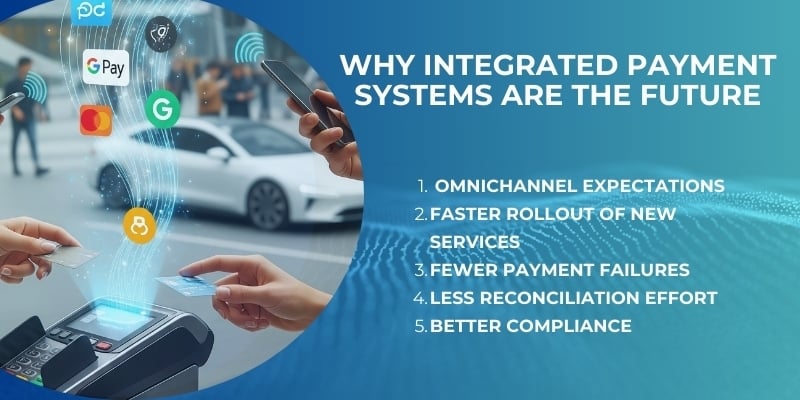
The shift toward integrated payment systems is driven by fundamental changes in customer behavior, technology capabilities, and business strategy.
Accenture found that 59 percent of banks still struggle with legacy payments IT, limiting their ability to meet customer demands quickly and affordably. This legacy friction is no longer acceptable in an era where instant payments are the baseline expectation.
The drivers for integration are clear.
- First, omnichannel expectations. Customers move seamlessly between devices and locations, and they expect payment experiences to move with them. Starting a transaction on mobile and finishing it in the branch should feel continuous, not disjointed.
- Second, faster rollout of new services. When payment logic is centralized in a unified platform, launching a new channel or adding a new payment method takes weeks, not months.
- Third, fewer payment failures. Integrated systems use intelligent routing to send transactions to the processor most likely to approve them, reducing false declines.
- Fourth, less reconciliation effort. With all transaction data flowing into one repository, matching payments to orders becomes automated instead of a manual spreadsheet exercise.
- Fifth, better compliance. A single, well-governed platform is easier to secure and audit than a patchwork of disparate systems.
This is the strategic shift from a collection of providers and patches to a true payment orchestration model where the platform, not the individual gateway, controls the payment experience.
The Role of APIs and Orchestration Layers
At the heart of every modern integrated payment system lies a robust API architecture. Payment APIs are the digital connectors that allow applications to initiate transactions, check statuses, retrieve settlement data, and manage disputes without human intervention.
But APIs alone are not enough. The real strategic value comes from the orchestration layer above them. This is the intelligent software that decides, in real time, where to route each transaction based on cost, success probability, latency, and processor availability.
- It handles fallback routing when a primary processor is down. It performs smart retries on declined transactions with adjusted parameters.
- It applies least-cost routing rules to optimize interchange fees. It unifies reporting so that transactions from different processors appear in a single, consistent format.
This orchestration layer also manages the complexity of connecting to multiple payment service providers, acquirers, fraud detection tools, and core banking systems.
Instead of building and maintaining dozens of point-to-point integrations, organizations connect once to the orchestration platform, which then manages the entire ecosystem.
This is the same architectural pattern that enables seamless customer journey management across banking channels, creating a consistent, intelligent, and adaptable payment infrastructure.
Real-Time Payments, Instant Settlement, and Always-On Rails
The migration from batch processing to real-time is one of the most profound shifts in the history of payments.
Traditional payment systems operated on cycles. Transactions initiated today would settle tomorrow or later. This delay created liquidity gaps, reconciliation lags, and customer frustration.
Real-time payments change everything. Funds move from payer to payee in seconds, 24 hours a day, 7 days a week, 365 days a year. There is no waiting for the next batch window.
Integrated payment systems are designed to plug directly into these instant payment rails, including FedNow in the United States, SEPA Instant in Europe, Pix in Brazil, UPI in India, and similar networks across dozens of countries.
The Bank for International Settlements explains “fast payments” as near-real-time transfers available close to 24/7, and discusses how adoption depends heavily on design and ecosystem choices.
This always-on capability requires payment infrastructure that never sleeps. It demands systems capable of handling high throughput with low latency and built-in redundancy. The opportunity is massive.
The World Bank notes projections that the real-time payments market could grow at 35.5 percent CAGR from 2023 to 2030, as referenced in its fast payments ecosystem work. Integrated payment systems are the on-ramp to this real-time future.
Integrated Payments for Branches and Self-Service Channels
Bank branches and self-service channels are often overlooked in payment modernization discussions, yet they remain critical touchpoints for high-value and complex transactions.
The challenge is that these channels frequently operate on different payment logic than digital channels.
A customer might successfully use their credit card on mobile banking but encounter a decline at the branch kiosk. Refunds processed at the teller line may take days to appear in online banking. These inconsistencies erode trust and create service drop-offs.
Integrated payment systems solve this by applying the same payment rules, authorization logic, and processing workflows across every channel.
A self-service kiosk transaction uses the same API orchestration as a mobile payment.
- A teller-initiated refund follows the same settlement rules as an online credit.
- Receipts, confirmation numbers, and transaction histories are consistent regardless of where the payment originated.
This cross-channel consistency is essential for queue management and bank branch transformation.
When customers can seamlessly transact anywhere, service becomes faster, staff can focus on advice rather than troubleshooting, and the branch becomes a true extension of the digital bank rather than an isolated island.
Data, Reconciliation, and Analytics Become Built-In
One of the most significant, yet underappreciated, benefits of integrated payment systems is the transformation of payment data from a byproduct into a strategic asset.
In fragmented payment environments, transaction data is scattered across multiple systems, each with its own format, identifiers, and reporting tools.
Reconciling payments to orders, deposits to settlements, and fees to transactions requires manual effort and constant spreadsheet intervention.
In an integrated model, every transaction generates a standardized set of events and identifiers that flow into a unified data repository.
Payment ID, order ID, transaction amount, processor, fee, settlement date, and status code are all captured consistently. This makes reconciliation automation possible.
Systems can automatically match payments to invoices, flag discrepancies, and generate real-time reports on settlement status.
Beyond reconciliation, this clean, unified data enables powerful transaction analytics. Organizations can track approval rates by processor, identify latency bottlenecks, monitor interchange costs, and detect emerging fraud patterns.
The demand for this capability is strong. In an Accenture commercial banking trends report, 61 percent of banks cite providing access to real-time payments data for analytics as a driver for modernization and investment.
Integrated payment systems turn payment operations from a cost center into a source of business intelligence.
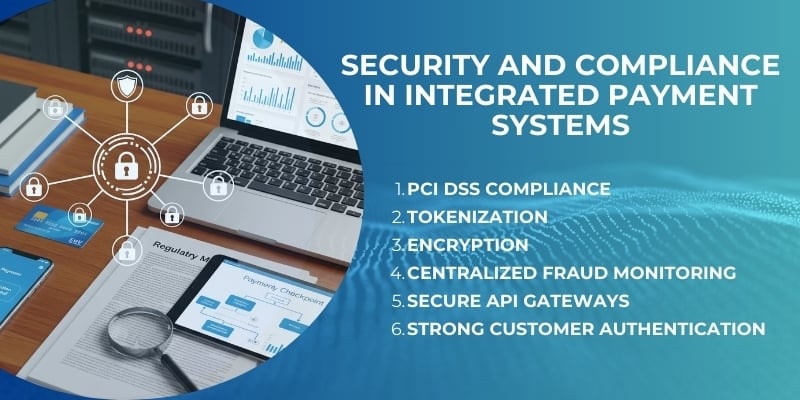
Security and Compliance in Integrated Payment Systems
A common concern with consolidation is that centralizing payments creates a single point of failure or a larger target for attackers.
In practice, well-architected integrated payment systems significantly improve security and compliance posture compared to fragmented alternatives.
The key is replacing dozens of bespoke, inconsistently maintained integrations with a single, professionally managed, and continuously audited platform.
- PCI DSS compliance becomes more manageable when the payment environment is clearly defined and contained.
- Tokenization replaces sensitive card data with non-sensitive tokens that can be safely stored and used for recurring transactions, refunds, and analytics without exposing actual account numbers.
- Encryption protects data in transit and at rest.
- Centralized fraud monitoring applies consistent rules and machine learning models to every transaction, regardless of channel.
- Secure API gateways enforce authentication, rate limiting, and access controls.
- Strong customer authentication, required under regulations like PSD2, can be implemented once and applied across all channels.
Audit trails are comprehensive and searchable. This is the security model for modern banking: defense in depth, centralized visibility, and proactive threat detection.
Architecture Trends Powering the Future
The architectural foundation of integrated payment systems has shifted decisively away from monolithic, on-premises software. The future is modular, cloud-native, and event-driven.
Microservices payments architecture breaks down the payment function into small, independently deployable services.
- One service handles authorization.
- Another manages settlement.
- A third processes refunds.
- A fourth calculates interchange fees.
These services communicate via lightweight APIs and event streams, allowing each to scale independently based on demand.
This event-driven architecture is critical for handling the unpredictable volume spikes common in payments. Holiday shopping surges, flash sales, and end-of-month billing cycles can drive transaction volumes to ten times normal levels.
A monolithic system must be scaled as a whole, which is expensive and inefficient. A microservices-based system can scale only the services under load, such as authorization processing, while leaving others at baseline capacity.
This architectural approach also improves fault tolerance. If one service fails, it does not bring down the entire payment system.
A 2024 University of Amsterdam master’s thesis on optimizing payment systems shows how moving from monoliths to microservices with event-driven mechanisms can improve scalability and fault tolerance in high-frequency payment environments. This is the technical foundation for resilient, future-ready payment infrastructure.
Embedded Payments and Platform Banking
Integrated payment systems are also the engine behind one of the most significant trends in financial services: embedded finance.
Embedded payments refers to the integration of payment capabilities directly into non-banking software platforms, applications, and experiences.
- A field service management platform can embed contractor payments into its workflow.
- A healthcare app can enable patients to pay copays during check-in.
- An e-commerce platform can offer seller financing at checkout.
In all these cases, the user never leaves the application environment. The payment experience is native, seamless, and branded.
This is made possible by APIs that expose payment functionality as a service.
Banks and payment providers offer Banking-as-a-Service platforms that licensed entities, like software companies or retailers, can integrate and white-label as their own. The user sees the merchant’s brand. The merchant controls the experience. The bank provides the regulated infrastructure.
For banks, this is a new distribution channel and revenue stream. For merchants and platforms, it is a way to deepen customer relationships and capture more of the transaction value.
Embedded payments are projected to grow exponentially as more industries recognize that payments are not just a utility, but an engagement layer.
Common Challenges and How to Solve Them
Transitioning from fragmented payment systems to an integrated, orchestrated model is not without obstacles. The most common enterprise payment integration challenges include:
- Legacy system migration
- Multi-provider complexity
- Latency requirements
- Operational governance
- Compliance across multiple jurisdictions
Legacy migration is often the most daunting. Core banking systems and enterprise resource planning platforms were never designed for real-time API access. The solution is not a risky, big-bang replacement but a phased approach using abstraction layers.
An orchestration platform sits in front of legacy systems, exposing modern APIs while translating calls into formats the old systems understand. This allows organizations to modernize the customer experience without waiting for core system rewrites.
Multi-provider complexity arises from the need to connect to dozens of acquirers, processors, fraud tools, and payment methods. The solution is a single, unified orchestration layer that manages all these connections. Instead of maintaining separate integrations for each provider, organizations integrate once to the orchestration platform, which then manages the provider ecosystem.
Latency is a constant concern in real-time payments. Every millisecond counts. The solution is edge processing and intelligent caching. Frequently accessed data, such as processor routing tables or fraud risk scores, is cached close to the decision point, reducing round-trip times to core systems.
Operational governance ensures that the payment platform remains reliable, secure, and compliant as it scales. This requires investment in monitoring, alerting, and automated remediation tools.
It also requires clear ownership and cross-functional collaboration between payments, IT, risk, and compliance teams.
Future Trends to Watch
The evolution of integrated payment systems shows no sign of slowing. Several key trends will define the next phase of innovation.
- AI-assisted fraud detection and risk scoring will move from reactive to predictive. Machine learning models trained on billions of transactions will identify fraud patterns milliseconds before the transaction completes, enabling real-time intervention without adding friction.
- Cross-border instant payments will become more common as domestic real-time rails begin to interconnect. The interoperability between systems like Pix in Brazil, UPI in India, and FedNow in the United States will enable near-instant, low-cost international transfers.
- Wallet, QR, and contactless dominance will continue as consumers increasingly leave their physical cards at home. Integrated systems must support the full spectrum of digital payment methods with consistent orchestration logic.
- ISO 20022 standardization will become universal, enriching payment messages with far more data than traditional formats. This structured data will enable smarter reconciliation, better analytics, and automated compliance screening.
- Provider-agnostic orchestration will emerge as the default architecture for large enterprises. Organizations will no longer be locked into a single processor or gateway. They will manage a portfolio of providers through a single payments control tower, dynamically routing transactions based on real-time performance, cost, and risk.
FAQs
What are integrated payment systems?
Integrated payment systems are unified technology platforms that connect all payment channels, providers, and back-end systems into a single, orchestrated environment.
They enable consistent transaction processing, real-time data flows, automated reconciliation, and centralized management across online, mobile, in-person, and self-service payment touchpoints.
How do integrated payment systems support omnichannel banking?
They ensure that the same payment rules, authorization logic, and processing workflows apply across every channel.
A customer can start a transaction on mobile, finish at a branch kiosk, and receive consistent receipts, confirmations, and settlement timing. This eliminates channel mismatch and creates a seamless customer experience.
What is payment orchestration and why does it matter?
Payment orchestration is the intelligent routing and management of transactions across multiple processors, acquirers, and payment methods. It optimizes for approval rates, cost, latency, and reliability.
It matters because no single processor performs best for every transaction in every scenario. Orchestration maximizes performance by dynamically choosing the optimal path.
Are integrated payment systems secure and PCI compliant?
Yes, when properly architected. Centralizing payments into a single, professionally managed platform reduces the attack surface compared to dozens of bespoke integrations.
Leading solutions include tokenization, encryption, API security controls, and comprehensive audit trails. They are designed to maintain PCI DSS compliance and simplify annual validation.
How do banks modernize legacy payment infrastructure?
The most effective approach is incremental modernization through an abstraction and orchestration layer. This platform sits in front of legacy core systems, exposing modern APIs while translating requests into formats the old systems understand.
It enables banks to deliver real-time, omnichannel payment experiences without waiting for multi-year core replacement projects.
Conclusion
The future of payments is not about any single technology or payment method. It is about integration.
Integrated payment systems are the architectural answer to a fragmented, multi-rail, always-on world.
- They unify channels, providers, and data into a single, intelligent orchestration layer.
- They enable real-time experiences, reduce operational friction, and transform payment data from a reconciliation burden into a strategic asset.
- They make omnichannel payments consistent, real-time payments accessible, and embedded finance possible.
For banks, retailers, and enterprises serving customers across physical and digital touchpoints, the path forward is clear.
Treating payments as a collection of isolated tools is no longer viable. The winning organizations will be those that treat payments as a connected platform, a strategic capability, and a foundation for growth.
Investing in integrated payment infrastructure is investing in the ability to move faster, serve better, and compete effectively in an increasingly real-time economy.
BOOK A FREE DEMO