Reducing no-show appointments requires a combination of automated multi-channel reminders, flexible rescheduling options, strategic overbooking, waitlist management, and clear no-show policies. The most effective organisations layer these tactics using intelligent scheduling software, cutting no-show rates by 30-50% and recovering significant weekly revenue.
Appointment no-shows are a silent revenue drain across healthcare, banking, government, and service businesses.
- A patient books a consultation and never arrives.
- A banking customer schedules a loan discussion and does not show up.
- A government service appointment is reserved, and the citizen is absent.
Each missed appointment represents lost revenue, wasted staff time, and a scheduling backlog that forces other customers to wait longer or go unserved that day.
Research compiled by DialogHealth shows the global average appointment no-show rate sits at 23.5%, with each missed appointment carrying an average cost of $200 or more. In outpatient care, no-show rates range between 23-33%, while independent physician practices face estimated annual losses of $150,000 from missed bookings alone. The problem is not improving.
A January 2025 MGMA Stat poll of 622 medical group leaders found that 42% of practices now charge no-show fees and more than one-third (37%) experienced an increase in no-show rates in 2024, confirming that unmanaged appointment abandonment is a growing operational and revenue challenge.
So the question is, how to reduce no show appointments?
This guide covers 10 proven ways to reduce no-show appointments, from automated reminders to AI risk scoring. Wavetec queue management system integrates these strategies into a single platform, helping organisations cut no-show rates by 30-50%.
The Real Cost of Appointment No-Shows
No-shows create a surge of costs that extend far beyond the immediate revenue loss. The most direct cost is the missed revenue from the appointment itself.
A healthcare provider with a 25% no-show rate loses one-quarter of their potential daily revenue. For a practice seeing 40 patients per day at $200 per visit, that is $2,000 in lost daily revenue, or over $500,000 annually.
The indirect costs are equally significant.
- Staff time is wasted preparing for appointments that do not happen.
- Schedulers spend time chasing no-shows and trying to fill empty slots.
- Other patients who could have used those slots remain unserved, creating backlogs and longer wait times for everyone.
A single no-show creates a scheduling gap that cannot always be filled, disrupting the flow of the entire day.
The business case for reducing no-shows is clear. Even a small reduction in the no-show rate can generate significant revenue recovery and improve the experience for everyone.
10 Proven Ways to Reduce No-Show Appointments
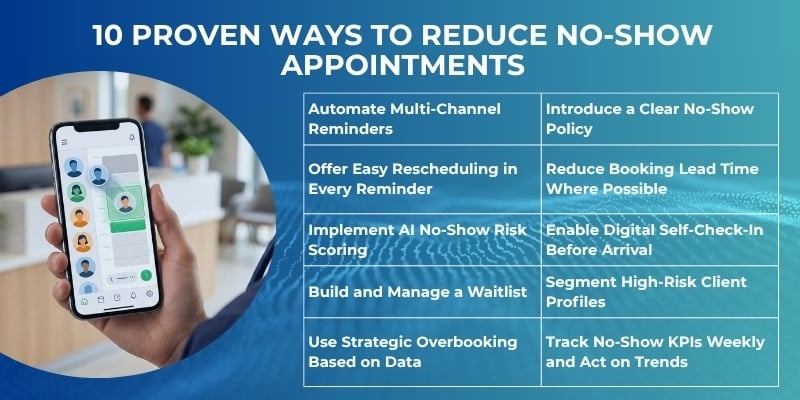
Here are 10 proven ways that can help you reduce no-show appointments.
-
Automate Multi-Channel Reminders
Single reminders are not enough. A customer who receives one email reminder a week before their appointment may simply forget or overlook it.
Omni-channel, multi-touch reminder sequences outperform single reminders significantly. Send reminders via SMS, WhatsApp, and email at three key intervals: 72 hours before the appointment, 24 hours before, and 2 hours before.
Each message should include the appointment details and a confirmation link. Customers who receive SMS reminders are far more likely to show up than those who receive only email reminders.
SMS open rates exceed 90%, while email open rates hover around 20%. The additional touchpoints catch customers who might have missed the first message and reinforce the commitment.
-
Offer Easy Rescheduling in Every Reminder
A customer who realizes they cannot make their appointment but cannot easily reschedule is likely to simply not show up. Every reminder should include a one-tap rescheduling link.
When rescheduling is frictionless, customers are more likely to proactively manage their appointment rather than abandoning it.
The rescheduling flow should show available alternative times and allow the customer to confirm a new slot without calling anyone. This reduces no-shows while keeping the slot filled with a different customer.
-
Implement AI No-Show Risk Scoring
Not all appointments carry the same no-show risk. Some customers are consistently reliable. Others have a history of missed appointments.
AI risk scoring uses historical booking data to flag high-risk appointments and trigger additional follow-up for those slots.
A patient who has missed three appointments in the past year might receive an extra reminder or a confirmation call. A first-time booker might receive a more detailed confirmation sequence.
The AI model learns over time, improving its predictions as more data is collected. This targeted approach is more efficient and effective than applying the same reminder strategy to everyone.
-
Build and Manage a Waitlist
Every cancellation should automatically offer the slot to the next person on a waitlist. This directly recovers no-show revenue and ensures that the slot does not go to waste.
A dynamic waitlist management system automatically identifies the most appropriate waitlist customer based on clinical urgency, location, and booking history. The offer is sent via SMS or email, and the slot is confirmed instantly.
Some systems can even send waitlist offers to multiple customers simultaneously, filling slots within minutes. Without a waitlist, every no-show is a permanent revenue loss.
-
Use Strategic Overbooking Based on Data
Overbooking has a bad reputation, but when done intelligently, it is a powerful tool for recovery. Calculate your historical no-show rate and overbook by a calibrated percentage to maintain full utilisation.
If your no-show rate is 15%, you can overbook by 10-12% without creating significant conflict.
The key is to limit overbooking to service types with reliable no-show patterns and to have a clear policy for managing the rare occasion when everyone shows up. Overbooking should be data-driven, not guesswork.
-
Introduce a Clear No-Show Policy
Patients and clients who know there is a fee or cancellation window show up at higher rates. A clear, communicated policy creates accountability.
The policy should specify the fee amount, the notice period required to avoid the fee, and the exceptions that apply.
Communicate the policy at the time of booking and in every reminder. Customers who are aware of a no-show fee are significantly more likely to cancel or reschedule rather than simply not show up. Many practices report that simply communicating the policy reduces no-show rates by 5-10%.
-
Reduce Booking Lead Time Where Possible
Appointments booked more than two weeks in advance carry significantly higher no-show rates. Customers forget, their circumstances change, and the commitment fades. Where possible, reduce the lead time between booking and the appointment.
Offer more immediate availability. Send additional reminders for long-lead appointments. If a customer books four weeks in advance, consider sending a mid-point check-in message to maintain engagement.
-
Enable Digital Self-Check-In Before Arrival
Sending a digital check-in link before the appointment confirms commitment and catches cancellations early. A customer who checks in digitally is far more likely to show up.
The check-in process can be simple: a button that says “I’m on my way” or a brief confirmation of details. If the customer does not check in, the system can send a follow-up message or offer the slot to a waitlist customer.
This early confirmation reduces uncertainty for the service provider and recovers slots that would otherwise be wasted.
-
Segment High-Risk Client Profiles
Historical data can identify groups with higher no-show patterns so targeted interventions can be applied.
Patients booking through certain channels, customers with specific appointment types, or those with a history of missed appointments can all be segmented. Each segment can receive a tailored reminder strategy.
High-risk segments might receive extra SMS reminders or a confirmation call.
Low-risk segments might receive standard email reminders.
This segmentation ensures that resources are directed where they will have the greatest impact.
-
Track No-Show KPIs Weekly and Act on Trends
Set a no-show rate target, track it at service-type and time-slot level, and adjust tactics based on what is working. A target of 5% might be reasonable for some services, while 10% might be acceptable for others.
Weekly tracking allows rapid course correction. If a particular service type shows a spike in no-shows, investigate the cause. Is the reminder sequence failing? Are customers not receiving the messages? Are there external factors affecting attendance? Acting on trends prevents problems from becoming entrenched.
Modern customer journey management platform automates and integrates all 10 strategies in one system rather than requiring manual effort across each.
How AI Scheduling Software Combines All 10 Strategies
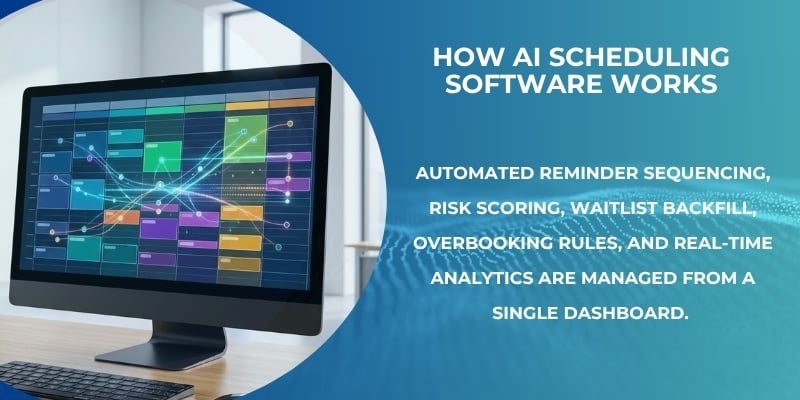
Implementing each of these 10 strategies separately is possible but inefficient. A modern appointment scheduling platform automates and integrates all 10 strategies in one system.
Automated reminder sequencing, risk scoring, waitlist backfill, overbooking rules, and real-time analytics are managed from a single dashboard. This integration is more effective than implementing each tactic separately with disconnected tools.
When a customer books an appointment, the AI system immediately assigns a no-show risk score. Based on that score, the system schedules the appropriate reminder sequence.
High-risk appointments receive extra touchpoints. When a cancellation occurs, the waitlist system automatically offers the slot to the next appropriate customer.
The overbooking rules ensure that high-demand slots are never wasted. The analytics dashboard tracks performance at the service-type and time-slot level, identifying trends before they become problems.
This integrated approach is scalable. A practice with 5 staff and a hospital network with 500 staff can use the same platform with the same workflows. The system learns from data across all locations, improving its predictions and recommendations over time.
Case Study: Nahdi Care Clinics Strengthens Appointment Attendance with WhatsApp Reminders
Outpatient clinics often struggle with missed appointments, uncertain patient arrivals, and disconnected communication between appointment and walk-in workflows.
When patients receive limited information before their visit, they may forget the appointment, arrive late, or abandon the booking without informing the clinic.
Nahdi Care Clinics partnered with Wavetec to create a more connected patient journey using WhatsApp communication, hospital system integration, and digital queue management.
Patients receive automated WhatsApp reminders before their visit, helping them stay informed and prepared for their scheduled appointment.
When patients arrive, the solution connects with the clinic’s Hospital Information System and transfers them into the appropriate service queue. This creates continuity between the scheduled appointment, check-in, and consultation journey while reducing the need for manual coordination by reception staff.
The deployment gave Nahdi Care Clinics a stronger operational foundation for improving appointment attendance, managing patient flow, and reducing uncertainty around scheduled visits.
The case study demonstrates how automated reminders and integrated patient journey management can address two major causes of missed appointments: forgetfulness and fragmented communication.
FAQs
What is a good no-show appointment rate?
A good no-show rate varies by industry and service type, but rates below 10% are generally considered excellent for most sectors. Healthcare outpatient clinics typically aim for 5-10%, while service businesses often target rates under 5%.
What is the best way to reduce no-shows?
The most effective approach combines multi-channel automated reminders, easy rescheduling options, a waitlist for cancelled slots, and AI-driven risk scoring. No single tactic works alone. A layered system reduces no-shows by 30-50%.
Should you charge a no-show fee?
A clear no-show policy with a reasonable fee can reduce no-shows by 5-10%. The fee should be communicated clearly at booking and in reminders. Many practices report that simply having the policy reduces no-shows, even if fees are rarely collected.
How do appointment reminders reduce no-shows?
Reminders reduce no-shows by reinforcing the commitment and providing an easy way to reschedule. Multi-channel, multi-touch reminders send SMS, WhatsApp, and email at 72, 24, and 2 hours before the appointment. SMS open rates exceed 90%, making them particularly effective.
What is AI no-show prediction and how does it work?
AI no-show prediction uses machine learning to analyse historical booking data and identify patterns associated with missed appointments. It assigns a risk score to each booking and triggers additional reminders for high-risk appointments. The model improves over time as more data is collected.
Conclusion
Reducing no-show appointments requires a layered system.
- Reminders reduce forgetting.
- Easy rescheduling captures intent.
- Waitlists recover lost slots.
- Strategic overbooking protects utilization.
- AI scales all of it together.
The 10 strategies covered in this guide work individually, but they work best when integrated into a single platform.
A modern appointment scheduling system automates reminders, predicts no-show risk, manages waitlists, and provides real-time analytics.
The results are clear: no-show rates drop from 25% to under 10%, revenue is recovered, and staff time is freed for higher-value work.
Ready to reduce your no-show rate? Visit the Wavetec queue management system page to learn more.
BOOK A FREE DEMO