For CX managers, the hardest question is often the simplest: “What is the return on this investment?” Leadership teams want numbers, not predictions.
They want to see that reducing wait times, improving digital signage, or deploying queue management systems actually moves the needle on revenue. Yet measuring customer experience ROI has historically been slippery.
Satisfaction scores feel intangible. Operational improvements seem disconnected from financial outcomes. The truth is that CX ROI is measurable, but it requires a disciplined framework that layers perception, operational, and financial data.
When done right, the numbers tell a compelling story. Forrester’s annual CX investment analysis finds that improving a company’s Customer Experience Index score by just one point can drive over $1 billion in additional revenue for large enterprises.
This figure varies by industry but consistently demonstrates that CX improvement has a direct, calculable financial return.
This guide breaks down the metrics every CX manager should track to prove the value of their investments. Customer journey management provides the analytics foundation to measure and report on these metrics with confidence.
Why Measuring Customer Experience ROI Is Harder Than It Looks
CX ROI is difficult to measure because it involves attribution.
- Which improvement drove which outcome?
- Did the NPS increase cause the revenue uplift, or was it the marketing campaign?
- Did the reduced wait time lead to higher retention, or was it the new product line?
The attribution problem is real, but not unsolvable. The solution is to layer multiple data sources:
- Satisfaction metrics (NPS, CSAT)
- Operational metrics (wait time, resolution rate)
- Financial metrics (CLV, churn rate)
When these layers are tracked together over time, patterns emerge. A 10% reduction in wait time correlates with a 5-point NPS improvement, which correlates with a 3% reduction in churn, which translates to a specific revenue figure.
Without this layered approach, CX teams rely on anecdotes. With it, they build a defensible business case.
Forrester built industry-specific models that show how CX improvements increase customer loyalty and drive growth across 12 industries including banking, retail, and healthcare. The models reveal that the benefits of improving CX increase exponentially when moving from “good” to “excellent” scores.
The Core CX ROI Metrics Framework

A robust CX ROI framework has three layers, each answering a different question.
Layer 1: Perception Metrics
Perception metrics measure how customers feel about their experience.
- NPS (Net Promoter Score) asks how likely a customer is to recommend the brand.
- CSAT (Customer Satisfaction Score) measures satisfaction with a specific interaction.
- CES (Customer Effort Score) measures how easy it was to complete a task.
These metrics provide the emotional context for CX performance.
Layer 2: Operational Metrics
Operational metrics measure what actually happens during service delivery.
Average wait time, first-contact resolution rate, service throughput, queue abandonment rate, and appointment no-show rate all fall into this category.
These metrics are objective and measurable. They answer the question: “Is the system working efficiently?”
Layer 3: Financial Metrics
Financial metrics connect CX performance to the bottom line. Customer Lifetime Value (CLV) measures total revenue from a customer over their relationship with the brand. Churn rate measures how many customers leave.
Repeat purchase rate measures loyalty. Revenue per visit and cost per service interaction measure efficiency. These metrics answer the ultimate question: “Is CX investment generating financial return?”
NPS and Revenue: Understanding the Real Correlation
NPS is often dismissed as a vanity metric, but the data tells a different story. As cited in Harvard Business Review’s analysis of Bain & Company loyalty research, a 5% increase in customer retention rates can increase profits by 25–95%.
This makes investments in experience that reduce churn, including queue management and service speed improvements, among the highest-ROI initiatives available to service businesses.
The connection between NPS and revenue works through two channels.
First, promoters are more likely to retain. A customer who gives a 9 or 10 on the NPS question is far less likely to churn than a detractor.
Second, promoters refer new customers. While Forrester found that recommendations account for less than 7% of the overall business benefit from improved CX, retention alone delivers substantial returns.
Smart CX teams segment NPS by service touchpoint. They ask: “What is the NPS for customers who waited less than 5 minutes versus those who waited more than 15 minutes?”
The difference is often dramatic. This segmentation allows CX managers to pinpoint exactly where investment will deliver the highest return.
How Wait Time Directly Impacts Customer Experience ROI
The chain from wait time to revenue loss is direct and measurable.
- Long wait times lead to lower CSAT scores.
- Lower CSAT scores lead to higher churn.
- Higher churn leads to lower CLV.
- Lower CLV means less revenue from the same customer base.
This chain can be quantified. A bank branch with a 15-minute average wait time might have an NPS of 45. A branch with a 5-minute wait time might have an NPS of 65. The 20-point NPS difference translates to a specific retention improvement, which translates to a specific revenue figure.
Queue management improvements are a direct CX ROI lever.
Reducing wait time by 10 minutes might cost $50,000 in technology and training. If that reduction leads to 100 fewer lost customers per year, and each lost customer represents $1,000 in annual revenue, the ROI is clear.
This is why CX managers increasingly focus on operational metrics as leading indicators of financial performance.
Wavetec’s queue management system provides the real-time data needed to track wait time reductions and their impact on satisfaction and retention.
Building a CX ROI Dashboard: What to Measure and How Often
A CX ROI dashboard should track metrics at three different cadences.
- Daily operational metrics include average wait time, queue length, service throughput, and abandonment rate. These metrics show whether the system is performing as expected. They allow for rapid course correction.
- Weekly satisfaction metrics include NPS, CSAT, and CES collected at key touchpoints. Tracking these weekly reveals trends before they become problems. A declining NPS over three weeks is a warning sign.
- Monthly financial metrics include CLV, churn rate, repeat purchase rate, and revenue per visit. These metrics lag operational and satisfaction metrics. A wait time improvement this month will show up in CLV and churn metrics in three to six months.
The dashboard should be visible to the entire CX team and shared with leadership. When leadership sees wait times declining and NPS improving in parallel, they gain confidence in the CX strategy. When they see the financial metrics trending upward, they approve more investment.
CX ROI in Queue Management: Real Numbers from Real Deployments
Queue management investments deliver measurable ROI across multiple dimensions. A 35-branch bank that deployed queue management and digital signage saw a 40% reduction in wait time, a 22-point NPS improvement, and an 18% reduction in walkaway rate. The financial impact was $2.3 million in annual revenue attributed to reduced walkaways and improved NPS-driven retention. The payback period was 11 months.
These numbers are not outliers. Multiple deployments show consistent patterns:
- Wait time reductions of 30–50%
- NPS improvements of 15–25 points
- Walkaway rate reductions of 50–80%
- Revenue increases of 5–15% in affected branches
The ROI calculation is straightforward. Calculate the revenue lost to walkaways before deployment, subtract the revenue lost after deployment, and add the revenue gained from improved retention. Subtract the cost of the queue management investment. The result is net ROI.
Wavetec’s customer journey management platform includes the analytics needed to track these metrics and build the business case for queue management investment.
Common Mistakes CX Managers Make When Measuring ROI
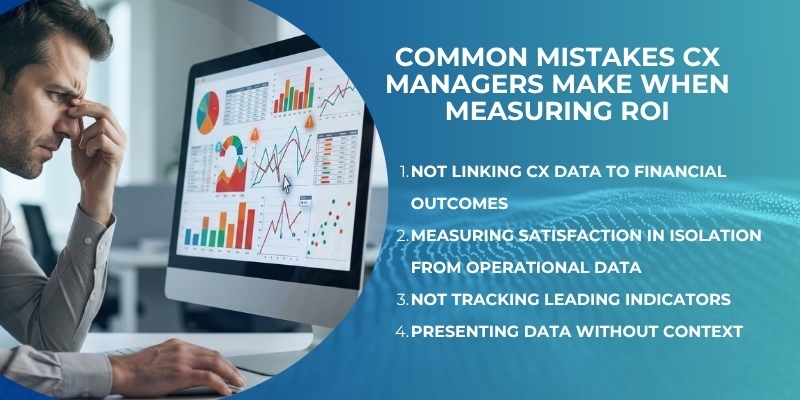
Over-relying on NPS alone. NPS is valuable but incomplete. It does not tell you why customers feel the way they do. It does not predict operational failures. It must be paired with operational and financial data.
- Not linking CX data to financial outcomes: Satisfaction scores are interesting, but leadership cares about revenue and profit. Every CX metric should eventually connect to a financial metric. If wait time improves, show the impact on retention and revenue.
- Measuring satisfaction in isolation from operational data: A CSAT score of 80% is meaningless without context. Is that for customers who waited 5 minutes or 15 minutes? Segmenting satisfaction by operational performance reveals where problems exist.
- Not tracking leading indicators: Financial metrics are lagging indicators. By the time churn increases, it is too late. Track operational metrics as leading indicators of financial performance.
- Presenting data without context: A dashboard full of numbers is not a business case. Every number should tell a story about customer experience and business impact.
Case Study – Retail Bank Proves CX ROI from Queue Management Investment
Retail banks can prove CX ROI when queue management data connects directly to operational and customer experience outcomes.
Banorte – Turning Queue Data into Measurable Branch ROI
Banorte deployed Wavetec’s queue management system across 1,000+ retail branches in Mexico to reduce waiting times, improve service quality, and optimize employee productivity.
The solution included customized self-service kiosks, customer identification through bank cards, digital signage powered by Donatello, live reporting dashboards, and real-time queue analytics.
Customers no longer had to physically stand in line; they could sit comfortably while monitoring their ticket number on LCD displays.
The strongest ROI angle comes from Banorte’s reporting and dashboard capabilities.
Management could monitor branch performance in real time, track waiting-time improvements, adjust calling logic based on customer inflow, and prioritize premium customers. This gave the bank quantitative data to improve service capacity, reduce idle staff time, and maintain customer service KPIs.
Banorte is the best fit for this heading because it clearly connects queue management investment with measurable CX ROI: reduced wait times, improved resource planning, premium customer prioritization, and stronger operational control.
These banking deployments show that queue management ROI is proven through measurable improvements in wait time, abandonment, branch productivity, customer prioritization, and satisfaction data.
FAQs
What is customer experience ROI?
Customer experience ROI is the measurable financial return generated by investments in CX improvement. It includes reduced churn, higher conversion, increased customer lifetime value, and lower service costs.
CX managers track it through satisfaction scores, operational metrics, and revenue indicators.
Which metrics best measure CX ROI?
The best CX ROI metrics combine perception (NPS, CSAT, CES), operations (wait time, resolution rate, abandonment rate), and finance (CLV, churn rate, repeat purchase rate). No single metric tells the full story.
How does NPS connect to revenue?
NPS predicts future revenue through retention and referral. Research shows that a 5% increase in customer retention, driven by higher NPS, can increase profits by 25–95%. Promoters are more loyal and more likely to recommend.
How do I calculate the ROI of a queue management investment?
Calculate the revenue lost to walkaways before deployment, subtract the revenue lost after deployment, and add the revenue gained from improved retention. Subtract the cost of the investment. Divide by the investment cost to get ROI percentage.
How often should CX ROI metrics be reviewed?
Track operational metrics daily, satisfaction metrics weekly, and financial metrics monthly. This cadence allows for rapid course correction while maintaining a long-term view of financial impact.
Author Bio: This article was written by the customer experience analytics team at Wavetec, a global provider of queue management, digital signage, and customer journey platforms. Wavetec helps CX professionals measure, prove, and improve the ROI of their customer experience investments.
Conclusion
Measuring customer experience ROI is not optional for serious CX leaders. It is the discipline that separates strategic CX from feel-good initiatives.
By layering perception, operational, and financial metrics, CX managers can build a defensible business case for every investment.
The data is clear: CX improvements deliver measurable financial returns.
- Wait time reductions drive NPS improvements.
- NPS improvements drive retention.
- Retention drives revenue.
Organizations with the strongest CX metrics discipline consistently outperform on revenue growth and profitability.
Wavetec’s analytics platform makes CX ROI measurable and defensible, providing the data needed to secure leadership buy-in and prove the value of customer experience investments.
BOOK A FREE DEMO