Burnout among healthcare support teams and patient-facing staff has reached critical levels. The constant emotional load of handling urgent patient needs, combined with high service volumes and inefficient workflows, creates unsustainable pressure on healthcare workers.
System inefficiencies such as manual scheduling, fragmented communication, and poor patient flow add to the stress.
For organizations focused on improving the customer journey management experience, addressing workforce wellbeing is not optional. It is essential!
This article outlines proven strategies to reduce burnout in healthcare, offering practical guidance for supporting care teams and building a sustainable work environment.
In call centers, including healthcare, 87% of agents report high stress levels, and over 50% experience daily burnout, sleep issues, and emotional exhaustion.
What Is Burnout in Healthcare Settings?
Burnout in healthcare is a state of physical, emotional, and mental exhaustion caused by prolonged and excessive workplace stress.
It manifests as emotional exhaustion, where workers feel drained and unable to cope; mental fatigue, where concentration and decision-making suffer; and reduced effectiveness, where even simple tasks feel overwhelming.
The World Health Organization classifies burnout as an occupational phenomenon resulting from chronic workplace stress that has not been successfully managed.
It has three main dimensions:
- Feelings of energy depletion
- Increased mental distance from one’s job
- Reduced professional effectiveness.
In patient-facing and support roles, burnout directly compromises the quality of care delivered and threatens the stability of healthcare teams.
Why Burnout Is Especially High in Healthcare Agents
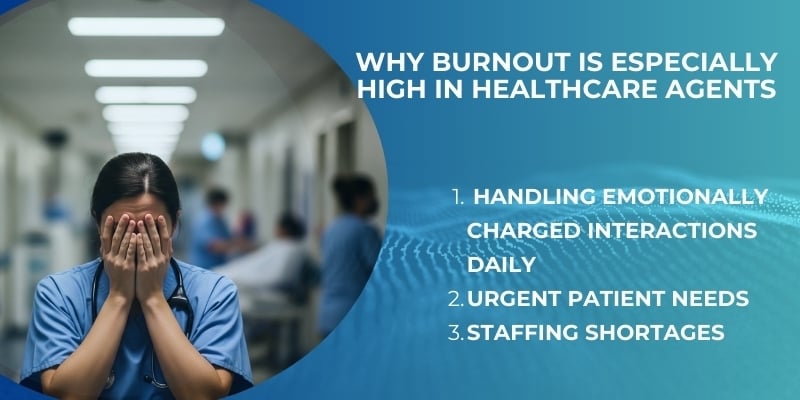
Healthcare agents and support staff face unique pressures that drive burnout rates higher than in many other industries. They handle emotionally charged interactions daily, from distressed patients to anxious family members.
Urgent patient needs create constant time pressure, with little room for recovery between calls or encounters.
Staffing shortages mean fewer people must do more work, extending shifts and eliminating breaks. The demand never stops, creating a relentless cycle of stress.
In addition to these visible pressures, healthcare workers deal with what one expert calls the expectation that they should “put themselves last,” a cultural norm that views self-sacrifice as heroic rather than destructive.
This expectation, combined with the moral distress of wanting to help more than resources allow, creates a perfect storm for healthcare workforce stress and call center burnout in healthcare.
Impact of Burnout on Healthcare Operations and Patient Experience
Burnout does not stay contained to the individual. It ripples through every aspect of healthcare operations.
- Service quality declines as exhausted workers make more errors, miss details, and struggle to maintain compassion.
- Patient satisfaction drops when interactions feel rushed or impersonal.
- Absenteeism increases as workers call in sick, both from physical illness and mental health days, leaving remaining staff even more stretched.
The most damaging impact may be staff turnover. Experienced, skilled workers leave the profession entirely, citing burnout as the primary reason. This creates a vicious cycle: fewer workers mean more work for those who remain, accelerating their burnout.
Research confirms that burnout is associated with increased medical errors, diminished quality and safety, decreased patient satisfaction, and reduced healthcare efficiency. Addressing burnout is therefore a patient safety imperative, not just an employee wellness program.
Strategies to Reduce Burnout in Healthcare Through Organizational Support
Individual resilience training alone cannot solve a systemic problem. Experts emphasize that burnout prevention requires organizational change, not just personal coping strategies.
As a research study noted, “Individual interventions are like saying, when the building is on fire, we have a good fire department to put it out. We want to prevent fires, and that requires systems change”.
Effective organizational support includes leadership that prioritizes wellbeing. A study of healthcare professionals found that feeling supported at work was associated with reduced risk of depression, insomnia, and burnout.
Specifically, workers who perceived that managers showed genuine understanding for staff welfare had significantly lower burnout scores.
Realistic KPIs that account for patient complexity, balanced workloads that prevent overload, and clear service processes that reduce ambiguity all lower burnout risk.
The National Academy of Medicine’s plan for workforce wellbeing emphasizes creating positive work environments and cultures as the first priority among seven action areas.
Role of Digital Tools in Reducing Healthcare Burnout
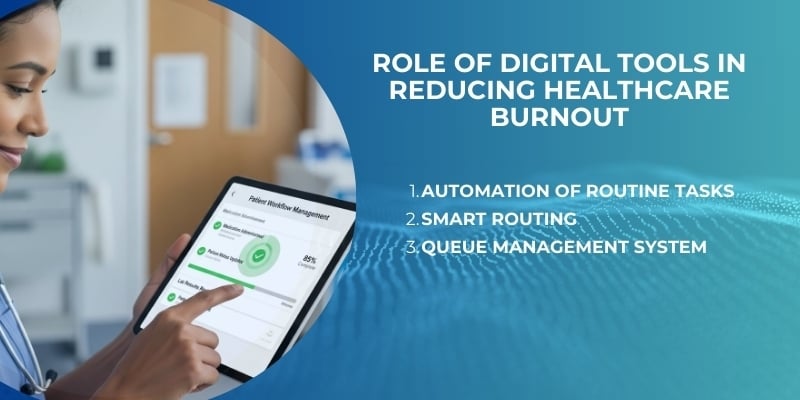
Technology, when designed well, can be a powerful ally in burnout prevention.
- Automation of routine tasks reduces the cognitive load on staff, freeing them to focus on complex patient needs.
- Smart routing in call centers ensures calls go to the right person the first time, eliminating frustrating transfers. Visibility into workload levels allows managers to adjust staffing in real time before teams become overwhelmed.
- A queue management system can smooth patient flow, reducing the chaos that contributes to staff stress. When patients move through check-in, waiting, and service areas predictably, staff experience fewer emergencies and disruptions.
Digital tools also support transparency, giving workers visibility into their schedules and workload so they can plan and pace themselves.
The National Academy of Medicine specifically includes “effective technology tools” as one of seven priority areas for workforce wellbeing, noting that technology should reduce administrative burden rather than increase it.
Mental Health Support and Multilevel Burnout Prevention
Multilevel approaches like organizational policies and mental health services via digital technology effectively prevent burnout in healthcare workers. This finding from a 2024 study confirms that prevention must operate on multiple levels simultaneously.
Individual support, such as confidential counseling or peer support programs, gives workers a place to process stress.
Organizational policies, such as reasonable workload expectations and supportive leave policies, prevent stress from accumulating in the first place.
The Dr. Lorna Breen Health Care Provider Protection Act, named after an emergency physician who died by suicide, provides funding for behavioral health services for frontline workers.
This legislation recognizes that mental health support must be accessible, confidential, and destigmatized.
Programs that normalize asking for help and provide multiple channels for support, from hotlines to peer groups, create safety nets for workers at risk.
Improving Scheduling and Workload Management
Smarter scheduling is one of the most direct ways to reduce burnout.
- Fair shift distribution ensures that the burden of nights, weekends, and high-demand periods is shared equitably rather than falling on the same people repeatedly.
- Demand-based staffing aligns the number of workers with patient volume, preventing the constant scramble of understaffed shifts.
Practical strategies include protecting break times. Workers should step away from their desks for meals and take short micro-breaks between intense interactions.
Administrative time should be scheduled into the day, not added as an afterthought.
When scheduling is transparent and workers have input into their shifts, they experience greater control over their work lives, which buffers against burnout.
Reducing Emotional Load Through Better Patient Flow
Chaotic patient flow creates stress for both patients and staff.
Long waits, unclear directions, and unexpected delays lead to frustrated patients who take out their frustration on the nearest staff member. Improving patient flow smooths these friction points, reducing the emotional load on healthcare workers.
When patients have clear journeys from check-in through service, they are calmer and more cooperative.
Reduced wait times mean fewer complaints and apologies. Better triage ensures that the most urgent cases get attention first, while routine cases flow through appropriate channels.
Self-service kiosks for check-in and registration give patients control over administrative tasks, freeing staff from repetitive data entry.
These improvements to patient flow optimization create a calmer environment where staff can focus on care rather than crisis management.
Training, Autonomy, and Empowerment Strategies
Workers who feel competent and in control are more resilient to stress. Proper training ensures that staff have the skills to handle the situations they face, reducing the anxiety of feeling unprepared.
Decision-making autonomy allows workers to use their judgment to solve problems rather than following rigid protocols that may not fit the situation.
Clear escalation paths are equally important. When workers know exactly how to get help for situations beyond their expertise, they feel supported rather than abandoned.
This combination of competence, autonomy, and support creates psychological empowerment, which research links to lower burnout and higher job satisfaction.
Training should include not only clinical or technical skills but also communication strategies for de-escalating tense situations and setting boundaries with demanding patients.
Building a Sustainable Culture to Reduce Burnout
Culture eats strategy for breakfast, as the saying goes. A sustainable culture that reduces burnout requires psychological safety where workers can admit struggles without fear of reprisal. It requires recognition that acknowledges effort and achievement, not just productivity metrics.
It requires leadership visibility, where executives and managers are present and approachable, not hidden in offices.
Open communication channels allow workers to raise concerns before they become crises. When staff see that their input leads to action, they trust that leadership genuinely cares about their wellbeing.
The CDC’s Impact Wellbeing campaign emphasizes two-way communication between management and workers, inviting healthcare workers into organizational decision-making. This participatory approach builds commitment and ensures that solutions actually address frontline realities.
Common Mistakes Healthcare Organizations Make
Many organizations inadvertently worsen burnout despite good intentions.
- Over-reliance on overtime to cover staffing gaps creates exhausted workers who never fully recover.
- Ignoring mental health needs until they reach crisis point misses opportunities for early intervention.
- Reactive staffing that scrambles to fill holes rather than proactively planning shifts keeps teams in constant survival mode.
The most common mistake is treating burnout as an individual issue rather than a system-level problem.
When organizations offer yoga classes and resilience training while ignoring unreasonable workloads and understaffing, they send the message that workers are the problem. This approach not only fails to solve burnout but increases cynicism and distrust.
Research consistently shows that organizational factors, not individual weaknesses, are the primary drivers of burnout.
Future Approaches to Reducing Burnout in Healthcare
The future of burnout prevention lies in smarter, more proactive approaches.
- AI-assisted workload balancing will use predictive analytics to anticipate demand and adjust staffing before overload occurs.
- Proactive wellbeing monitoring, using anonymized data on stress indicators, will allow organizations to identify units or teams at risk and intervene early.
- Hybrid support models will combine digital tools with human connection, giving workers multiple ways to access help.
- Digital-first healthcare operations will reduce administrative burden through automation, freeing workers for meaningful patient interaction.
The National Academy of Medicine envisions a future where healthcare worker wellbeing is integrated into every conversation about quality and safety, not treated as a separate initiative.
As one expert noted, “We need systemic changes to protect the mental health and well-being of the health and care workforce“. These strategies to reduce burnout in healthcare represent the path forward for organizations committed to sustainable healthcare operations.
FAQs
What causes burnout in healthcare agents?
Burnout stems from chronic workplace stress, including emotionally charged patient interactions, high service volumes, staffing shortages, system inefficiencies, and cultural expectations that workers should sacrifice their own wellbeing for patient care.
What are the most effective strategies to reduce burnout in healthcare?
The most effective approaches combine organizational support (realistic workloads, supportive leadership), digital tools that reduce administrative burden, mental health services, improved scheduling, and a culture that prioritizes worker wellbeing as essential to patient safety.
How does technology help reduce agent burnout?
Technology reduces burnout by automating routine tasks, smart routing to eliminate frustrating transfers, providing visibility into workload levels for better staffing, smoothing patient flow to reduce chaos, and offering digital mental health support accessible anytime.
Why is burnout a systemic issue in healthcare?
Burnout is systemic because it results from organizational factors such as understaffing, unreasonable workloads, inefficient processes, and cultural norms, not individual weakness. Treating it solely with individual interventions while ignoring system problems is ineffective.
How can healthcare leaders better support staff wellbeing?
Leaders can support wellbeing by being visible and approachable, showing genuine concern for staff welfare, involving workers in decisions, ensuring fair scheduling, removing barriers to mental health care, and treating wellbeing as a core operational metric equal to productivity.
Conclusion
Burnout in healthcare is both a human crisis and an operational emergency. It threatens patient safety, drives experienced workers from the profession, and undermines the quality of care. Yet burnout is not inevitable.
Sustainable strategies to reduce burnout in healthcare exist, and they share common themes: organizational support, smart technology, fair scheduling, mental health resources, and a culture that values workers as much as patients.
The evidence is clear that multilevel approaches combining organizational policies with accessible digital mental health services effectively prevent burnout.
For healthcare leaders, the message is urgent and hopeful: burnout can be prevented, but only through systemic change that treats worker wellbeing as essential to healthcare delivery, not optional. Investing in healthcare burnout prevention is investing in the future of care itself.
BOOK A FREE DEMO